

5.30 Mitigation and the Corona Vaccine
This article is not intended to indicate or recommend trading timing.
Please make your own investment decisions.
There is no technical analysis in today’s article as it is written as a reading material.
From my experience of trading for more than ten years and watching the market, I would like to write about what I think you should keep as basic knowledge regarding the current market.
Since the corona shock last year, the global market environment has changed dramatically.
Especially for those who became traders in recent years, there have been many situations that have been surprising.
From the situation when the market was in a full-blown bear to now, with the spread of COVID-19 vaccines, some countries where vaccinations have progressed are entering a recovery phase and moving from actual performance markets to an economic reopening phase, which is the current situation.
In such a phase, although not a market adage, the most important thing is not to go against the intentions of central banks, and you need to keep in mind that their movements are the current theme of the market.
The faster vaccine adoption has, centered on the United States, accelerated investment and pushed up the entire market.
Earlier this year I wrote several times that currencies from countries with high vaccine adoption would be bought, and it seems to have progressed accordingly in reality.
However, regarding the dollar, market funding rates remain at zero, and even if buying in a pinch, you can buy at any time, which has kept it weak.
The Federal Reserve reiterating a accommodative stance is also one of the factors contributing to the dollar’s decline.
This stance is affecting the current foreign exchange market, and several countries have mentioned tapering (reduction of monetary stimulus).
In some countries tapering has already begun, and its effects are clearly visible in charts.
In the cross of the Bank of Canada's tapering announcement, the location of the arrow shows where tapering was announced.
Yen and dollar have not loosened their accommodative stance and are gradually increasing their money supply, which undermines the value of cash and pushes up inflation, but Canada is entering a phase of unwinding the cash they have created, and as time passes, the gap will widen further.
Therefore, basically CAD/JPY or USD/CAD tend to follow a trend that favors buying Canadian dollars.
Taking this into account, with vaccine adoption in North America and economic support, along with Canada’s resource-rich economy and rising commodity prices, the outlook for the Canadian dollar could be solid.
Another point is the UK, where vaccine adoption has been fastest.
Many may be predicting a large drop in the pound based on movements before last year, but it’s important to remember that the environment is different from the past five years.
Last year, the UK left the EU and completed Brexit.
The Brexit issue accelerated political instability since the Conservative Party took office in May 2015.
So-called pound selling.
From around 190 yen, the pound fell to around 123 yen after the coronavirus-driven second bottom and brexit completion.
And the rise phase has begun since Brexit completed.
Simply speaking, domestic euro demand has declined, while pound demand rises, increasing liquidity for the pound.
Additionally, BOE has mentioned the possibility of tapering, aiming to exit the accommodative environment.
In reality, bond purchases have been gradually reduced (they say it is not tightening), and preparations are proceeding.
There are rumors of a full relaxation of Covid regulations in June, and June is expected to show steady progress.
Technically, the pound has formed a new high above the 2018 highs, and with expectations of faster momentum toward the tapering, there may be little reason for a decline other than profit-taking on risk-off or global risk-off factors.
For cross yen, given the deteriorating domestic economy and the domestic demand stalling due to emergency declarations, foreign demand for yen is not strong even in risk-off phases, and the risk of holding yen is higher when considering the future, so it is not functioning as a safe-haven asset at present.
Of course, if the whole world stock market turns bearish, domestic investors’ yen conversion from overseas assets will rise, leading to some yen buying.
If you are aiming for risk-off, the EU area where vaccine rollout is accelerating, and Swiss francs or euros, are safer and more likely to attract risk-off funds.
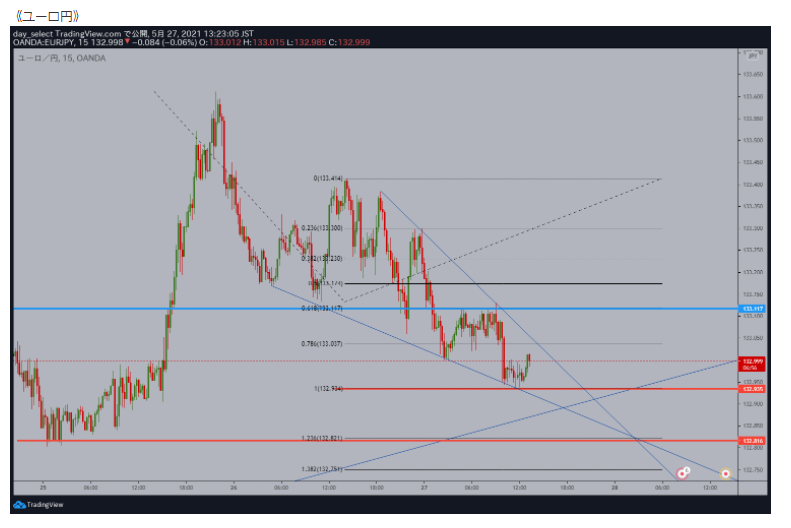
The euro, which is bought in both risk-on and risk-off conditions, is also steady against the dollar and in cross-yen terms.
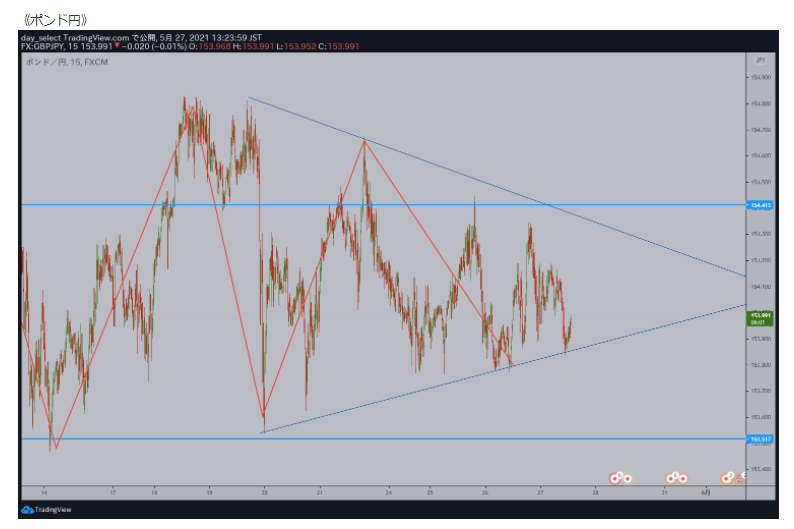
With regards to the pound-yen, given the gap in stance, I think this rise is only the opening act, and it wouldn’t be surprising if it breaks into the 200-yen range.
With all of the above in mind, the key factors are tapering and domestic conditions.
In the currency market, if both of these are present in a country, you can generally expect a solid trend to be maintained.
Recently New Zealand hinted at a rate hike and surged, but it’s not a solid economic environment due to liquidity issues and regulations on China’s commodity price increases, so caution is warranted.
Therefore, while maintaining a buying bias, the chart is likely to be volatile, making it a relatively cautious instrument to enter.
Canada dollar is a resource-based currency as well, but resources are primarily consumed in the United States, so I think the impact from China is limited.
As for June trading strategies, in cross-yen terms, look for buying dips in the Pound and Canadian dollar, while watching the euro’s stability from Europe’s recovery trend and similarly buying euros in cross-yen terms.
The Oceania currencies are flat.
As for the dollar, tapering talks are expected to continue for a while, and speculative dollar buying is likely to be abundant, so rather than entering dollar-spot trades, a cross-yen approach that accepts the status quo is more desirable.
Market outlook for stocks
Stocks in countries with advancing vaccination tend to be bought on strength.
There is no need to overthink: as external demand (U.S. vigor) becomes less relied upon for exports, domestic demand strengthens, boosting activities in transportation, dining, and luxury brands, which also attracts investment from abroad.
In contrast, Japan has been disliked for slow recovery from infection, with large sell-offs from foreign investors, and the Nikkei average has fallen more than 10% from its high.
However, as large vaccination sites are being established, domestic conditions are gradually turning upward.
Full recovery is expected after the state of emergency is lifted, but...
Regarding the Nikkei, with many companies reporting strong earnings yet selling pressure persisted, it is viewed as relatively undervalued and has room to rise more than other countries’ stocks as infections ease.
From a technical standpoint, the moment when 29200 became a support in February is likely to be a trigger.
Currently, 28350 is a very strong support, so looking for pullback buying remains feasible in this market sentiment.
As noted above, while U.S. stocks may not fully rise, Tokyo market buying driven by expectations of COVID-19 recovery can be observed.
Market activity on Monday is expected to be subdued as London and the U.S. markets will be closed, but the Nikkei may move, so pay attention to Tokyo’s Nikkei.
Although the New York market briefly trended bearish, the near-term support is expected around 28800-28700.
This area can be a good level to attempt a pullback buy.
This area served as support in the latter half of April.
This article ends here for today.
《Business Notice》
Recently, the market has often moved during London time, so this article’s posting time has been changed from the usual US market close to an irregular time.
.
As in the previous European currency analysis, I plan to increase the number of postings while reducing the length of each post, but this will be experimental for a while.
Also, as I mentioned in early May, I will not be able to post from June 7 to 10 due to personal reasons, so I am giving advance notice.
× ![]()