
Guide to Charting Classroom 2: A Method to Identify Tops and Bottoms Using Long Hairs Visible on Monthly Charts, Plaza Investment Advisory, Hidehiro Ito
The first episode of the guideline line classroom explained that stock analysis is simplest when it is straightforward, and pointed out that the meanings of patterns such as the Three Soldiers’ March, the Three Crows, the Five-Yin Formation, and the Five-Yang Formation vary by the position they appear in by as much as 180 degrees.
I also explained that market judgments should be made on a monthly chart, not a daily chart.
The second episode of the guideline line classroom cited concrete examples such as 4563 Anges, which significantly benefited members from 2018 to 2020, and explained the long upper shadows that appear on the monthly chart used to determine the peaks and troughs.
Content of the video
A pattern that reveals the bottom and top
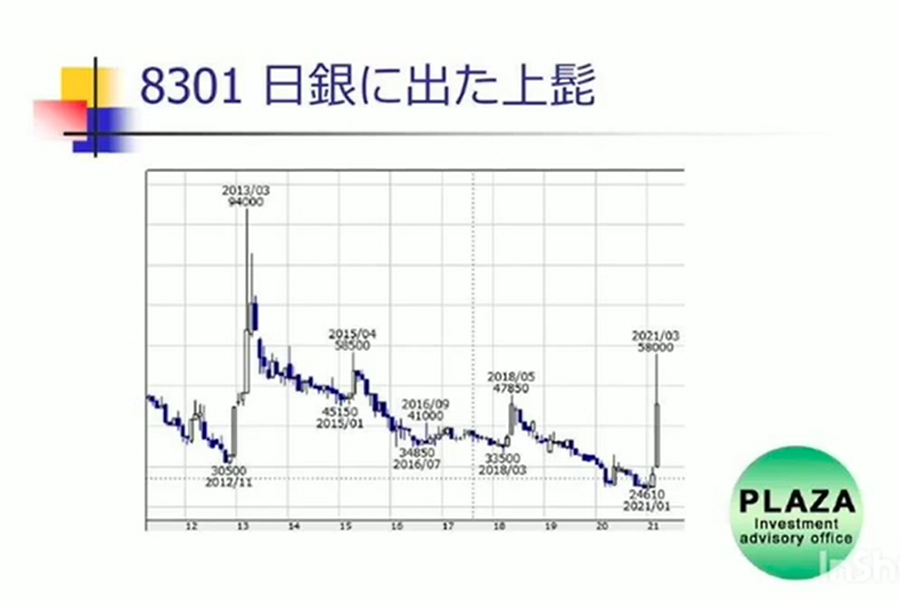
8301 Bank of Japan raised upper shadow
4562 Anges long upper shadow of a long consolidation
6954 Fanuc shadow that is more than twice the body
9984 SoftBank
Shows shadows both up and down
Nikkei Average shape in May–June 2013
4901 Fuji Film shape in March–April 2020
Nikkei Average small hanging man and stupa shapes in December 2017 and January 2018
What matters is the position where the upper and lower shadows appear
Penetrating line and pinching line
Penetration line on TDk6762
Shadow-encased line on Mitsui Zosen
Penetrating line alone does not constitute a sell signal
Penetrating and overlaying on Dai-Ichi Seiyaku (Dai Nippon Pharmaceutical)
Penetrating Ying-Yang line on 9983 Uniqlo

