
The take-profit target is at least a 3–5 yen range [Kaburagi Takaaki's "Market Cycles and Pattern Analysis"] 6/19 edition
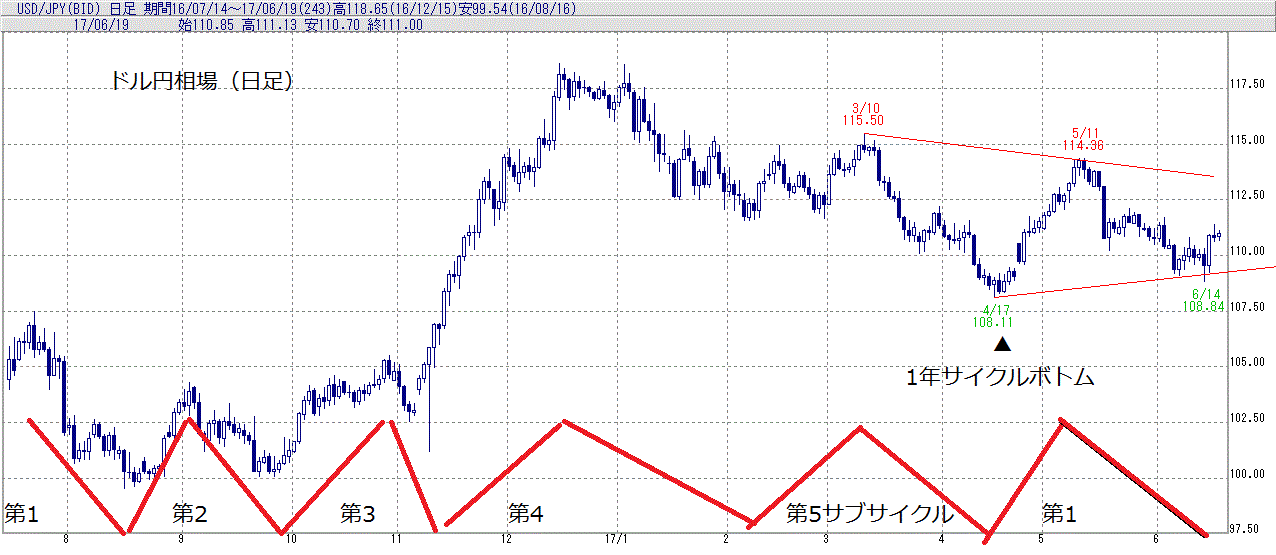
At the FOMC, the dollar ironically hit a low and rebounded. Over the weekend, it commented, "The April low is the 1-year cycle bottom, and yesterday's low is the first sub-cycle bottom; we will trade with that assumption. The type of this subcycle is center-translation."
It might be described as a somewhat bullish-type cycle. If you look closely, the same type of cycle appeared in the second subcycle after last June, which touched a five-year cycle bottom.
The rise is a straight upward move, the decline is a two-step drop; in wave theory, this is the three-wave downward movement a-b-c. This is a corrective-wave type. When a decline becomes a trend, it usually unfolds in five waves. Therefore, if so, the rise after the April 17 one-year cycle bottom is a trend, and the decline after briefly hitting a top on May 11 would be a corrective decline, with the June 14 first subcycle bottoming being judged.
Since last June, the second subcycle started on August 16 and ended with a double bottom on September 22 and 27 at 100.09, but it was shortened to about six weeks. This time, the bottom is judged to have formed within the usual eight-week timeframe.
Last year's September 22 and 27 also ended with a double bottom, but this time it is almost a double bottom on June 7 and 14 as well.
If so, the next cycle should be the same as last year, starting from the end of September, and we would anticipate the third subcycle bottom after the Trump shock. However, this cycle is an unusual one that accompanies the presidential election. After forming a double top before the election, the decline ended in about five hours. It was a very unusual bottom, but the previous cycle also ended in six weeks. Therefore, I do not think this time will be similar, but as a cycle type, a bullish-type light-translation could appear and would not be surprising at all.
In an extremely bullish-type, the cycle would rise for 5–8 weeks to form a top, and fall for 1–2 weeks to form a bottom.
Last year's third subcycle also ended with a distorted bottom due to the Trump shock and was shortened, but in its ascent it showed the standard pattern of a fully bullish-type cycle. Ultimately, the rise to the top from the double bottom occurred around days 23–26, and from there to the Trump shock bottom took eight days. 76.4% of the cycle duration was the upward phase. This is a fairly bullish-type cycle. Fibonacci also applies here, but a pattern where the top is reached after 62% of the cycle duration is typical of a normal bullish type, 76%–85% is an ultra-bullish type. However, since the cycle duration is only roughly 7–11 weeks, the exact timing for the top cannot be pinpointed, but as long as it is a bullish-type cycle, an upward trend for more than half the cycle duration (4–6 weeks) is not unusual. If so, this week would be week 1. If you believe in the bullish-type, you would expect this upward trend to continue into mid-July or later.
If the above reasoning holds, a break below 110 yen would raise concerns, and if from next week onward the June 14 low is breached, the bullish-type would be negated, or this week would still be judged as not having bottomed in the ninth week. However, thinking that far would lead to perpetual indecision, so in the world of investing, once you set a stop, you can only rely on probabilities.
Therefore, we will maintain a bullish stance on the dollar until it breaks below and closes below 108.84. Investors who cannot endure that should stop out at the close below 110.
As I mentioned last weekend, at the current stage there remains a formation that tests yesterday's low, but if you focus on that, you cannot aim for substantial profits. At least there have been several instances of stop losses, so in the next trend you would want to target a profit of 3–5 yen or more.
If we stay bullish, we will carry through with weekend trades as they are.
That is, “If we assume the subcycle bottom was yesterday, a few weeks of ascent could be expected if this is a bullish-type cycle. Its first target would be 112.50 or higher. Ideally we would aim for the 115 yen range. However, along the way, the line connecting the March 10 high of 115.50 and the May 11 high will face resistance as the upper side of a triangle pattern; currently around 113 yen. There is weak resistance near 111.80 before that. In each resistance zone, partial profits might be prudent. All pullbacks before that should be bought. If the 15th's low is the subcycle bottom, only one day has passed, and from here you can still add to your longs. Also, as long as pullbacks stay above 110.30 yen, there is no need to worry that the subcycle has not bottomed yet.”
Takaaki Kabuki's “Market Cycles and Pattern Analysis”
Monthly fee ¥5,400