
The Limited Lower Price Brings Downward Pressure on the Upper Price - from Kono Hiroshi's "From the Technical Room"
Release date: 2016/09/11 11:26
The Side Effects of “The Bottom Is Firm”
Since the Bank of Japan's decision to increase ETFs, the market has come to believe that “the bottom is limited.”
It has become common sense that “the bottom is firm.” However, we must not forget the opposite fact that “the top is also heavy.”
The market naturally has the property of buying when prices fall, and rising when bought.
In the current stock market, stock prices are becoming less prone to fall.
If this erodes the market’s natural functions of price discovery and price formation,
it would affect medium- to long-term stock price cycles.
There is a well-known market adage: “The valleys are deep, the mountains high.”
But the reverse is also true: “If the valleys are shallow, the mountains are low.”
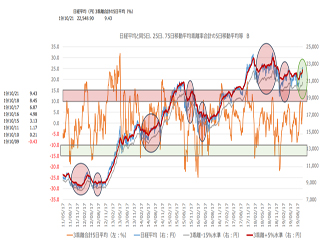
The firmness of the bottom equals the shallowness of the valley, but here we will examine the one-month (20-day) average versus the daily
closing price deviation rate, to verify the range and duration of the stock price cycle since this year began.
Deviation rate against the one-month average
Minimum deviation Maximum deviation Variation range Days
1/21 ▲10.64 2/01 +3.09 13.73 7 days
2/12 ▲11.13 3/04 +5.06 16.19 15
4/05 ▲ 6.36 4/22 +6.50 12.86 13
5/06 ▲ 2.63 5/31 +3.73 6.36 17
6/24 ▲ 8.28 7/21 +6.06 14.34 18
Markets with little fluctuation continue
but compared with the first half of this year, price movements are inevitably confined to a narrower range.
A market with little movement deprives investors of opportunities. Investors who actively seek opportunities, especially foreign participants, may lose momentum.
Foreign investors have a strong influence on the rise of Japanese stocks, so monitoring their movements daily is required more than ever.
Foreign investors pay close attention to the relationship between short-selling ratios and the dollar-yen exchange rate,
making this a key item. In any case, with a trend that is hard to identify and a narrow trading range, planning strategies becomes more essential than ever.