

We compared the performance of Trend Surfer EA Type I and Type II
Blog “When you view and freely attach, the market becomes a tool for drawing a sword” I am reproducing from.
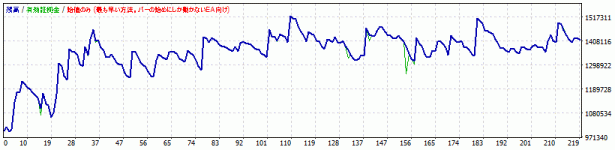
First, the Type II performance (backtest results).
The period is from the beginning of this year to yesterday. To avoid the effect of weekly MATAgi gaps, weekend closes are valid.
One position, long bias, small loss, large profit, in a large market you are sure to win, realized profit emphasis
Trend Surfer EA II-type
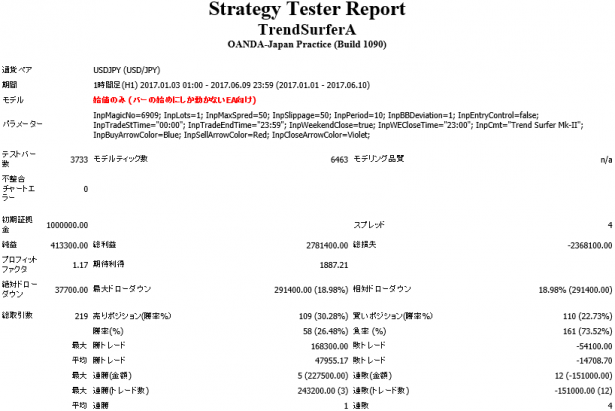
Detailed data ⇒TSAusdjpyH1201701-0610.htm
One position, long bias, small loss, large profit, in a large market you are sure to win, realized profit emphasis
Trend Surfer EA II-type
I expected this month to be promising, but so far it has not broken out of the sideways market. It’s inevitable because the USD/JPY market is not moving vertically.
Next is Type I, two-position type.
Here as well, the period and weekend closes are the same as Type II.
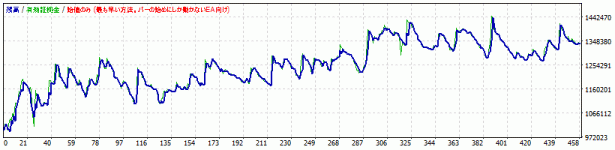
Two positions, long bias, small loss, large profit, in a large market you are sure to win, realized profit emphasis
Trend Surfer EA
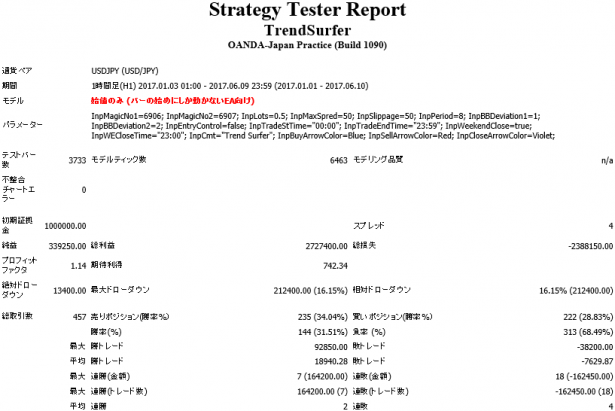
Detailed data ⇒TSusdjpyH1_201701-0610a.htm
Two positions, long bias, small loss, large profit, in a large market you are sure to win, realized profit emphasis
Trend Surfer EA
At a glance, the profit-and-loss curve looks generally gentle with a rightward slope, and this one appears to have better results, but profits are smaller.
This is probably because this EA has parameter optimization applied.
This EA shows a large discrepancy between forward test on fx-on and backtest results. The reasons are two: (1) during fx-on forward testing, the currency pair being measured was changed mid-way (GBPUSD 15-minute to USDJPY 1-hour), and (2) occasional malfunction in operation (details arehere). The backtest results are thought to be closer to real conditions.