

In each market, not all moving in step; can the yen-dollar, after closing at a low, recover?
In the ADP employment statistics, the dollar-yen started to pick up momentum in June with positive content.
However, the May nonfarm payrolls came in at 138,000 versus the market forecast of 185,000, and although the unemployment rate was slightly better than expected,
the US trade deficit announced at the same time widened,
leading to a one-way week of selling the US dollar.
The dollar-yen closed after retreating back into the 110 yen level and making a new low.
This month is becoming an important month, and the support levels are a point of interest.
On the other hand, in the stock market, since the end of last month, institutional investors have been buying stocks, and in the Tokyo market,
the Nikkei stock average surpassed 20,000, which I think had a considerable impact.
With Japanese stocks rising, the yen gathered strength as well in the Tokyo market, and the dollar-yen rose too,
but when it entered overseas markets, it fell, so across markets the pace did not align, causing the currency market to be unsettled.
If the Nikkei average, along with the US Dow, maintains 20,000 and 20,000 dollars, the dollar-yen would not deteriorate greatly.
In June, during the first week after the employment statistics, the dollar-yen was approaching the upper cloud bound on the monthly chart and important points,
this month, several important data releases cluster on the 8th, and with FOMC also on the horizon, it is key to use this point well
to gain momentum.
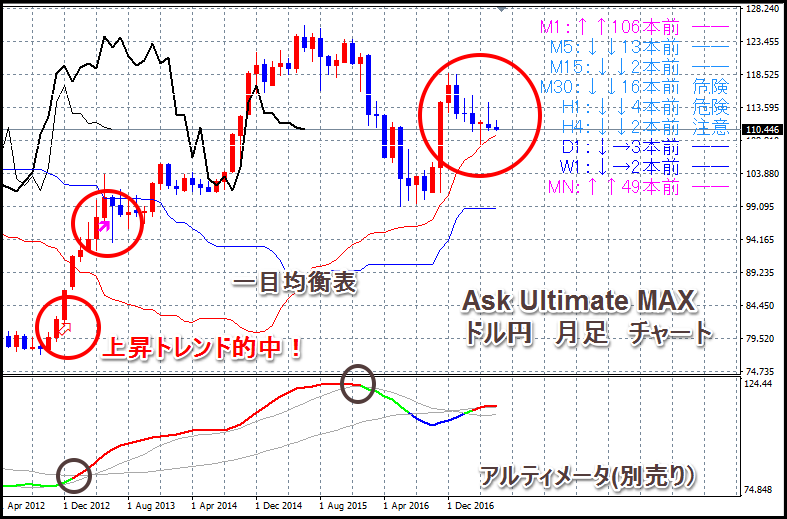
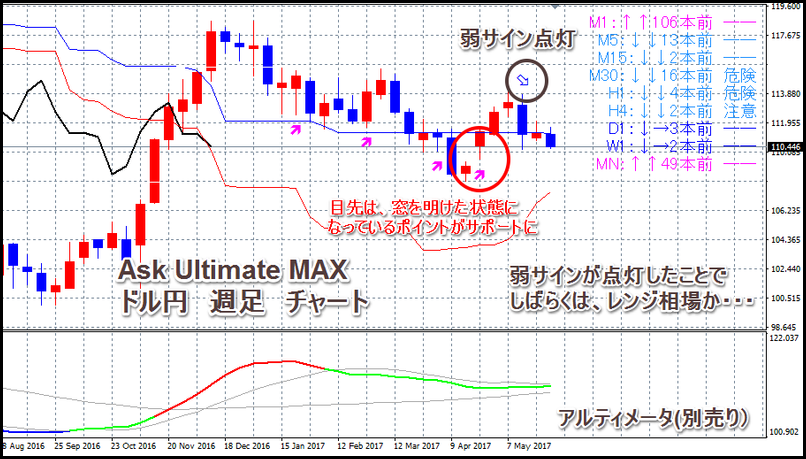
The chart shows the dollar-yen since President Trump took office,
on monthly and weekly charts, noting positions near the monthly cloud upper bound, etc.,
and considering rapid changes in circumstances, it would be prudent for a while to frame a strategy that incorporates Heikin-Ashi/Kinko lines (Ichimoku) in range-bound trading.
The downside is around the previous support point, with a slight gap opening, and since it is also the 61.8% retracement of Trump’s honeymoon rally, if it breaks below 110 yen,
a sharp rebound seems likely.
In the near term, the dollar-yen could gap down at the start of the week on a weak close,
but if institutional investors continue to buy Japanese equities daily, breaking 110 yen seems unlikely to be a unilateral drop in the dollar-yen.
Of course, if the Nikkei average breaks below 20,000 quickly, that would be another matter...
June 8 – Key items
★ UK general election
The Conservative Party under Prime Minister May is expected to be short of the majority by 9 seats, so volatility is expected this time as well.
Pound and yen exchange rates will also be affected.
★ Former FBI Director Comey's congressional testimony
Trump appears to be considering legal options to block the testimony, but…
it will affect the US dollar and the yen exchange rates.
★ European Central Bank (ECB) meeting
The euro market will move mainly around.
★ US FOMC policy rate announcement on 6/15 3:00
★ Indicators used in this chart
They detect signs of a major market turning and indicate optimal timing for settlements!
With this, you can grasp the market trend!
★ We also update the blog daily.
Nikkei 20,000 breakthrough successfully predicted!
Kawase Rīgu FX blog
★ Limited-time offer: up to 30% OFF – last chance!


