
An outstanding trader's method for gauging the environment using bond yields and the Dow to time currency trades
FX investors often wonder how to learn fundamentals analysis and technical analysis; they read books and web content, attend seminars hosted by FX companies, and gradually gain knowledge, but I’ve often heard that by consulting various opinions they become uncertain and feel they’re taking a detour.
Mr. Ere, who has a huge following on Twitter, and whose daily report combines line trading and fundamental analysis, is highly recommended as content that dispels that sense of detour.
Let me explain the reasons starting from the initial writing.
“The flow of exchange rates moving as money flows into stocks, bonds, and commodities becomes a natural progression.
To grasp the overall market, we recognize the environment using bond yields and stock charts and then translate it into the forex for analysis.
Because, for example, if U.S. investment activity increases, the Dow, the S&P, and the Nasdaq rise.
Investing covers assets beyond stocks, such as real estate, so some things may not be obvious from appearance alone, but fundamentally this is how it works.”
It is written like that, but he writes a daily analysis report almost every weekday, using bond yields and stock charts to understand the overall environment and then translating it into forex.
2020/10/15 Update
Yesterday I interviewed him again; it was a story that would be useful to traders, so I’d like to add an update.
“Investing starts with FX, and I have been reading Bloomberg, Reuters, The Wall Street Journal, and The Nikkei newspaper cover to cover for nearly 20 years.
You might think I’m an unusual person, but since the appearance of Wikipedia, I have read articles about every country in the world, and learning about demographics and major industries, geopolitical risks such as conflicts has become a hobby that helps me understand the balance of power between nations and aids in capturing price movements of all financial instruments.
Having absorbed this knowledge for many years, day by day, and continually watching U.S. Treasuries, the Dow, the Nikkei, and charts for various currency pairs, I think I’ve understood the mechanism by which fundamentals affect price movements.
I also receive various information from former prop traders I met online, but they all do fundamental analysis in a similar way, so I believe what I have done is correct.
However, fundamental analysis relies on accumulated knowledge and experience—based on years of practice you think, “That happened then, so in a similar situation now it will be like this.” Thus, a trader with only a few years of experience finding buy/sell decisions using fundamentals can be challenging.
On the other hand, technical analysis is something I also draw lines for, and I think it can be mastered even over three to five years, so when explaining to others I use technical analysis as the subject.”
He said.
Let us present the daily analysis report.
Here, from the July 5 market environment recognition and weekend market analysis article, I would like to present concrete analysis examples.
“7/5 Market Environment Recognition
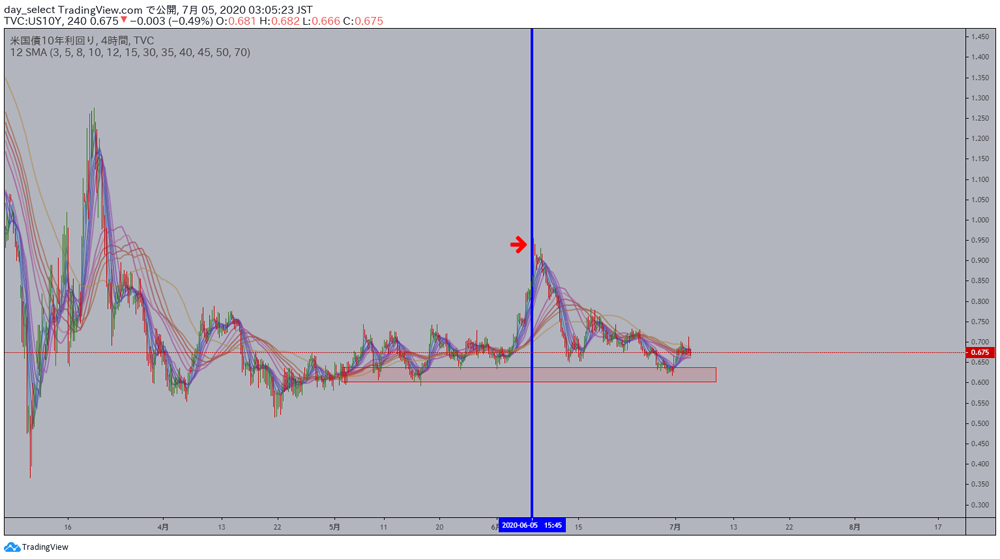
The following chart is the U.S. 10-year yield, commonly called the 10-year yield.
This is the Dow chart.
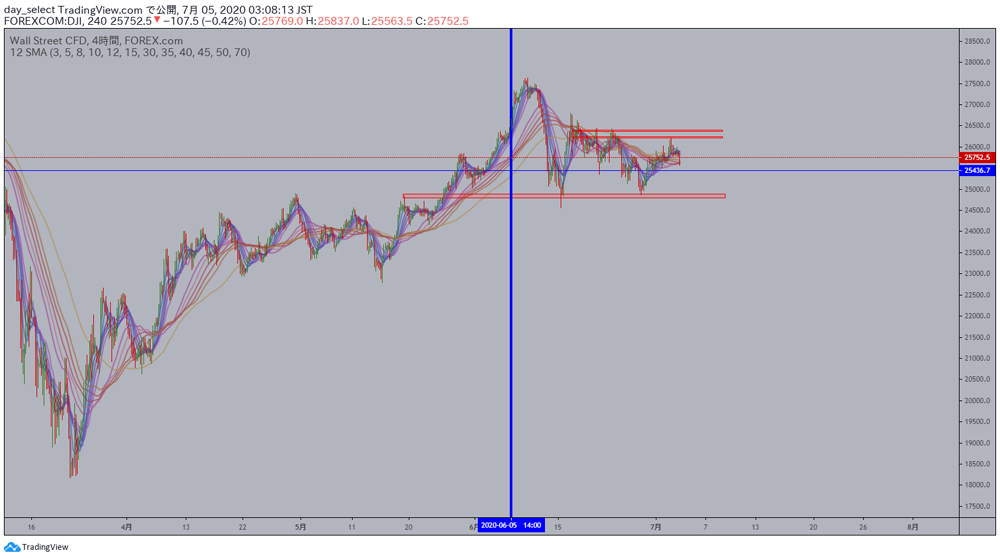
In this way,we look at the 10-year yield and the Dow to form our environment recognition.
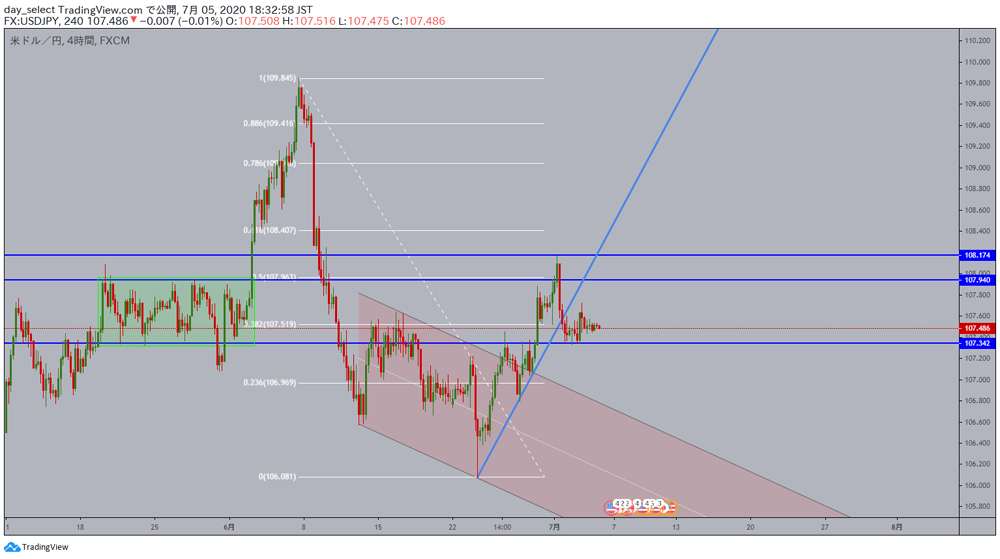
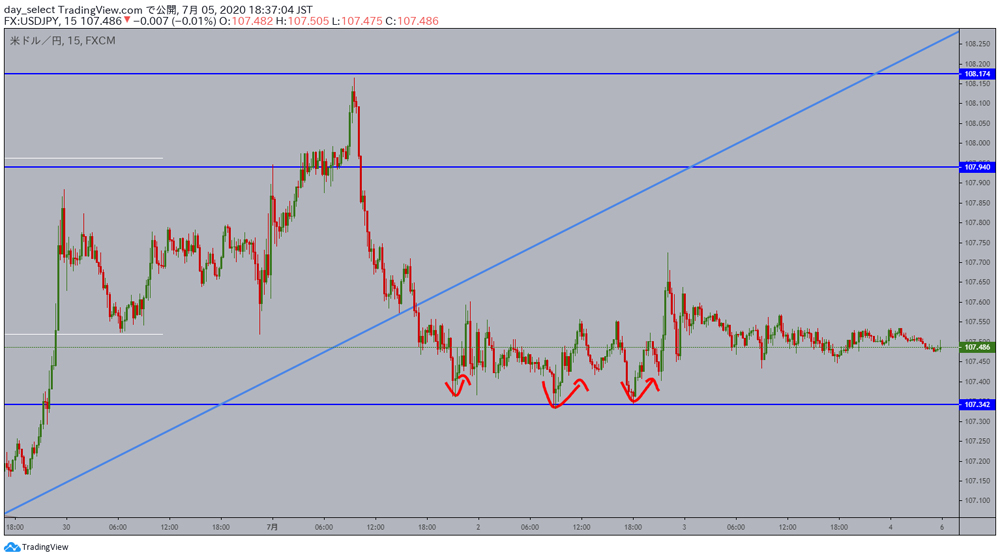
And next is the dollar/yen.
“7/5 Weekend Market Analysis