
May 15 Tetsu Emori 'Real Trading Strategy' Probing the near-term bottom for stock prices and the USD/JPY
Emori Tetsu's "Real Trading Strategy" (monthly newsletter product)
We will pick up and deliver the May 15 edition.
“Japan's most substantial and longest”, so it is said
Please be amazed by the full text volume of Mr. Emori's newsletter!
====================================================
(※The preface notice is omitted)
〔EQUITY MARKET〕
【Market commentary and analysis of the US stock and Western bond markets】
U.S. stocks: the Dow average fell for the fourth straight day. Weak U.S. economic indicators dampened sentiment. The Nasdaq Composite edged up slightly. April U.S. retail sales rose 0.4% month over month, below market expectations of 0.6%, sparking selling pressure. Additionally, after major department stores reported weak earnings the previous day, concerns about the outlook for consumer spending—America's key growth driver—spread, keeping selling pressure. The April U.S. CPI rose 0.2% from the previous month, in line with expectations, but the core CPI rose 0.1%, below the market expectation of 0.2%, cooling market sentiment somewhat.
Upsetting market sentiment, CPI softness drew calls that the Fed's rate hikes would be insufficient. While oil prices rebounded, narrowing the downside at times, a decline in U.S. long-term rates weighed on financial stocks, keeping overall sentiment weak. Furthermore, President Trump's dismissal of FBI Director James Comey has Congress and the media pressing the administration, casting uncertainty on policy management. If this issue drags on, anticipated tax reforms could be delayed, increasing market instability risk. This is unlikely to be resolved quickly, but we must adapt. If you understand that stock prices ultimately reflect corporate earnings, then the current administration's missteps can be considered tolerable. According to Thomson Reuters, S&P 500 companies are expected to report a 14.7% year-over-year earnings gain in Q1 2017; excluding the energy sector, earnings growth is expected at 10.5%. Of 500 companies, 454 reported their Q1 results, and 75.1% beat market expectations, above both the long-term average of 64% and the past four-quarter average of 71%. For Q2 2017, 59 companies are expected to report EPS that deteriorates or misses, while 30 are expected to improve or beat expectations. The S&P 500's forward four-quarter (Q2 2017–Q1 2018) estimated P/E ratio is 17.7x. In the week starting May 15, 19 companies are scheduled to report quarterly earnings.
April's CPI rose 0.2% month-over-month, core rose 0.1%. Energy up 1.1%, with gasoline up 1.2% and food up 0.2%. Year-over-year, overall CPI up 2.2%, core up 1.9%. Inflation pressures do not appear to be increasing yet. April retail sales up 0.4% month-over-month; up 4.5% year-over-year, and March was revised up from a initially reported -0.2% to +0.1%. This is not a poor outcome. The University of Michigan's May Consumer Sentiment Index (preliminary) was 97.7, up from 97.0 and ahead of expectations of 97.0. May's current conditions index was 112.7, unchanged from the prior month; the expectations index was 88.1, above 87.0. The gap between hard data and soft data appears to be narrowing. Hard data are not bad, and soft data remain high. The U.S. economy, temporarily soft, could expand again in Q2.
U.S. Treasuries rose. Because April CPI came in below expectations, expectations for two additional rate hikes this year faded, sending the 10-year yield down 7 basis points to 2.329%, the largest drop in roughly three weeks. April retail sales growth also underperformed expectations, contributing. Additionally, weak demand for the quarterly $62 billion auction likely pushed yields lower. CPI for April rose 2.2% year over year, though slower than March’s 2.4%, still above 2%. The Fed’s voting member from the Chicago region, Evans, remarked that it would be very surprising if the Fed raised rates more than two times this year, and that if inflation outlook remains unclear, one more rate hike could be sufficient for the year. He also suggested the balance sheet could be gradually reduced later this year, returning to normal over 3–4 years. The probability of two more rate hikes this year fell to about 46% from 54% prior to the data release. Philadelphia Fed President Harker said two more rate hikes this year would be appropriate.
Furthermore, Lane, the President of the Central Bank of Ireland and a member of the ECB Governing Council, stated that, “The risks to the euro-area economy are not yet balanced,” and that the ECB needs to find convincing evidence that rising wages are feeding inflation before altering policy stance. April euro-area industrial production fell 0.1%, a surprise decline. Also, weak U.S. CPI and retail sales contributed to bond buying. Euro-area 10-year yields fell overall by 3–5 bps, with German 10-year yields down 4 bps to 0.39%. Meanwhile, Germany’s April CPI rose 2.0% year over year, accelerating from March's 1.6%. In April, energy price inflation was 5.1%, and excluding energy it was 1.7%.
【U.S. Stock Trading Strategy】
The Dow, S&P 500, and Nasdaq remain long. However, they are pricing in strong corporate earnings, and upside momentum is gradually thinning. A near-term pullback is possible. Yet, it is unlikely to see a “SELL IN MAY” crash scenario. If you want to pare positions and re-enter on dips, you could take profits temporarily, but the longer-term strategy remains to hold and add on dips. Compared with stock returns, bond yields remain relatively low, and the long-short yield spread remains negative. Also, the U.S.–Germany 10-year yield spread is not a concern yet. However, it is important to monitor the U.S. 2-year–10-year yield spread and the U.S.–Germany 10-year yield spread to gauge whether these signal a long-term peak in U.S. stocks. The Dow Transports vs. Dow Jones Industrial Average ratio is a concern, as it remains weak, limiting upside for the Dow. Currently the ratio is 12.85; if it falls below 12.60, caution is warranted. On the other hand, if May’s bullish scenario lower bound of 20,655 is not breached, there is little to worry about. If prices fall, it could be a good dip-buying opportunity. May has shown a history of rising 34 times and falling 32 times over 66 years, not always down. However, May’s average return is −0.02% (9th out of 12), meaning gains are near parity but with limited upside. June, by contrast, rose 30 times and fell 36 times, with a poor performance of −0.3% (second worst). So, some caution is warranted, but not excessive. Maintain positions until a clear trend shift occurs. As noted, U.S. stocks tend to stay bullish once they start moving up.
Over the next 17 years, this uptrend is likely to continue. The current uptrend began in 2012, and if it lasts 17 years, it would continue until 2029. There is no need to be swayed by short-term fluctuations. The Dow’s average annual return is about 8.75%; at that pace, the Dow could reach about 58,800 by 2029, about 2.8 times today's level. This view is important for U.S. stock investments. U.S. stocks are believed to be in the second stage of a very long-term uptrend through 2029, continuing at least into mid-2019. If you could hold U.S. stocks for more than 10 years, the minimum return would be at least double the investment. It is prudent to focus on the U.S. in equity investing. The tried-and-true approach is to buy on dips while holding long-term exposure to U.S. stocks.
【Dow Jones Industrial Average: 2017 Projection Range】
Bull scenario: 19,310–23,185 (year-end 22,870) / Bear scenario: 16,050–20,195 (year-end 17,850)
【Dow Jones Industrial Average: May Projection Range】
Bull scenario: 20,655–21,900 / Bear scenario: 18,995–20,130
【U.S. Government Bond Trading Strategy】
Continue to short the 10-year. Downside room for rates is limited.
【Japanese Stock Market: Market Commentary & Analysis】
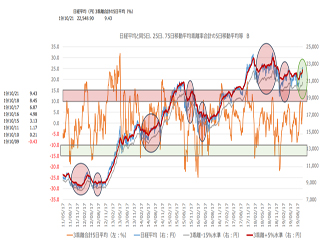
The Japanese stock market fell back. The Nikkei Average is hovering near 20,000, with near-term selling likely to come first. Individual investors remain quite cautious. However, foreign investors have started buying on the back of solid corporate earnings. You need to buy where prices look cheap to avoid chasing high prices; we are watching individual investors' actions. Technical indicators show overheating, making it difficult to chase highs immediately. The gap from the 25-day moving average has reached 5%, and the 25-day breadth ratio is 131%, still above the overbought threshold of 120%. The 6-day average is 163%, 10-day average 168%, and 15-day average 195%, high but gradually falling, indicating a daily pattern adjustment is under way. It will likely be a period of patience, but earnings-based pricing levels are clearly cheap. The rally this time is justified by strong corporate earnings, and prices are still cheap. The EPS of Nikkei 225 constituent stocks rose sharply to 1,316 yen. The current P/E ratio is 15.11x and there is no overvaluation yet. Even if it rises to 17x, theoretically it could reach around 22,371 yen.
Even at 16x, there is room to rise to about 21,055 yen. Given this, it wouldn’t be unreasonable for the Nikkei to rise from around 20,500 to nearly 22,000. The 2017 March-term earnings results for 1st Section of the Tokyo Stock Exchange showed consolidated net profit up 21.1% year over year for 1117 companies (excluding financials). Of those, 34.6% or 387 companies reported record highs. Companies such as trading houses and domestic real estate/construction benefiting from higher resource prices led the rally. Conversely, for the 2018 March-term, due to uncertainty over the Trump administration’s policies, many companies set USD/JPY assumptions around 105–110, with consolidated net profit growth expected to slow to about 2.8%, though earnings improvement is projected to continue.
【Nikkei Index Futures Trading Strategy】
Maintain long positions. Technically the market shows overheating, so a near-term correction is likely. If you are aiming for short-term trading, consider closing out or taking profits at some level. If you worry about declines, hedging for long-term investments could be considered, but this is not easy. Personally, I plan to hedge only very lightly. Since there is no overvaluation in price, long-term investors should hold non-overvalued individual stocks. Ultimately, valuation-based overvaluation is not the key; the key is not to ignore the intrinsic value and to emphasize the overheating signals. If you ignore fundamentals, you may sacrifice the intrinsic value. Also, shorting could incur losses if you misunderstand value. The USD/JPY is facing resistance on the upside, but it remains well above 110 and, if this continues, would support earnings growth for FY2018. I do not expect 110 to persist long, but as long as it does not break below around 105, earnings growth should be maintained. If prices exceed the December 2015 high of 20,012 yen, they could rise toward the June 2015 high of 20,952 yen (16x P/E). For now, the near-term overheating needs to dissipate. Again, prices ultimately move toward fundamental values. Foreign investors have recently purchased Japanese stocks for five straight weeks, suggesting that valuations are not overvalued, and will likely continue purchasing and holding for the near future.
If selling pressure does not emerge soon, short-sellers may become cornered, and futures-led gains could reappear. If individual stocks rise excessively, it would be prudent to take profits and look for undervalued names. Buying undervalued stocks will provide some downside protection. The Nikkei has moved above the weak-scenario upper bound of 19,545 yen, temporarily escaping the weak scenario; if it rises above the weak-scenario lower bound of 20,075 yen, it will enter a bullish trend. If this level is clearly exceeded, the bullish stance will become more pronounced. In any case, major companies remain quite conservative about the 2018 fiscal year results. It is crucial not to miss the opportunity to build positions in anticipation of future stock-price gains. If May brings a pullback, do not miss it.
【Nikkei Average: 2017 Projection Range】
Bull: 18,335–23,400 (year-end 23,020) / Bear: 14,970–19,915 (year-end 15,620)
【Nikkei Average: May Projection Range】
Bull: 20,075–21,775 / Bear: 18,005–19,545
〔CURRENCY MARKET〕
The yen strengthened. Weaker U.S. economic indicators and a decline in U.S. long-term yields favored yen buying and dollar selling, pushing USD/JPY into the low-113s. April CPI rose 0.2% month-over-month, in line with expectations, but the core CPI rose 0.1%, below the 0.2% expected. Year-over-year, the core CPI rose 1.9%, below the Fed's 2% inflation target for the first time since October 2015, which promoted dollar selling. Additionally, April retail sales rose only 0.4% month-over-month, below expectations of 0.6%, contributing to dollar weakness. This reduced expectations for a faster pace of rate hikes, and U.S. long-term yields fell, increasing dollar selling pressure. The dollar also weakened against the euro, with EUR/USD back around the 1.09 level. Markets priced in about a 46% chance of two more Fed rate hikes for the year, down from 54% before the data. It seems the dollar's near-term peak may have been reached, and for now price and time corrections will take priority.
The G7 finance ministers and central bank governors meeting in Bari, southern Italy, adopted a joint statement. The statement commits to addressing inequality arising from globalization, noting that excessive economic disparity constrains growth potential and stressing the need to use fiscal and structural policies to respond. It points out that while the world economy is growing, inequality affecting lower- and middle-income groups has widened, and calls for shared prosperity and higher growth. It also calls for stronger cyberattack defenses for the financial system and cooperation to curb terrorist financing. On exchange-rate policy, the conventional agreement to avoid competitive devaluation was reaffirmed. On trade, the G7 stated it would work to strengthen the contribution of trade to the economy and reaffirmed its stance to promote global growth through expanding trade. The statement's content will be reflected in discussions at the G7 summit later this month. The expression "to counter protectionism"—an area of disagreement between the U.S. and Japan/Europe—was not included in the statement and will be left to leader discussions. Mnuchin, the U.S. Treasury Secretary, stated regarding the Trump administration's trade policy, "If it isn't fair and free trade, we have the right to adopt protectionist measures against trading partners." He emphasized that understanding among G7 participants has progressed and noted that improvements toward addressing U.S.–China trade imbalances could lead to U.S. beef exports to China. He also indicated that bilateral negotiations between the U.S. and China are moving in the right direction. However, given the current administration's chaos, the decision on a rate or level is not yet decided.
The dollar policy team is not yet ready to set a target rate; as the dollar's path remains uncertain, analysts will monitor statements and rate decisions closely. It is possible the administration has not progressed to deciding a specific rate.
【Currency Trading Strategy】
We close the long USD/JPY positions and construct a short for the short term. With failure to reach 115 and signs of overbought conditions, adopting a short position now aligns with prior views. There is immediate support at 112.50. If overheating subsides, consider buying back at this level. If 112.50 breaks, next supports are at 112.00, 111.70, 111.20, and 110.75. Priority is to see whether it can drop to 112.50. We should continue to monitor U.S.-Japan stock moves and U.S. long-term interest rates. Long-term U.S. yields tend to push to dollar weakness.
May's bear scenario upper bound of 116 yen seems distant.
EUR/JPY remains short. However, EUR/USD is advancing, limiting downside. A drop to around 121.50 yen is possible but unlikely this time. If it recovers to 123.90, we should exit positions and be ready for the next move.
We enter a new long on EUR/USD. It has held at 1.0870 and rebounded, confirming a medium-term uptrend. If it clearly exceeds 1.0960 again and holds, a substantial uptrend could ensue.
We establish a new short in GBP/JPY. The yen strength is likely to push prices lower in the near term. Immediate support is 143.90; we should expect to see this level hold. If it declines, it could fall to around 1.26 USD per GBP.
GBP/USD is on hold. It remains in a tight range between 1.2880 and 1.2900; the breakout direction will set the trend. The overall trend appears downward, but we should observe without bias for now.
AUD/JPY stays long. The upside is already heavy, but we should hold the position until it breaks below 83.30. If it rises, resistance around 84.65 is likely to come quickly, so it would be prudent to trim here.
AUD/USD is closing long. However, if it moves higher, we would consider new long entries. The condition is to hold at 0.7370; if it turns up, it could rise toward around 0.7460.
ZAR/JPY closes long. It is hovering around a resistance near 8.47 yen, with upside a bit heavy. A new range is likely to form; if breached, consider going long again.
【USD/JPY: 2017 Projection Range】
Bull: 115.25–129.85 (year-end 128.35) / Bear: 103.60–118.75 (year-end 104.70)
【USD/JPY: May Projection Range】
Bull: 117.80–123.55 / Bear: 111.35–116.00
【EUR/JPY: 2017 Projection Range】
Bull: 119.80–134.85 (year-end 133.70) / Bear: 107.95–124.75 (year-end 109.65)
【EUR/JPY: May Projection Range】
Bull: 120.65–126.50 / Bear: 115.25–121.35
【EUR/USD: 2017 Projection Range】
Bull: 1.0270–1.1700 (year-end 1.1550) / Bear: 0.9480–1.0695 (year-end 0.9730)
【EUR/USD: May Projection Range】
Bull: 1.0505–1.0995 / Bear: 0.9840–1.0330
【AUD/JPY: 2017 Projection Range】
Bull: 83.20–96.10 (year-end 94.80) / Bear: 74.45–87.00 (year-end 77.70)
【AUD/JPY: May Projection Range】
Bull: 86.65–91.90 / Bear: 80.75–86.30
〔COMMODITY MARKET〕「Dollar weakness and stock declines spur gold, oil remains resilient」
【Precious Metals Market: Market Commentary & Analysis】
Gold prices rose. Reports suggest that Trump's firing of FBI Director Comey has spurred investor concerns, increasing gold demand. Additionally, the declines in U.S. stocks, dollar, and U.S. Treasury yields support gold. Gold held support around 1220 and rebounded, suggesting a near-term bottom may be in. Political uncertainty around Comey’s dismissal and Britain's general election, plus a likely drop in June's rate-hike odds, support gold. The world's largest gold ETF, SPDR Gold Trust, held 853.08 tons on the 5th and 851.89 tons on the 12th, indicating investors are still interested in owning gold. In the COMEX futures market, as of May 9, the net long position was 150,006 contracts, down 39,628 from the prior week. Long positions fell by 39,917 contracts, while short positions fell by 289 contracts. The decline in gold prices has led to a significant reduction in speculative long positions, though this appears to have run its course. Near-term price targets around $1,250 are anticipated.
【Precious Metals Trading Strategy】
Gold, silver, platinum, and palladium stay long. Gold's near-term correction appears largely over. Investors who should sell have already exited, and there is no current selling pressure pushing prices down. Near-term, expect upward movement toward about $1,250, but long-term views remain unchanged. I want to buy dips firmly. If you're late to buy, current levels are still reasonably affordable. As reiterated, you should not sell gold. Preparedness is key to holding gold. To lower holding costs, buy on dips rather than chasing higher prices. This is crucial for long-term investing. Currently, real interest-rate levels imply gold prices should be above $1,500. Gold is currently quite cheap. We see precious metals as a long-term upward trend, and holding them while adding on dips alongside stock purchases is prudent. Oil should be central to the overall investment, ensuring dips are bought. In any case, do not sell gold at least through mid-2019.
【Gold Price: 2017 Projection Range】
Bull: $1,117.65–$1,373.40 (year-end $1,329.50) / Bear: $1,036.65–$1,187.20 (year-end $1,059.00)
【Gold Price: May Projection Range】
Bull: $1,185–$1,295 / Bear: $1,070–$1,130
【Nonferrous Market: Market Commentary & Analysis】
Nonferrous prices are recovering. Bottoms are forming and testing higher levels again. Aluminum shows a rebound from around $1,860 and could move back toward around $1,915. Copper remains at around $5,500 and, if it breaks above $5,625, could aim for $5,775. Nickel is testing a rebound from below $9,000; if it surpasses $9,335, it could head toward $10,000. Zinc has fallen to $2,550, and lead to $2,125, but this dip looks like a solid support. Markets are concerned about slowing economic indicators due to tightened financial conditions in China, but with the autumn restructuring of Xi Jinping’s leadership, the broader Chinese economy is unlikely to become a major problem. Industrial production and retail sales in China will be released May 15, drawing market attention.
【Nonferrous Trading Strategy】
Longs remain in aluminum, copper, nickel, zinc, and lead. In the medium-to-long term, current levels are too cheap and will rise as supply-demand improves. The long-term view remains. This is a level where one should buy firmly. The long-term trend remains intact. Do not sell low; buy on dips. The long-term approach is crucial. Copper is expected to rise toward $7,700 by year-end, but due to volatility, risk management must be robust. Nonferrous stocks are in a long-term uptrend; improvements in supply-demand will eventually drive a major bull market. Even small exposures to copper and other nonferrous metals should be considered for the portfolio. Nonferrous markets are set for a major upside ahead.
【Copper Price: 2017 Projection Range】
Bull: $5,266–$7,704 (year-end $7,522) / Bear: $4,520–$5,812 (year-end $4,672)
【Copper Price: May Projection Range】
Bull: $5,880–$6,615 / Bear: $5,145–$5,605
【Energy Market: Market Commentary & Analysis】
Crude oil extended gains slightly. Reports of falling U.S. crude stocks and extension of coordinated output cuts by OPEC and non-OPEC members boosted expectations of a reduction in global oversupply. OPEC members and non-members will meet on the 25th to decide whether to extend the coordinated cuts agreed in November last year. Saudi Arabia aims for an extension of six months or longer. Meanwhile, the number of U.S. oil rigs rose by 9 to 712, the highest since April 2015, marking 17 consecutive weeks of increases. The pace of increases has slowed and the level is approaching Russia and Saudi levels. Saudi Arabia is seeking to expand cuts to reduce world oil inventories toward the five-year average, but coordination with other producers is challenging. If cuts are eased, supply-demand balance would not improve and crude would likely fall. May end is a crucial period. The U.S. gas-demand season coincides with this time; historically, even in weak years, prices tend to hold or rise from May into autumn. If OPEC can extend the cuts, crude may not fall below current levels during summer.
【Energy Trading Strategy】
Maintain long positions in WTI and Brent crude, as well as NYMEX gasoline and NYMEX heating oil. WTI may face slightly firmer resistance; technically, overbought conditions could prevent a move above $48.50. Still, downside risk is limited. If the bottom at $48.50 is not broken, there is little chance of rising above $50; after the May correction, the direction should become clearer. As noted, a break below $50 would make it almost impossible for most oil producers to continue production. Given this, there is no room for further downside. The May bearish scenario lower bound of $50.30 will not persist indefinitely; the market will likely move higher toward gasoline demand season by late May. Historically, even weak years see prices flat or rising after May. Therefore, assuming a move into autumn, levels should be higher than today. Medium-term supply-demand improvements are visible, and oil price increases are highly probable. For now, the strategy remains to buy dips at or above current levels and hold. The possibility of testing $75 by year-end remains unchanged. Stay long and wait for a rebound. Oil should be a core long-term holding in the portfolio.
【WTI Crude Oil Price: 2017 Projection Range】
Bull: $50–$74 (year-end $70) / Bear: $35–$58 (year-end $38)
【WTI Crude Oil Price: May Projection Range】
Bull: $57.00–$66.05 / Bear: $50.30–$57.35
◇ Global Macro Strategy
The investment strategy introduced in this newsletter falls into the 'Global Macro Strategy' category in the hedge fund industry.
This is the approach that hedge funds worldwide excel at—the so-called "royal road" of hedge fund management.
In this strategy, we monitor across all markets to seek investment opportunities and maximize profits.
Regardless of whether markets rise or fall, if price movements are anticipated, we bet on them (a betting strategy).
Volaility drives profit potential, so we aggressively pursue opportunities when they arise.
In a world with global political and economic uncertainty, price movements in major markets—foreign exchange, equities, interest rates, and commodities—have become more volatile.
As a result, predicting each market has become extremely difficult.
In such market conditions, a broader, macro perspective and a "Global Macro Strategy" are advantageous.
Of course, to be able to operate effectively in individual markets, we will also provide concrete trading timings.
Let us compete in the markets together with the Global Macro Strategy, the royal road of hedge fund strategies.
====================================================