
SQ Week price movement
Delivery date: 2016/09/04 11:16
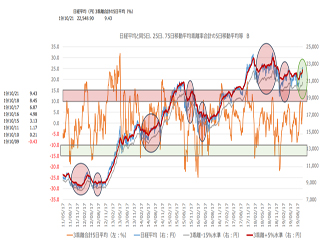
Around SQ days tend to be market turning points
We checked the price movement of the Nikkei Stock Average for the week of the SQ (Special Quotation) calculation after February and the preceding week.
and the preceding week's movements.
.
(SQ week and the previous week's stock price change and yen)
SQ day Previous week SQ week Low High
2/12 ▼698 ▼1866 2/12
3/11 +826 ▼ 75 3/14
4/08 ▼838 ▼ 342 4/06
5/13 ▼559 + 305 5/06
6/10 ▼192 ▼ 40
7/08 +730 ▼ 575 7/08
8/12 ▼314 + 665 8/12
9/09 +564
With the UK referendum looming, world markets were unsettled
and, excluding June, SQ days tended to mark a low or high
point, becoming a market turning point. In addition, when
two consecutive weeks of decline occurred, or when declines
during the SQ week were large (over 500 points), the SQ day
also tended to be a low two days earlier.
Will this SQ week test the highs?
Since the beginning of the year, there has not been a period
where the stock price rose for two consecutive weeks toward SQ day,
but it seems the trend is about to break. A decline in the short‑selling
ratio would signal a weakening of selling pressure (especially from foreign institutions),
which would lighten the upside pressure.
Additionally, price volatility has decreased, with the one‑month average range
of (high − low)/close dropping to 0.86%. In the first half of this year (Jan–Jun)
the average volatility was 1.97%, so this is less than half. Even compared
with the more stable first half of last year at 0.93%, the low volatility is evident.
The lower volatility compared with the prior year’s half suggests
that the market’s volatility is subdued.
It can be inferred that the decline in the short‑selling ratio and the low volatility
will support stock prices, but in the short term the market is clearly nearing the peak.
This week (possibly extending into the early part of next week),
when prices rise, the emphasis should be on selling rather than buying.
Keep that in mind.