
Trend 270 The risk that the Statue of Liberty will be closed during Golden Week is still present.
Publication date: 2017/04/27 09:28
The basic policy of the large-scale tax reform that the Trump administration announced on short notice was, after all, a one-page document containing items that were too ambiguous.
There are times when before cooking you're shown, "May I use this fish or meat?" But what Mnuchin, the Treasury Secretary, and NEC Chairman Gary Cohn opened up to show wasn't the ingredients but a single sheet of the menu—an impression that had already been on the table.
The answer to that one page is not "YES" nor "NO," but "?." I will write about this basic policy in a later column, "Trend," but the reaction in last night's US markets (notably, yields in the bond market declined slightly, and thus the dollar weakened) suggests the same assessment.
On the 29th, as the Trump administration reaches its 100-day honeymoon, it will first face the fiscal cliff on that day. Because passing an interim budget is an urgent priority, after last week's report on the 'basic policy for major tax reform,' I had the impression that 'first, the interim budget's passage is of higher necessity, and it would be okay if the earlier basic-policy announcement didn't cause trouble,' and indeed that turned out to be the case.
Now, regarding the interim budget, it appears to adopt a plan to exclude the cost of building the wall with Mexico until the second half of the year, leaving out the 'wall' and crossing the cliff; but because there is too little time for deliberation, the likelihood is gradually increasing that we must ride out about a one-week "bridging" budget. If even that does not go well, as in October 2013, the Statue of Liberty may be closed. Tourists who went to NYC during Golden Week will not be able to get close to it, and rather more than 800,000 federal employees will be involuntarily staying at home during Golden Week. In any case, the cliff deadline is 0:01 on the 29th local time (Japan time: 1:01 PM on the 29th).
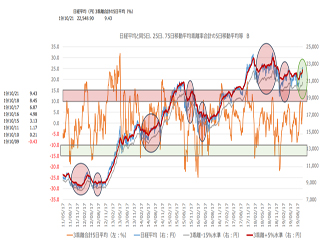
Now, as for the Japanese market, yesterday the Nikkei rose for the fourth consecutive day by more than 1%, and its deviation on the 25th rose to 2.60%. This is one of the five overheating signals on 'Sign'; its trigger is 3%, and there is still room, but 2.60% is the second-highest level this year, next to the 3.14% recorded on January 4's big start.
The largest such figure recorded during the Trump rally is 6.15%. That was recorded on December 13 of last year, when the Nikkei was 19,250 yen. It is at roughly the same level as yesterday's closing price. As shown in 'Sign' (the take-profit target if you were long), that target has also been in the range of 19,180 to 19,300 yen recently.
Similarly, the situation with the US market not giving up NASDAQ, which I previously noted in "Trend," remains solid as the index hit all-time highs again this week, and US Q1 earnings are strong, so downside risk is limited (of course, excluding geopolitical risk). For the Nikkei, however, given that the heavy trading volume is accumulated in this price band (19,000–19,500 yen), a cautious taking-profit in that zone is expected to play out.
Earlier, when the Nikkei first rose above 19,500, I wrote that "this 19,500 yen is a level that will be crossed many times," and since then it has crossed it countless times; if it closes above 19,300 yen, I might feel the same.
Yet even so, the situation with options (calls) remains crushed as I noted in intraday trading yesterday. There is no premium. Therefore, call selling cannot be activated yet while waiting for the right timing.
Now, as for the futures-handling I wrote in detail yesterday, today I will note what can be inferred from yesterday's basket trades.
Yesterday's ToSTNeT off-exchange trading totaled about 86.6 billion yen, with around 45 billion yen occurring during lunch. Our estimated number of cases was 62. Of these, stocks that did not involve large domestic securities firms or large domestic banks were included.
When looking at baskets, you must recognize that the rule is that arbitrage trades conducted by a brokerage's own trading desk do not include 'its own stock,' and the same applies if the parent company is a bank.
You probably understand by now: the above 'basket excluding large domestic securities firms and large domestic banks' equals 'arbitrage trading.'
Yesterday's market condition had not changed from the day before, and yet institutional investors have not appeared as players.