
How to count Elliott Waves and about indicators
In the West, Elliott Wave theory stands shoulder to shoulder with Dow Theory as a major concept,
but in Japan, it is said that it is not as well known.
This time, we will explain such Elliott Wave theory, its basics and recommended indicators,
and how to apply it to trading.
What is Elliott Wave Theory?
Elliott Wave Theory is a technical analysis theory of investing first introduced in the 1938 book
“The Wave Principle.”
The main idea of Elliott Wave Theory is
“There are certain cycles in markets, and price movements have a fixed rhythm.”
Elliott studied the Dow Jones Industrial Average price movements for decades.
As a result, he discovered the fact that “waves of rise→fall (or fall→rise) occur at regular intervals within price movements.”
This forms the basis of Elliott Wave Theory: the rising 5 waves and the falling 3 waves.
Fundamentals of Elliott Wave Theory: How to count the rising 5 waves and falling 3 waves
From here, we will explain the basics of Elliott Wave Theory.
First, please check the diagram summarizing the rising 5 waves and the falling 5 waves.

A characteristic of price movements is that during rising phases, it forms five consecutive waves: “rise→fall→rise→fall→rise.”
This is the five waves in a rising phase.
Also, during a declining phase, three waves occur: “fall→rise→fall.”
This is the concept of rising 5 waves and falling 3 waves, and Elliott Wave Theory posits that, regardless of the period observed,
price movements move in this rhythm.
As a visual, you can remember rises as “W” and falls as “N.”
Because there is a condition of observing the market over any period, the following can also be said.
For example, if we extract waves 1 and 2 from the diagram above,
Wave 1 will form the rising 5 waves, and Wave 2 will form the falling 3 waves.

In other words, within a 1-hour chart, the rising Wave 1 contains the rising 5 waves of a 5-minute chart,
meaning that the 5-minute rising 5 waves are contained within it.
Even more, within that 5-minute rising Wave 1, there are the rising 5 waves of a 1-minute chart.
Indicator “ZigZag” for finding Elliott Waves and how to count waves
We introduce the MT4 indicator ZigZag, useful for finding Elliott Waves.

As the name implies, ZigZag connects highs and lows with lines, forming a zigzag shape.
Since ZigZag is built into MT4 by default, you can easily set it up and use it.
Counting waves is simple as well; as in the image below, count from rising Wave 1 to Wave 5, and from falling Wave 1 to Wave 3.

Indicator more refined than ZigZag that displays Elliott Waves with higher precision
On this site, we have developed an indicator that displays Elliott Waves with greater refinement than ZigZag.
This indicator is called the Principle of Market Fundamentals Indicator,
and on MT4 charts it not only displays Elliott Waves but also shows targets for Waves 3 and 5 that aid entries,
as well as Fibonacci retracements useful for timing entries.

As a bonus, a real-time risk-reward indicator is included for free, helping to support high-quality trading.
(For a detailed article on risk-reward,
here)
Regarding the output level of targets,Please check the scenarios for USD/JPY movementandGBP/JPY movement.
Details of the Elliott Wave indicator arehere
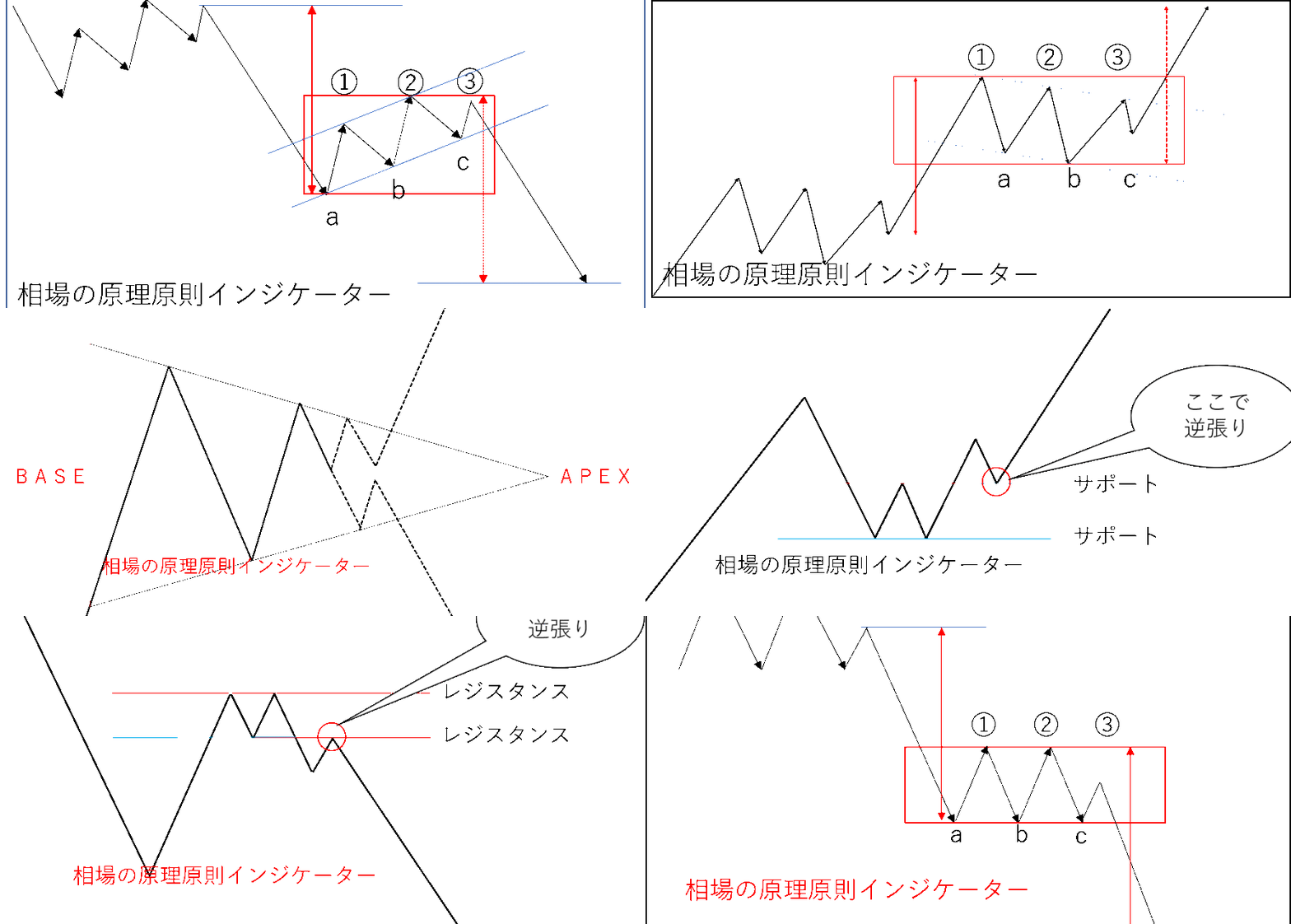
Six Wave Patterns of Elliott Wave
That covers the basics of Elliott Wave.
However, what has been introduced so far is the ideal movement of Elliott Waves; in real charts, price movements are often more complex.
Even in charts with complex price movements, it is possible to analyze them into the six patterns below.
Next, we will explain each Wave pattern.

I Elliott Wave
I Wave is a combination of rising 5 waves and a single falling 1 wave, forming the basis of 6 patterns.V Elliott Wave
V Wave is a pattern formed by a chain of Wave I.As V Wave chains, the four patterns to be introduced below are formed.
Y Elliott Wave
Y Elliott Wave is also called the “reverse pennant.”It progresses while making higher highs and lower lows, often appearing during short pauses in uptrends or downtrends, indicating investors are waiting and watching.
P Elliott Wave
P Wave is the reverse of Y Wave, progressing while making lower highs and higher lows,gradually narrowing price range.
Also called “pennant,” this also represents a pause in the trend.
However, when the P wave price breaks upper or lower, there is a possibility of trend resume or reversal, so be cautious.
N Elliott Wave
N Wave is a pattern that moves with higher highs in uptrends (lower lows in downtrends).It eventually allows drawing a trendline, making it the best pattern for buying on dips or selling on rallies.
S Elliott Wave
S Wave is the pattern formed when, within an N Wave, the support line (in an uptrend resistance line) is broken in a downtrend.These are the six patterns of Elliott Waves.
Important Rules of Elliott Wave Theory
As tips for identifying each wave in Elliott Wave, here are several important rules.① The third wave cannot be shorter than the first and fifth waves
If you label the rising five waves and the third wave ends up shorter than the first and fifth,that would indicate a mistake.
② The first wave cannot fall below the second wave
If the starting price of Wave 1 is below Wave 2, then Wave 1 was incorrect.These two are the tricks for spotting Elliott Waves.
Labeling waves incorrectly can lead to trading when there is no opportunity, which is risky, so be careful.
Using Elliott Wave Theory: When is the right time to trade?
The wave to target within Elliott Waves is the “Wave 3.”If you are aiming to follow the trend, Wave 1 is too early to identify,
and Wave 5 timing is unclear.
Wave 3 is longer than Waves 1 and 5, and even if profit-taking is delayed and Wave 4 intrudes,
there is a chance that Wave 5 will come afterward.
Elliott Wave Content Videos
Tried explaining Elliott WaveHow to catch Wave 1 of Elliott Wave on the right side of the chart
Elliott Wave Theory — Summary
That concludes the basic explanation of Elliott Wave. How was it?
Elliott Wave is a deep chart analysis theory that could fill a book when explored in depth.
However, we are aiming not to become chart theory PhDs but to be winning traders, so
there is no need to understand overly difficult concepts.
If you thoroughly understand the content of this article, you can grasp the current market situation, and
you can reasonably anticipate how it might progress in the future.
The content presented here is a carefully selected subset of the most important parts, so be sure to remember it well.
× ![]()