

Total demand for gold in Q2 2016 remained firm, supported by a macro environment with increasing uncertainty
1. Supported by a macro environment with increasing uncertainty, overall demand in Q2 2016 remained solid
The World Gold Council released its Gold Demand Trend for the second quarter of 2016.
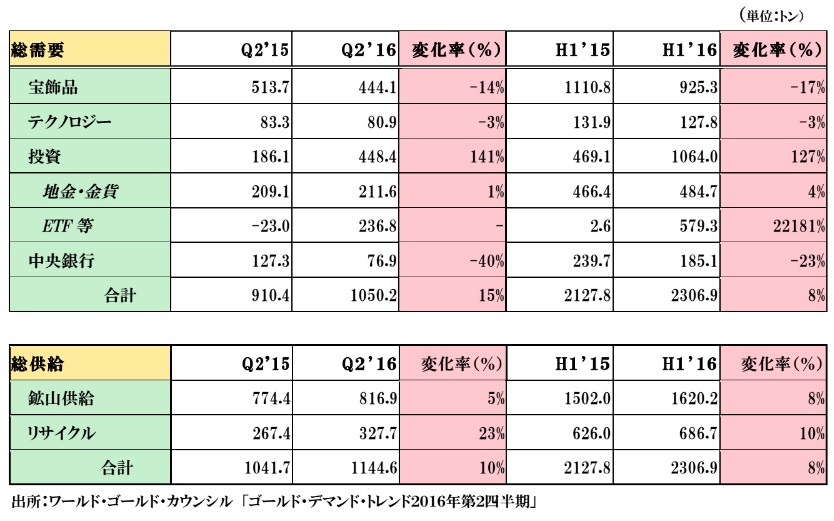
According to it, investor concerns about the macro environment and the view that the long-term downward trend in gold prices was ending are reflected in a significant rise in investment demand (particularly ETFs), and total demand in Q2 rose 15% year over year.
— Takahiro Morita's Bite-sized Commentary —
In a macro-political-economic, opaque environment, with a sense of policy paralysis in financial policy, negative interest rate policy, Brexit, and the unrelenting Trump surge in the U.S. presidential race, the investment environment is highly volatile.
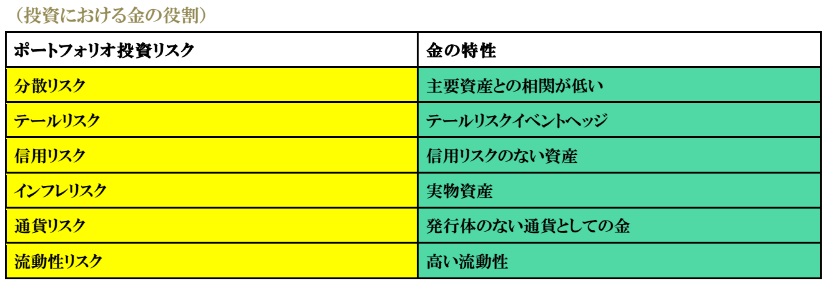
In such an environment, the fundamental principle of investing is diversification and risk hedging. There are six main roles gold can play in investment (see the chart below), and all apply in the current investment environment. This so-called perfect storm has pushed up gold investment demand.
Investment demand in the first half of 2016 was higher than after the Lehman crisis, reaching a half-year record, suggesting that investment demand is likely to stay firm for a while. On the other hand, the sharp rise in gold prices driven by increased investment demand has had a negative impact on jewelry demand and central bank purchases.
Many buyers are believed to have taken a wait-and-see approach until prices stabilize, and the buying interest of the three major gold buyers—China, India, and central banks—has not fundamentally changed.
Technology (industrial) demand, compared with the past, has been driven to substitute high-priced gold with cheaper materials, and demand has fallen by about 3% per year recently.
On the supply side, rising gold prices stimulated high price elasticity, and recycling showed strong growth.
2. The strength of gold demand in India indicated by smuggling
According to local media such as Reuters and Indian Express, smuggling in the Indian gold market has surged this year.
Smuggling could reach 300 tons in 2016.
According to statistics released by the World Gold Council, last year India’s gold demand was about 860 tons, and in the first half of 2016 it was about 250 tons. India is the second-largest gold demand country after China.
— Takahiro Morita's Bite-sized Commentary —
A few years ago, to reduce the trade deficit, the Indian government introduced import duties on gold (currently 10%). This year it announced a new 1% goods and services tax on gold transactions.
However, in protest, gold retailers conducted a strike for more than 40 days in the first quarter, negatively impacting domestic demand.
Furthermore, as gold prices surged, a gray market (smuggled gold that avoids taxes) grew rapidly because it enabled cheaper gold purchases.
Local reports say smugglers are selling to traders at prices about $100 per ounce below international prices (currently about $1,320 per ounce).
Therefore, along with the rise in smuggling, local gold refiners face closures, and the government faces a difficult situation seeking aid. Government revenue from import taxes potentially lost due to smuggling is expected to exceed $1 billion annually (assuming smuggling volume is 300 tons).
Even through the gray market, the attitude of consumers who want to purchase gold reflects India’s underlying strong potential demand. In addition to wedding and religious purposes, gold is still used daily as a savings/financing instrument in urban areas where banking functions are provided, and there is no effective substitute.
Recently, the Indian government signaled a review of its past policies to suppress gold demand, and India’s central bank has announced it will set up a committee to study the current and future state of consumer finance.