
U.S. stocks continued to rise on the back of solid earnings from major financial institutions, and together with this week's economic indicators, optimism about the outlook for the U.S. economy is spreading
Investment Salon"Tetsu Emori's Real Trading Strategy"Here you can review at a glance the information analyzed across many markets, including stocks, bonds, and currencies, as distributed in the newsletter. This enables you to effectively use theGlobal Macro Strategythat is, the Global Macro Strategy recommended by Tetsu Emori.
About the Global Macro Strategy
The investment strategy introduced in this newsletter belongs to the hedge fund industry's "Global Macro Strategy" category. This is the approach that hedge funds worldwide excel at the most, and it is the so-called "royal road" of hedge fund management.
Under this strategy,we monitor all markets and seek investment opportunities to aim for profits. Regardless of whether market prices rise or fall, if price fluctuations are expected, we bet on them (make bets).Since higher volatility implies higher potential returns, we attack boldly whenever opportunities arise.
In a world with unclear global conditions, price fluctuations in major markets such as currencies, stocks, interest rates, and commodities have become even larger. Therefore, forecasts for each market are extremely difficult. In such market environments,a macro perspective that operates across a broader range of markets—the Global Macro Strategy—has an advantage.
("Tetsu Emori's Real Trading Strategy"Quoted from)

This time, we excerpt a portion from the newsletter distributed on January 17, 2020 at 8:27.
〔EQUITY & BOND MARKET〕
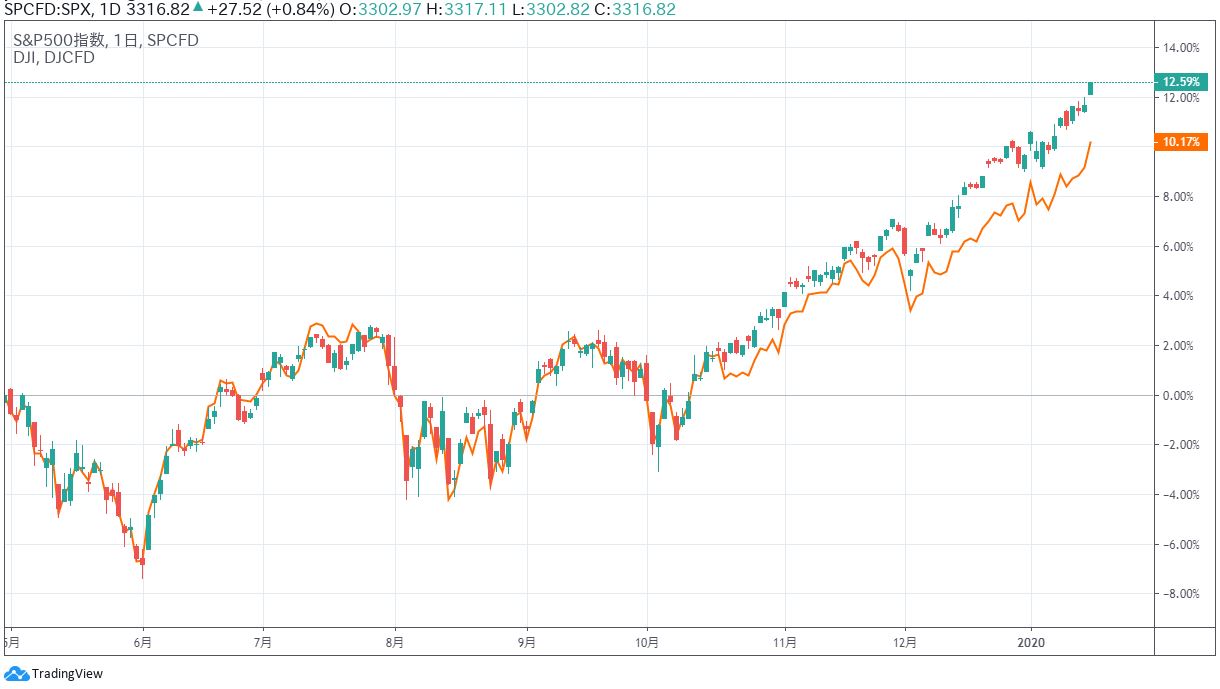
【U.S. & Europe Equity & Bond Markets: Market Commentary & Analysis】U.S. stocks continued to rise on the back of solid earnings from major U.S. financials. The Dow Jones Industrial Average closed up 267.42 to 29,297.64, a new record high for the second consecutive day. The S&P 500 rose 27.52 to 3,316.81, and the Nasdaq Composite added 98.43 to 9,357.13, also hitting a fresh high for the third day. The VIX fell 0.10 to 12.32, and the SOX rose 31.77 to 1,903.93 at the close. Morgan Stanley's Q4 2019 results showed growth in fixed-income trading, delivering year-over-year revenue and profit gains. Adjusted earnings per share came in at $1.30, well above the consensus estimate of $1.03. With other major U.S. financials’ results broadly solid this week, the market grew more optimistic about the economy's outlook and bought a broad range of stocks. Also, the U.S. economic indicators released on this day were generally favorable, supporting the rise in stock prices. December 2019 retail sales rose 0.3% month on month, in line with expectations. The latest weekly initial jobless claims fell by 10,000 to 204,000, below market expectations of 216,000.
At this stage, the view that it is best not to easily short U.S. stocks remains unchanged. We will simply focus on riding the long-term uptrend. There may be sharp declines along the way, but barring exceptional cases, we will continue to buy on dips. We expect the S&P 500 to rise about 8% this year. This is a very reasonable target return based on historical data. Of course, there is a good chance it could exceed this. With earnings growth expected at about 9.5%, we will watch for further upside.
【U.S. Stock Trading Strategy】
At this stage, the view that it is best not to easily short U.S. stocks remains unchanged. We will simply focus on riding the long-term uptrend. There may be sharp declines along the way, but barring exceptional cases, we will continue to buy on dips. We expect the S&P 500 to rise about 8% this year. This is a very reasonable target return based on historical data. Of course, there is a good chance it could exceed this. With earnings growth expected at about 9.5%, we will watch for further upside.
As repeated, this year faces a big event—the U.S. presidential election. President Trump has been judged to have managed the administration remarkably well so far. I do not deny there are issues with his methods, but in terms of results and achievements, no one can deny them. Stock prices are rising anyway. The United States is a "stock-price capitalism." If you understand this, the future path of stock prices seems essentially determined. The Trump administration has been the one most aware of this in its economic governance. Going forward, there will be various issues and challenges, including impeachment. However, worrying about them won't help. The basic approach is to view the election as likely to be won by Trump. In the current semi-war-like state of the U.S., there seems to be no option other than President Trump.
【Japan Stocks & Bonds Market Commentary & Analysis】
The Nikkei Stock Average rose 16.55 points to 23,933.13, a modest gain. The TOPIX fell 2.34 points to 1,728.72, also modestly lower. After the signing of the Phase 1 agreement in the U.S.-China trade talks, downside risk receded, but with no new catalysts, direction was unclear. About 30% of stocks rose, 65% fell. Trading volume was 1,033,010,000 shares, and turnover was 1.9376 trillion yen. By sector, pharmaceuticals and electric utilities rose, while securities & commodities, mining, metal products, and steel declined. There was chatter that the Phase 1 agreement lacked novelty, and the rally had run out of steam. While it was positive that an agreement was reached, selling pressure did not intensify, but there was also little buying, leaving the Nikkei's moves mostly flat for the day. With earnings season for Oct-Dec 2019 not yet in full swing until the last week of January, there may be few catalysts ahead, leading to a heavy upward drift.
〔CURRENCY MARKET〕
Dollar/Yen rose on the back of solid U.S. data as traders sold the yen and bought the dollar, pushing into the lower 110s. U.S. December retail sales rose 0.3% month on month, in line with expectations. November's figure was revised up from 0.2% to 0.3%. The January manufacturing index from the Philadelphia Fed came in at 17.0, well above the previous month and market expectations. Additionally, weekly initial jobless claims were 204,000, below market expectations. Following these indicators, USD/JPY rose and the yen weakened. EUR/USD traded around 1.1140. GBP/USD rose to around 1.3076. The Swiss franc was slightly weaker against the dollar. In overseas markets the prior day, the CHF traded at 0.961, a 16-month high. The U.S. currency report noted that 'Switzerland's foreign currency purchases expanded notably since mid-2019,' adding Switzerland to the watch list. This suggests the SNB could find it harder to intervene in the FX market.
【Currency Trading Strategy】
We will maintain long USD/JPY. It has moved back into the 110s. There were expectations for a pullback due to overbought signals, but it has held up more strongly than anticipated. The rise is supported by a rising U.S. stock market and a risk-on mood. If it exceeds the recent highs, there could be further upside. If Japanese stocks stay firm, USD/JPY could push higher in tandem. We will maintain long positions and watch how far it can go. The trend reversal point is around 107.65 yen. Also, based on the U.S.-Japan real interest rate differential, the theoretical value of USD/JPY is in the 107 yen area, so right now it’s in a yen-soft regime. However, there have been times when it deviated by about 13 yen to the upside. If that happens, an upward move to 120 yen would be permissible. Based on historical data, the most bullish pattern for this year would see USD/JPY peaking at 120 yen. With this in mind, we will monitor market trends.
〔COMMODITY MARKET〕
【Precious Metals Market: Market Commentary & Analysis】Gold prices edged lower. With solid U.S. economic indicators, gold, traditionally a safe-haven, has lost investor interest. Moreover, the stock market's rise on the back of optimism about the Phase 1 U.S.-China trade agreement contributed to gold's decline. Palladium used in catalytic converters for gasoline reached $2,395.14, a new record. Platinum used in automotive catalysts fell 1.9% to $1,001.12. At one point it touched $1,041.05, a level not seen since February 2017. Silver declined modestly.
【Precious Metals Trading Strategy】
We will maintain long positions in gold. Currently this is a period of consolidation against rising stock prices. However, even as U.S. shares reach new highs, gold remains broadly firm. This dynamic is quite interesting. With low interest rates, gold has supportive factors. Investors maintain gold holdings for diversification. There is no reason to sell gold at this time. As long as gold stays above $1,455, the long-term uptrend remains intact, so we will continue the buy-on-dips approach. The key is a portfolio approach of 'holding gold.' Moreover, November through February is a period when you should not sell gold. Do not be swayed by near-term fluctuations; prioritize holding. Ultimately, maintaining a long-term position is crucial. Even as stock prices rise, from a diversification perspective it’s important to allocate a portion of funds to gold. In the current market environment, holding around 10% of assets in gold is theoretically ideal. A portion of funds should be allocated to gold without fail.
"Tetsu Emori's Real Trading Strategy" (Tetsu Emori)Quoted from.
Reference chart: daily chart of the S&P 500 index and the Dow Jones Industrial Average