
Investing in apartment buildings is, surprisingly, a low-risk, close-to-home investment for ordinary individual investors
People who invest in mutual funds, stocks, FX, and so on increase their assets, and it is said that real estate investment is what they tackle last.
It is often thought that you can only invest in real estate after becoming wealthy, but today I attended a seminar by SYLA Co., Ltd., a condo management and investment company based in Hiroo, Shibuya Ward, which is actively promoting an investment method that allows you to enter real estate investment not at the end of asset formation but somewhere in the middle, together with other investors, and I would like to report on that experience.
The seminar speakers were Masahiro Kinjo, Director of the Marketing Department, and Haruhiko Nakazawa, who has worked in product development for institutional investors at Barclays Securities and other foreign financial institutions and Japanese asset management firms, and is currently active as CFO of a venture company.
The seminar began with Kinjo’s background as an investor, his thoughts, and why condo management is beneficial.
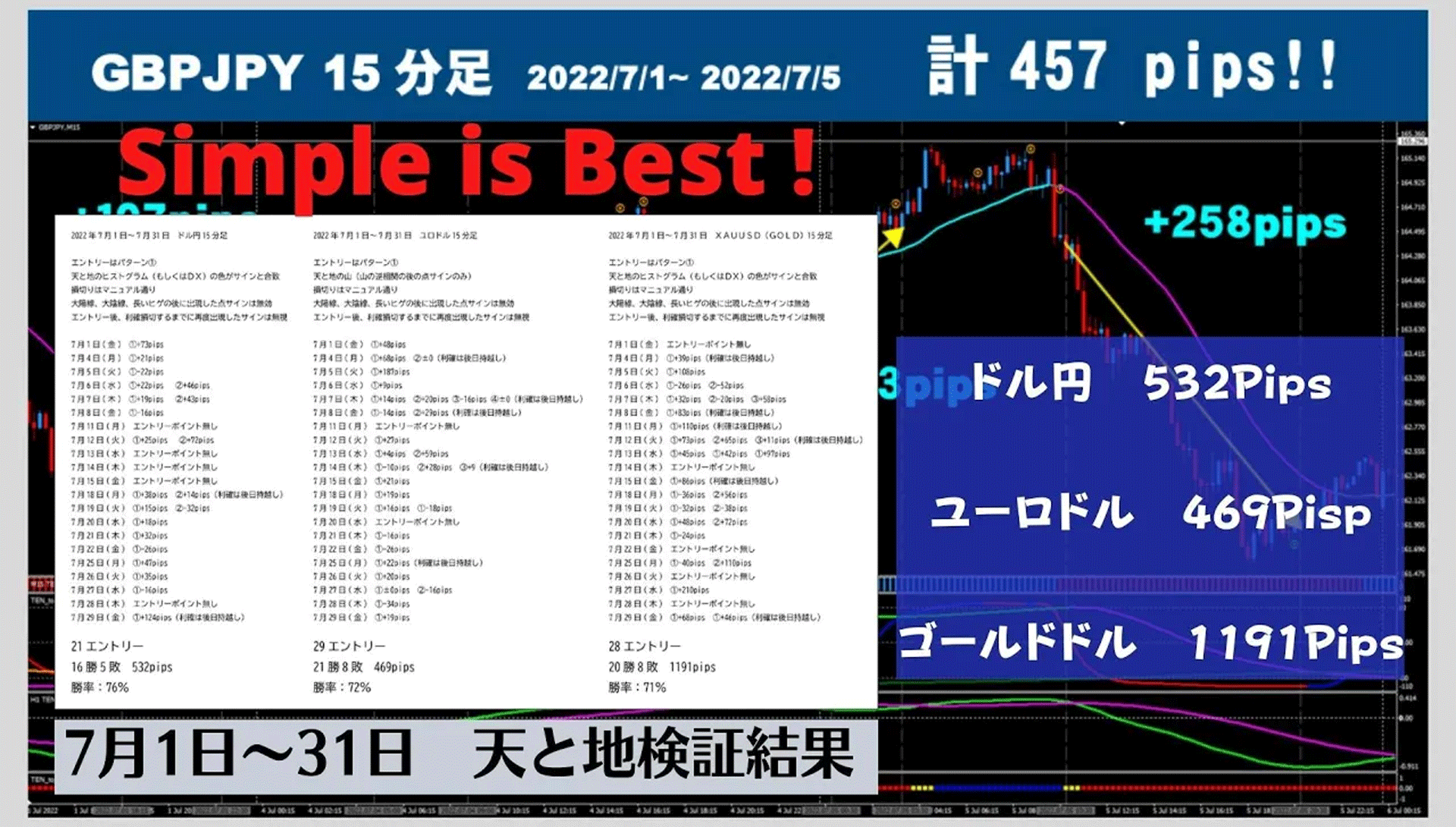
Kinjo, after graduating from university, worked for a publicly listed company and then ran his own company, and in parallel with his work, started investing in stocks and FX among other investments.
In terms of investment methods for stocks and FX, he began with short-term trading and gradually shifted to swing trading, holding positions for two to three months.
However, even with swing trades, having a position made him anxious during work and at night, and he became mentally exhausted. He also engaged in automated FX trading, but around the time of President Trump’s inauguration in 2017, the various algorithms he used did not work, resulting in large losses.
Kinjo became determined to break away from the cycle of winning and losing in speculation and, while searching for what true investment really means, was headhunted by the president of SYLA, Yuto, and learned the solidity and reliability of condo investment, deciding that this was his calling and entering the world of condo investment.
Furthermore, Kinjo’s story moved into the realm of investment.
Director Kinjo
When estimating retirement living expenses, the period after retirement at 65 and living until 90 is 25 years. For a couple, monthly living costs are 380,000 yen, so annual costs are 4.56 million yen. Over 25 years, you would need about 120 million yen. This has also been published by the Ministry of Economy, Trade and Industry.
For an average company employee, it is said that at retirement they will have assets of about 68 million yen including savings and severance pay, so they would need to cover a shortfall of a little over 50 million yen through investments.
However, this is the current situation, and it is hard to believe it will continue in the same way. Like many companies, overtime pay has been reduced due to recent work-style reforms.
On the other hand, social insurance premiums are rising year by year. This is because the number of elderly people to be supported by workers is increasing, and currently one elderly person is supported by about 2.6 workers. As Japan continues to age, workers in their 30s and 40s and incoming immigrant workers face a major social issue of how to secure their own retirement funds.
Thus, many people turn to side jobs or investments beyond their corporate jobs, but even among those who pursue side jobs, those with skills that generate reliable income are very rare, so demand for investments is overwhelming.
However, the problem is that although the goal of investing is to grow assets, many people take on more risk than necessary, causing their funds to decrease.
For example, in Japan, as many as 47% of mutual funds do not make a profit. I would like to hand this discussion over to Nakazawa, who specializes in developing financial products.
Mr. Nakazawa
The fact that 47% of mutual funds do not generate profits and shrink assets is largely influenced by the Financial Services Agency’s guidance toward financial institutions.
In reality, fund management companies aim to diversify into Japanese stocks, U.S. stocks, European stocks, government bonds of those countries, FX, etc., but when composing mutual funds there is a tendency that the Financial Services Agency will approve more readily if there is a justification for cultivating a specific sector, making it difficult for asset managers to freely switch investment products. In other words, they are being forced into constrained management.
If such constraints on management are lifted, I believe more mutual funds that succeed will emerge.
Kinjo
Regarding investments other than mutual funds, stocks, FX, and recently cryptocurrencies are cited. The share of people who have been successful and increased their assets through these investments is said to be around 15%.
So about 85% of people are losing.
Nakazawa
When I worked at a financial institution, I was part of a team led by a fund manager who specialized in Japanese stock investments.
They narrowed down a fixed number of investment targets from all listed stocks, and for each target they thoroughly researched the company’s history, industry context, the impact of the global economy, and geopolitical risks. Even among individual investors who love stock investing, getting close to a fund manager may be possible, but the result is reflected in the 15% success rate.
Kinjo
When I was running a company, I once suffered an 8 million yen loss in stocks, and as mentioned earlier, investing in stocks and FX is extremely exhausting, so I encountered condo investment.
Condo investment offers five advantages: stable, regular income; inflation resistance; leverage; ability to do it while employed; and minimizing risk as much as possible.
Stable, regular income is possible when you meet conditions such as being in popular areas where tenants actually move in, close to stations, and rooms for singles. Areas with low vacancy rates for rental apartments are said to be Tokyo, Kanagawa, and Fukuoka, but in the future urban populations will concentrate further in cities, and immigration from abroad is expected to increase mainly in urban areas.
SYLA’s condos are developed in-house on carefully selected sites near stations, limited to Tokyo’s 23 wards and Yokohama. The average occupancy rate in central urban areas is about 95%, which already provides a reliably stable regular income, but by adding design to the location, SYLA’s condos maintain occupancy rates above 99% for many years, offering even more stable income.
Properties of SYLA condos with emphasis on design and quality
Units for singles designed for design and functionality
Inflation-resistant means that nationwide average salary income has risen 3.3 times since 1970. Meanwhile, the average price of condominiums in Tokyo has risen from 7.74 million yen to 37.41 million yen, a rise of about 4.8 times. This outpaces salary growth, illustrating how promising condo investment is based on this data.
Leverage works means you don’t have to fund the entire condo investment with your own money; by using bank loans, you can operate with low-risk leverage. In addition to the investor’s credibility as an employee, well-located condo properties in Tokyo’s 23 wards and Yokohama are low-risk assets for banks, making it relatively easy to obtain loans from banks.
Can be done while employed, as in my experience, investments like stocks and FX were mentally exhausting and affected my main job. Once condo investment is started, you just wait patiently, so it offers ample leeway and is thus ideal for employed individuals.
Risk can be brought to near zero because the properties are kept to sustain high occupancy over many years.
Compared with stock and FX investments that increase assets by only about 15%, the risk here is dramatically lower; it’s not an exaggeration to say it is near zero.
Now, let’s simulate investing in a single-occupant condo.
35-year payment
Property price: 25,000,000 yen Interest paid to bank: 5,000,000 yen Total: 30,000,000 yen
Rent income
Monthly rent: 90,000 yen Total over 35 years: 37,800,000 yen
Profit
7,800,000+Profit from selling the property (about 7,000,000 yen?)
Even after considering maintenance costs, a substantial profit is expected from just one unit.
Also, considering rental income, you can repay the bank loan early without waiting for the full 35 years, so the profit from selling the property could be even larger.
By starting with one condo and gradually increasing the number of units, you can steadily fill the retirement shortfall of over 50 million yen as mentioned earlier.
Now, at SYLA, in addition to condo investments, together with Nakazawa, we are developing fund products that diversify investments across Japanese stocks, US stocks, European stocks, and their government bonds, and FX (foreign exchange).Japanese stocks, US stocks, European stocks,and their government bonds, FX (foreign exchange).
Although the initial investment is only around 1 million yen, by compounding over a long period, profits accumulate and the maximum 35-year period for condo investment can be shortened to about 18 years, while aiming for similar returns.
----------------------------------------
During the seminar,diversified investment across Japanese stocks, US stocks, European stocks,and their government bonds, FX (foreign exchange)We are making progress to offer these diversified fund products to investors.Portfolios for diversified investment were handed out.
For each participant’s completed diversified investment sheet, Nakazawa explained the results considering the risks of each financial product, so you could understand an appropriate portfolio.
My portfolio was allocated 20% to US stocks, 20% to US Treasuries, 20% to Japanese bonds, 10% to Japanese stocks, and a small amount to others. Nakazawa noted that when risks are accounted for, it is overweight in US equities at 35.9% and in Japanese equities at 18%.
There will be a second seminar to discuss how the returns from my portfolio after one month compare with Nakazawa’s managed portfolio, and at that seminar, if participants’ portfolio funds increase, they will award an Amazon card equal to the increase. It was announced as a pleasant incentive.
I had always thought that condo investment came after mutual funds, stocks, and FX, but leveraging bank loans using one’s own credit makes it surprisingly accessible to ordinary individual investors. With the favorable conditions of Tokyo’s 23 wards and Yokohama, and looking toward Japan’s economy’s future, it feels like a solid investment.
By participating in SYLA’s seminar,I felt that learning about the reality of condo management and investment, as well as fund diversification, broadens one’s investment knowledge.
Written by Hayakawa