
ECB's policy rate held steady, and is the pound-dollar making a historic move due to the Conservative Party's landslide victory in the UK general election?
Investment Salon“Emori Tetsu's Real Trading Strategy”In the distributed newsletter, you can review at once information analyzing many markets including stocks, bonds, and currencies. This allows you to effectively utilize Emori Tetsu's recommendedGlobal Macro Strategy.
◇ About Global Macro Strategy
The investment strategies introduced in this newsletter belong to the category of “Global Macro Strategy” in the hedge fund industry. This is the approach that hedge funds worldwide are most proficient at, the so-called “royal road” of hedge fund management.
In this strategy,you monitor all markets, seeking investment opportunities and aiming for profits. Regardless of whether market prices rise or fall, if price fluctuations are expected, you bet on them (you wager).Higher volatility implies higher profits, so when opportunities arise we advance boldly.
In a world where geopolitical developments are uncertain, price movements in major markets such as currencies, equities, interest rates, and commodities have become even larger. Therefore forecasting each market is extremely difficult. In such market conditions,a Global Macro Strategy that operates across a broader range of markets from a macro perspective is advantageous.
(Quoted from Emori Tetsu's Real Trading Strategy)

This time we present a portion from the newsletter distributed on December 13, 2019 at 8:26.
〔EQUITY & BOND MARKET〕
【U.S. & European Stock and Bond Market Commentary & Analysis】U.S. stocks continued to rise on expectations for progress in U.S.–China trade talks. The Dow Jones Industrial Average rose 220.75 points to 28,132.05; the S&P 500 climbed 26.94 points to 3,168.57; and the Nasdaq Composite gained 63.27 points to 8,717.32, each closing at record highs. President Trump tweeted in the morning on the 12th that “a large-scale trade deal with China is very close to being reached. China wants it, and the U.S. wants it as well.” On expectations for progress, stocks that had started soft turned higher. In the afternoon, reports that the U.S. and China had reached a preliminary agreement further pushed prices higher. Bloomberg reported that the U.S. and China agreed on the conditions of Phase 1 of the deal, with the agreement awaiting President Trump’s approval. The Wall Street Journal (WSJ) also reported earlier that the U.S. proposed cancelling tariffs on China planned for the 15th and reducing by up to half the tariffs on $360 billion previously imposed.
On this day, shares rose in the morning after President Trump posted on Twitter that the trade agreement with China was “extremely close.” Later, reports that the U.S. and China had reached a de facto “Phase 1” agreement circulated.
European stocks extended gains. ECB President Lagarde said she recognizes the side effects of non-traditional monetary policy, boosting bank stocks. With reports of progress in U.S.–China trade talks, stocks rose further. The STOXX Europe 600 Banks index rose 2.76%. Lagarde, at her first policy meeting as president, kept rates unchanged. Lagarde said she would not be a dove or a hawk, but a symbol of wisdom (an owl), to repair divisions within the Governing Council. It is also expected that the ECB will review its governance starting January 2020. Germany’s Xetra-DAX rose 0.57%. In addition to reports that the U.S. might delay tariffs on Chinese goods due on the 15th, the prospects for a U.S.–China deal improved as Trump tweeted that the agreement is very close.
The U.K. general election, centered on Brexit, closed at 10:00 p.m. local time (7:00 a.m. Japan time on the 13th) and will be counted immediately. It remains to be seen whether the Conservative Party led by Prime Minister Johnson will win an outright majority. Exit polls after polling closed suggested a large victory for the Conservatives. A Conservative victory would make Brexit by the end of January next year decisive. The U.K. voted to leave the EU in 2016, but May’s withdrawal plan was rejected by Parliament. May’s successor, Johnson, reached a new withdrawal agreement with the EU in October this year. To obtain parliamentary approval, strengthening the governing majority was deemed essential, leading to the general election. The U.K. general election was the first since June 2017 under May, and December’s election is the first in 2.5 years. This December election is the first since 1923.
【Japan Stock & Bond Market Commentary & Analysis】
The Nikkei Stock Average rose 32.95 points to 23,424.81, rebounding for the first time in three days. The TOPIX finished down 2.12 points at 1,712.83. About 33% of issues rose, 62% fell. Trading volume was 1.14442 billion shares, with a turnover of 19.935 trillion yen. After the FOMC, U.S. Treasury yields fell, encouraging buying in semiconductor stocks that influence the Nikkei. Semiconductors are viewed as bottoming out, and markets responded to the continuation of accommodative U.S. policy. However, declines among Nikkei 225 constituents outpaced gains on this day as well. With the tariffication date of the 15th approaching, risk-off sentiment persisted, and the Tokyo market saw more disposals and profit-taking.
〔CURRENCY MARKET〕
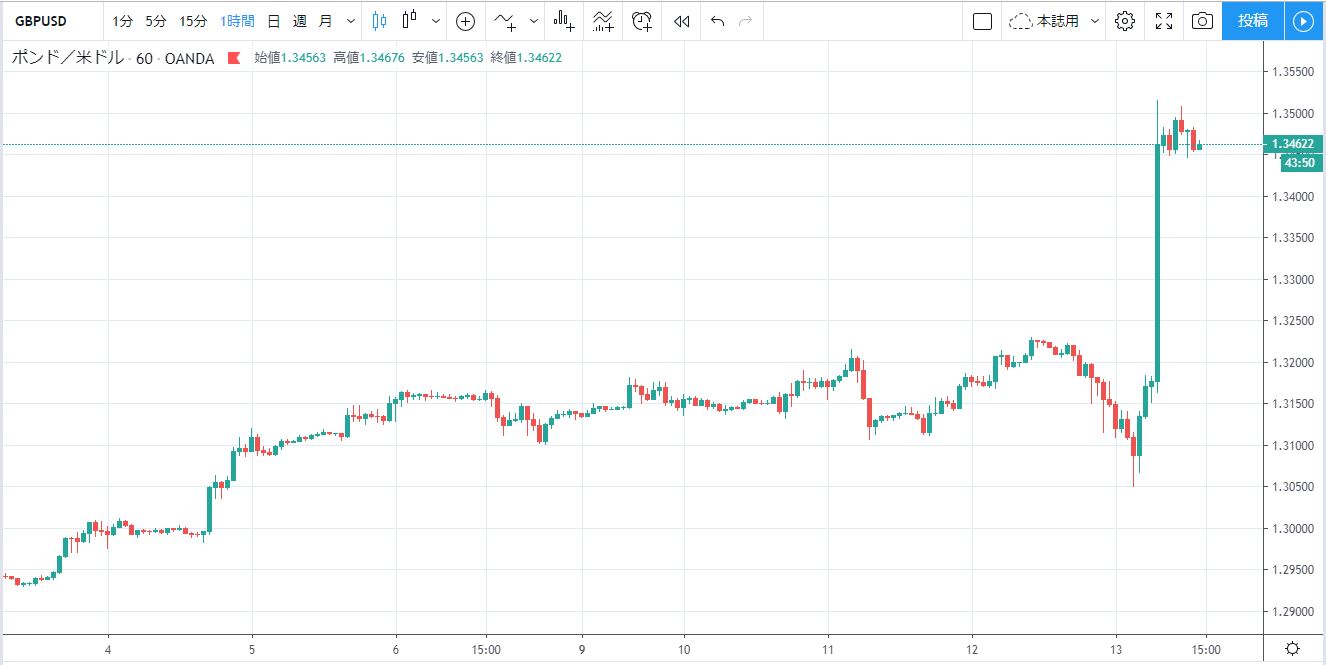
The USD/JPY rose to the low-109s amid rising expectations for progress in U.S.–China trade talks. President Trump tweeted in the morning of the 12th that “the trade talks with China are very close to a large-scale deal.” This led markets to expect postponement of the full implementation of the fourth round tariffs on China due on the 15th, triggering a risk-on environment and selling the yen to buy dollars. In the afternoon, Bloomberg reported that the Trump administration had reached an agreement in principle on the Phase 1 trade talks with China. Dollar buying and yen selling intensified, and USD/JPY climbed to around 109.45 yen. However, with the UK election results in view, caution prevailed and price movement was limited. EUR/USD rose to the low 1.11s. Meanwhile, BBC reported that the Conservative Party won 368 seats and would take an outright majority in the House of Commons, according to exit polls; the center-left Labour Party was forecast to win 191 seats, down from before the dissolution. In response, the pound surged to near 1.35.
【Currency Trading Strategy】
USD/JPY stays on hold. We have reached a very critical point. If it clearly breaks above 109.50, the long-term trend could turn upward. For now, we would like to sell rallies, but we will pause today. We will assess market reactions after the trade-talk news becomes definitive and the UK election result becomes clear. In other words, we plan to observe today’s New York market reaction and begin moving from the start of next week. If we must trade, we might go short to capture a short-term decline. The stock market is gaining momentum, so the yen tends to weaken; thus today it is wiser to wait. Of course, if 109.50 proves to have been a ceiling, selling could become easier. But in the current situation it does not seem likely to fall easily.
The primary focus remains on GBP/USD. It has risen to around 1.35. Exit polls suggest a landslide victory for the Conservatives. The upside potential is increasing. If it continues to rise, this would be a historic move, so we should follow. We would like to accumulate positions by gradually buying on dips. The theoretical value for GBP/USD is 1.4898, so there is substantial room for upside. EUR/USD is also likely to rise; its theoretical value is 1.1779, so keep an eye on European currencies for further upside.
〔COMMODITY MARKET〕
【Precious Metals Market Commentary & Analysis】Gold prices eased slightly from about a one-month high. President Trump’s tweet that trade talks with China are nearing an agreement triggered selling of gold, traditionally a safe-haven asset. Ahead of the 15th when the U.S. plans to impose additional tariffs on Chinese goods, gold had risen due to uncertainty, but Trump’s tweet signaling that “an agreement is very close” dampened the momentum. Stocks rose sharply. Spot palladium rose to around $1,944, a fresh record high. After heavy rains and floods in South Africa, a major producer, mines halted operations, raising concerns about supply. Prices continued to push above $1,900. Silver and platinum also advanced.
【Precious Metals Trading Strategy】
Maintain long gold positions. Market optimism has capped upside. Nonetheless, the trend remains unchanged, and holding gold remains sensible. As long as $1,450 supports, there’s no issue. The key question is whether investors will buy as gold becomes seen as undervalued. The current theoretical price for gold is $1,420. Below this, buying is the standard. This time we also consider a pullback toward around $1,400. If price declines, consider buying on dips below $1,420. Above all, holding gold is essential. If stock prices weaken, funds will likely shift to safe assets like gold. As noted, November to February is a period when you should not sell gold. Do not let near-term fluctuations drive decisions; prioritize holding first. Then wait for risk-off moves accompanying stock adjustments.
“Emori Tetsu's Real Trading Strategy” (Emori Tetsu)Quoted from.
Reference chart: GBP/USD 1-hour chart, December 13, 2019 14:15