
President Trump signs the Hong Kong Human Rights and Democracy Act, affecting various markets. Markets after US Thanksgiving are in focus
Investment Salon “Tetsu Emori's Real Trading Strategy” allows you to check at a glance the information analyzing many markets including stocks, bonds, and currencies, delivered in the newsletter. This enables you to effectively utilize Mr. Tetsu Emori's recommended Global Macro Strategy.
◇About Global Macro Strategy
The investment strategy introduced in this newsletter falls into the “Global Macro Strategy” category in the hedge fund industry. This is the approach most of the world's hedge funds excel at—the orthodox, mainstream method of hedge fund management.
In this strategy,you look across all markets, seeking investment opportunities and aiming to earn returns. Regardless of whether market prices rise or fall, if price movements are anticipated, you bet on them.Because higher volatility generally yields higher profits, we attack boldly when opportunities arise.
In a world where global events are unclear, price movements in major markets such as currencies, stocks, interest rates, and commodities have become even larger. Consequently, forecasts for each market have become extremely difficult. In such market conditions,a Global Macro Strategy, which operates across a wider range of markets from a macro perspective, is advantageous.
(Quoted from Tetsu Emori's Real Trading Strategy)
This time we will introduce a portion from the newsletter distributed on November 29, 2019.
〔EQUITY & BOND MARKET〕
The U.S. stock and bond markets are closed for Thanksgiving.
London stocks fell. There was selling in ex-dividend stocks, and concerns about progress in U.S.-China trade talks weighed on sentiment. The FTSE 100 had been rising for four days, but ended 0.18% lower. On the 27th, President Trump signed the “Hong Kong Human Rights & Democracy Act” to support anti-government protests in Hong Kong. In response, the Chinese government said on the 28th it would take “firm countermeasures” and warned that attempts to interfere in Hong Kong would fail, raising concerns about progress in U.S.-China talks.
Although trading was light because U.S. markets were closed for Thanksgiving, following Trump's signature on the Hong Kong law, selling occurred in HSBC Holdings, which focuses on Asia operations, and in mining-related stocks.
European stocks declined. Concerns about U.S.-China trade talks resurfaced. The STOXX600 fell 0.14%, snapping a five-day rising streak. The STOXX600 Automobiles & Parts index led the decline, down 0.8%, the largest drop in more than a week.
【Japan Equities & Bond Market Commentary & Analysis】
The Nikkei Stock Average closed at 23,409.14, down 28.63 points from the previous day; the TOPIX fell 2.92 points to 1,708.06, both down for the fifth straight day. 66% of stocks fell and 29% rose. The trading volume was 925.01 million shares, and the turnover was ¥1,598.2 billion.
On the 27th, U.S. major stock indices rose, but in the early morning hours Japan time President Trump reportedly signed the Hong Kong Human Rights and Democracy Act into law, raising concerns about Chinese retaliation and causing the Nikkei to move around near the previous close.
Because U.S. markets were closed for Thanksgiving on the 28th, foreign investors were on vacation and there was little active trading. During the session, China issued a protest statement expressing “extreme regret” toward the Hong Kong Human Rights Act, but no concrete retaliation measures were announced. It is anticipated that foreign participants will return to trading in earnest in December, and whether China moves to stall trade talks will be the key.〔CURRENCY MARKET〕
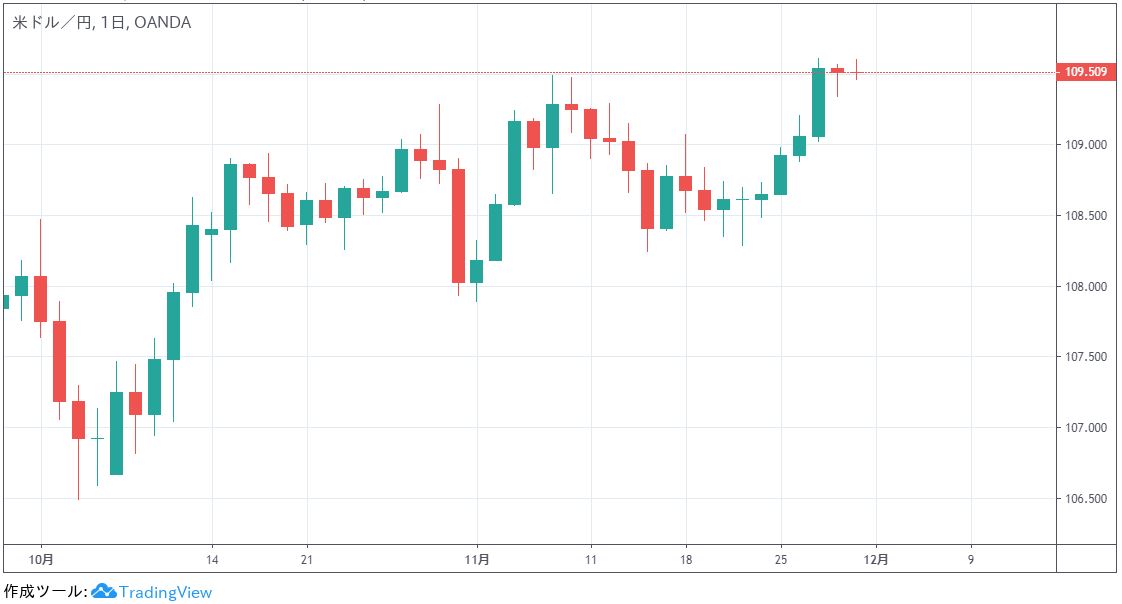
The USD/JPY declined. On the 27th, President Trump signed the “Hong Kong Human Rights & Democracy Act” to support anti-government protests in Hong Kong. In response, the Chinese government stated on the 28th that it would take “firm countermeasures” and warned that attempts to interfere in Hong Kong would fail, lifting concerns about progress in U.S.-China talks, with a brief dip to around 109.32 yen before gradually rebounding to 109.50 at the close. Trading was light as U.S. markets were closed for Thanksgiving.
In the UK ahead of the December 12 general election, the Conservative Party under Prime Minister Johnson was expected to win a majority, pushing the pound to its highest level against the euro in about seven months. However, it later softened and closed slightly lower. YouGov's forecast model suggests Conservatives will win 359 of the 650 seats to gain an outright majority; in 2017 they won 317 seats. The pound briefly rose to $1.2953 against the dollar, the highest in about a week, but then softened and closed at $1.2907.
【Currency Trading Strategy】
We will maintain a short USD/JPY. If it moves lower, there is potential for further declines, so target that. Conversely, if it climbs higher, it could rise further. With the downside rising, breaking above the important resistance at 109.65 yen could push toward the round 110 yen, and then toward around 111.80 yen. If that happens, we would close the shorts for now. Depending on the situation, we may consider going long. In the current market, U.S. rates are a key point to watch. We should monitor the bond market movements.〔COMMODITY MARKET〕
【Precious Metals Market Commentary & Analysis】
Gold prices rose slightly. Silver continued to fall, platinum rebounded, and palladium extended gains, reaching a new all-time high.
【Precious Metals Trading Strategy】
We will maintain long positions in gold. The strategy remains unchanged. Downside now appears to have become quite firm, so once it turns up, there is potential for substantial gains. Of course, everything depends on U.S. stocks.
Global stock prices have risen, particularly in the U.S., and investors are moving away from gold. However, now is not the time to sell gold. If it holds at around $1,440, it would provide solid support and could rebound. To limit risk, holding gold is best. Eventually stock prices will correct, and interest in gold will grow. There is no need to take a short-term stance at all.
We should also note again that the theoretical value based on U.S. real yields is around $1,440. If prices fall this far, we would like to add to our positions. As repeated, November through February is a period when you must not sell gold. Do not be swayed by near-term fluctuations; priority is to hold firmly. Then wait for risk-off moves accompanying stock price adjustments. We will skip silver and platinum and focus on gold for now.
“Tetsu Emori's Real Trading Strategy” (Tetsu Emori)Quoted.