

Frankly, how do you pick a high-quality EA?
Note: This article was updated on November 20.
A question for those trading foreign exchange.
Are you a discretionary trader? Are you an EA trader?
There are advantages and disadvantages to each, but
「Is an EA safe? What criteria should I use to choose one?」
That’s the honest feeling, I think.
Therefore, this time we conducted interviews with actual EA traders,and had them anonymously reveal the criteria for choosing an EA!
What almost all of them had in common was the following:
・Forward results are accumulated to some extent, and the chart is upward-trending
・Low drawdown
・Not averaging down or using martingale
・PF above 1.5
・Risk-return ratio
Regarding the forward period, most responses were“at least six months!”, and there were also responses that wanted to see a year.
Regarding low drawdown,“Just because recent results are good doesn’t mean you should jump in and take a drawdown; if you’ve recovered the EA’s cost, you might think ‘it’s fine’ and end there. If you view it with a long-term perspective, using it would be definitely better.”” is also the trader’s honest opinion.
PF(Profit Factor) isn’t simply better when higher;1.5–2.0 is about right, and this was the common view.
Generally, if PF is 2 or higher, profits accumulate with each trade, butas long as it does not drop below 1, you won’t incur a loss, so for EAs that trade many times via scalping, you don’t need to worry too much.
Regarding drawdown, some traders also check the height of therisk-return ratio※.
(Note: The risk-return ratio is the metric of how long it took to recover from a drawdown.)
Even with a long forward testing period and a good PF, if the risk-return ratio is low, the recovery ability is not great.
To calculate, use the following formula.
Risk-return ratio = total P/L ÷ maximum drawdown
And a risk-return ratio of2.0 or higheris one guideline.
However, if the number of trades is extremely low or the EA hasn’t traded much within the specified measurement period, a high value may occur, so please be careful.
It seems better to compute using a longer measurement period with a reasonable number of trades.
We narrowed the forward measurement period to over one year and looked for EAs with focus on the risk-return ratio!



Also, when you want to find an EA with small losses and large profits, the important thing is the【Risk-Reward Ratio】.
The risk-reward ratio takes into account the balance between win rate and TP/SL (Take Profit / Stop Loss), and
Risk-reward ratio = average profit ÷ average loss
is the concept,
in simple terms, if the risk-reward ratio is 1 (average profit equals average loss) and you have a win rate of over 50%, profits will remain.
Also, it’s good to consider your preference for the relationship between risk-reward ratio and win rate, as well as how often you want to trade.
・Low risk-reward ratio (1 or less) implies a higher win rate
・High risk-reward ratio (greater than 1) implies a lower win rate
It’s fine either way.
Up to here we’ve shared traders’ various decision criteria, and based on those, we picked up several EAs.










What do you think?
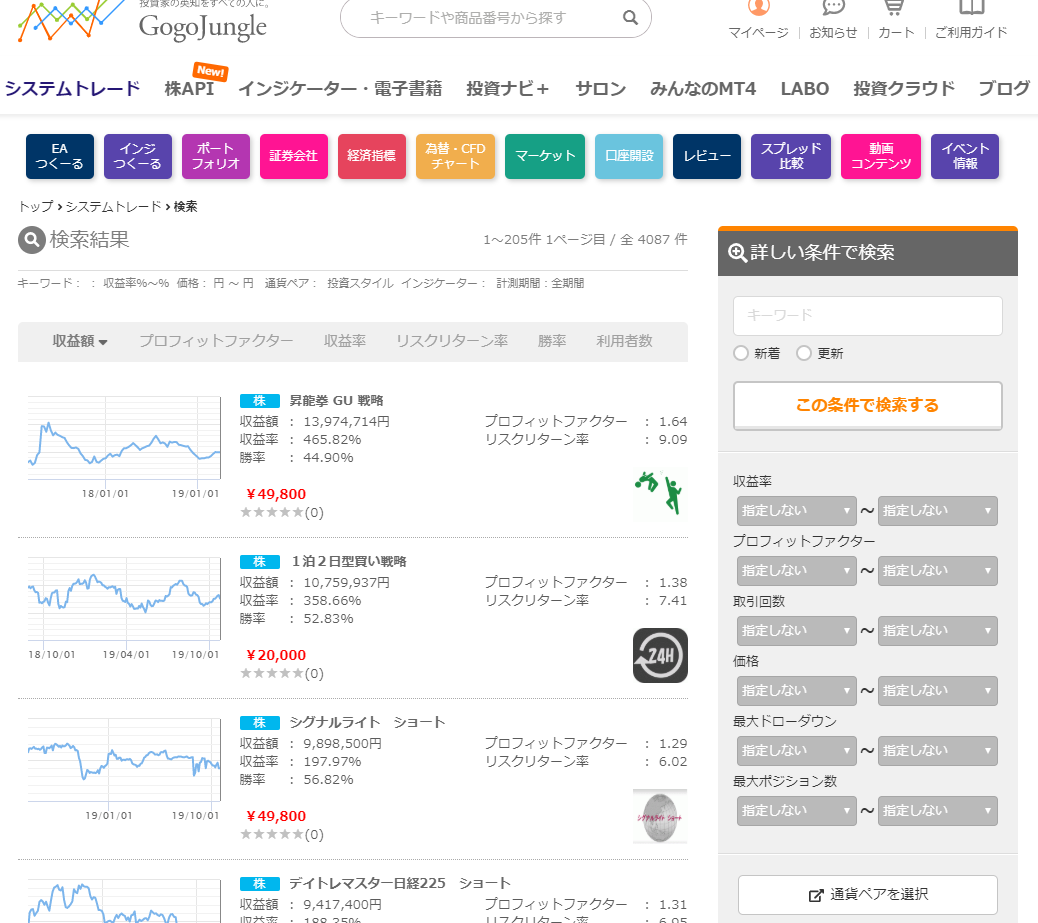
At GogoJungle, you can also search by setting your preferred criteria!
【FX System Trading Search】
Top Page → System Trading → System Trading FX → Search with detailed conditions
You can set each value and filter by currency pair as well.
Please take advantage of it and discover the best EA you can!
Written by Kuwabara