
The Nikkei average will stop rising soon — Mr. Tetsuo Inoue
Extremely Important Trend 896: Nikkei Average 3-Deviation NEW Graph 4
According to Tetsuo Inoue's "Market Trends" article published on October 23 (Wednesday), the overheating in the Nikkei Average has become quite pronounced.
We thought this would be essential reading for investors trading Nikkei futures, so we’re sharing it.
Today we also upload two graphs. This series has been running for four business days, and as noted in 'Sign', the Nikkei Average 3-deviation plus 5% level has risen for nine consecutive days, reaching 22,281 yen. In conclusion, we can say that we are entering a timing where we start to consciously acknowledge the overheated sentiment that had not been discussed before.
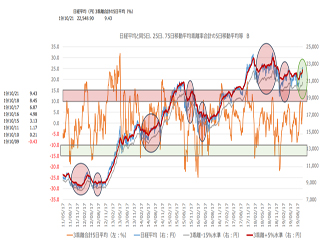
To explain using Graphs 1 and 2, first look at the shape of Graph 1 and pay attention to the values of the raw data (numbers) shown on the left.
Graph 1
From this shape, you can see that it is still rising, and while it remains an upward phase until the peak is hit, it finally seems likely to touch the "outside-the-speed-limit level (10%–15%)."
And from the left raw data, you can also see that the value at the start of this series (which began on October 17) rose from 4.98% to 9.43% in three days.
If we list the day-to-day changes in the left raw data from 10/10 in order, they are +0.64%, +0.96%, +1.96%, +1.85%, +1.89%, +1.58%, +0.98%.
From this, not only does it seem likely to touch the "outside-the-speed-limit level (10%–15%)", but the rise rate exceeded 1.8% and continued for three days with momentum, and after that, momentum began to wane somewhat over these two business days. Therefore, it is time to start watching with a sidelong glance.
Here, the 5% level, which is the green line in Graph 1, is shown in terms of actual Nikkei Average levels in Graph 2 (NEW Graph).
Graph 2
This blue line is the actual Nikkei Average, while the thick red line shows the +5% level, and the gray line shows the -15% level. It is the line that is described daily in 'Sign' as the near-call line.
And the portion on Graph 2 enclosed in blue from the left shows the Nikkei Average dipping below the gray line, and after the bottoming, moving up to reach the outside-the-speed-limit (upper bound = +10%) level; this is the quantitative "buy signal" in Sign.
If you look at the green-enclosed portion this time, you can see that the red line has been sideways for a short period since late September, and then rises again. And that gap (the divergence rate) has now reached the current level of 9.43%, which is the near the outside-the-speed-limit (upper bound = +10%) level.
Therefore, we expect the rise to stop soon.
Tetsuo Inoue "Market Trends"