
Mr. Tetsu Emori week-over-week, there is a large revenue opportunity for the British pound; the theoretical value is $1.49
A global macro strategy that eyes all markets, seeking profits by spotting investment opportunities. According to Mr. Tetsu Emori, it is the most proficient method used by hedge funds worldwide, and, regardless of whether market prices rise or fall, if price fluctuations are anticipated, a strategy that bets on them can be far more advantageous than approaches that focus solely on Japanese stocks, US stocks, bonds, or FX.
10月18日(金)の江守哲氏のグローバルマクロ戦略の中から一部をご紹介しましょう。

【通貨トレード戦略】
USD/JPY: Short. It tested higher yesterday as well, but the move seems to be getting a bit heavy. If it breaks below 108.50, it could retrace to about 107.80. Prices have risen quite high, but we will maintain the strategy. From the current price action, there is still room for further downside. Therefore, the exit point is raised to 110.50. To ensure that you can add to shorts if it rises this far, solid money management is essential. In macro strategies, this kind of situation is common. Since contrarian trading is not rare, money management is extremely important.
Over the week, approval of a new proposal in the UK Parliament is required, so depending on the outcome there could be significant moves at the start of next week. Optimism is not certain, but personally I think the opposition Labour Party and the DUP may have to accept it. Some believe that if it is rejected, extending the Brexit deadline to the EU will be requested. The possibility is not zero, but I do not think there is much point in further delays. The Parliament appears to be driven by each party's ego, and a national rerun referendum could be seen as a neutral option, but how about redoing something that was decided? In any case, Britain should decide this time.
There are major profit opportunities in the pound. Looking at the UK-US real interest rate differential, the pound appears quite undervalued. The theoretical value is around 1.49 USD, so there is substantial room for adjustment. If Brexit negotiations progress, given the large number of short positions in the pound in the currency futures market, buybacks could come in quite strongly. It looks like a profitable opportunity, so I will watch carefully.
If USD/JPY starts to fall, I would also consider shorting the cross-yen pairs.
Investable targets are USD, JPY, EUR, GBP, AUD, NZD, and CAD. We will focus on trades against USD and JPY.
USD/JPY: Short
EUR/USD: Long
GBP/USD: Long
AUD/USD: Cover shorts and establish a new long
NZD/USD: None
USD/CAD: New long
EUR/JPY: None
GBP/JPY: None
AUD/JPY: Cover short
NZD/JPY: None
CAD/JPY: None
〔EQUITY & BOND MARKET〕
【U.S. & European Stock & Bond Market Commentary & Analysis】
<omitted>
【US Stock Trading Strategy】
<omitted>
【Major Stock Index Trading Strategy】
<omitted>
【U.S. Treasuries Trading Strategy】
U.S. 2-year and 10-year Treasuries stay long. They are oversold. Yields should start to fall soon. We maintain positions expecting a stock correction and a rebound in bonds. We will keep positions until the situation clearly changes. Expanding to bond futures would be quite broad, so if you lack liquidity you don't need to trade aggressively. This is provided for portfolio diversification reference.
That said, the basics of macro investing are to diversify across stocks, bonds, currencies, and commodities. Owning many individual stock names does not provide risk diversification. If macro factors crash the stock market, micro analysis and individual stock investments won't work. Please understand this and use macro investing to your advantage. Also, bond trading should be based on futures or CFDs.
【Japanese Stocks & Bonds Market Overview & Analysis】
<omitted>
【Nikkei 225 Futures Trading Strategy】
The Chicago market is again holding around the 22,500 yen level today. While it attempted higher, the inability of US stocks to extend gains and the limits of yen weakness kept the upside in check. Nevertheless, it remains at 22,500 yen. The bullish side tends to maintain a bullish stance in this environment. It seems retail investors created another round of selling during the rise, and until these buybacks finish, prices are likely to stay elevated. Major foreign players have shown choppy moves in the futures market. The buyers and the heavily selling side over the past two days are intersecting. Both sides appear to have hedge funds behind them; we will watch price developments. If buyers turn into sellers, it could break down sharply.
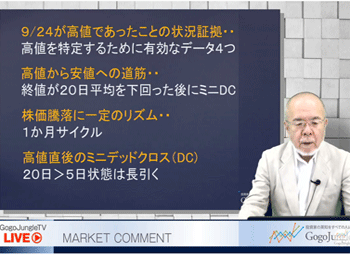
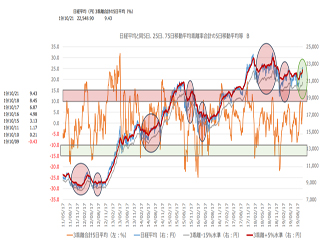
In yesterday's after-hours trading, it rose to 22,690 yen. That is likely to be the upside target. The high-price range could stay elevated for about 10 days. This pattern has been common recently. If this pattern holds, late October 29–30 could be a turning point. It coincides with the Bank of Japan's policy meeting. A new policy is expected to be announced here, and we will determine what it contains and how it impacts the market. If disappointing, a pullback is likely for a while.
In any case, the current market is driven by position flows rather than solid cash demand. The market is fragile. Chart shapes have improved, but the stock price itself remains overpriced and technically overbought. In such a situation, one could argue for strength, but it seems quite stretched. The chart pattern of a "three gaps" cannot be ignored. When it appears in a high-price area, it is considered a sign of a peak. The buyers may take profits here.
Also, as noted, the dollar-denominated Nikkei has risen to about $207. At such levels, it tends to fall as in January 2018 and October 2018. The same pattern seems likely. Nikkei VI has fallen to the 15-range. It may be time for a stock price correction and a rebound. Historically, stock prices peak at certain levels. Therefore, the current price level is not a buying opportunity even if viewed as a selling opportunity.
Thus, indicators suggesting stock price peaks are all that remain. We should interpret these objective data straightforwardly and wait for a correction. If prices rise, we will continue to add to shorts. In that case, rigorous money management is essential. First, wait for a correction to around 21,850 yen.
In technical terms, the 25-day moving average of the advance-decline ratio has fallen to 128%, but the overbought condition remains. The 6-day average has fallen from 182% to around 127%, but still shows an overbought state. PER is 12.68x, EPS is 1,770 yen. PER is at this year's peak. EPS rising is surprising. PBR is 1.11x, BPS is 20,226 yen. The environment where PBR around 1x (near 20,000 yen) tends to act as a lower bound remains unchanged.
Short-selling ratio mildly declined to 41.1%. Recently there has been little movement at low prices. New highs: 53; New lows: 10; bullish patterns persist, but the number of new highs has fallen sharply. As of October 11, the margin debt ratio was 2.35x, down slightly from 2.38x the previous week. Not much movement. As of October 13, the credit valuation loss rate fell from 14.05% to 13.63% week over week.
As of October 4, foreign investor net buying was 114.912 billion yen; individual investors net bought 131.740 billion yen. Both sides are buying again in unison. The securities sector net sold 213.463 billion yen, repeating the previous pattern. This suggests purchases during pullbacks from highs; if prices move higher from here, selling will occur. Upside looks limited. Looking at positions around 21,500 yen suggests they do not expect much downside.
〔CURRENCY MARKET〕
<omitted>
〔COMMODITY MARKET〕
<omitted>
Other analyses, etc.
Over the week in the UK Parliament, and comments that the pound's theoretical value is around 1.49 dollars will be particularly meaningful for FX traders at the start of the week.
I hope this serves as a reference for your trading strategy.
Report by Hayakawa
Tetsu Emori's Real Trading Strategyhttps://www.gogojungle.co.jp/re/veX11PkkCC7wjhh
Tetsu Emori's 225 Options Real Tradinghttps://www.gogojungle.co.jp/re/gnn8sLIuxbNVTVi