

Yamada Consulting Group (4792), specializing in small and medium-sized enterprises. Can expanding personnel uncover dormant needs?
Yamada Consulting Group (4792) is a company whose main business is management consulting for small and medium-sized enterprises.Management consulting for SMEsis its core business.
In recent years, performance has been expanding. Although the latest profits declined,sales continue to reach new records, and this term is expected to hit a new high.
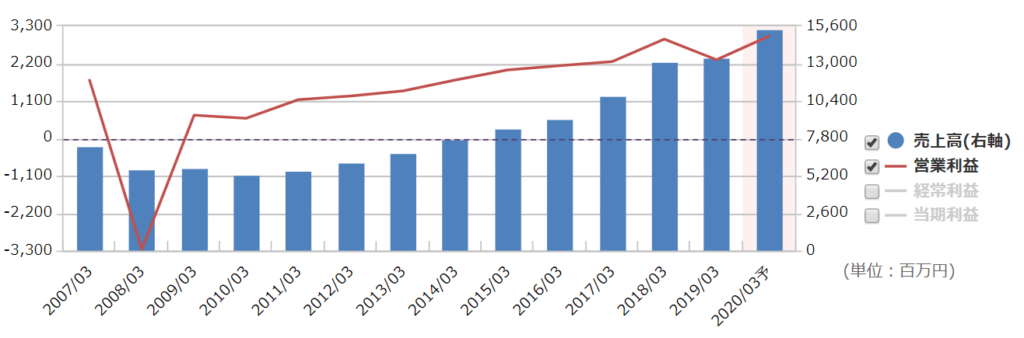
Behind the expansion of performance is a demand for, in addition to traditional management consulting,succession planning and M&A.
The domestic economy is shrinking due to aging and population decline. In an era of growth, perhaps profits would have grown even with merely vague management, but as growth slows, efficient management is required for survival.
However, transforming management significantly requires enormous power. A consulting company shows the way and helps steer toward a better path.
The consulting needs of SMEs are still sleeping
When you think of management consulting, McKinsey or Boston Consulting Group come to mind. However,these firms are geared toward large enterprises and do not reach SMEs. That is where the company steps in to complement them.
When thinking of SME consulting, you might assume it is troublesome and not very profitable. At least, it used to be thought that large, publicly listed companies were the ones to do it.
What overturned this notion isNihon M&A Center (2127), which specializes in M&A for SMEs that large investment banks and consulting firms did not handle, and has rapidly grown its performance.
Nihon M&A Center (2127) Performance
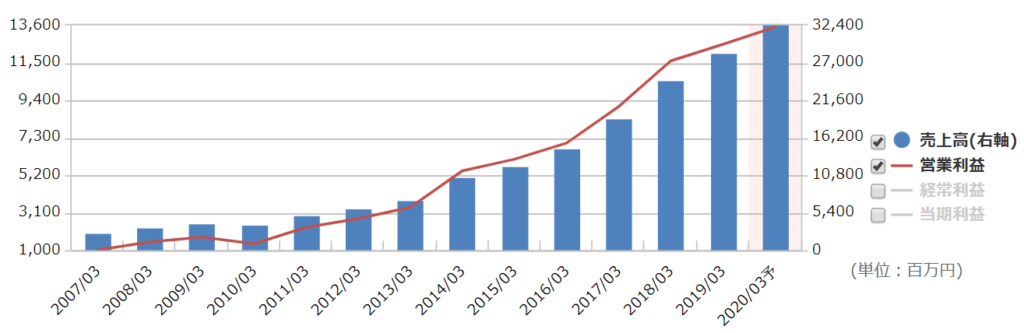
Until now, M&A was considered something for large companies, but in reality it is also necessary for SMEs. In particular, for companies suffering from a lack of successors, the option of having someone buy the business is essential for continuation.Thus, the option of “selling the company” is necessary for continued operation.
Yamada Consulting likewise engages in M&A and contributes to performance growth. In addition, the company’s strength lies in meeting a wide range of needs beyond M&A.
As evidenced by M&A,there are still many needs among SMEs that were once thought to be only for large corporations. For example, IT integration and overseas expansion. If these areas can be addressed, further growth in performance can be expected from here.
By the way, I learned of the company’s existence from a signboard installed at an airport. This seems to contribute to brand strength.
Profit growth slows with increasing number of personnel
The company’s expansion intentions are evident from the trajectory of its workforce.It has roughly doubledover the past five years.
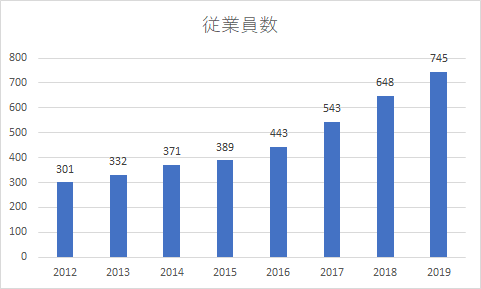
Consulting firms are all about people, so expanding the business requires expanding the workforce.
On the other hand, increasing personnel meansfixed costs rise correspondingly.
Recent profit growth has been gradual compared to revenue growth. The latest results show a decline in profits. It seems sales did not meet expectations, butthe increase in staff carries a risk of such profit declines.
Moreover, M&A requires buyers. When the economy is good, buyers are more willing, but in bad times they decrease sharply. In other words,there is an economy-cyclical aspect, and such companies cannot escape an economic downturn.
That is, in the long term, SME M&A may trend upward, but temporarily it could contract. If that happens, labor costs could become a burden and lead to losses..
Economic downturns are unavoidable but long-term growth potential remains
Nevertheless, the company offers not only M&A but a broad consulting menu, capable of meeting needs as they arise.Even immediately after the Lehman Shock, revenue from management consulting grew.
Even if there were a period of losses, the financial condition remains very healthy.Debt-free with 8 billion yen in cash and deposits. It is hard to imagine a situation where management would be desperate.
From these points,while there is a possibility that M&A demand temporarily declines during an economic downturn, in the long run the demand for SME consulting tends to rise, and once on track, the company can further grow its performance.
In such a situation,the PER is around 16 times, which is not high. The stock price has paused after listing on the Tokyo Stock Exchange First Section in February, but it may not be a bad time to enter.