
Behavior around the 5-day line. A market with little movement. Kōya Hiroshi's "From the Technical Room"

Delivery date: 2016/08/25 08:08
There is no clear “direction” in the stock price
The closing price of the Nikkei 225 futures, both during daytime trading and after-hours trading,
remains in the 16,500 yen range for five consecutive days.
It feels like the market has become even more lacking in direction than before.
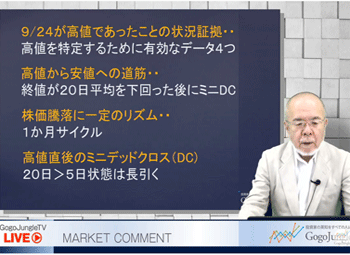
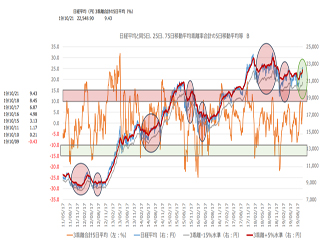
In this environment, yesterday the 5-day moving average and the 1-month (20-day) line of the Nikkei average
generated a mini dead cross (DC). As the up/down cycles are shorter,
the Golden Cross (GC) and DC are being repeated frequently, so it may not be something to worry about.
The last mini-DC occurred on 8/05, and in just three days it resolved the DC condition.
In chart terms, it ended as a “fakeout.” The subsequent GC condition also ended within eight days, highlighting the lack of direction in the stock price.
The same applies to the DC; the lack of direction is evident.
Yesterday’s 5-day moving average was 16,545 yen. The 2% move from this level would be about 330 yen, implying a rough range of 16,200–16,900 yen.
There are many indications here that the market is not moving much.
The reason for the lack of movement seems to lie in this area as well.
The 5-day MA was around 16,545 yen yesterday. A 2% move from there would be about 330 yen, so roughly 16,200 to 16,900 yen is the expected range.
There are few clear moves to speak of, and that is a factor in the subdued momentum.
“There is not much directional movement” is the general takeaway.
Movements within ±2% of the 5-day MA
The daily closes have been fluctuating around the 5-day MA as a central point
for about a month. The relationship between the closes and the 5-day MA over the past month is as follows:
Close < 5-day MA Close > 5-day MA
7/22–26 (3 days) 7/27
7/28 7/29–8/01
8/02–05 (4 days) 8/08–15 (5 days)
8/16–19 (4 days) 8/22
8/23 8/24
If you check the divergence between the close and the 5-day MA,
there was only one instance of exceeding +2% (8/09, +2.22%), and only one instance of exceeding -2% (8/03, -2.12%). About 90% of the time, movement was within ±2% of the 5-day MA.
The lack of movement is largely due to this range.
Yesterday’s 5-day MA was around 16,545 yen. A move of ±2% from this level would be roughly 330 yen, implying a general range of 16,200–16,900 yen.
This is a factor behind the perceived lack of movement.
The reason for the dull movement can be traced to this area as well.
The 5-day MA around yesterday was 16,545 yen.
A move of ±2% would be about 330 yen, suggesting a broad 16,200–16,900 yen range.
Around yesterday’s level, the 2% move corresponds to about 330 yen, so the 16,200–16,900 yen range is mostly anticipated.
Stock prices supported from the bottom
Since mid-February, when the Bank of Japan introduced negative interest rates,
the Nikkei Average price-to-book ratio (PBR) has ranged between 1.03 and 1.17 times,
and over the past month the PBR range has risen to about 1.11–1.16 times,
making the downside stronger.
Earnings per share for the Nikkei Average have been rising, with a price staying in the 14,400 yen range for lower values,
and if you estimate with a PBR of 1.11–1.16, the range would be about 16,000–16,750 yen.
From the past month's movement, the bottom of the Nikkei Average around 16,000 yen has been nudged up by 200–300 yen,
while the upper side around 17,000 yen remains heavy,
forming a price pattern where 16,500 yen acts as a central stalemate for the month.
Volatility is expected to linger within 16,500 yen for the month, and trading momentum is likely to start around September, when expectations for the BOJ’s policy meeting begin to take hold.
This is likely to be the point at which price action becomes more evident.
↓↓Kojima Hiro’s 'Technical Room' column