
Trend 233 Industry-wise Ranking Mr. Tetsuo Inoue
Publication date: 2017/03/03 07:00
Foreign investors have shifted to substantial net selling in both the spot market and futures since the second week of January this year, as I have written, but after Mr. Trump's election, the share of equities in funds' asset allocations rose, and purchases of Japanese stocks have also paused. Even if a second wave of buying arrives, it has never reached the size of the first wave. "Foreigners buying after X weeks" reports may appear, and even if that buying lasts for 2-3 weeks, it would be premature to believe they will resume large net buying; past patterns have shown the index tends to move within a range for a while (or turn downward).
Therefore, the next time foreigners consider investing in Japanese stocks is after the March corporate earnings are announced (from late April to May 15), and after going through a process of evaluating the overall index valuation relatively (in comparison with PERs and other metrics from overseas markets).
I have repeatedly stated that there are only 2-3 buying opportunities per year, but outside those periods a steady, ongoing effort is required to study individual stocks (ETFs, REITs, mutual funds) and to monitor their past price movements (solely for valuation judgments). In this newsletter I kept to described topics, writing about indices, supply-demand, and technicals for ten full months without mentioning individual stocks until I could say “learn 300 stocks!” Having completed this learning period, I now plan to increase opportunities to reference individual stocks somewhat.
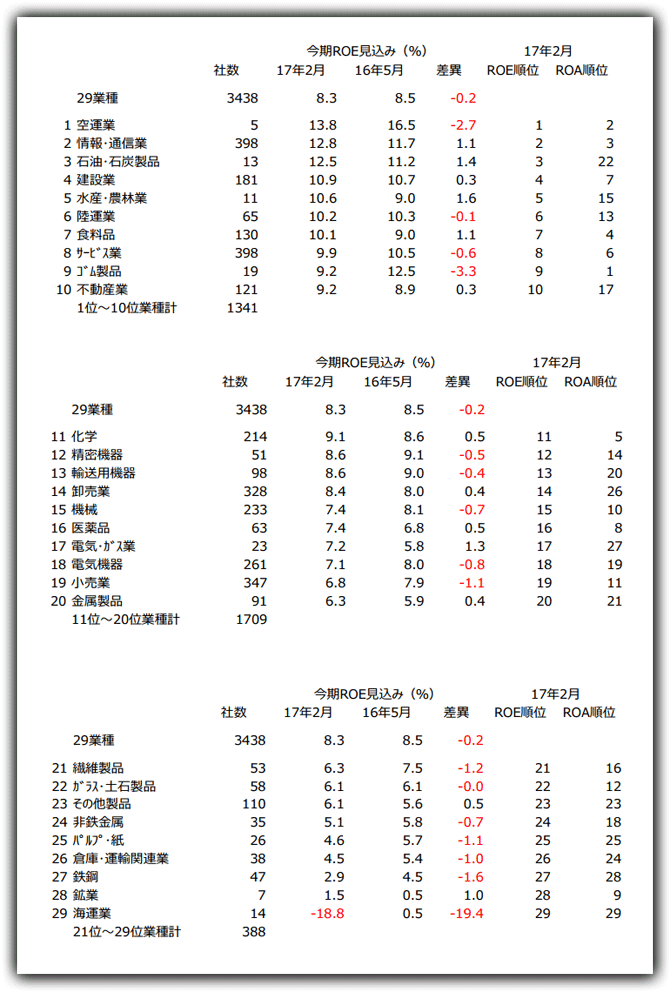
Therefore, today I will attach ROE and ROA figures by industry for the 29 non-financial sectors as of the end of the third quarter. When researching individual stocks, it is far more efficient to understand the characteristics of the “forest” of industries and then look for the “trees” within that forest, rather than searching blindly. Before the 2017 fiscal year earnings outlook is released, knowing the changes in ROE from the 2016 initial estimates (by industry) to the actual ROE will help determine which forest to enter in the next year’s industry exploration.
This year, which sectors have been upwardly revised from their initial forecasts? It is somewhat surprising that “construction” is actually quite good; what does it mean that ROE is high while ROA is mediocre? (I will write about these later), and “the ‘Air’ and ‘Sea’ are heaven and hell?” There are various points you might be wondering about.