

Recommended stock Unicorn Holdings (3258) hits the limit up. Publishing members-only report
For Members-Only ServicesUnizo Holdings (3258), which has persistently recommended in the members-only service, hit a limit-up today.
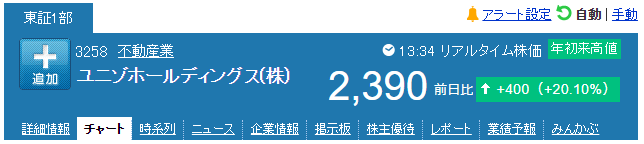
Unizo Holdings is a company that operates rental office buildings and hotels. In recent years, backed by low interest rates, it has continued an expansion strategy, but its stock price has fallen almost every year due to public offerings of new shares.
However, its performance has continued to grow, and the rise in the value of its properties, combined with this, the stock price has become increasingly undervalued. Recently, the fair value of its held real estate minus interest-bearing debt wasthe fair value was 300 billion yen, while market capitalization had fallen to 60 billion yen.
This is the thrill of value investing—“looking for a 1000-yen note that can be sold for 500 yen.” The following is an excerpt from a member report.
【Investment Points】
- Unizo Holdings (3258) hasseen its stock price fall due to three consecutive capital increases. However, a public offering of new shares does not inherently reduce the value of the stock. EPS is still being maintained, and future profits are expected to rise.
- Compared with REITs, which are also in the real estate rental business,Unizo Holdings is valued at only about one-third of a typical REIT. The source of value is the same, yet a clear discrepancy is evident.
- Although the stock price remains depressed due to concerns about further capital increases, conversely, if the capital increase stops, there is room for a big rise.If you wait patiently, it will become a solid investment.
【Company Details】
Capital increases do not reduce stock value
Since July last year, the recommended stockUnizo Holdings (3258) has conducted a public offering of new shares, causing the stock price to fall. At the start of the recommendation as well, the price fell due to a public offering. Public offerings were conducted in 2013, 2014, 2016, and 2017, and this is the third consecutive year.

If you understand that there will be a public offering, why recommend it?Because, in principle, capital increases do not reduce the value of the stock. When new shares are issued, EPS temporarily declines, but the funds raised by the capital increase undoubtedly increase corporate value. If the funds are used to generate profits, EPS will eventually rise.
If funds are spent on executive compensation or luxurious offices, shareholders’ anger is understandable, but Unizo invests in assets that are highly likely to generate profits, such as real estate and hotels,which can reliably generate profits. If profits can be generated from there, the per-share value does not decrease.
Despite repeated capital increases, EPS has risen or stayed flat. Inversely,PER has become increasingly undervalued. This is likely due to the actions of short-term investors worried about temporary EPS declines or poor supply. Considering value, the “morsels” become greater as time passes.

※2019 earnings per share (EPS) shown as company forecast (adjusted for capital increases), price reference is the close on 2018/5/11
There is a time lag for profit increases. For existing properties, profits are reflected immediately, but what is being strengthened now are newly built hotels. It takes time and money from capital infusion to construction and opening preparations, soprofit will come later.
Conversely, as hotel openings progress, profits will naturally increase. There are currently 20 operational properties, with 11 in development. When these open, considering profits,the current price level could reach a PER approaching 5, showing undervaluation.
Value potential at about three times the current price when evaluated by REIT standards
Stocks that frequently increase capital are REITs. For example, Daiwa Securities Office Investment Corporation (8976) conducted three consecutive capital increases from 2014 to 2016. REITs borrow to grow, but because that weakens financials, capital increases strengthen equity.
The same thinking generally applies to Unizo Holdings, a real estate rental company. However, while REIT capital increases are not as disliked,it is odd that Unizo Holdings’ capital increases are particularly disliked.
Compared with REITs that invest in real estate, the inherent value becomes clearer. The metrics emphasized for REITs are,net asset value (NAV) multiple and yield.
【NAV Multiple】0.25x vs 0.8–1.3x
NAV multiple indicates how many times the market value of real estate is compared to shares. Real estate valuations are relatively stable, soa fair value is around 1x, and listed REITs actually fall within 0.8–1.3x.
Applying the same standard to Unizo Holdings’ NAV multiple yields 0.25x, only one-quarter of the fair value of its held properties. This meansa property worth 100 million yen could be bought for 25 million yen. Even accounting for corporate taxes at 70%,Unizo Holdings has a safety margin of about 2.8x.
【Yield】12.5% vs 3.2–3.6%
REITs distribute 3.2–6.5% yield. Unizo Holdings’ dividend yield is about 3.5%, but it is important to consider the differences in their structures. REITs must distribute more than 90% of profits as dividends, so their yields are necessarily higher.
If Unizo Holdings paid out all profits as dividends, the yield would be 12.5%. If the yield is adjusted to the REIT average of 4.5%,Unizo’s stock price could rise by about 2.8x. Interestingly, this is exactly the same figure as the NAV-based calculation.
In other words, if Unizo Holdings were to simply become a REIT,value could be about 2.8 times the current price. Of course, the sources of value do not change for REITs or stocks, so I can say with confidence that Unizo Holdings is undervalued.
Once the capital increases stop, the rise will be a matter of time
So why has it been left so undervalued? Because of the capital increase concerns,which is the sole reason. Regardless of rationality, it is a long-standing rule that stock prices fall when capital increases occur.
Nevertheless, the company’s value is undoubtedly increasing. In the long term, the stock price should approach its value.
Forecasting the exact timing is difficult, but the clear signal iswhen annual capital increases stop. The value is evident, and the metrics show undervaluation, so if the capital-increase concerns vanish, the stock price should rise.
New investment was 140 billion yen in 2016, 130 billion yen in 2017, and 80 billion yen in 2018, gradually decreasing. It had previously expanded rapidly, but it seems the pace is slowing. Domestic real estate acquisitions have cooled, and if held properties are disposed of, latent gains will become realized profits.
Even if capital increases do not stop,the stock value will not decrease, so there is no need to worry. The question is when the market will recognize the value. Since it is centered on inner-city rental properties, the business model is relatively resistant to economic downturns.
Clearly undervalued, with unlikely value decline, making it an ideal long-term holding. Buy when it’s cheap and wait patiently.
※Commentary as of May 31, 2019
It has become clear that HIS (9063) has appeared as the top shareholder of Unizo Holdings (3258) for the first time.
The stake is 4.52%. In response, the stock price has risen.
When asked by HIS, the reply was that Unizo Holdings’ finances are being viewed as a “net investment.” Of course, even if there is strategic partnership intent, that is not necessarily the case.There is a possibility of some action in the future.
Even if nothing happens, we still see holdings as significantly undervalued. Hisashi (HIS) chairman Sawada is a strong figure who built wealth through stock investments, and “net investment” might not be entirely false.
Investment Advisory Contract here