

[World Financial Markets and Foreign Exchange Comprehensive Analysis] Tokyo Core CPI +2.9% (highest in 16 months) rebounds to Nikkei 58,628 yen — the duel at USD/JPY 159.34, Saudi oil refinery strike (Brent $97.71), and the overlap of U.S. shortened tradi
After the Tokyo market closes on Friday, November 27, 2026, around 18:00, the global financial markets are characterized by a “substantial rebound in Asian equities.”andin the midst of a complex backdrop of “rising U.S. rates, a stronger dollar, and higher oil,” we are heading into the weekend.
Currently, the five core drivers moving the overall market are as follows.
Expectations of BoJ rate hikes in December and the rise in Japan’s long-term yields:November’s core CPI for the Tokyo metropolitan area rose to year-on-year +2.9% (the highest in 16 months). Speculation ahead of the December 18 BoJ meeting and fluctuations in the bond market are in focus.
U.S. Federal Reserve policy and the dollar strength trend:The U.S. 10-year yield rose to 4.921%, and USD/JPY remains in the low 159s.
Repurchase after AI and semiconductor stock adjustments:Semiconductor-related stocks such as Tokyo Electron and Advantest were bought, and the Nikkei and Asian stocks broadly rebounded.
Middle East tension around the U.S., Israel, and Iran and oil supply risk:Reports of missiles striking Saudi Aramco’s Jazran refinery and tensions in the Hormuz Strait have pushed Brent crude toward the 97-dollar range.
End-of-month position adjustments and shortened U.S. trading (light turnover):Following yesterday’s Thanksgiving holiday in the U.S., today the 27th the U.S. market will also operate on shortened trading hours, making it necessary to watch for sudden price moves amid lower liquidity.
The most important point here is that “while stocks are rebounding, the simultaneous rise in dollar, oil, and Treasury yields means this is not a straightforward risk-on environment.” In particular, the combination of rising Japanese yields and the dollar/yen approaching 160 is an extremely important monitoring theme for next week as well.
This article is based on 18:00 on November 27, 2026 (Japan time) and uses confirmed Tokyo market closing prices, quotes, and public reporting, clearly separating unconfirmed information and conditional scenarios in detail.
Chapter 1: Today's Major Market Overview
(as of 18:00 on November 27)
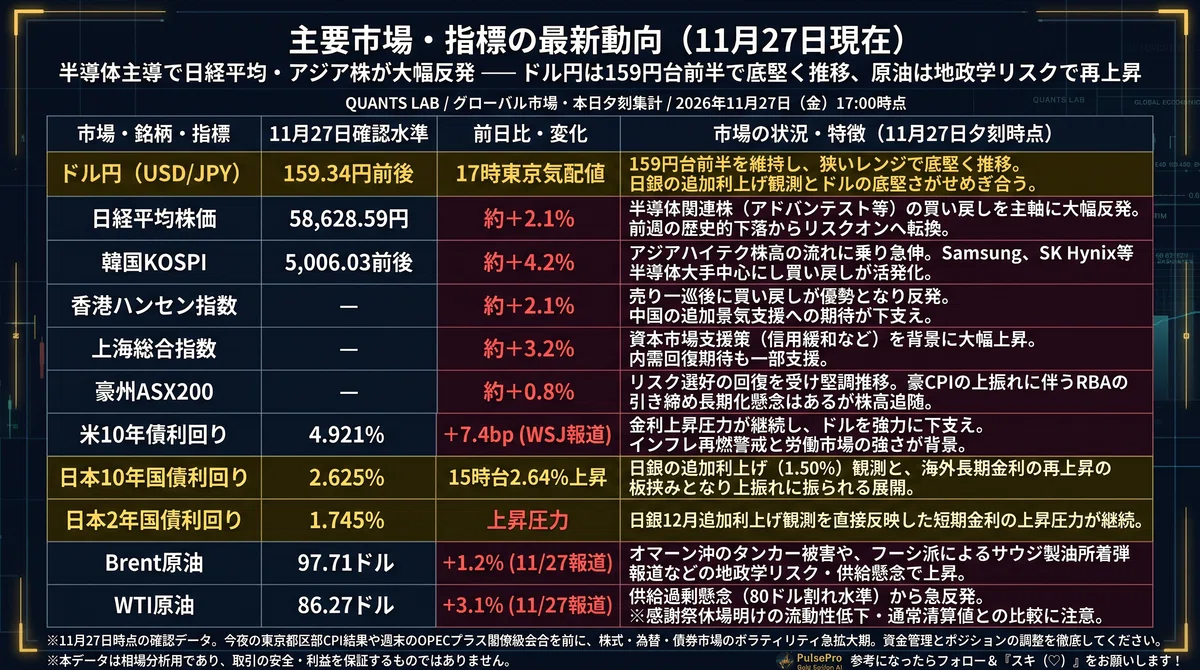
While Asian stocks, led by Japan, South Korea, and China, rebounded, crude oil rose on concerns about Middle East supply, exerting upward pressure on U.S. yields as well (the following notes reflect Tokyo market closing prices and afternoon quotes and overseas reporting standards confirmed as of 18:00, not real-time prices at the same moment).
Chapter 2: Domestic Japan — Tokyo Core CPI +
2.9% and BoJ December rate hike expectations; Government bond market
1. November Tokyo metropolitan CPI: 16-month high growth
Today, November 27 at 8:30 a.m., the Tokyo metropolitan CPI for November showed inflation across a wide range of items, including food, daily necessities, accommodation, public transport, and medical-related goods.
[November Tokyo Met CPI (CPI) Actual]
・All items excluding fresh foods (core CPI)
:YoY +2.9% (October +2.6% / market expectation +3.0%)
・All items excluding fresh foods and energy (core-core)
:YoY +2.5%
YoY +2.9% compared with the same month last year isthe highest in 16 months, but the market expectation (+3.0%) was slightly lower.
2. BoJ December meeting (end of December 18) and key official remarks
The current policy rate is 1.25%. In a Reuters survey, many economists expect an additional rate hike at the December 18 policy decision meeting, with some voices expecting further hikes through March 2027. However, today’s Tokyo CPI slightly underperformed, so the data alone does not make a December rate hike certain.
Also, yesterday the 26th, it was reported thatBank of Japan Governor Ueda stated that rate hikes should not be rushed, indicating cautious sentiment toward rapid financial normalization. Today, the 27th, no definitive statements indicating a policy change by Governor Ueda have been confirmed.
3. Japanese government bond market and the risk of “yen carry trade unwind”
The 10-year JGB yield rose to 2.64% in the afternoon after hitting 2.625% in the morning (source: SMTB, Reuters, WSJ). The 2-year yield rose to 1.745% as well, signaling upward pressure on short-term rates.
If Japan’s rates rise sharply, it could trigger mortgage rate increases and bond valuation losses at financial institutions, as well as a “yen carry unwind” (cross-yen declines including high-yield currencies), so extreme caution is needed regarding changes in the U.S.-Japan rate differential.
Chapter 3: U.S. Situation — Fed and U.S. Treasuries —
Discrepancies among information sources and Thanksgiving shortened trading cautions
1. U.S. monetary policy outlook and 4.921% on the 10-year Treasury
A WSJ report dated November 27 shows the U.S. 10-year yield at 4.921% (up 7.4bp). This supports the dollar against the yen.
However, note that there are discrepancies among media and information sources regarding how much the market has priced in for policy moves (some reports emphasize a December hike; others anticipate rate cuts). Therefore, do not blindly rely on a single probability figure; check the Fed’s official statements and the latest CME FedWatch trend calmly.
2. Liquidity risk from shortened trading after Thanksgiving
Following Thanksgiving on the 26th, U.S. stock markets are open in shortened trading on the 27th as well. With light participation from foreign players, liquidity is thin, so be alert for
① sudden news-driven moves,
② surges in stop orders,
③ widened spreads,
④ price moves on smaller orders,
⑤ gap risk at the start of next week if Middle East tensions change over the weekend.
Chapter 4: World Equity Markets — Asian Semiconductors’ rebound and AI concerns remaining
In today’s Asian markets, semiconductor-related stocks like Tokyo Electron and Advantest led the rebound in the Nikkei Stock Average (+2.1%) and Korea’s KOSPI (+4.2%), lifting Asia-wide equities.
However, structural concerns that have unsettled global markets this month—such as the potential recoverability of AI-related equipment investments, rising data center construction costs, financing burden, and high stock valuations—have not been resolved. Even with NVIDIA, credit-rating concerns and server shipment issues are reported, so today’s upside should be viewed largely as an intramonth rebound (short-covering). Next week, NASDAQ activity and semiconductor stock volume and continuity will be tested after U.S. markets reopen.
Chapter 5: Middle East Tensions, Saudi Oil Facility Strike and Oil Market (Brent 97.71 USD)
The most cautionary area today is the Middle East energy supply risk.
Attack on Saudi oil facilities (Reuters, November 27):There were reports of a strike at Saudi Aramco’s Jazzan refinery, resulting in one death and multiple injuries among workers.Additionally, the Houthis claim attacks on Ras Tanura and Red Sea port facilities (note: claims of attacks must be distinguished from actual shutdowns and export capacity impacts).
Navigational risk in the Hormuz Strait and Qatar’s diplomacy:Reuters highlights attack risk around the Hormuz Strait, and on the 26th Qatar and the U.S. held their 8th Strategic Dialogue, with Prime Minister Mohammed of Qatar warning of new military tensions (this alone does not imply risk reduction).
Oil prices surpassing $100 risk:As of November 27, Brent crude rose to 97.71 USD (+1.2%) and WTI to 86.27 USD (+3.1%). Reuters notes that if available supply is notably constrained, Brent could exceed $100. On the other hand, OPEC+ is expected to maintain current production targets at least through Q1 2027 (as reported).
Double burden on the Japanese economy:If oil prices rise and the yen falls (toward the 159-160 level), Japan’s import costs will balloon, accelerating domestic inflation via gasoline, electricity, gas, and logistics costs, thereby complicating BoJ policy decisions further.
Chapter 6: Foreign Exchange Market — Thorough Analysis of USD/JPY, EUR, GBP and Cross-Yen
Focusing on Tokyo market quotes observed around 15:00 on November 27 (not real-time order data).
[Tokyo Market Quotes at 15:00 on November 27 (USD/JPY at 17:00 around 159.34)]
・USD/JPY: 159.14–159.38 (narrow range under 30 pips) ・EUR/USD: around 1.0986 • EUR/JPY: around 174.98
・GBP/USD: around 1.3132 • GBP/JPY: around 209.18
・AUD/USD: around 0.6678 • AUD/JPY: around 106.36
・NZD/USD: around 0.5505 • NZD/JPY: around 87.64
1. Key price bands and breakout lines for USD/JPY
Rising U.S. long-term yields, Nikkei rebound, and dollar-buying by importing companies support USD/JPY, while Tokyo CPI rise and BoJ December hike expectations, plus proximity to the 160 threshold, cap the upside.
【Target price bands for USD/JPY (as per today’s market analysis to guide expectations)】
★ 160.00 yen (major resistance): psychologically critical, yen intervention risk increases here
★ 159.50 yen (upside resistance): if broken and held, could test 160 yen —————
17:00 Tokyo quote: 159.34 yen (159.30–159.40 range)
———
★ 158.50 yen (major support): breaking below could strengthen yen buying
★ 156.50 yen (next downside target): if BoJ hawkishness and U.S. rate declines coincide with multiple drivers
2. Focus points for Euros, GBP, and Oceania currencies
EUR/USD (around 1.0986) & ECB:Dollar weakness supports the euro, but euro-area economy remains fragile. The ECB minutes reportedly discussed potential for further hikes due to inflation concerns, and former Spanish central bank head Pablo Hernandez de Cos has emerged as a candidate for next ECB president.
GBP/USD (around 1.3132):UK 10-year yield around 5.18% remains high; attention to inflation, fiscal policy, and growth balance.
Cross-yen generally:Asian stock strength supports OECD currencies (AUD/JPY around 106.36, NZD/JPY around 87.64), but if BoJ rate hike expectations intensify, cross-yen could plunge even in a stock rally.
Chapter 7: New Zealand Election Results, Emerging Market Currencies
China, Europe, and precious metals BTC movements
1. New Zealand election results and the fate of EM currencies
NZD:Final results of the New Zealand general election were released on November 27. Prime Minister Luxon’s center-right party failed to secure a majority, and government stability will require cooperation from the centrist Opportunities Party. The NZD initially weakened before rebounding, with coalition negotiations becoming the focal point.
Indonesian rupiah (IDR):Nov. 27 reports show around 18,380 rupiahs per dollar (down over 9% year-to-date), near a record low. Fiscal concerns, U.S. tariff policy, expected Fed tightening, and MSCI investment access screening weigh on the IDR.
Mexican peso (MXN):October unemployment rate at 2.97% versus expectations of 2.63%, drawing attention to the labor market.
Turkish lira (TRY):Reports of the Turkish central bank pausing a one-week repo auction and early elections denial by the finance minister require careful separation of policy management and currency depreciation risks.
2. China, Europe, and Russia
China:The Shanghai Composite rose about 3.2% on announced market-support measures. The PBOC’s on Nov 27 yuan reference rate was 6.7075 yuan per dollar (the strongest yuan in over four years).
European events (Nov 27 evening):Following the 16:45 French GDP revision and November CPI flash, and the 17:55 German November unemployment numbers, later tonight come 19:00 Eurozone Economic Confidence, 21:15 ECB Lane executive board member lecture, 21:50 Bundesbank Nagel president speech, and 23:15 ECB Vice-President de Guindos lecture.
Russia and Ukraine:Reports indicate the U.S. president expressed views that a rapid agreement between Russia and Ukraine could be achieved, though diplomatic expectations and actual ceasefire agreements must be verified separately.
3. Gold (XAU/USD) and Bitcoin (BTC)
As of 18:00 on November 27, the definitive latest prices and BTC ETF fund flows are not confirmed, so speculative figures are avoided. Gold sits at cross-currents between U.S. rate rises and dollar strength (bearish) and Middle East geopolitical risk (safe-haven buying). BTC’s movements hinge on U.S. stocks (AI-related), DXY, U.S. long-term yields, ETF flows, and margin calls.
Chapter 8: Tonight through Weekend—Important Dates and Next Week’s
Five Major Drivers and Three Scenarios
Tonight (after 18:00 on November 27) to Weekend: Key Schedule (Japan time)
Fri 11/27 18:30–19:00: South Africa October PPI; Eurozone November Economic Confidence; Consumer Confidence
Fri 11/27 21:00–23:15: Mexico October Trade Balance;ECB Lane Executive Director, Germany’s Nagel, and ECB Vice-President de Guindos speeches; U.S. October Wholesale Inventories; Canada Current Account
Sat 11/28 00:30: Banque de France Governor Molan speech
Sun 11/29: OPEC Plus Ministerial Meeting????? (Production targets and supply stabilization measures for Q1 2027) / Spanish election
Five market-moving factors and three USD/JPY scenarios for next week
Next week, the following five factors will drive markets:
① BoJ December 18 rate-hike decision,
② Fed policy stance,
③ Middle East and Hormuz Strait (risk of crude surpassing $100),
④ Continuation of AI and semiconductor stock rebounds,
⑤ OPEC+ meeting results on Sundaywill lead the market.
? Scenario A [Sustained dollar-strength and yen-weakness (conditional rise)]:
Conditions: U.S. long-term yields stay high, BoJ remains cautious on hikes, and U.S. stocks rebound continues.
Watch levels:Break of 159.50 → test 160.00 (However, around 160, government and Ministry of Finance warnings and intervention risk intensify).
? Scenario B [Caution toward yen strength (risk-off scenario)]:
Conditions: BoJ December rate hike expectations rise again, while U.S. long-term yields fall and stock market risk-off intensifies.
Watch levels:Dip below 158.50 → toward 156.50.
? Scenario C [Range-bound (neutral)]:
Conditions: Shortened-trading aftermath shows mixed signals, selling near 160 before profit-taking occurs.
Watch levels:Range of 158.50–159.50.
Overall Conclusion: The Risks I Am Most Watching
Three Risks and Next Week’s Monitoring Order
In this analysis, the three risks to watch most closely are:Three Key Risks.
Simultaneous Oil Rise and Yen Depreciation:If Middle East risk pushes oil toward $100 and USD/JPY nears 160, Japan’s import prices could surge, making BoJ policy decisions extremely challenging.
BoJ rate hikes and “yen carry trade unwind”:If Japan’s rates rise while other rates fall, wide cross-yen unwinds (including AUD/JPY, NZD/JPY, MXN/JPY, TRY/JPY) could occur as positions are dumped rapidly.
Are AI-related stock rebounds “real”?Although today’s Asia stock rally is positive, if NASDAQ falls again after the U.S. market reopens, Asia stocks could face selling pressure.
Next Week’s Market Monitoring Priorities (TOP 7)
Hormuz Strait and Saudi energy facilities (weekend developments)
U.S. 10-year yield (4.921%) and the U.S. Dollar Index (DXY)
USD/JPY at 159.50 and 160.00 — defenses
BoJ December 18 meeting expectations
Sustainability of Nasdaq and semiconductor stock rebounds
OPEC+ ministerial meeting results on Sunday (11/29)
AUD, NZD, MXN, TRY against the yen
This weekend is a period when U.S. shortened trading liquidity tends to be low and Middle East news can move quickly. Be mindful of weekend gap risks at the start of next week, and maintain disciplined money management with limited leverage.
Notes on Information Accuracy and Key Sources
Note:This report compiles information from public reporting and market data confirmed by 18:00 on November 27, 2026. Indicators and unconfirmed statements after 18:00 and real-time prices are not reflected. Market figures are not at the same time and are not investment recommendations.
Main reference materials:Reuters (global equities, dollar, AI-related markets, Tokyo CPI, BoJ rate hike expectations, Middle East oil supply risk, FX and government bond market news) / JETRO (Middle East-related info) / European and American economic indicators and events
If this is at all helpful, please follow and press the 'Like' (♡) button at the bottom of the screen to encourage updates!

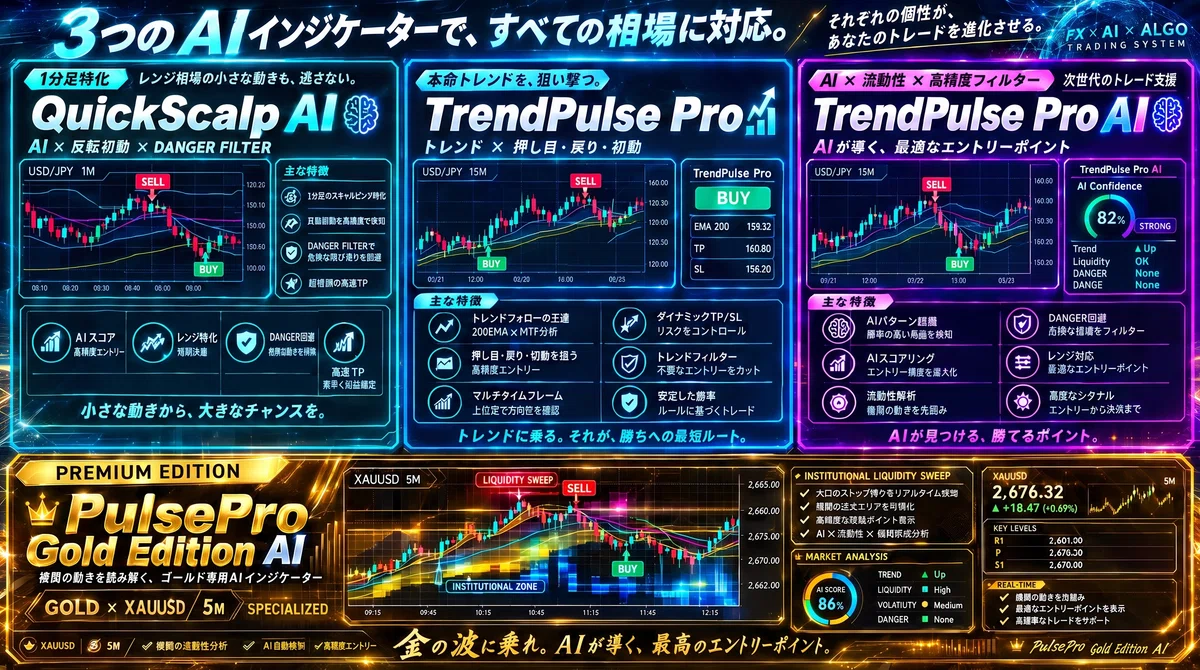
TrendPulse Pro free trial:https://www.gogojungle.co.jp/tools/indicators/86532?via=users
TrendPulse Pro AI free trial:https://www.gogojungle.co.jp/tools/indicators/86529?via=users
QuickScalp AI free trial:https://www.gogojungle.co.jp/tools/indicators/86523?via=users
An indicator that strips emotion and analyzes the market with clear evidence and rules.
Details on features and design logic are published on each product page
? [GogoJungle product page]