

【FX Front Line|Episode 3】Domestic KO Options or Overseas FX? Reasons domestic KO outweighs / The required funds and effective leverage for USD/JPY, GOLD, and BTC thoroughly examined
The "domestic KO option" is the correct substitute for high leverage in overseas FX! Thorough on-screen verification of required funds and effective leverage for USD/JPY, GOLD, and BTC
“I want to aim for large price moves with a small amount of capital, but the 25x leverage on domestic FX feels insufficient for capital efficiency…”
“And with overseas FX, the risk of withdrawal denial and the up to 55% total taxation (tax) are major drawbacks….”
In the previous installments (Episodes 1 and 2), we explained the basic mechanism of domestic knockout options (KO options), their advantages and disadvantages, and how to open a demo account to test with zero risk.
In this third part, we go a step further and“examine how overseas FX high-leverage environments can be replaced by domestic KO options”with actual order screen data. We will verify the required funds for the three major assets—FX (USD/JPY), Gold (XAU/USD), and crypto assets (BTC/USD)—andeffective leverage, and also precisely explain the “difference in the unit of 1 lot” that you must understand when migrating from overseas FX.
Contents
- Why KO options are the strongest replacement for high leverage? The secret of capital efficiency
- [Important] Before comparing, confirm this! Domestic KO vs. overseas FX differ in “1.0 lot trading unit”
- [Actual screen reveal] Thorough verification of required funds and effective leverage for USD/JPY, GOLD, BTC
- Key differences among overseas FX, domestic standard FX, and domestic KO options (efficiency, margin calls, taxes)
- Three iron rules for KO options: knockout width and lot management to avoid failures with high leverage
- Summary: A new era of trading with small funds and domestic reliability
1. Why KO options are the strongest replacement for high leverage? The reason for high capital efficiency
Due to Japanese financial authority regulations, maximum leverage in a standard domestic account is strictly limited. Specifically,FX (currency) up to 25x, commodity CFDs (gold etc.) up to 20x, crypto asset CFDs (Bitcoin, etc.) up to 2xis the limit on leverage.
Thus, many traders who want to grow assets efficiently from tens of thousands of yen have moved to overseas FX providers offering leverage of 500x–1,000x. However, the advent of KO options has dramatically changed this conventional wisdom.
Reason KO options can exceed leverage limits
KO options do not calculate required margin by “notional value ÷ leverage,” but instead“width from entry price to knockout price (maximum loss line) + knockout guarantee fee = option price”as the only payment required.
In other words, by tightly setting the knockout price based on technical grounds, the required funds can be made cheaper, and as a resultyou can achieve high effective leverage of 200x to over 600x legally in a domestic account.
Moreover, while overseas FX employs a “zero-cut system” where brokers provide a top-up as a safety net, KO options lock in the maximum loss amount at the time of order on the system. Even if a big gap occurs at the start of the week or due to sudden economic data, you will not incur losses or debt beyond the option price you initially paid.
2. [Important] Before comparing, confirm this! Domestic KO vs. overseas FX differ in “1.0 lot trading unit”
When migrating from overseas FX to domestic KO options (FXTF GX),you must not overlook the difference in “contract size per 1.0 lot”.
In overseas FX (MT4/MT5 Standard accounts), 1 lot of currency is typically 100,000 units, and 1 lot of gold is 100 troy ounces, butFXTF GX KO options set 1 currency lot to 10,000 units (one-tenth of overseas) and 1 gold lot to 1 troy ounce (one-hundredth of overseas). If you don’t align these units when comparing, you can misjudge the required funds and lot sizing significantly.
| Asset category | Domestic KO option (FXTF GX) 1.0 lot |
Overseas FX (Standard) 1.0 lot |
Equivalent quantity conversion |
|---|---|---|---|
| FX (USD/JPY, etc.) |
10,000 currency units | 100,000 currency units | Domestic 1.0 lot = Overseas 0.1 lot 換算 |
| Gold (XAU/USD) |
1 troy ounce | 100 troy ounces | Domestic 1.0 lot = Overseas 0.01 lot |
| Crypto asset (BTC/USD) |
1 BTC (minimum 0.01 lot) | 1 BTC (minimum 0.01 lot) | Domestic 0.01 lot = Overseas 0.01 lot |
FXTF GX uses smaller per‑lot units, which providesthe huge convenience of intuitively adjusting funds in 1.0-lot units while still maintaining the feel of overseas FX micro-lots (0.01 lot).
3. [Actual screen reveal] Thorough verification of required funds and effective leverage for USD/JPY, GOLD, BTC
Keeping the above trading units in mind,the actual new-order screen of “FXTF GX”was used to accurately compare and verify the required funds andeffective leverage (notional value ÷ required funds)for the three major assets on the same quantity basis.
① The Currency King: USD/JPY 1.0 lot (10,000 units) costs “2,490 yen” | Effective leverage about 633x
First, a bullish (buy) order screen for USD/JPY. Compare the bid price at 157.719 yen with knockout price set at 157.500 yen (width 21.9 pips). Data:
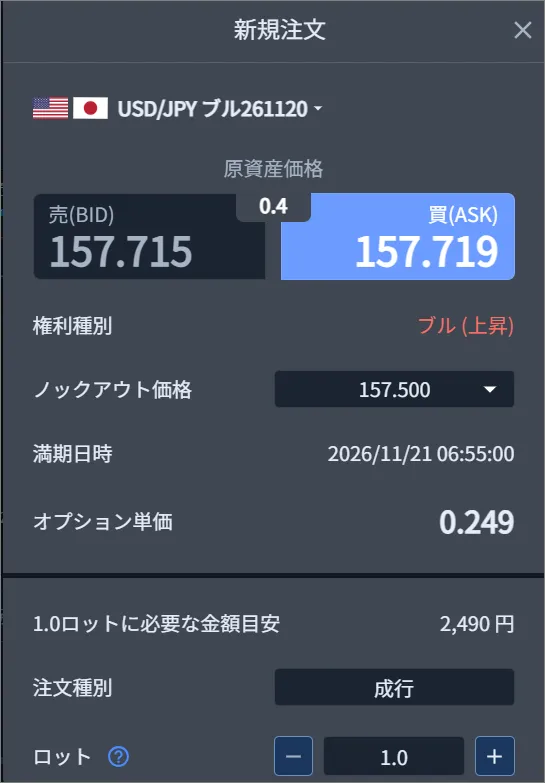
- Trading conditions:Bid 157.719 yen / KO price 157.500 yen (width 21.9 pips) / option price 0.249
- Notional value (1.0 lot = 10,000 units):157.719 yen × 10,000 =1,577,190 yen (about 1.577 million yen)
- Required funds and effective leverage:2,490 yen(Effective leverage ≈ 633x= 1,577,190 yen ÷ 2,490 yen)
- Comparison with domestic standard FX (25x):Holding the same amount (10,000 units) requires about 63,088 yen in margin. With KO options, you can hold the same 10,000 units with about 1/25 of that capital.
- Comparison with overseas FX (1 lot = 100,000 units):For the same quantity (10,000 units = overseas 0.1 lot), in overseas 500x accounts you need about 3,154 yen; in 1,000x accounts about 1,577 yen. If you hold a size equivalent to overseas 1.0 lot (100,000 units), it would be 10.0 lots on FXTF (24,900 yen), which is cheaper than overseas 500x (about 31,544 yen).
② Dominant volatility: GOLD (XAU/USD) 1.0 lot (1 oz) costs “2,292 yen” | Effective leverage about 276x
Next is gold (XAU/USD), which is extremely popular among overseas FX traders. FXTF GX allows trading 1.0 lot (1 troy ounce = 0.01 lot in overseas FX) from only a little over 2,000 yen.
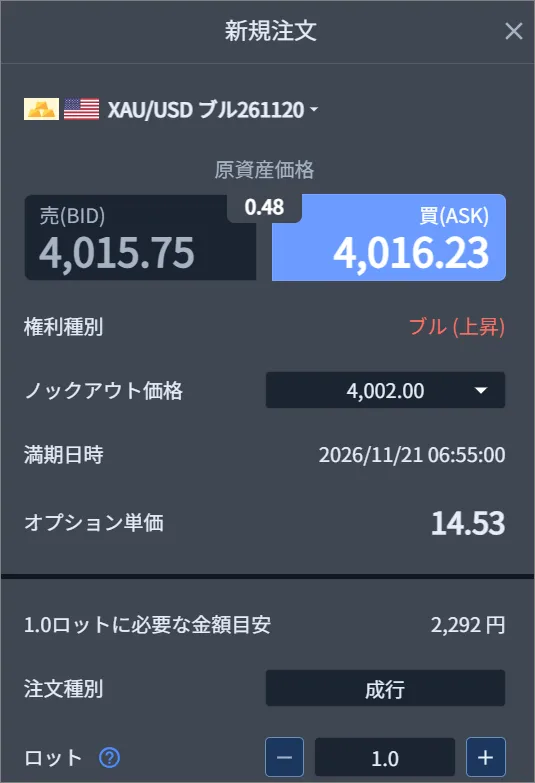
- Trading conditions:Bid 4,016.23 / KO price 4,002.00 (width 14.23 dollars = 142.3 pips) / option price 14.53
- Notional value (1.0 lot = 1 oz):$4,016.23 × approximate conversion rate of 157.74 yen ≈約633,531 yen (about 634,000 yen)
- Required funds and effective leverage:2,292 yen(≈276x= 633,531 yen ÷ 2,292 yen)
- Comparison with domestic commodity CFDs (20x):Holding the same quantity (1 oz) requires about 31,677 yen (about 3.2 ten thousand yen) in margin. With KO options, you can hold the same size position with about 1/14 of that capital.
- Comparison with overseas FX (1 lot = 100 oz):For the same quantity (1 oz = overseas 0.01 lot), overseas 500x accounts require about 1,267 yen; 1,000x accounts about 634 yen. If you hold overseas 1.0 lot (100 oz), FXTF would require 100 lots (229,200 yen).
③ 24/7 Cryptocurrencies: BTC/USD 0.01 lot (0.01 BTC) costs “2,834 yen” | Effective leverage about 44.5x
Another noteworthy highlight is the KO option on crypto assets (Bitcoin). Japanese crypto exchanges cap leverage at 2x, but KO options let you freely employ short strategies (bear positions) from small amounts (BTC/USD is 1.0 lot = 1 BTC for both domestic and overseas).
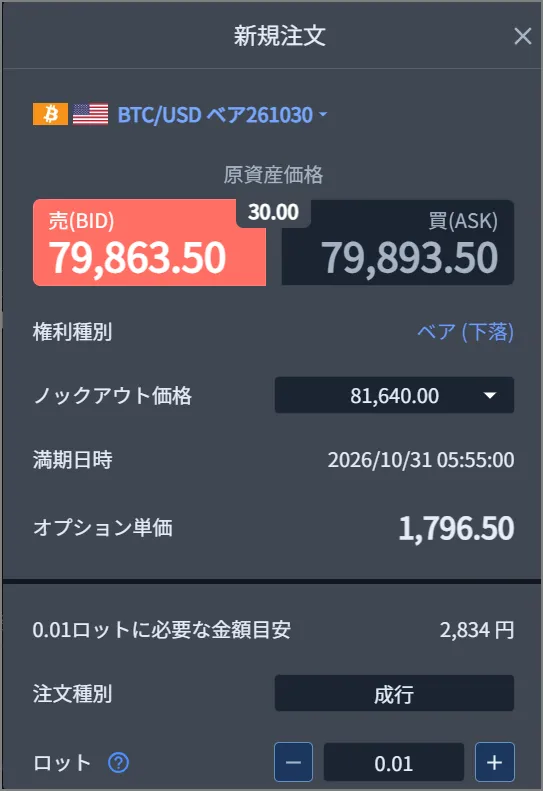
- Trading conditions:Bid 79,863.50 / KO price 81,640.00 (bear/decline forecast) / option price 1,796.50
- Notional value (0.01 lot = 0.01 BTC):$798.64 × approximate conversion rate of 157.75 yen =約125,986 yen (about 126,000 yen)
- Required funds and effective leverage:2,834 yen(≈44.5x= 125,986 yen ÷ 2,834 yen)
- Comparison with domestic crypto exchanges (2x):Holding the same quantity (0.01 BTC) requires about 62,993 yen (about 6.3 ten thousand yen) in margin. With KO options, you can trade the same size with about 1/22 of that capital.
4. The decisive differences among overseas FX, domestic standard FX, and domestic KO options
In addition to the ability to aim with a small amount and high leverage, the decisive differences for a trader who wants to preserve long-term wealth lie in“taxes” and “fund safety”. Let’s compare the three trading environments side by side.
| Comparison items | Domestic KO options (FXTF GX, etc.) |
Overseas FX (high-leverage brokers) |
Standard domestic FX / CFDs |
|---|---|---|---|
| Capital efficiency (effective leverage) |
◎ Extremely high (FX ≈ 633x / Gold ≈ 276x) |
◎ High (500–1,000x) |
△ Low (FX 25x / Commodities 20x) |
| Variation risk / margin calls | ◎ None (losses fully limited) | ○ Generally none (zero-cut) | × Present (margin calls on sudden moves) |
| Taxation | ◎ Separate tax filing Flat 20.315% |
× Comprehensive taxation Up to 55% (progressive tax) |
◎ Separate tax filing Flat 20.315% |
| Loss carryforward | ◎ Carried forward 3 years | × Not allowed | ◎ Carried forward 3 years |
| Asset protection / withdrawal safety |
◎ Financial Services Agency registered / fully trust safeguarded | △ Broker risk / withdrawal restrictions | ◎ Financial Services Agency registered / fully trust safeguarded |
What stands out is the“drastic difference in tax rates”. If overseas FX earns 10 million yen in a year, taxes can swell to around 3–4 million yen or more due to comprehensive taxation when combined with salary income, but with domestic KO options you paya flat 20.315% (about 2.03 million yen). The cash left in hand can differ by more than a million yen per year in some cases.
5. Three iron rules for KO options: knockout width and lot management to avoid failures with high leverage
KO options offer extremely high capital efficiency, but many lose by not fully leveraging this strength, common in the mistake“trying to lower the option price by pushing the knockout price too close to the current price”.
In particular, with volatile assets like Gold (XAU/USD), even a few dollars (tens of pips) of noise can touch the knockout price in an instant, causing a full loss despite correct directional bias. To prevent this, adhere strictly to the following three rules.
6. Conclusion: Move toward a new era of trading with small capital and domestic reliability
In this article, we explained how domestic KO options (FXTF GX) can be a superior alternative to overseas FX high leverage, supported by actual screen data and trading unit comparisons.
- USD/JPY (2,490 yen; about 633x leverage), GOLD (2,292 yen; about 276x), BTC (2,834 yen; about 44.5x); all three major assets can be traded from about 2,000 yen
- Because the maximum loss is determined at order time, there is zero risk of margin calls (no debt) even in sudden market moves
- With Financial Services Agency registered trust safeguards and separate taxation (20.315%), your post-tax funds remain significantly higher
Automatically visualize where to place the KO price and profit targets
'KO Soulja'to take your next step
“I understand KO options’ advantages, but calculating an appropriate knockout price and take-profit (TP) line for each actual market in real time is difficult…”
To solve this, we developed a dedicated MT5 tool optimized for GOLD (XAUUSD) 5-minute day trading in domestic KO options‘KO Soulja’.
▼ ‘KO Soulja’ strongly supports your KO trading
- Automatically draw TP / KO / TRAIL lines:Eliminate entry hesitation, protect capital, and optimize profit
- Two-step smart alerts (STANDBY → ENTRY):Prepare and place orders without staring at charts
- Volatility danger zone alerts & real-time settlement guidance:Help avoid reckless entries and lock in profits
- Beginner-friendly KO option攻略指南 & demo usage manual bonus:Practice risk-free even for beginners
Note: The trading screens and verification values shown are based on historical data and do not guarantee future profits. Please try the virtual demo account to get the feel. For pre-implementation questions, feel free to reach out via the product page message!