
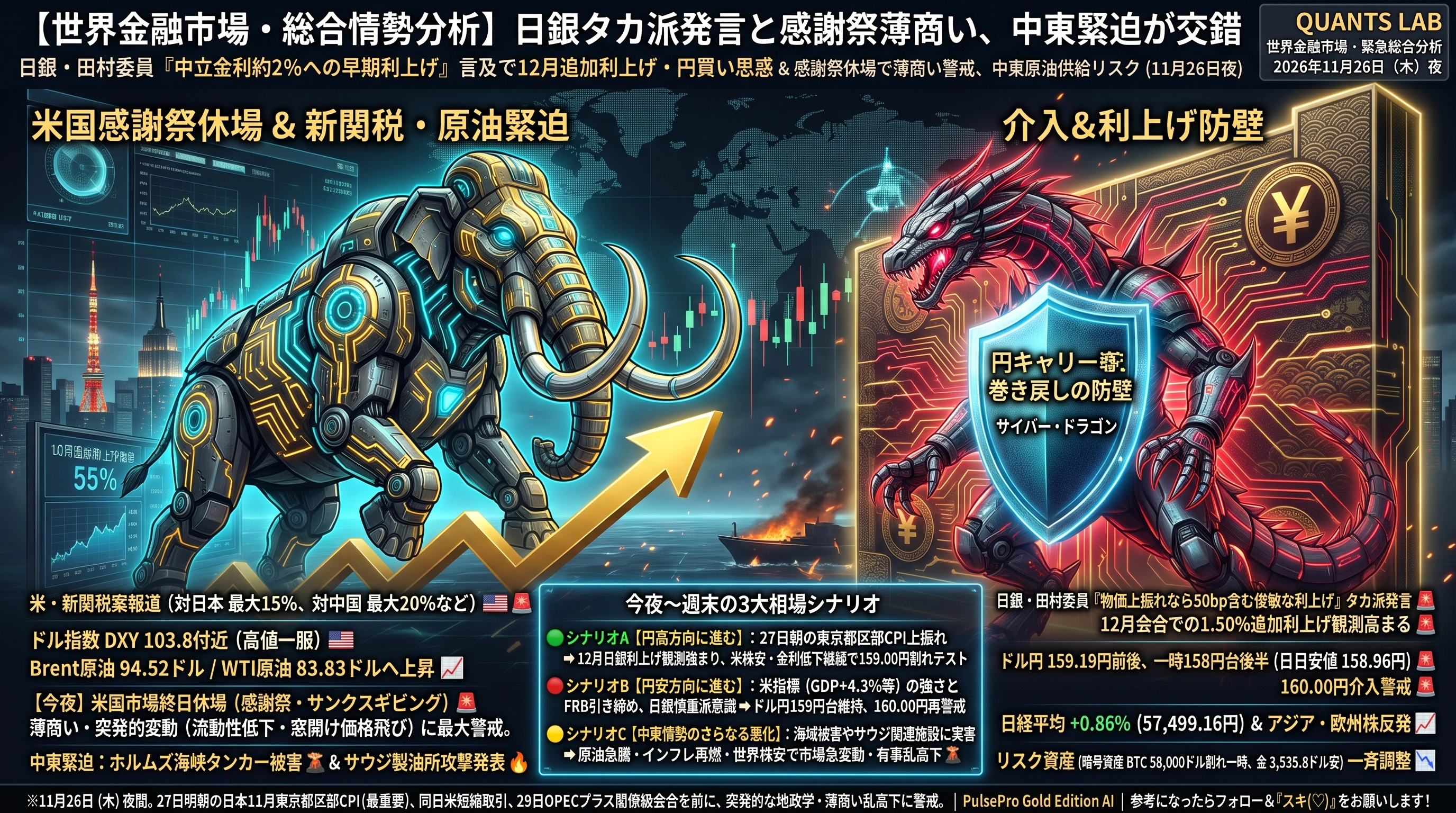
【Global Market, Forex, and Geopolitics Comprehensive Analysis】Bank of Japan's Tamura member says “Neutral rate around 2%, rate hike pace could accelerate” and the dollar/yen battle around the 159 yen front amid Thanksgiving market lull; reports of tanker
As of around 8 p.m. Japan time on November 26, 2026 (Thursday), forex and financial markets worldwide are facing a confluence of several important factors: hawkish signals in Japan’s monetary policy, liquidity drying up in U.S. markets due to Thanksgiving, and geopolitical risk in the Middle East.
Today (November 26, 2026), the market’s biggest themes are the following five points.
Hawkish remarks by Bank of Japan Governor nominee Tamura:He estimated the neutral rate at about 2%, and noted that if inflation risks push prices higher, the pace of hikes could accelerate (including a 50bp move). Attention toward the December 17–18 BOJ meeting has intensified.
U.S. Thanksgiving holiday:Today the U.S. stock and bond markets are closed, and liquidity is markedly lower than usual. In thin trading, sudden moves (widening spreads and price gaps) require vigilance.
Concerns about worsening Middle East tensions:Oil prices are being pushed higher amid reports of tanker mines in the Hormuz Strait and Yemen's Houthi attacks on Saudi Arabia’s Ras Tanura refinery.
Volatility in AI and semiconductor stocks:Despite a rebound in Asia and Europe after U.S. tech shares fell yesterday, concerns about AI investment profitability and credit ratings remain persistent.
New U.S. tariff proposals:Reports on new tariff plans affecting 14 countries/regions, including Japan (up to 15%) and China (up to 20%), could influence future stock, trade, and inflation outlooks.
In particular, tonight the U.S. market is closed, so normal U.S. trading flows cannot clearly indicate a direction. This article will, based on 8 p.m. Japan time on November 26, 2026, separate confirmed primary information/report data from unconfirmed information and conditional scenarios for detailed analysis.
Chapter 1: Foreign exchange market — Tamura’s hawkish remarks and
low-volume trading in USD/JPY in the 159 range
Today’s FX market saw a mix of yen-buying triggered by Tamura’s remarks and a cautious stance ahead of the U.S. market holiday.
【Tokyo market on November 26 — Confirmed exchange rates (not the real-time price at 20:00)]
・USD/JPY:
159.17–159.18 at 14:00 / 159.19 at 15:43
Morning moves: yen briefly strengthened toward around 158.96
・EUR/JPY: 174.66 (NY close on 25th)
・AUD/JPY: 105.57 (as of 26th 15:43)
1. USD/JPY dynamics and monitoring levels
Yesterday’s decline in U.S. long-term yields supported yen buying and dollar selling, but active trading ahead of the U.S. holiday was restrained. The hawkish Tamura acknowledged that policy rates might need to be raised more quickly to prevent inflation from overshooting 2%, including potential 50bp hikes if inflation risks intensify, and that a path of 25bp hikes every few months remains the baseline.
This is clearly a yen-supporting development, but declaring an immediate reversal into a new yen-strengthening trend would be premature; it is essential to watch U.S. rates and the actual BoJ decision.
【Monitoring levels for USD/JPY (not definitive supports/resistances, but trading scenario guidelines)】
★ 160.00: psychological absolute level; line of caution for government and Finance Ministry intervention
★ 159.50: line to test the recent upper range
――――――
15:43 confirm rate: 159.19 (morning low around 158.96)
――――――
★ 159.00: near-term battle line
★ 158.50: confirm whether the move toward yen strength continues
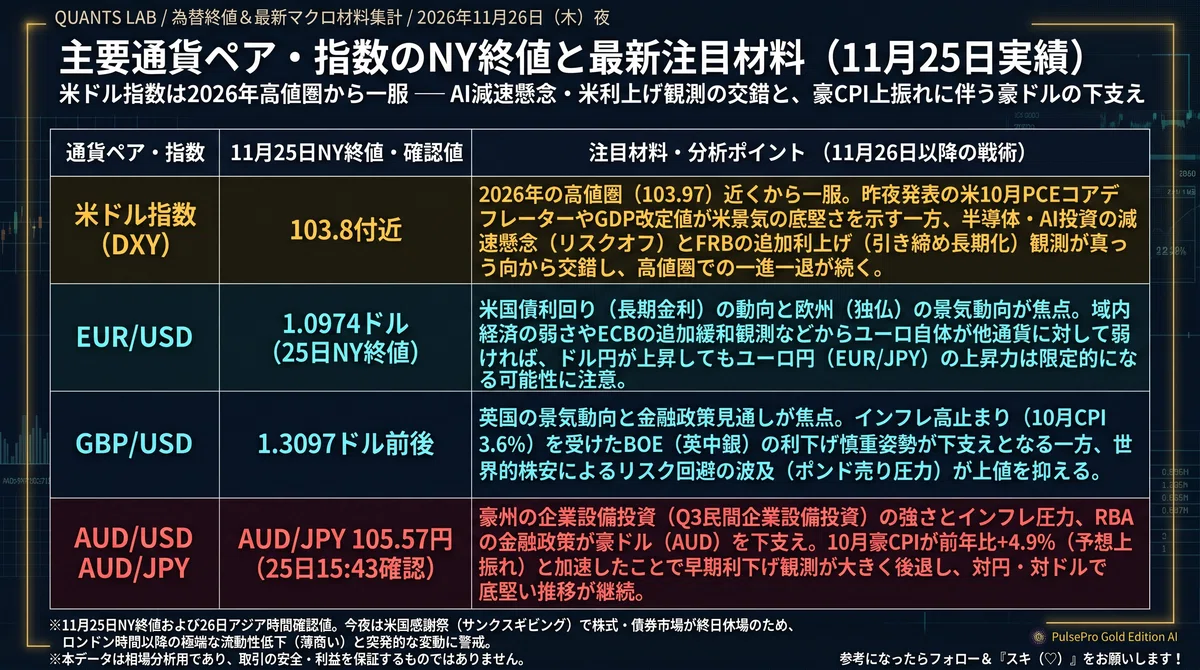
2. Cross yen and dollar indices status (DXY around 103.8 pulling back)
Chapter 2: Domestic Japan — Tamura’s hawkish view and Nikkei and JGB market
1. Core of Tamura’s remarks (Yamanashi Prefecture Financial and Economic Liaison Council)
Key points from Tamura’s speech in Kofu on November 26 (as reported by Reuters and others):
Rising prices for crude oil and other inputs are spreading to a broad range of goods.
Import costs are rising due to yen depreciation, and robust AI-related demand adds inflation pressure.
Regarding inflation risks, the pace of hikes should be accelerated if needed.
Current policy rate (assumed 1.25%) remains accommodative; rates should be raised toward the neutral level (around 2%) sooner rather than later.
Regarding the period to evaluate the impact of rate hikes, he mentioned, “it can be possible to judge within about three months” (suggesting a decision scope at the December 17–18 meeting).
Market implication:While markets price in a 1.50% hike at the December meeting, this is market consensus and should be distinguished from the policy committee’s actual decision. For the yen, factors include not only expectations of BoJ rate hikes (yen buying) but also higher oil costs raising Japan’s import burden (yen selling) and expectations of U.S. rate hikes supporting the dollar; thus, a one-way yen-strength trend is unlikely.
2. Japanese equities (Nikkei 57,499) and Japanese government bonds’ reactions
【November 26 Tokyo market: stock and JGB confirmation values】
・Nikkei Stock Average: 57,499.16, up 487.54 points or +0.86%
・TOPIX: 3,750.40, +4.20
・New 10-year JGB yield: 2.630–2.635% (down vs. previous)
・December JGB futures: 128.24
Nikkei briefly rose over 2% in morning as AI/semiconductor stocks were bought on dips, but fell back in the afternoon ahead of the U.S. market holiday. In the bond market, long-term yields fell following the BoJ’s government bond purchases (surplus bids for 10–25 years remain modestly weighted), and Tamura’s hawkish remarks elicited a limited reaction from long-dated bonds.
Chapter 3: U.S. economy, Fed monetary policy, and the “14-country additional tariff plan”
1. U.S. economic indicators announced on November 25: strong growth, employment, and sticky core PCE
Late November 25 (U.S. time) statistics underscored the economy’s resilience and persistent inflation.
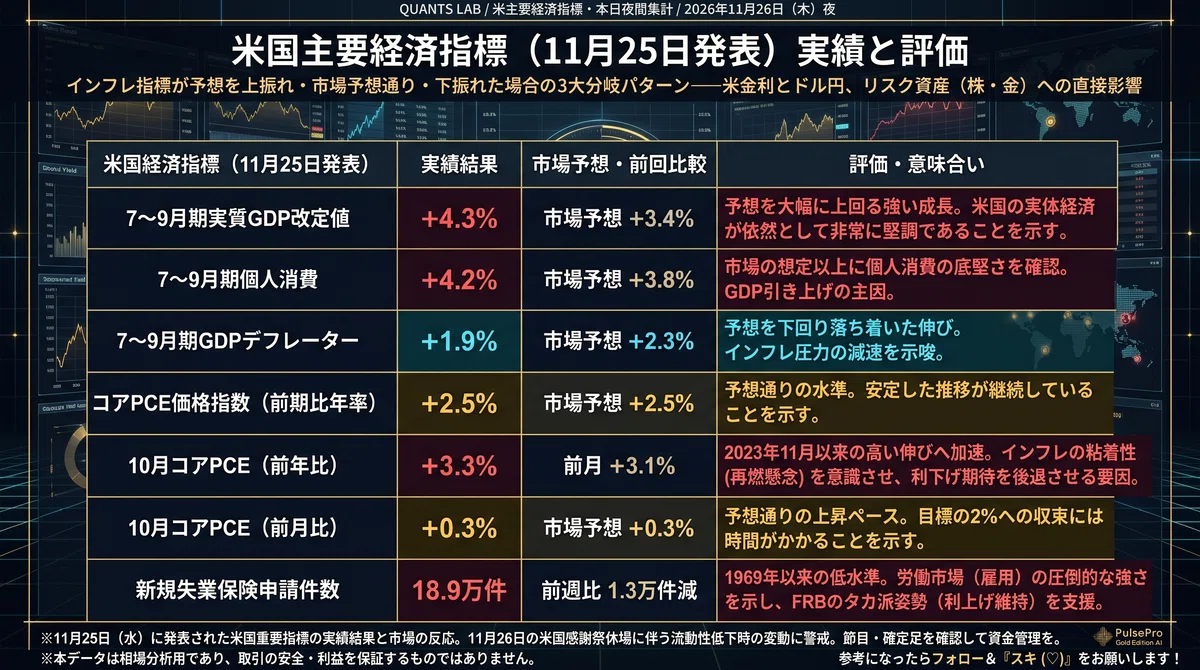
Strong core inflation (YoY 3.3%) and upward revisions to GDP, along with historically low unemployment claims, have heightened expectations for a 25bp hike in December and possible additional hikes in early 2027 according to Reuters coverage on November 26.The market is pricing in December’s 25bp hike and potential early-2027 hikes. If AI investment slows, growth and earnings could face downward pressure, forcing the Fed to balance inflation control with economic considerations.
2. U.S. tariff proposal (Japan up to 15%, China up to 20%)
The U.S. reportedly announced a new tariff plan targeting 14 countries/regions, with Japan up to 15% and China up to 20%. The key is to distinguish clearly between “the published plan” and “tariffs that actually take effect.”Precise confirmation is needed on items, conditions, timing, and overlap with existing tariffs, but if realized, it would have major implications for Japan’s auto, machinery, and electronics exports and for U.S. import prices and inflation outlook..
Chapter 4: Global stock markets, AI semiconductors ratings, and
Middle East Hormuz Strait and oil market
1. Stock movements in the U.S., Europe, and NVIDIA rating review reports
U.S. equities on November 25 diverged by index (Dow +164.25 to 50,182.95; Nasdaq -147.74 to 23,585.80; S&P -18.31 to 7,182.78). Reuters reported that S&P might downgrade NVIDIA’s credit rating amid concerns about governance and oversight.
Meanwhile, Asian and European markets on November 26 recovered ahead of the U.S. holiday (Nikkei +0.9%; TAIEX +2.5%; Hang Seng +1.2%; KOSPI +0.3%; DAX +1.8%; CAC 40 +1.6%; FTSE 100 +1.3%), though stock price rebounds and AI sector fundamentals are separate issues; earnings and capex plans will continue to be scrutinized.
2. Reports of tanker mine damage in the Hormuz Strait and Saudi Ras Tanura refinery attack; oil market
From November 25 to 26, Middle East energy-supply risks have risen again.
Reports of tanker damage in the Hormuz Strait:Iranian media reported two ships were struck by mines and exploded; Iranian military statements also described one vessel hit and on fire in restricted waters (note: verification from independent sources is needed; no confirmation of a complete blockade of the strait).
Houthi attack on Ras Tanura refinery in Saudi Arabia announced:The Houthis claimed an attack on the refinery on the 25th (note: actual facility damage or operations disruption may differ; currently no confirmed supply reductions).
Oil prices (as of 07:58 GMT on Nov 26, Reuters): Brent at $94.52, WTI at $83.83. After significant gains the day before, prices have been relatively subdued. U.S. EIA data for the week ending Nov 20 showed crude stocks up 1.1 million barrels (vs. expectations of +1.5 million).
The complex relationship between oil and the yen:Because Japan is heavily dependent on energy imports, a prolonged rise in oil prices could worsen the trade balance and exert yen selling pressure, while domestic price increases may also strengthen BoJ rate-hike expectations, which could support the yen in other ways. The weekend’s OPEC+ meeting (Nov 29) and potential calls for raising capacity in Iraq and Kazakhstan require close watching.
Chapter 5: Gold (XAU/USD), Bitcoin (BTC), and cross-currency overview
Gold (XAU/USD):From market data through the previous day, December gold futures were at$3,535.8 per ounce (down $26.1). With strong U.S. GDP and core PCE suggesting extended rate hikes and a stronger dollar as a headwind, and Middle East tensions driving safe-haven demand (a potential rise), geopolitical risk and U.S. real interest rates should be prioritized in assessment.
Bitcoin (BTC):Sank briefly below $58,000 around November 25 U.S. data release, with domestic exchanges reporting around 9.2 million yen. AI-related stress on valuations, Nasdaq correlation, DXY, U.S. rates, and ETF flows are focal points.
Comprehensive summary by major currency pairs and markets
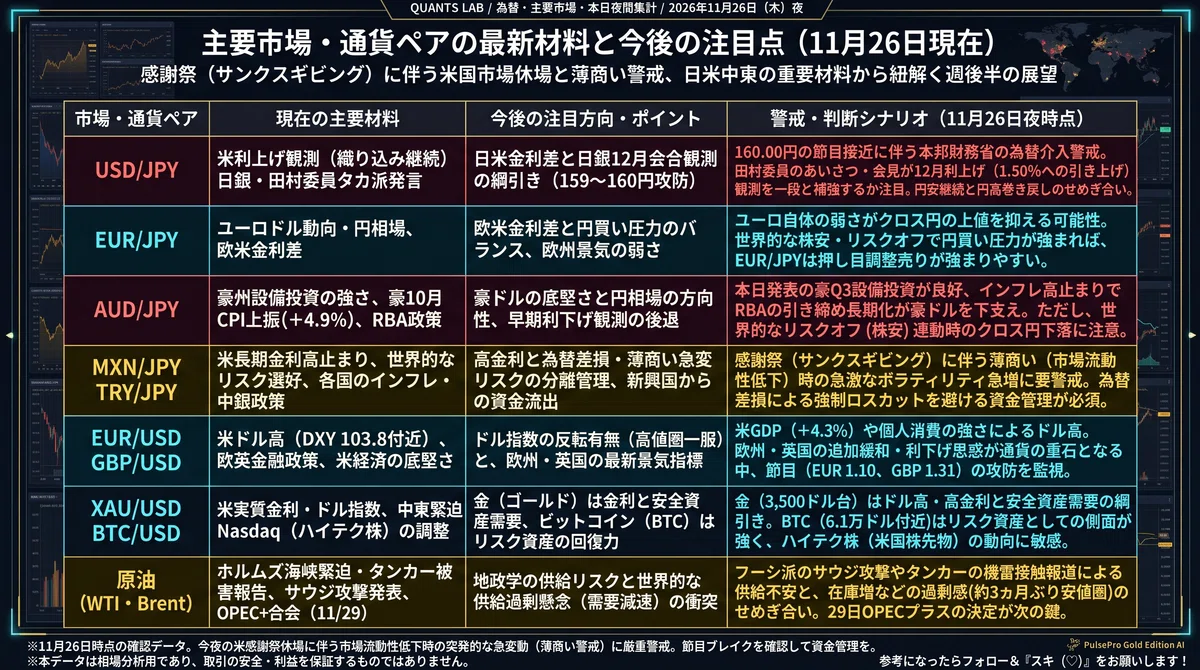
Chapter 6: Upcoming key events and three market scenarios
Upcoming important schedule (Japan time)
11/26 (Thu) all day: U.S. Thanksgiving (U.S. stock and bond markets closed; liquidity warning)
11/27 (Fri) 08:30: Japan November Tokyo Metropolitan Area CPI???? (Key input for BoJ December policy decision)
11/27 (Fri) Japan-China: U.S. stock market with shortened hours (thin trading; weekend adjustment caution)
11/29 (Sun): OPEC+ ministerial meeting???? (discussions on 2027 production policy)
Early December:U.S. congressional hearings on NVIDIA (AI and semiconductor governance, export controls)
12/17 (Thu)–12/18 (Fri): BOJ Monetary Policy Meeting????? (Primary focus on whether rates rise to 1.50%)
Three main market scenarios with conditional structure
? Scenario A [yen strengthens]:
Conditions: BoJ rate-hike expectations strengthen further (Tokyo CPI on the morning of 8:30 shows higher readings), U.S. rate declines continue along with AI stock weakness, and USD/JPY decisively breaks below 159.00.
? Scenario B [yen weakens]:
Conditions: Strong U.S. data and Fed rate-hike expectations push U.S. rates higher again, with BoJ hikes not expected to occur as quickly as market had anticipated.
? Scenario C [Middle East tensions cause market turmoil]:
Conditions: Increasing shipping disruptions in Hormuz and confirmed damage to Saudi export facilities cause oil to surge and global equities to fall.
Overall conclusion: Prepare for surprise headlines in thin trading
“Seven monitoring orders”
The current market is not a simple one-way trend; it reflects both expectations of additional U.S. rate hikes and BoJ rate hikes. At around the 159-yen level for USD/JPY, strong U.S. data supports the dollar, while hawkish signals from Tamura and intervention risk near 160 could support the yen.
For future market analysis, a suggested sequence to monitor correlations is as follows:
U.S. 10-year and 2-year yields(direction after holidays)
U.S. Dollar Index (DXY)(whether it reverses from around 103.8 or resumes rising)
USD/JPY and cross-yen pairs(reaction to Tokyo CPI at 8:30 tomorrow)
Brent and WTI crude oil(movements around the 94 and 83 dollar levels)
Actual shipping status through Hormuz Strait(verify actual conditions, not statements)
Nasdaq and SOX indices(AI and semiconductor stock stability)
Gold and BTC(barometer of real interest rates and risk appetite)
Until the end of this week, low liquidity due to U.S. Thanksgiving and unexpected headlines from the Middle East are likely to coincide. Practice disciplined risk management that accounts for spread widening, gap openings, and price gaps in addition to standard technical analysis.
Note on information accuracy
This article compiles publicly available data and reports confirmed up to around 8 p.m. Japan time on November 26, 2026. Price information reflects different markets’ confirmation times and does not guarantee coverage of all 20:00 real-time prices. Unconfirmed values are not backfilled as current values.
If you found this helpful at all, please follow and press the heart at the bottom of the screen to encourage updates!

“TrendPulse Pro” free trial:https://www.gogojungle.co.jp/tools/indicators/86532?via=users
“TrendPulse Pro AI” free trial:https://www.gogojungle.co.jp/tools/indicators/86529?via=users
“QuickScalp AI” free trial:https://www.gogojungle.co.jp/tools/indicators/86523?via=users
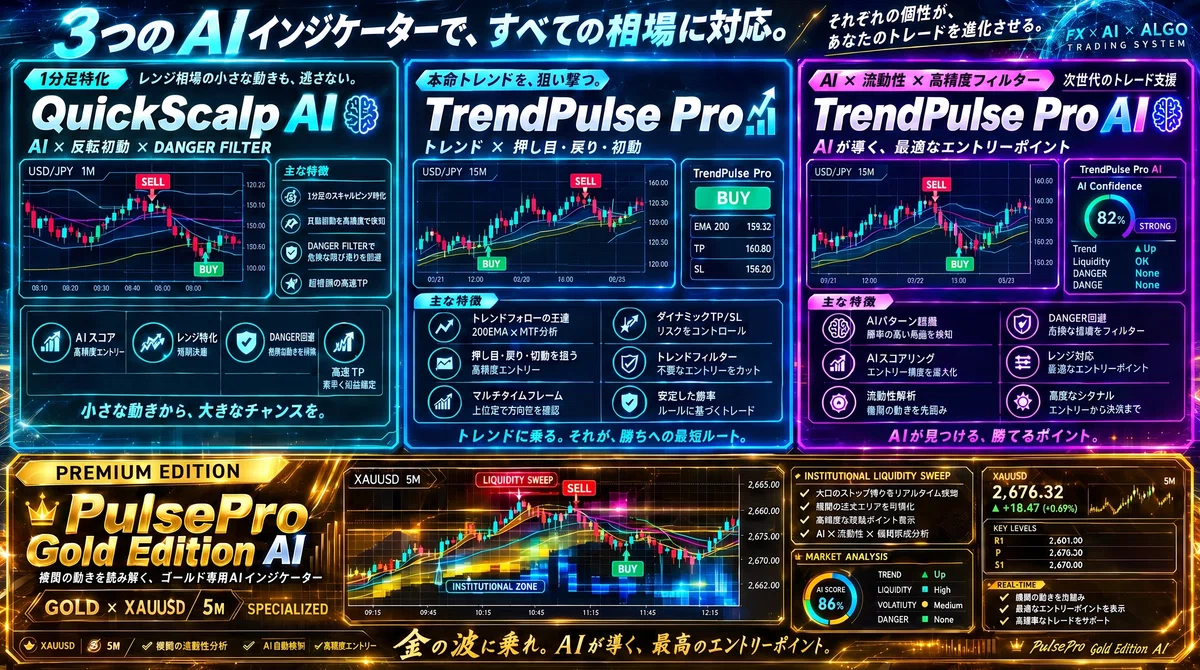
An indicator that removes emotions and captures market moves with clear justification and rules.
Details of functions and design logic are published on each product page
? [GogoJungle product page]