
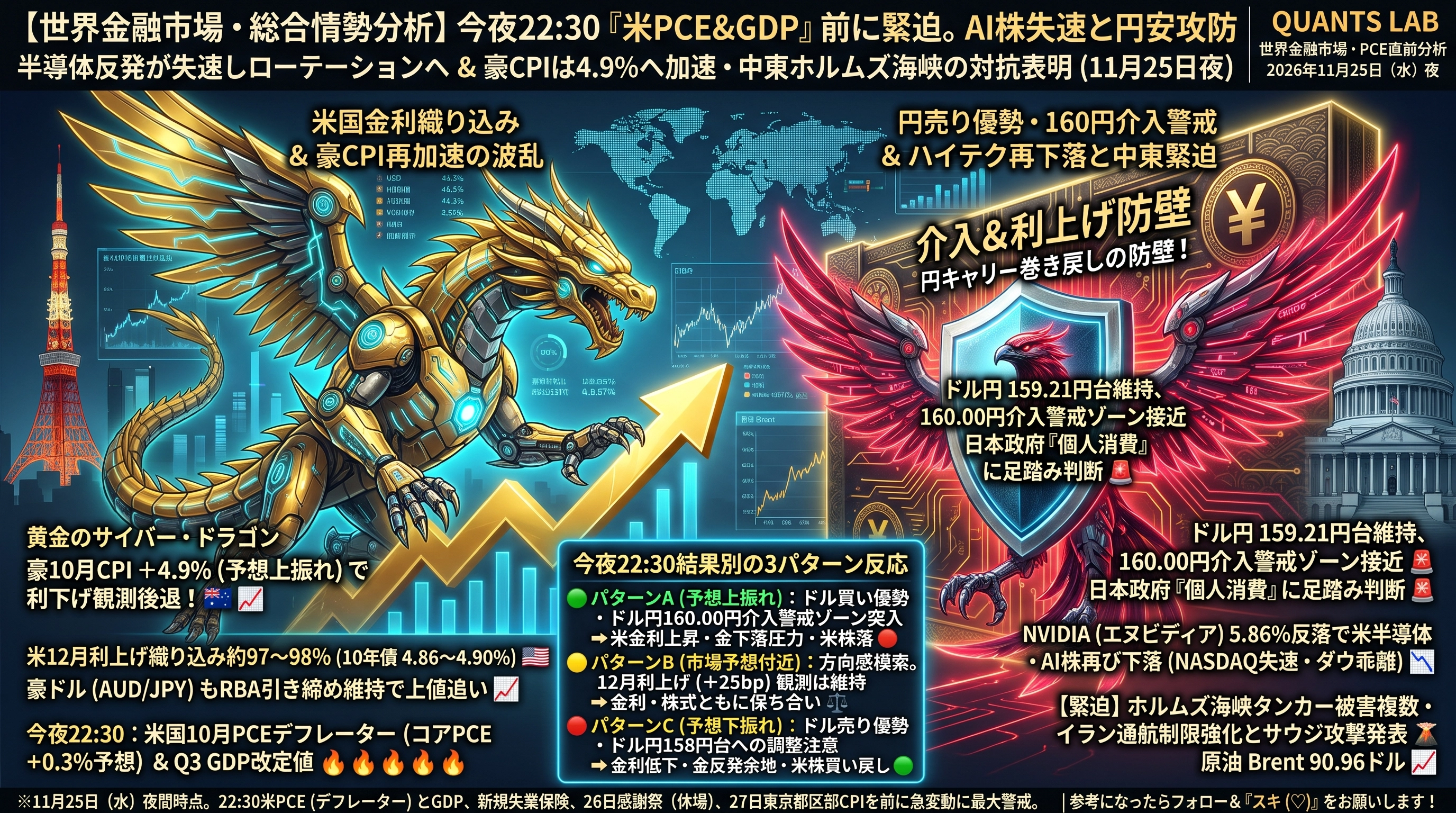
[Global Financial Markets & Currency Comprehensive Analysis] NVIDIA Rebound Stalls, Semiconductor Stocks Decline Again & Dow Jones Upswing Amid Inter-Index Divergence — USD/JPY at 159.21 (near 160), Australia CPI Surges 4.9%, Strait of Hormuz Tense, Tonig
On the night of Wednesday, November 25, 2026, global financial markets have shifted from the previous day's sharp rebound to an unsettled tone again, with selling returning in semiconductor and AI-related stocks.
Meanwhile, in the foreign exchange marketUSD/JPY remains in the 159 yen areaas pressures build ahead of the release scheduled for 22:30 tonightof the US October PCE deflator and Q3 GDP revision. Tensions are rising in the Middle East over the Strait of Hormuz, with Iran signaling tighter navigation restrictions for tankers, keeping geopolitical risks smoldering.
Today’s major points to watch in the 20:00 hour (Japan time, 기준 20:07) in the market are seven in number.
US stock rebound stalls, again dragging down semiconductor and AI-related stocks(NASDAQ and S&P 500 decline while the Dow Jones industrial average diverges higher).
USD/JPY remains in the 159 handle, with the risk of a move toward 160 and ongoing intervention vigilance.
Australia's October CPI exceeds market expectations (year over year 4.9%), influencing the RBA’s policy outlook.
Ahead of tonight’s 22:30 US PCE release, the market continues to price in a December rate hike by the Fed (approximately 97–98% probability).
New tanker damages (mine contact and fire reports) and navigation restrictions in the Hormuz Strait emerge.
Oil prices are being pulled by a tug-of-war between global supply concerns and Middle East geopolitical risk.
The government of Japan’s downward revision of personal consumption and the Bank of Japan’s December policy decision dilemma.
Furthermore, this article is based on the time point of20:07 Japan time on November 25, and the 22:30 releases such as the US PCE and GDP are treated as market forecasts, not confirmed facts. We will clearly separate confirmed facts from conditional scenarios and explain in detail.
Chapter 1: Global financial markets — latest status and
Meaning of “inter-index divergence”
The Asia market on November 24 rose sharply across the board on the back of the US stock surge, but later the US market saw renewed selling in semiconductor and AI-related stocks.
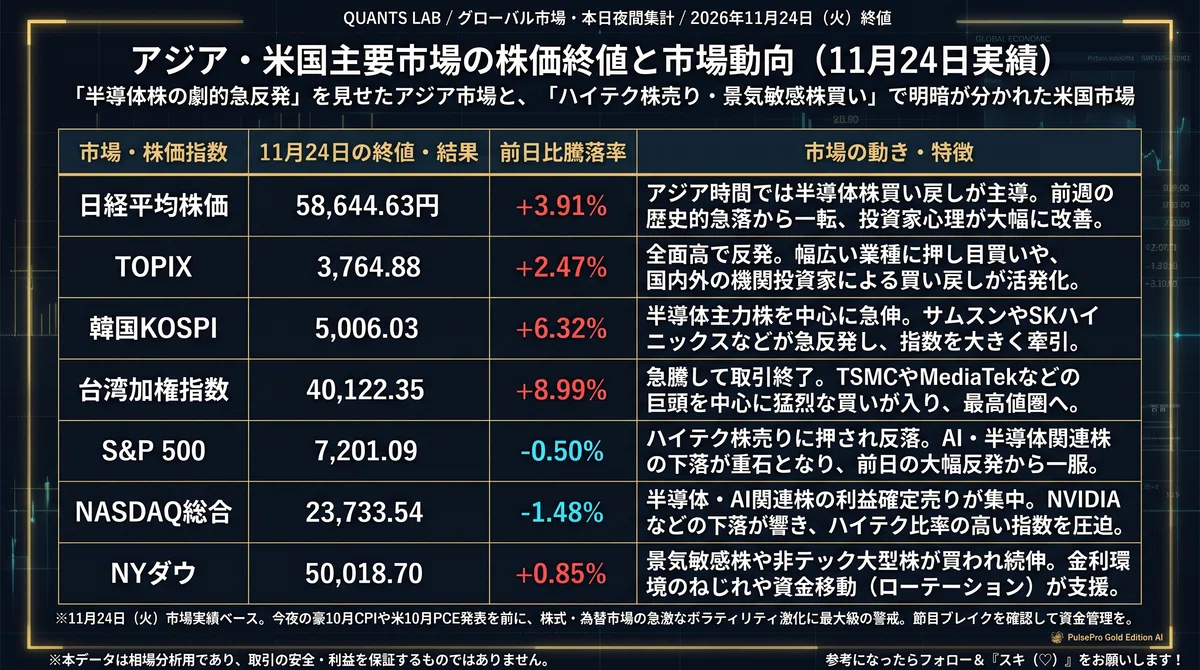
Important change: NASDAQ decline vs NY Dow rise — fund rotation
The sharp rebound on November 23 did not lead to a broad rally on the 24th. While NASDAQ and S&P 500 fell, the Dow rose, suggesting funds are rotating from high-tech/AI stocks to cyclicals and other large-cap stocks.
In particular, on November 23,NVIDIA stock surged, then fell about 5.86% on the 24th. The news of CEO return alone wasn’t enough to sustain buying, and the market remains focused on
① profitability of AI equipment investments,
② payback period for data center investments,
③ US export controls,
④ overvalued valuations. Tonight onward, investors should watch for profit-taking in semiconductor stocks such as NVIDIA, TSMC, Samsung Electronics, SK Hynix, and in Japanese players like Tokyo Electron and Advantest.
Chapter 2: Foreign exchange market analysis (USD/JPY 159.21; cross yen and dollar/yen)
The Bank of Japan’s foreign exchange market status as of 17:00 today (November 25) is as follows (note: differentiated from real-time quotes in the 20:00 hour).
【November 25 BOJ release — Foreign exchange market (17:00 JST)】
・USD/JPY: 159.21–159.23
(09:00 level: 159.25–159.27)
└ Tokyo range for the day: high 159.49 / low 159.00 / midpoint 159.34 • EUR/USD: 1.0934–1.0935
・EUR/JPY: 174.09–174.13
1. Monitoring levels for USD/JPY and tonight’s focus
USD/JPY remains in the 159 handle, but it is somewhat heavier than the around 159.50 at 19:00 yesterday. The pace of a December rate hike by the US supports the pair, while lower US Treasury yields, BOJ rate hike expectations, caution around 160, and semiconductor stock declines all cap upside.
【Monitoring levels for USD/JPY (for analysis)】
(Note: not a guarantee of current value)
★ 160.00: psychological absolute threshold — MOF FX intervention warning line
★ 159.50: latest upper level reference (today’s high 159.49)
―――――― 17:00 BOJ rate: 159.21–159.23―――――
★ 159.00: today’s low — short-term battle line
★ 158.50: watch next level if break below 159
★ 158.00: psychological threshold
2. Cross currencies and high-yield currencies (MXN/JPY, TRY/JPY) notes
EUR/JPY trades in the 174 yen range. Meanwhile, high-yield currencies (MXN/JPY, TRY/JPY) are sensitive to US monetary policy and global risk appetite. In phases of renewed semiconductor stock declines, risk appetite tends to wane, so manage MXN/JPY and TRY/JPY with attention to not only swap income but also FX losses and margin capacity.
Chapter 3: AUD October CPI acceleration and the RBA
• The course of the AUD
Today, November 25, Australia’s October CPI exceeded market expectations, showing faster inflation.
【Australia October 2026 CPI Realization】
・CPI (YoY): +4.9% (previous +4.3% / above market)
・CPI (MoM): +0.5% • Trimmed mean (YoY): +3.8% (previous +3.6%)
・Trimmed mean (MoM): +0.5%
The trimmed mean, excluding volatile food and energy, rose to 3.8%, indicating underlying price pressures that cannot be explained by a temporary oil rise alone. The RBA has raised rates by a total of 125bp in 2026, but with unemployment rising to 4.9% in September, it faces a difficult balance between inflation and employment. According to Reuters, the market’s expectations for rate cuts receded in light of this result.
The Australian dollar briefly rose to around0.6650 on the releasebefore pulling back.
(Note: another market analysis reported a 11-month low of 0.6559, but the time difference around the release prevents exact contemporaneous comparison.)
Going forward,AUD/USD staying above 0.66 and the AUD/JPY movement in conjunction with tonight’s US PCE reaction will be key.
Chapter 4: US Treasuries and Japanese Government Bonds (40-year JGB auction)
・European bonds movement
1. US Treasuries: risk-off bond buying and “Fed December hike 97–98% priced in”
In the US Treasuries market on November 25, amid risk-off from AI stock declines and position adjustments ahead of PCE release, US 10-year yield briefly fell to 4.861% (about 7bp lower than the previous day).
【US Treasuries and European yields as of Nov 25】
・US 2-year yield: 4.66–4.69%
・US 10-year yield: 4.86–4.90% (briefly at 4.861%)
・US 30-year yield: low 5% area
・Germany 10-year yield: around 3.235% (near two-week low)
However, the futures market is pricing in about a 97–98% chance of a 25bp rate hike at the December FOMC (note: market expectations, not a confirmed policy), so it would be premature to conclude that rate hike expectations have vanished merely from a decline in long-term yields.
2. Japanese Government Bonds (JGB): results of today’s 40-year issue auction
Today, November 25, the Ministry of Finance announced the auction results for the ultra-long 40-year bonds (source: MOF, November 25, 2026, 40-year bond auction results).
【November 25 MOF 40-year JGB Auction Results】
・Bid amount: 786.5 billion yen
・Winning amount: 299.6 billion yen • Coupon: 3.8%
・Highest yield: 4.090%
Note that the end-of-day data from ADB shows Japan’s 2-year yield at 1.786%, 5-year at 2.130%, and 10-year at 2.732% (down about 6.8bp from the previous day). Japan’s rate trends must be viewed considering not only BoJ normalization expectations but also supply/demand for ultra-long bonds and fiscal policy assessments.
Chapter 5: Internal FRB views and
“US 16-nation tariff policy”
1. FRB internal debate on inflation drivers (Reuters, November 25)
Within the Fed there are two camps on the main causes of inflation.
Supply-side view (Bessenet Secretary of the Treasury and others):Tariffs under Trump and oil price increases from Middle East tensions are temporary supply constraints and will weaken over time.
Demand-side view (Waller and others):Emphasizes robust consumer spending, expansion of AI-related investment, stickiness of service prices, and rising inflation expectations; argues for stronger tightening (Waller suggested 50bp in December). Williams, President of the NY Fed, also indicated need for additional action on the 23rd.
2. Trump administration's plan to consider announcing tariffs on 16 trading partners
Reuters reported today that the Trump administration plans to consider and announce new tariffs targeting 16 major trading partners believed to have excess capacity (to replace existing tariffs that were blocked by the US Supreme Court). Tariffs would raise import prices and risk re-accelerating US inflation, so formal announcements of the covered countries, items and rates will be watched closely.
Chapter 6: Domestic Japan — downward revisions to consumer spending and the BOJ December meeting dilemma
The Cabinet Office’s November Monthly Economic Report released on November 24 kept a view of gradual overall economic recovery, but due to price increases squeezing consumer sentiment, personal consumption was downgraded to a “sluggish recovery.”Personal consumption has slowed despite improvements in equipment investment, exports, and production.
Ahead of the BOJ’s December policy meeting, situations include “imported price rises from a weaker yen and rising wages and service prices (a factor for hikes)”and,“sluggish consumer spending, Q3–Q4 GDP negative growth, and Middle East tensions (cautious factor)” are competing, so a rate hike is not yet confirmed. Also, while warnings about MOF statements in the 159 yen range persist, there is no information confirming actual intervention today.
Chapter 7: Middle East tensions (Hormuz Strait tanker incidents and Saudi attacks) and the oil market
1. Navigation restrictions in Hormuz and Saudi attack announcements
Two tankers hit by mines and set ablaze (Reuters, November 25):Iranian Revolutionary Guard Navy announced that two oil tankers attempting to sail through an unauthorized route in the Hormuz Strait were struck by mines, causing explosions and fires; they warned vessels not to pass without coordination. (On the 25th, a container ship halt was also announced). UKMTO also reported three vessels coming from the east were attacked by projectiles on the 24th. While announcements of attacks and full closure should be distinguished, shipper diversions and higher insurance premiums are effectively a supply risk.
Iran’s terms:Iran said that if the US would accept the lifting of naval blockades on Iranian ports and cessation of war on all fronts through Doha, they would reopen the strait within 48 hours; the US has not accepted.
Saudi attack announcement:Today, Yemen’s Houthi movement claimed to have attacked Saudi Arabia’s Ras Tanura refinery and Riyadh’s financial district (Reuters). The actual impact on refinery operations and supply remains unconfirmed.
2. Oil prices (Brent $90.96 / WTI $81.43) contradiction
According to Reuters at 10:35 GMT on November 25, Brent is at $90.96 and WTI at $81.43. This reflects global supply glut fears, rising US oil stock forecasts (API +126k barrels vs analysts +1.5 million), and restart of Libyan oil field pipelines. The contradiction is “supply-demand in oil low vs geopolitical risk high,” and news sensitivity is elevated ahead of the November 29 OPEC+ meeting (discussions on 2027 production plans). to be continued
Chapter 8: Gold ($3,500 defense) and BTC
• European and Chinese key mineral regulations
Gold (XAU/USD):In November 25 markets it sits in the 15-month low area, with the psychological threshold of $3,500 in sight (rebound targets around $3,550–$3,600–$3,650). Despite Hormuz Strait tension, the US dollar strength and Fed rate hike expectations (real rate rise concerns) are offsetting geopolitical risks, preventing a full rise.
Bitcoin (BTC/USD):Exact spot price and ETF flows around 20:00 are not confirmed, but as risk assets see capital outflows with AI stock declines, caution is needed regarding Nasdaq, DXY, and US rates correlations.
European stocks and Germany GDP:Nov 25 European stocks saw consumer-related and auto sectors rising with STOXX 600 up early by 0.5%, while tech stocks softened. Germany’s Q3–Q4 GDP avoided contraction, growing 0.1% quarter-on-quarter.
China’s key mineral export restrictions:On Nov 24, China extended the temporary suspension of export controls on gallium, germanium, and antimony to Jan 27, 2027 (export licenses and military exports remain prohibited).
Chapter 9: Tonight’s 22:30 US PCE and GDP — three pattern analyses and monitoring priority
At 22:30 local time tonight, BEA will release the most important inflation and growth indicators (not yet released as of 20:07).
【November 25 (Wed) 22:30 JST — Key US Indicators and Market Expectations】
・October PCE deflator (YoY): Market expectation +3.8%
・October Core PCE deflator (YoY): Market expectation +3.2%
・October Core PCE deflator (MoM): Market expectation +0.3%
・Q3 GDP revision / Personal income and consumption / Initial jobless claims
※Then,
11/26 (Thu) 04:00 FRB Beige Book → Thanksgiving Day holiday in the US on the same day →
11/27 (Fri) 08:30 Tokyo CPI and US short trading
Tonight’s US PCE: three pattern reactions and prioritization
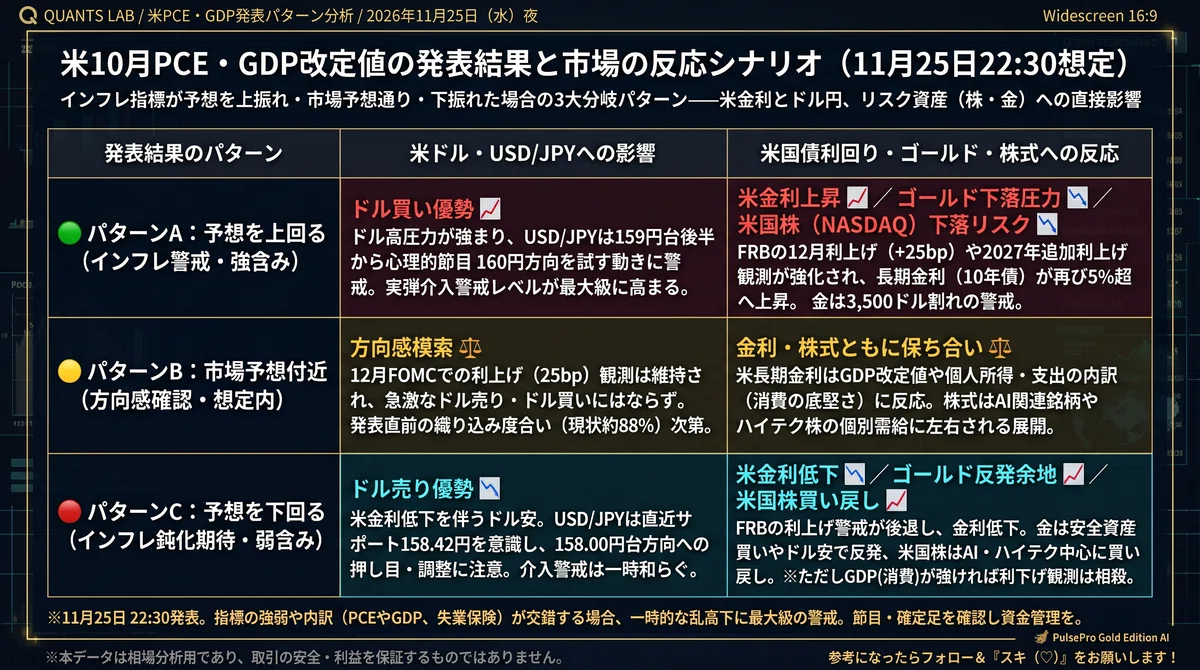
Overall conclusion: tonight’s monitoring sequence and
the “three-combination” approach
This market is not adequately understood by a simple one-dimensional view of “strong dollar, weak yen.” Pay attention to the following three combinations.Three combinations:
“US stock prices fall + US Treasury yields fall”:A sign of risk-off and economic concerns that tends to strengthen yen buying.
“Australia CPI rising + US PCE release”:The relative strength of monetary policies in the two countries will determine the direction of AUD/USD and AUD/JPY.
“Oil supply-demand balance decline + worsening Middle East tensions”:It’s dangerous to underplay geopolitical risks by oil price stabilization alone.
Tonight’s top 6 practical monitoring orders from 22:30
US PCE, Core PCE, GDP revision, and personal consumption announced at 22:30
Direction after US 10-year yield (around 4.86–4.90%) release
Maintain USD/JPY at 159.00 and defend near 160.00
Continuation or absence of Nasdaq and NVIDIA declines
New Hormuz Strait attack and navigation information
Gold (XAU/USD) around $3,500 defense
Not only the momentary spike immediately after the release but also the subsequent direction of US Treasuries yields, consider carefully and implement disciplined risk management ahead of tomorrow’s US Thanksgiving holiday (thin trading).
Notes on data accuracy and key sources
Note:This article is based on 20:07 on November 25, 2026; the 22:30 releases for US PCE and GDP are forecast values. FX rates are based on the BOJ’s 17:00 release, distinct from 20:00 real-time quotes.
Main references:Bank of Japan (Nov 25 Foreign Exchange Market) / Ministry of Finance (40-year JGB auction results) / Reuters (Australia Oct CPI, US tariff actions and semis, PCE, FRB inflation perceptions, Iran/Hormuz Strait nav issues, oil prices, supply glut, Middle East tensions)
If this is at all helpful, please follow and press the “Heart” icon at the bottom of the screen to support updates!

“TrendPulse Pro” Free Trial:https://www.gogojungle.co.jp/tools/indicators/86532?via=users
“TrendPulse Pro AI” Free Trial:https://www.gogojungle.co.jp/tools/indicators/86529?via=users
“QuickScalp AI” Free Trial:https://www.gogojungle.co.jp/tools/indicators/86523?via=users
A tool that eliminates emotion and captures the market with clear evidence and rules.
Details of features and design logic are published on each product page
? [GogoJungle product page]