
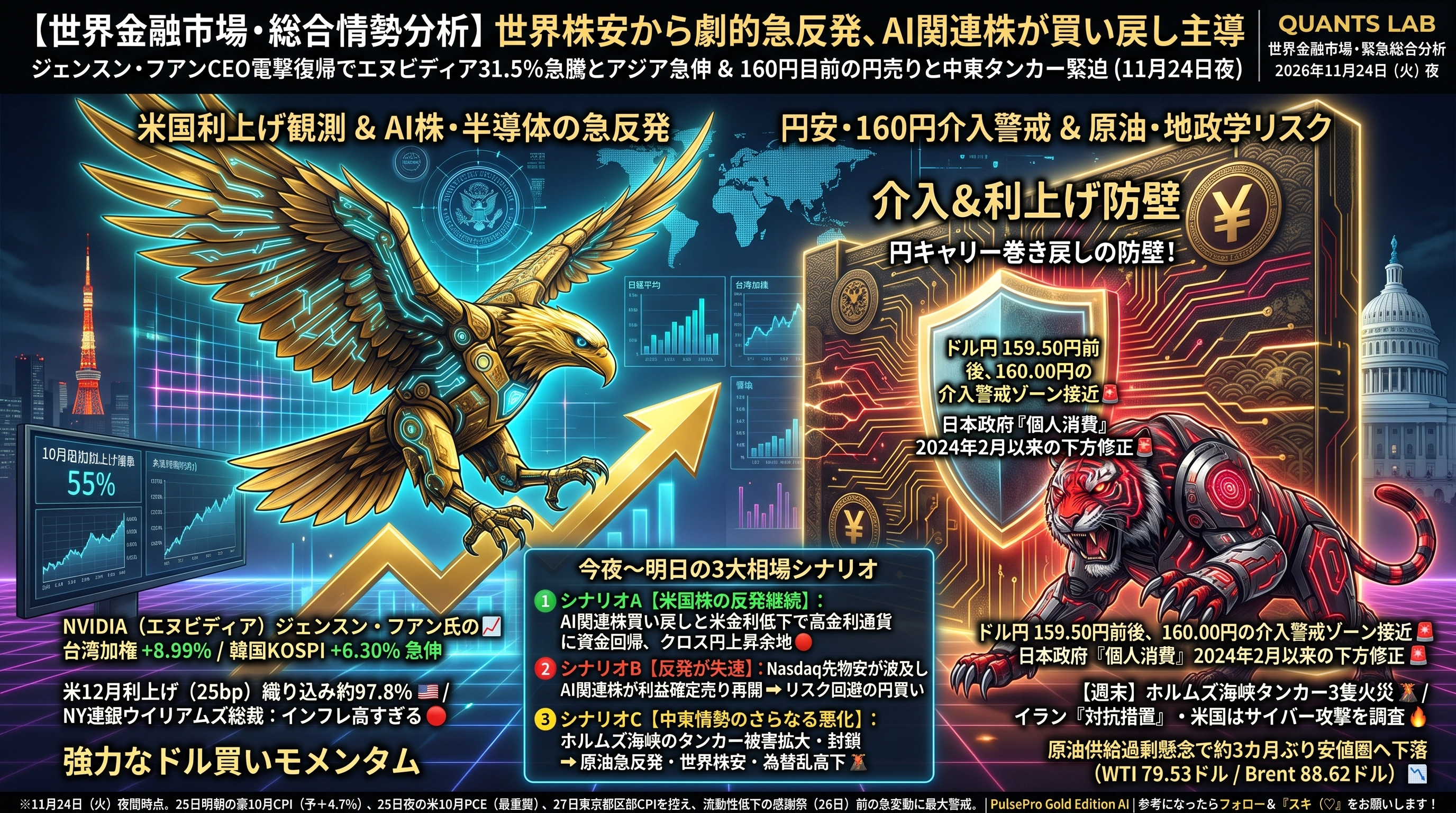
[World Market Comprehensive Analysis] NVIDIA's Huang CEO's surprise return triggers sharp U.S. stock rebound (NVDA +31.5%) & Nikkei rises rapidly to 58,644 yen — Dollar/Yen at 159.50 (near 160), U.S. 10-year yield around 4.9% declines as the Hormuz Strait
Evening of Tuesday, November 24, 2026: The world's financial markets have undergone dramatic changes since the previous day.
Following the US stock plunge on November 20 last weekend, global risk aversion had been strengthening, but on November 23 (Monday) the US market sawthe surprise return of NVIDIA CEO Jensen Huang, triggering a strong rebound in tech and semiconductor shares via broad buying. That momentum carried into today, the 24th, with Asian markets—Nikkei, Taiwan, and Korea all sharply higher.
However, despite the stock market's vibrant rally, expectations for further rate hikes by the Federal Reserve remain strong. Tensions in the Middle East continue, with clashes between the US and Iran and tanker incidents in the Strait of Hormuz, so there is no environment to be complacent.
The key points to monitor in the market around 8:00 p.m. today are six in total:
A sharp rebound in AI-related stocks sparked by Jensen Huang's return as CEO(NVDA +31.5%, Nikkei Average +3.91%).
The USD/JPY rising into the upper 159s and approaching 160 as a warning(driven by yen selling).
Fed rate hike expectations and hawkish comments from Williams, NY Fed President(December 25bp rate hike priced in at 97.8%).
Reports of three tankers on fire in the Hormuz Strait and talks with Iran stalling(cyberattack investigations have also emerged).
Crude oil prices dropping to a three-month low(global oversupply expectations offset geopolitical risk).
Downward revisions to Japan's consumer spending judgement (since February 2024) and the Bank of Japan's policy stance。
Based on market levels around 19:00 JST on November 24, I will provide a detailed breakdown distinguishing confirmed facts, market prices at reporting time, unconfirmed information, and a practical scenario for the PCE release at 22:30 tomorrow night.
Chapter 1: The Latest Global Market Situation
(November 24 Confirmation Level)
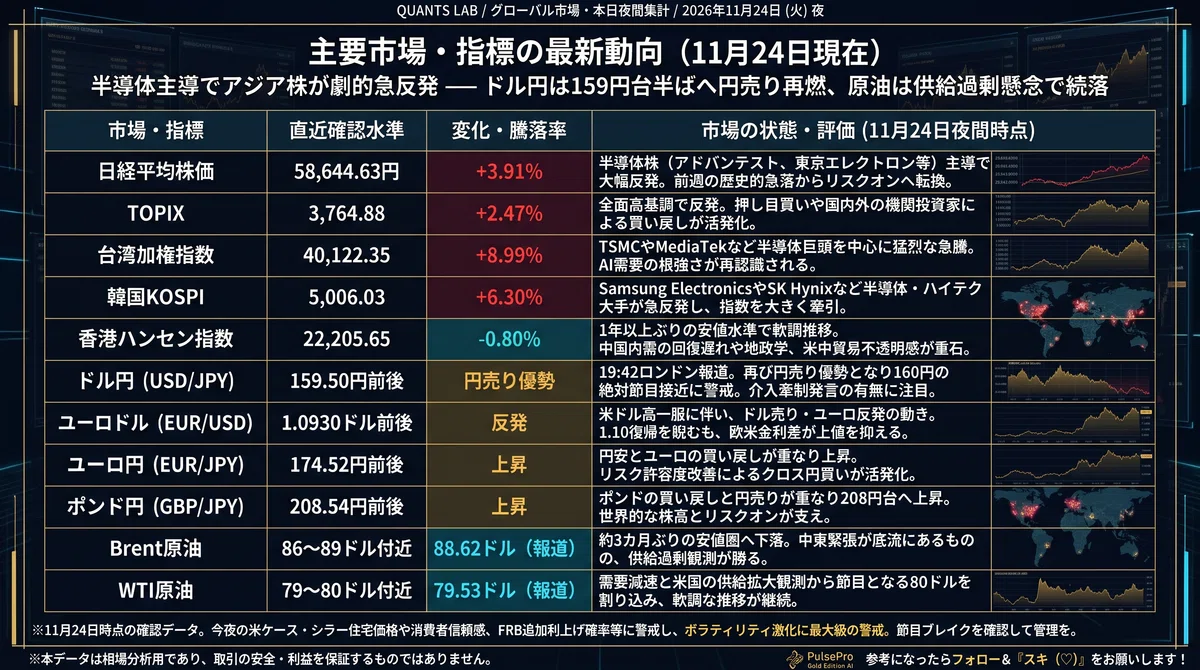
Stock markets were led by AI-related stock buybacks, while the Hong Kong Hang Seng index ended at a level not seen in over a year, so the Asian market did not recover uniformly (note: stock data refers to end-of-day in Asia on the 24th, exchange rates around 19:42, commodities at levels at the time of reporting; the baseline times are not unified).
Chapter 2: US Stocks, NVIDIA, and AI-Related Markets—
The Shock of Huang's Return and Remaining Challenges
1. Jensen Huang's CEO Return and NVIDIA's 31.5% Rally
The trigger for the global stock rally was news on November 23 that NVIDIA's board appointed Jensen Huang to return as CEO.Huang's return was approved. According to Reuters and others, Huang had resigned as CEO, but the US government found no national security concerns, and President Trump supported the decision to return him to the post.
In response, on November 23 the US market sawNVIDIA shares surge about 31.5%, with major indices rebounding sharply. (However, not all of the prior week's losses were fully regained.)
【US Major Stock Indices on November 23 vs. Previous Day】
・S&P 500: +4.7% (largest jump since April)
・NASDAQ Composite: +6.5%
・Dow Jones: about +3.0%
2. Spillover to Asia on November 24
Japan:Tokyo Electron (+7.7%), Advantest (+12.5%) surged.
Korea:Samsung Electronics and SK Hynix rose about 6.7% each.
Taiwan:Semiconductors such as TSMC and MediaTek were bought, lifting the Taiwan Weighted Index about 9%.
3. The “New Risks” We Cannot Be Happy About and Tonight's Points of Focus
Huang's return does not solve all AI industry challenges. In Washington, there is criticism of the return decision, and debates over national security and corporate governance continue. Also, profitability and funding for massive AI data center investments, and export controls on semiconductors to China (including the addition of a Singaporean company to the blacklist mentioned later) remain major concerns.
Indeed,Nasdaq futures were about 1% lower in Europe around 19:00,while Dow and S&P futures were relatively flat, so tonight's US cash market requires a calm assessment of whether NVIDIA's gains sustain, whether there will be profit-taking in semiconductors, and whether Nasdaq futures declines will spread.
Chapter 3: Foreign Exchange Market Analysis (USD/JPY around 159.50; Cross Yen and Dollar/Euro)
As of 19:42 on November 24 (London market reporting), USD/JPY rose to around159.50, approaching the 160 big round figure again.
【Intraday USD/JPY on November 24】
・Tokyo morning: around 159.00
・Tokyo session low: 158.77
・Tokyo afternoon: 159.22
・17:00: 159.34–159.36
・London 19:42: around 159.50
Note: It is not a “dollar-wide rally,” but a “yen-selling-driven” move
What is supporting this USD/JPY rise is
1) risk-on unwind after US stock rally,
2) expectations of further US rate hikes,
3) U.S.–Japan interest rate differentials,
4) general yen selling in cross currencies.
On the other hand, the decline in US 10-year yields, the BoJ rate hike expectations, and the risk of intervention near 160 keep a cap on gains.
What matters is that, as of around 19:00, euro/dollar (around 1.0930) and pound/dollar (around 1.3070) are also rising. This means today’s USD/JPY rise is not pure dollar buying but driven by “risk-on yen selling.”
【19:00 Local Crosses and Dollar/Euro/Other References (Not real-time quotes)】
USD/JPY: 159.50
EUR/JPY: 174.52
GBP/JPY: 208.54
AUD/JPY: 105.58 (Australia’s October CPI due the 25th is the focus)
NZD/JPY: 86.77 (NZ retail sales Q3–Q4 improved to +2.2% vs -0.5% prior)
EUR/USD: around 1.0930
GBP/USD: around 1.3070
High-interest currencies (MXN/JPY, TRY/JPY, ZAR/JPY) also benefit from the rally in US stocks, but in particular the Turkish lira yen pair (TRY/JPY) is high-yielding and exchange stability is a separate issue; swap income and currency risk must be managed separately.
Chapter 4: US Treasuries and Japanese Government Bonds
The “Conundrum” of Higher Stocks and Lower Yields
Today the bond market shows a simultaneous occurrence of the “sharp rebound in US stocks” and the decline in long-term rates in the US and Japan.
【11/24 Confirmed US/JGB Yields】
・US 2-year yield: around 4.68%
・US 10-year yield: around 4.91–4.93% (down from a high near 5.12%)
・US 30-year yield: around 5.30%
・Japan 10-year yield: around 2.72% (down from 2.78% in overseas markets)
(Difference between US and Japan 10-year yields around 2.20 percentage points)
Even with the stock rise, long-term yields are easing in both the US and Japan because
1) oil price declines have eased inflation fears,
2) bond buybacks (inflows) into US Treasuries and Japanese government bonds,
3) concerns about how AI investment will affect the US economy,
4) positioning adjustments ahead of the December FOMC.
Tonight, the auction of US 5-year Treasuries ($70 billion) and 2-year floating-rate notes is scheduled, and the results—bid-to-cover, highest yield, and indirect bid ratio—will be watched to see if yields rebound again.
Chapter 5: Fed Officials’ Remarks (Williams) and 97.8% December Rate-Hike Pricing
1. Hawkish Remarks from NY Fed President John Williams (Nov 23)
John Williams, President of the New York Federal Reserve, stated on November 23 that “inflation remains too high” and that “additional steps are needed to return to the 2% target,” emphasizing a data-driven assessment ahead of the December 8–9 FOMC meeting (not committing to a specific rate hike size or timing).
2. December 25bp Rate-Hike priced in at 97.8%
MarketWatch reported on November 24 that in the Fed Funds futures market, the probability of a 25bp hike at the December FOMC stood at 97.8%, and the odds of one or more additional 25bp hikes through January 2027 were priced at 65.1% (these are probabilistic estimates from market data, not official Fed decisions).
Chapter 6: Domestic Japan—Government Revises “Personal Consumption Judgement” Downward
for the First Time Since February 2024
The Cabinet Office released the November 2026 Monthly Economic Report today, keeping the overall economic assessment that “on the whole, the economy is gradually recovering, but the Middle East situation requires close watch,” while lowering the assessment of personal consumption to a “stalled improvement” path (Reuters notes government downgrades of personal consumption since February 2024).Personal consumption assessment downgraded to a stagnating recovery(According to Reuters, this is the first downgrade of personal consumption since February 2024).
Downgrade:Personal consumption (pressured by rising prices on consumer psychology)
Upgrade/Improvement:Exports (mainly to the US and Europe), production (semiconductor manufacturing equipment, etc.)
Government Middle East and price measures:Measures to smooth fuel oil volatility, alternative crude procurement, strategic stock releases as needed, and dynamic use of supplementary budgets.
This downward revision to personal consumption adds a cautious note to the outlook for the BoJ meeting in December. Also, although the USD/JPY is approaching the upper 159s,there is no confirmed report that new direct intervention has occurred today.
Chapter 7: Middle East Tensions (Three Tankers on Fire, Cyber Attack Investigations) and Oil at a Three-Month Low
1. Rejection of US–Iran Negotiations and Hormuz Strait Tension
Iran’s refusal to negotiate (AP, November 24):Iran’s negotiator Bahman Ghalibaf stated that he would not engage with the US until seven conditions—unblocked sanctions relief, naval blockade removal from Iranian ports, and unblocked assets—are met; he also warned of potential expansion of conflict (the complete official list of seven conditions has not been published).
Reports of three tankers on fire in the Hormuz Strait:The IRGC Navy stated that three oil tankers violating navigation rules were hit by mines, causing fires (reports include Iran’s announcements; not all causes or responsibilities have been independently verified).
US investigating cyber attacks on tankers (Reuters/WSJ, Nov 24):The United States is investigating possible Iranian involvement in cyber attacks targeting up to 50 vessels carrying oil and LNG, among others (investigation ongoing, involvement not confirmed).
Qatar mediation and Gaza scenario:US Vice President Harris and Secretary of State Rubio met with Qatar’s premier, the mediator, while fighting in Gaza has reportedly killed at least eight people per hospital sources.
2. Why Are Oil Prices Falling to About a Three-Month Low?
A Reuters report on November 24 noted Brent crude at 88.62 USD and WTI at 79.53 USD (AP Asia time: Brent 86.38, WTI 79.87), marking the lowest in around three months.
Reasons include:
1) Global oil supply rising,
2) Release of strategic reserves,
3) Increased purchases of Russian crude by China and India,
4) Reopening of the Sharara oil field pipeline in Libya,
5) Global stockpiling of oil (Deutsche Bank estimated a supply overhang of 1.7 million barrels per day in October).
These opposing forces—fundamental oversupply and geopolitical risk—mean sudden rebounds remain a risk.
Thus, caution is still warranted for potential rapid recoveries.
Chapter 8: Precious Metals and BTC
• Europe (Germany IFO improvement)• US-China semiconductor restrictions
Gold, Silver, Platinum:A Reuters update at 08:27 UTC on November 24 shows spot gold retreating after the previous day’s roughly 3% rise, around $3,611.99 (-0.5%); silver and platinum also down more than 2%. US rates and the dollar have strong influence; psychological levels at $3,600 and potential support at $3,500, with a rebound target around $3,650–$3,700.
Bitcoin (BTC/USD):Exact spot price and ETF flows around 8:00 p.m. on November 24 are not confirmed, so figures are omitted. The focus remains on whether AI stock rebounds will bring capital back into crypto markets (and its correlation with Nasdaq and DXY).
Germany November IFO Business Climate Index (improved):The November IFO is 90.6 (previous 90.1, seven months of improvement; current conditions 89.4, expectations 91.9). Services and trade improved, but manufacturing and construction remain weak. At 21:30 tonight, BOE Governor Green is scheduled to speak (content not confirmed).
US Department of Commerce adds Singapore-based Megaspeed to the blacklist:A Reuters report on November 24 states that Megaspeed, a Singapore cloud company linked to NVIDIA, has been added to the US trade blacklist amid suspicions of transferring advanced AI semiconductors to China. US-China tech competition persists.
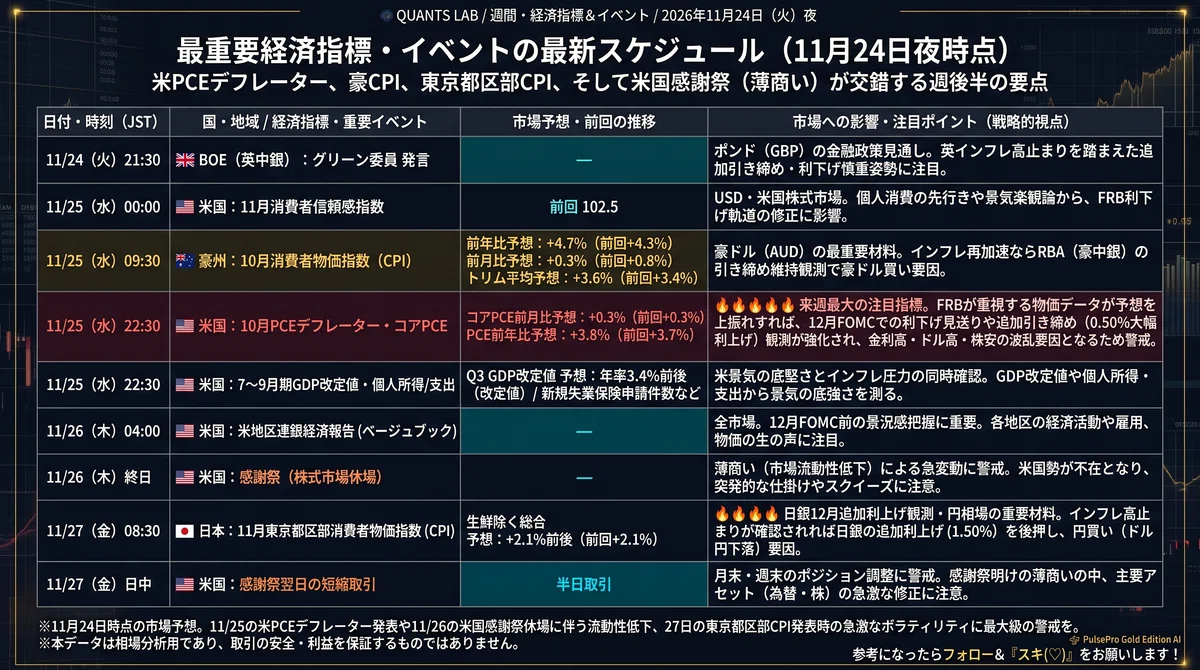
Chapter 9: Upcoming Key Economic Indicators Calendar
(Japan Time, BEA Official Standards)
This week includes Thanksgiving in the US on Thursday; the biggest weekly focus will be on the Australian CPI and the US PCE and GDP revisions coming on Wednesday, November 25.
Chapter 10: The Three Major Market Scenarios and Top 6 Monitoring Priorities
Scenario A: US stocks continue to rebound (risk-on recovery):
Conditions: AI and semiconductor-related stocks keep rebounding, and tomorrow night’s US PCE does not indicate renewed inflation.
Trajectory: Increased funds flowing back into high-yield currencies (MXN/JPY, AUD/JPY, etc.) and room for cross-yen upside, but if US rates keep falling, USD/JPY upside will be capped.
Scenario B: US stock rebound loses momentum (reversal risk):
Conditions: Nasdaq futures in Europe drift lower, spilling into US cash market and leading to profit-taking and renewed declines in AI stocks.
Trajectory: Safe-haven demand reignites and cross-yen declines; a tug-of-war between yen selling and dollar buying ensues.
Scenario C: Deterioration in Middle East (geopolitical risk expands):
Conditions: Expanded tanker incidents and navigation disruptions push crude from a three-month low into a sharp rebound.
Trajectory: Inflation fears resurface, US rates rise again, global stock markets fall, and safe-haven gold demand along with volatile forex trade intensify.
Tonight through Tomorrow: Monitoring Priorities (Top 6)
US PCE and Fed (tonight at 22:30):The most important indicator moving dollars, bonds, gold, and equities
USD/JPY at 159.50–160.00:Continued yen weakness and possible FX intervention by Japanese authorities
US stocks and NVIDIA continuation: Impact of Nasdaq futures on the cash market
Hormuz Strait and crude (WTI around $80):Balance change between supply-demand relief and geopolitical risk
Australian CPI (tomorrow 9:30) and Tokyo Metropolitan CPI (27th 8:30):A litmus test for AUD/JPY and BoJ December rate hike expectations
US 10-year yield (around 4.91%) and tonight’s 5-year auction:Will yields pause and turn higher again?
Overall Conclusion: Calmly Evaluate the “Twist” of Rising Equities, Falling Yields, and Yen Selling
What this market situation most demands attention to is the fact thatUS stocks are rebounding sharply while long-term US and Japan yields are falling,and that the rise in USD/JPY is driven by yen selling rather than a broad dollar rally.
From tonight into tomorrow, look not at a single chart but at a set of four indicators together:
1) US 10-year yield (fluctuating around 4.9%),
2) USD/JPY (holding at 159.50 and approaching 160),
3) US stocks (AI stock rebounds continuing),
4) Oil priceand maintain disciplined risk management in anticipation of tomorrow night’s 22:30 US PCE deflator and Thursday’s Thanksgiving holiday (light trading).
Notes on Data Accuracy and Key Information Sources
Note:Currency prices reflect the report time around 19:00; stock prices are end-of-day figures for each market; bonds and commodities reflect the point of data retrieval. Unconfirmed real-time prices and statements by officials or economic indicators before official releases are not treated as facts.
Main References:AP News (Nov 24: Global equities, NVIDIA, Asia markets, Middle East), MINKABU (Nov 24 19:42 London FX), Reuters (Williams remarks, oil prices, oversupply, Hormuz, Japan personal consumption, Singapore company restrictions), Cabinet Office (Nov 2026 Monthly Economic Report), BEA (US economic indicators to be released in 2026)
If this was of some help, please follow and press the “Like (♡)” button at the bottom of the screen to support updates!

TrendPulse Pro free trial:https://www.gogojungle.co.jp/tools/indicators/86532?via=users
TrendPulse Pro AI free trial:https://www.gogojungle.co.jp/tools/indicators/86529?via=users
QuickScalp AI free trial:https://www.gogojungle.co.jp/tools/indicators/86523?via=users
Eliminating emotion, this indicator captures the market with clear fundamentals and rules.
The detailed features and design logic are published on each product page
? [GogoJungle Product Page]