

[Global Market Comprehensive Analysis] U.S. AI Stocks Plunge sharply (NASDAQ in a correction phase) and the Battle over USD/JPY at 158.95 — U.S. 10-year yield 4.962% · 88.6% priced in for December rate hike by the Fed · Damage to tanker in the Strait of H
On the night of Monday, November 23, 2026, as the world financial markets enter an extremely crucial phase this week, they are assessing the upcoming key economic indicators and the geopolitical risks in the Middle East, while inheriting the sharp adjustments in US high-tech and AI-related stocks at the end of last week.
Currently, the four core drivers moving the market are as follows.
Adjustments centered on US AI-related stocks:The S&P 500 has fallen more than 10% from its recent high, entering a correction, and NASDAQ has slipped into negative territory for the year. Although US stock futures are showing an autonomous rebound at the start of trading on the 23rd, caution regarding the profitability of AI investments remains entrenched.
Changes in the outlook for US monetary policy and growth concerns:With December’s FOMC pricing in about 88.6% for a 25 basis point rate hike, the market’s view is shifting from the traditional “US rate rises = unconditional dollar buying” to “US rate rises = higher corporate financing costs and slower growth (growth concerns).”
Continued yen weakness (dollar/yen in the high 158s) and expectations of a December BOJ rate hike:Despite a sharp drop in US stocks, the yen has not strengthened across the board, as it remains a tug-of-war between yen selling driven by US-Japan rate differentials and safe-haven demand.
Middle East risk from US-Israel-Iran tensions:The Iranian Foreign Ministry has signaled a stance against the US naval blockade, and reports of tanker damage near the Strait of Hormuz continue, increasing uncertainty for energy supply.
Based on reporting data and market levels confirmed by late Japan time on November 23 around 21:00, I will distinguish fact from unconfirmed information and conditional scenarios, and provide a detailed overview of the currencies, bonds, equities, and commodities markets.
Chapter 1: The World’s Most Important News —
AI-related stock adjustments and Monday rebound
On Friday, November 20, US stock markets saw heavy selling focused on AI and semiconductor-related shares.
S&P 500:Fell more than 10% from the October 6 high, entering a correction (collection).
NASDAQ:Fell 5.3% on Friday, slipping into negative territory for the year.
NVIDIA:Declined on 9 of the last 10 trading days, with concerns surrounding former CEO contributing to a drop of more than 30% from its recent high.
Meanwhile, on Monday, November 23, US stock futures are being bought back (AP News, November 23 report).
【November 23 (Mon) US stock futures and crude oil price levels (AP News)】
・S&P 500 futures: +2.6%
・Dow Jones futures: +1.8% ・Brent crude oil: 92.02 USD
・WTI crude oil: 83.04 USD
This drop is not merely profit-taking; it has raised questions about AI investment profitability, the burden of massive capital expenditure, and the valuation of corporate value. A rebound in futures does not mean the correction is over, and going forward we must monitor:① The decline halting in semiconductor stocks like NVIDIA,
② A reallocation of funds to large tech stocks,
③ The trajectory of US Treasury yields,
④ FRB’s policy outlook,
⑤ Whether stock weakness spreads to the credit market and the real economy
to confirm.
Chapter 2: Forex Market — Dollar Index at 19-month high
A pullback from the highs; dollar/yen in the high-158s
Continued yen depreciation warnings
As of November 23, the market levels for major currencies according to Reuters are as follows (note: these are the levels at the time of the report and not the definitive rates at 21:00).
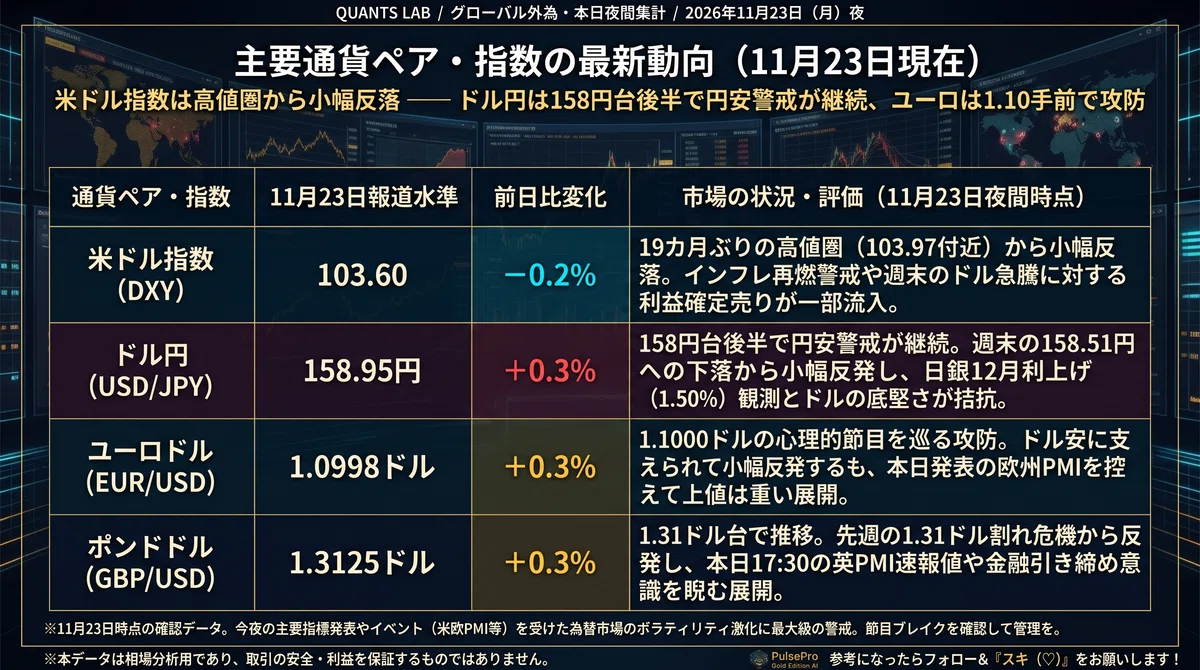
1. USD/JPY: Battle around 158–160
The current USD/JPY is being pressured by “the US-Japan rate differential and expectations of a December Fed rate hike” and “risk-off and Bank of Japan vigilance about additional rate hikes due to US stock declines and safe-haven yen buying” are contending head-on.
What to watch in particular is that,even as US stocks fall sharply, the yen has not become a broad safe-haven buy. Going forward, attention will be on the persistence at the 159 level, any statements from the government or the MoF when it nears 160, and the evolution of the US 10-year yield (note: 159–160 is a psychological barrier, but reaching 160 is not yet definitively predicted).
2. Views on major dollar pairs and high-yield currencies
EUR/USD (1.0998):Whether it can clearly break above the 1.10 level is a focal point. Intra-European disparities include improving German sentiment and weakness in French services, in addition to the ECB’s policy stance and the US PCE results that will matter.
GBP/USD (1.3125):Attention on UK PMI and speeches by BOE officials. It is a development that weighs inflation against growth slowdown.
AUD/NZD:China’s economy and commodity prices, and this week’s October CPI data from Australia (to be released on the 25th) are key factors (a stronger print would push toward expectations of RBA tightening).
MXN/JPY and TRY/JPY (Mexican peso and Turkish lira):Risks of global risk-off due to US stock weakness and potential outflows from emerging markets driven by rising US yields. It is necessary to manage swaps income separately from currency depreciation and margin maintenance requirements.
Chapter 3: US Treasuries, Japanese Government Bonds, European Bonds —
Be wary of shifts in the meaning of “rising rates”
In the US and European bond markets on November 23, there was some reversal from the previous week’s safe-haven buying that had lowered yields (WSJ data as of Nov 23).
【Nov 23 Major 10-year yields】
(WSJ report; Japan is a reference level)
・US 10-year yield: 4.962%
・UK 10-year yield: 5.256%
・Germany 10-year yield: 3.319%
・Japan 10-year yield: about 2.78%
Shifts in correlation between US rate rises and USD/JPY
What to watch in the US Treasuries market is that the market's interpretation of rate hikes is changing.
Traditional framework:US rate rises ➔ dollar buying ➔ USD/JPY rises
Current warning framework:US rate rises ➔ higher corporate financing costs ➔ lower equity prices ➔ growth slowdown (growth concerns)
Therefore, a rise in US rates does not automatically imply a rise in USD/JPY.
Also, the rise in Japan’s 10-year yield (about 2.78%) could be a bullish factor for the yen if driven by BOJ rate-hike expectations or domestic price pressures, butif the rise is due to bond supply concerns or fiscal risks, it may not support a stronger yen. The simple interest-rate differential between US 10-year (4.96%) and Japan 10-year (2.78%) is about 2.18 percentage points, but the currency direction should be judged considering short-term rates, policy rate outlook, and real yields.
Chapter 4: Domestic Japan — Tokyo market closed;
BOJ December rate hike expectations and intervention warnings
Today, Monday, November 23, is Labor Thanksgiving Day, so the Tokyo stock market is closed and there is no closing price for today. The confirmed closing values as of Friday, November 20, are as follows.
【Closing values on Friday, November 20】
・Nikkei 225: 56,436.65 (down 5.06% from previous day)
・TOPIX: 3,674.22 (down 3.88% from previous day)
※ AI-related adjustments led SoftBank Group to drop 14.48% on the 20th.
Views on BOJ’s December meeting and foreign exchange intervention
A Reuters report dated November 19 indicated that economists surveyed expected additional rate hikes at the December meeting and further hikes through the end of March 2027 (the backdrop being imports price inflation due to yen depreciation and the core CPI exceeding 2%).
On the other hand, there were reports that Japan’s Q3–Q4 GDP contracted for the first time in a year, suggesting the BOJ should assess not only prices but wages, household spending, and corporate earnings. For the yen, what matters more than the mere “whether December raises rates” is whether the central bank signals that it will continue to raise rates subsequently.
Moreover, while 159 yen remains a threshold where intervention risk persists,there is no confirmed evidence of any fresh direct intervention at this time. Be careful not to confuse unconfirmed speculation with official government statements.
Chapter 5: Middle East situation — Hormuz Strait
Tanker attacks and crude market
Geopolitical risk: the confrontation between the US and Iran has escalated again.
Iran’s stance against the blockade (Nov 23 Reuters):Iran’s foreign ministry spokesman says Iran will counter the blockade by “any means,” asserting self-defense. The sequence includes the US blocking Iranian oil exports in April, a tentative deal in June that was subsequently undone in July, and renewed calls by Iran to negotiate conditions for Hormuz Strait passage.
Tanker attacks in the Hormuz Strait (Nov 23 Gulf News):Since November 16, seven tankers have been damaged, and three were attacked off the Oman coast around November 20–21 (one Jordanian crewman is missing; UAE and Oman are conducting search efforts). Note that not all perpetrators or causes are independently confirmed.
Outlook for Middle East–Hormuz scenarios and crude market (Brent 92.02 USD / WTI 83.04 USD) with spillovers to the FX market
① Progress in US–Iran talksRecovery of risk appetite
② Continued tensionPersistent inflation worries
③ Escalation of Strait closures and attacksPossibility of global risk aversion and yen buying (increased import burden for Japan and competition)
Chapter 6: European PMI (Germany vs. France performance gap) • China market measures • Fed officials’ remarks
1. Europe November PMI flash — Germany solid, France weak
The flash PMI for Europe released today showed a clear divergence between the region’s two major economies (note: Germany’s manufacturing PMI is sometimes reported as 55.0 in separate sources; differences among data providers should be considered).
【November 23 Europe major PMI flash values】
・Germany Manufacturing PMI: 54.1 (previous 54.2)
・Germany Services PMI: 52.4 (previous 52.5)
・France Manufacturing PMI: 49.8 (previous 49.5)
・France Services PMI: 47.4 (previous 46.2)
2. China stabilizing measures and Asian equities (Nov 23)
In response to AI stock declines, China’s exchanges announced market-stabilizing measures such as easing margin financing conditions; similar steps reported in Korea and Taiwan. Asia stocks on the 23rd: Korea’s KOSPI fell 3.3% while Taiwan’s TAIEX rose 2.2% (Japan’s market was closed).
3. Fed December rate hike expectations (about 88.6%) and a Williams speech
Reports on November 23 stated that the fed funds futures imply about an 88.6% chance of a 25bp hike in December, while expectations for a 50bp hike have receded.Tonight at around 21:00 Japan time, New York Fed President John Williams is due to speak; expectations for December policy, inflation stickiness, labor market, and the impact of AI stock adjustments are anticipated (note: the actual remarks are not confirmed at this time, so no speculation is included).
Chapter 7: Gold (rebound beyond 3,600) and Bitcoin (BTC) trends
Gold (XAU/USD):According to FXStreet’s market report on November 23, after a roughly 9% drop the week prior, spot gold rose over 2% to surpass 3,600 dollars, acting as a safe-haven against the US stock plunge. If US yields remain elevated, this may cap the upside, so the 3,600 level’s persistence is key.
Bitcoin (BTC):As of 21:00 on November 23, exact real-time price and exchange-specific flows cannot be confirmed from the reported data alone. Given the recent AI stock declines, investors are increasingly treating Bitcoin as a correlated risk asset with equities, so monitoring BTC/stock correlations with NASDAQ, the dollar index (DXY), US rates, spot ETFs, and margin-liquidation trends is essential.
Chapter 8: This Week (Nov 23–27) Important Economic Calendar
The key events are the US PCE deflator and GDP revision on Nov 25, and the Tokyo CPI for the metropolitan area on Nov 27; note that liquidity may thin on Nov 26 (Thanksgiving) and Nov 27 (shortened trading) (sources: MUFG, Mitsubishi UFJ Morgan Stanley, etc. weekly calendar / all times in Japan time).
This week’s key events areNov 25: US PCE deflator and GDP revisionandNov 27: Tokyo metropolitan CPIwith liquidity risk due to Thanksgiving holiday on Nov 26 and shortened trading on Nov 27(sources: MUFG, Mitsubishi UFJ Morgan Stanley, and others’ weekly economic calendars; all times are Japan time).

Chapter 9: This Week’s Top 3 Market Scenarios and Top 5 Monitoring Priorities
Based on confirmed material, here are three conditional market scenarios for the week ahead.
? Scenario A【US stocks keep correcting (watchful scenario)】:
Conditions: NASDAQ and AI-related stock selloffs intensify, and growth concerns deepen.
Market impact: Funds accelerate into safe assets, with strong downward pressure on cross currencies (AUD/JPY, MXN/JPY, TRY/JPY). USD/JPY may lean toward risk-off yen buying as stock declines widen.
? Scenario B【US stocks rebound autonomously (risk appetite recovery)】:
Conditions: Buying interest returns to AI-related stocks, and US futures rebound becomes established in the cash market.
Market impact: Funds flow back into high-yield currencies and cross yen pairs, potentially resuming yen selling.
? Scenario C【Middle East tensions worsen (geopolitical risk expands)】:
Conditions: Increased tanker attacks or blockades in the Hormuz Strait push crude higher.
Market impact: Inflation fears re-emerge alongside global stock weakness, with capital shifting into US Treasuries and gold, and the FX market experiencing sharp moves.
Top 5 monitoring points this week
1st: US AI-related stock adjustments (Temporary correction or a revaluation of AI investments)
2nd: Nov 25 US PCE, GDP and the Fed’s December policy decision(Where the 88.6% priced-in rate hike goes)
3rd: Hormuz Strait navigation status and oil supply( spillover risks to inflation and monetary policy)
4th: BOJ December rate hike expectations and Tokyo CPI on Nov 27(import price pressures from yen depreciation versus economic strength)
5th: US 10-year yield around 4.962%(the burden of a high-rate environment coinciding with stock weakness)
Overall conclusion: Avoid a single-factor decision; monitor three variables simultaneously
As of November 23, 2026, the market is in a cautionary phase where three variables — ① US monetary policy, ② AI-related stock adjustments, and ③ Middle East geopolitical risk — intersect in a complex way. The fact that USD/JPY remains in the high-158s despite a sharp drop in US equities indicates that markets cannot be measured solely by the textbook correlation of “stock weakness = yen strength” or “US rate rises = dollar strength.”
This week especially,Nov 25 US PCE and GDPandNov 27 Tokyo CPI, along with caution over liquidity in the second half of the week due to Thanksgiving, should be carefully watched. Discipline to monitor the movements of interest rates, the dollar index, US equities, and crude oil in tandem is essential for trading.
Notes on data accuracy and major information sources
Note:Forex levels such as 158.95 yen and other indicators are confirmed at the time of reporting and are not the real-time definitive rates at 21:00. Government bond yields vary by market reporting times. Unconfirmed remarks from prominent figures and cross-rate quotes not yet obtained are not treated as facts.
Main reference sources:AP News (Nov 23 — world equity and US stock futures) / Reuters (AI stock declines, dollar, yen, euro exchange trends, Iran-US naval blockade issue, BOJ December rate hike expectations) / WSJ (US and European bond markets) / MUFG (weekly economic indicators calendar)
If this is at least somewhat helpful, please consider following and pressing the heart at the bottom of the screen to encourage updates!

TrendPulse Pro free trial:https://www.gogojungle.co.jp/tools/indicators/86532?via=users
TrendPulse Pro AI free trial:https://www.gogojungle.co.jp/tools/indicators/86529?via=users
QuickScalp AI free trial:https://www.gogojungle.co.jp/tools/indicators/86523?via=users
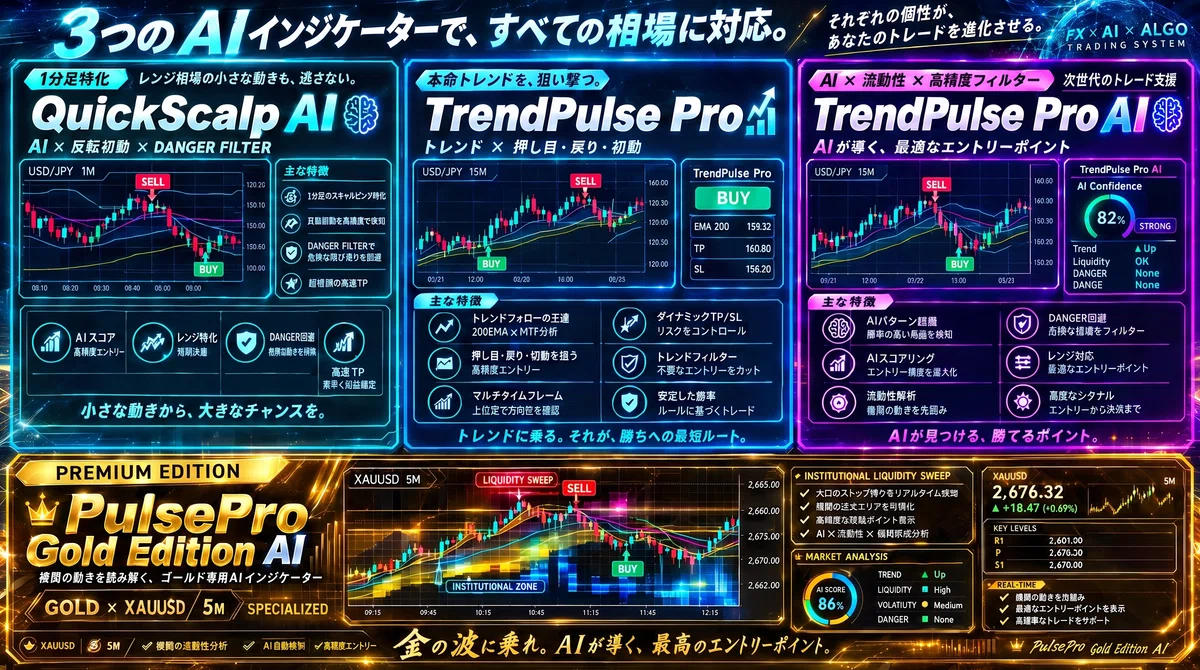
An indicator that eliminates emotion and analyzes the market with clear fundamentals and rules.
Functional details and design logic are available on each product page
? [GogoJungle product page]