

[Weekly Market Outlook: November 23–27] U.S. stocks slump sharply (Dow Jones down 909 points, SOX down 10%) and dollar/yen retreat to the 158 level — narrowing U.S.-Japan 2-year yield gap; continuing reports of tanker strikes in the Hormuz Strait; Novembe
On the night of Sunday, November 22, 2026, global financial markets face the situation of Friday, November 20, 2026, with the “plunge in US high-tech and semiconductor stocks” and the “rebound of USD/JPY to the mid-158s,” and reports over the weekend of continued tanker attacks near the Hormuz Strait, as we head into the new trading week of November 23 (Mon) to 27 (Fri). and and the “continuing reports of tanker attacks around the Hormuz Strait,” and as the weekend reports continue to arrivewe are approaching the new trading week of November 23 (Mon) to 27 (Fri) with that in mind.
The most important themes that will move next week's markets can be summarized in five points.
Whether US stock declines will continue:Whether a sharp drop in AI and semiconductor stocks will spill over to reduce risk across the market.
Federal Reserve December policy:Which will move rates and the dollar more—the expectation of further rate hikes or concerns about economic slowdown.
Bank of Japan December rate hike expectations:How the BoJ will respond to inflation (October core CPI 2.2%) and the yen’s exchange rate.
Middle East and Hormuz Strait risk:Whether supply risk from rising reports of tanker attacks will expand at the start of the week.
US Thanksgiving and weekend liquidity:The US market holiday on November 26 (Thu) and shortened trading on 27 (Fri) could amplify currency and equity moves in thin liquidity.
Note that today, November 22 is Sunday, so physical stock, bond, and regular currency markets are closed. As of 21:00, the confirmed closing price and trading range from November 20 (Fri) remain the latest reference by default. In this article, I will strictly distinguish weekend reports from confirmed data through Friday, and provide a detailed market outlook and practical scenarios for next week.
Chapter 1: The Four Major Latest News Confirmed by November 22
First, four latest developments that will determine the market at the Monday opening.
① US stocks: November 20 plunge becomes Monday’s focus
On Friday, November 20, US stock markets saw selling not only in semiconductors but across the NASDAQ. The market news on that day on domestic FX information sites recorded the following movements.
【US market and FX quick checks on Friday, November 20】
・Dow Jones: about 909 points down ・NASDAQ Composite: about 5% down
・SOX semiconductor index: about 10% down ・NVIDIA: over 12% drop
・USD/JPY: briefly fell to 158.51 (trading range 158.42–159.84)
The background to this sharp drop included concerns about high valuations for AI-related stocks, and reports that“the SEC is investigating potential accounting issues related to NVIDIA”were released (note: reporting on investigations and confirmed accounting irregularities are separate issues and require follow-up). Also, comments from Federal Reserve officials about not ruling out further hikes heightened policy uncertainty.
Monday’s confirmation items:We need to monitor the downside of semiconductor stocks led by NVIDIA and the SOX index, the movement of the VIX, the direction of US Treasuries yields and the dollar index, and whether the stock declines spill over into the credit market (bond spreads, etc.).
② The Fed: remarks on further rate hikes and “the Treasury Secretary’s dissent”
Key figures’ remarks on November 20 highlighted a divergence in views on monetary tightening.
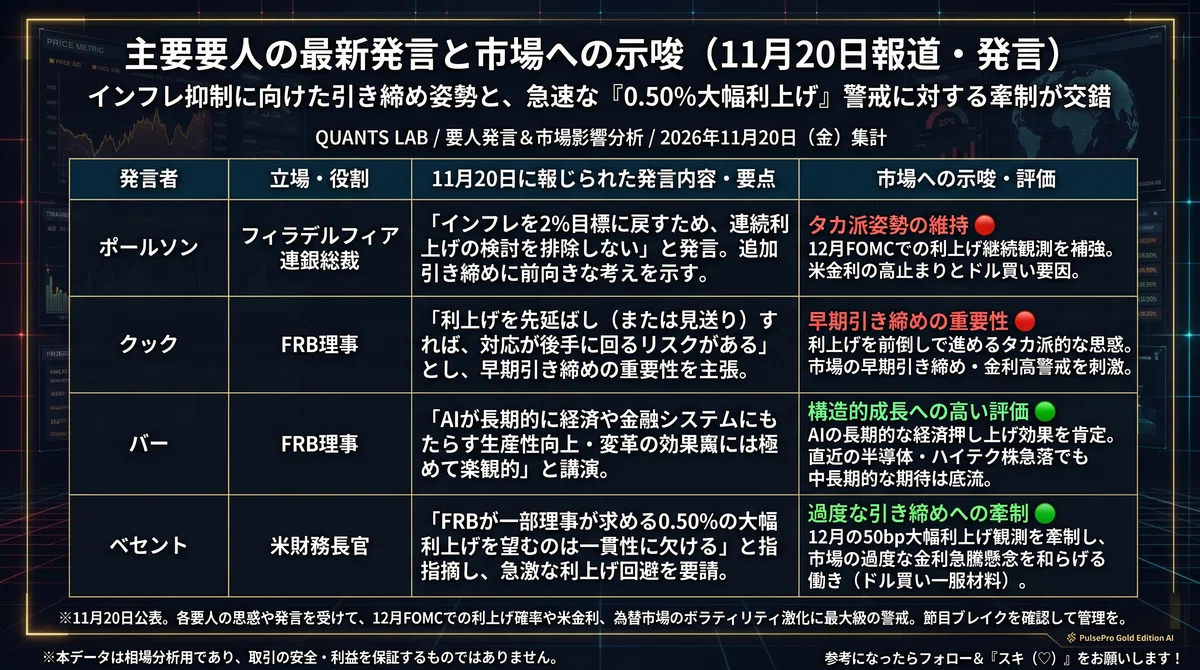
Because there is not a unified view within the Fed and with the government, it is essential not to treat December rate hikes as a foregone conclusion, but to monitor inflation indicators such as the PCE deflator scheduled for November 25.
③ Middle East: multiple tanker attacks reported near Hormuz
This is crucial for the oil market at the start of the week. UKMTO says three reports of projectiles hitting a tanker near Haql, Oman, during about 15 hours on November 21 (Sat).The locations and injuries: tanker hit near Ha Sa b, Oman (no injuries reported among crew, per reports).There are discrepancies regarding who launched the attacks and how; Iran describes it as a mine contact, so the assessment should distinguish between official maritime agency reports and Iran’s claims.
Impact on week-start markets:With crude futures trading halted over the weekend, true price realization will start when markets reopen. In addition to upward pressure on WTI and Brent due to supply concerns, watch USD/CAD (Cdn dollar support from higher oil), AUD/USD (downside pressure in risk-off), and the tug-of-war among USD/JPY, gold, and Japanese government bonds.
Japan: government and diplomacyPrime Minister Kato (Katsuhiko) on November 19 attended ASEAN-related summits and the APEC summit and emphasized QUAD cooperation, a free and open Indo-Pacific, and cooperation with ASEAN countries. The APEC summit that adopted a leaders’ declaration on November 19 discussed AI and digital economy, free trade, and energy supply stabilization, with attention on energy security and U.S.–China trade policy actions going forward.
Chapter 2: Japan's Economy, BoJ, and government bond market
(Focus on 40-year JGB auction on November 25)
The October nationwide CPI for Japan released on November 20 shows core CPI excluding fresh food at 2.2% year over year, staying above BoJ’s 2% price target. This keeps the December 18 meeting’s rate hike expectations in view, but BoJ will assess prices alongside wages, household consumption, corporate profits, overseas economy, and exchange rates.
【Important domestic schedule for next week (Nov 23–27)】
・11/23 (Mon): Labour Thanksgiving Day (Japanese markets closed)
・11/25 (Wed): 40-year government bond auction (long-term yield supply/demand assessment)
・11/26 (Thu): remarks by BoJ Governor Wakatabe (Naoki Tamura)
・Press conference (influencing December rate hike expectations)
・11/27 (Fri): November Tokyo metropolitan CPI
In the current Japanese government bond market, it is necessary to monitor three aspects:
① Short-term rate changes driven by BoJ policy rate outlook,
② Long-term yield changes driven by Treasury supply concerns and fiscal anxieties,
③ Ultra-long-term yields affected by the 40-year bond auction on the 25th (bid-to-cover and tails).
Chapter 3: US Treasuries and Financial Markets —
A decline in long-term yields and the retreat of “Fed rate hike expectations”
The most notable structural change in last week’s markets was that US stocks fell sharply while Treasuries, as a safe-haven, rose, pushing long-term yields lower.
【November 20, US Treasuries and yield curve movements】
・US 10-year yield: fell to 4.95%
・USD/JPY trading range: 158.42–159.84
・US-JP 2-year yield spread: narrowed by 21bp (0.21%) week over week
StoneX analysis (as of Nov 21) showing changes in the yield futures market
In the futures market, excessive rate hike expectations from the prior week have largely faded.
Rate hikes in December remain plausible, but not as strongly priced in as before.
Market pricing for additional hikes through January 2027 is now roughly evenly split (around 50%).
Until mid-last week, expectations for further rate hikes supported the dollar unilaterally, but next week the most important indicator will be whether the US 2-year yield continues to fall, which will determine the direction of USD/JPY. Attention also on demand for US Treasuries at upcoming auctions (23: 2-year, 24: 5-year, 25: 7-year).
Chapter 4: Forex Market — Thorough Analysis of USD/JPY, Crosses, and Carry Trades
In the forex market on November 20, USD/JPY fell from the 159 range to mid-158s as US stock declines and the narrowing of the US-Japan 2-year yield gap (week’s -21bp) occurred.
1. USD/JPY: Key battle in 158.42–159.84 range and monitoring levels
【Important monitoring price bands for USD/JPY (as of Nov 20)】
★ 160.00: psychological inflection and alert line for potential intervention
★ 159.84: November 20 high (resistance reference)
★ 159.00: psychological level and near-term battleground
★ 158.70: buying-interest level observed around Nov 20
★ 158.42: November 20 low (nearest support reference)
Bullish factors:Expectations for US rate hikes, sustained US-Japan rate differential, safe-haven dollar funding in crisis, and a gradual normalization of BoJ policy.
Bearish factors:Continued US stock declines, lower yields on 2-year and 10-year Treasuries, unwinding of yen carry trades, expectations of BoJ December rate hikes, and intervention risk around the 160 mark.
It is important not only to see whether 160 is breached, but also to assess whether a simultaneous drop in US 2-year yields and USD/JPY occurs (i.e., a genuine yen strength driven by narrowing US-Japan rate differentials).
2. Key drivers by major currency pairs for next week
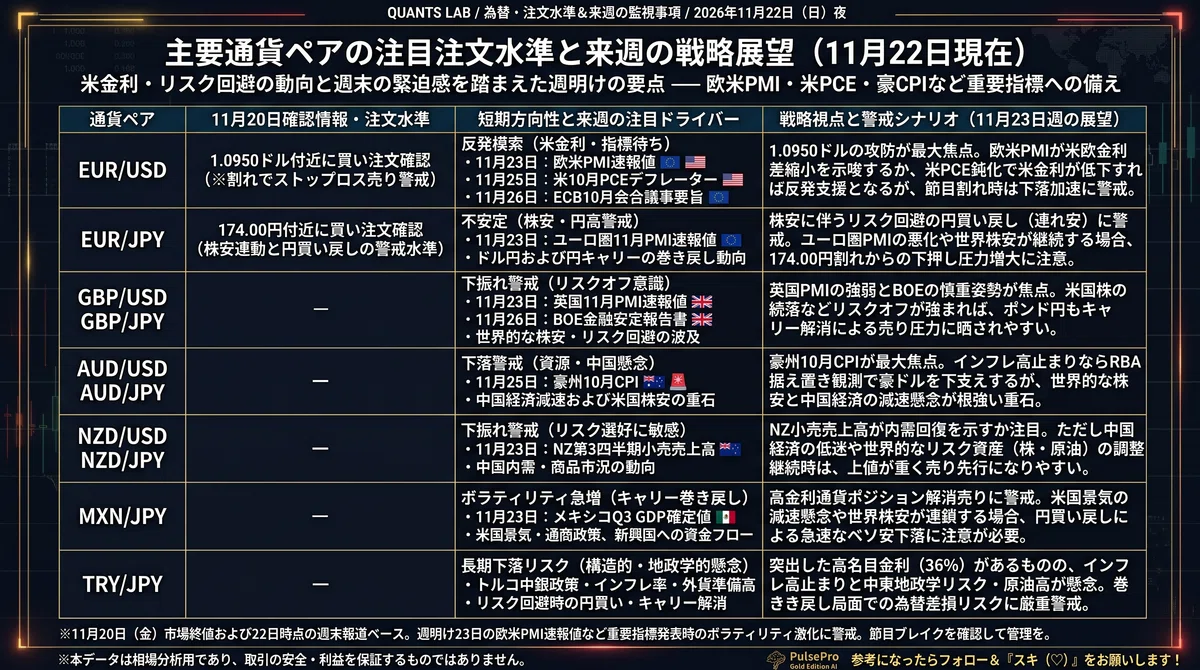
Note: In general, if stock markets decline and short-term US interest rates fall across the board, be wary of a shrinking yen carry trade. StoneX also notes that yen futures speculative positioning has already tilted toward yen strength, so avoid assuming a panic-driven one-way backtracking and instead confirm supply-demand calmly.
Chapter 5: Global Markets and Crude Oil, Gold, and BTC — Monitoring Points
1. Equity markets: Japan closed on 23rd; cash market resumes on 24th
Japanese stocks:On November 23 (Mon), the Japanese market is closed for Labour Thanksgiving Day. The cash market will resume on November 24 (Tue), absorbing last week’s US semiconductor stock plunge (SOX down 10%) and currency moves. Watch semiconductor equipment, AI/data-center related stocks, export-driven stocks, banks and insurers, and the impact of oil on electricity and airline stocks.
US stocks:According to StoneX, the NASDAQ-100 fell 10.4% for the week, marking the 11th largest weekly drop since 1985. Be mindful of follow-up on NVIDIA investigation reports, AI sector profitability, post-PCE rate trajectory, and the thin trading around Thanksgiving (Nov 26 holiday, Nov 27 shortened trading).
Europe and Asia stocks:Focus on Germany and euro-area PMI on the 23rd, France’s fiscal and debt dynamics, and post-APEC measures for China and US–China trade policies.
2. Crude oil, precious metals, and crypto assets (checklist for start of week)
Crude oil (WTI/Brent):In light of three reports of tanker attacks near the Hormuz Strait over the weekend, expect heightened risk of an open on Monday. Start the week by checking: ① additional damage reports from UKMTO,
② restrictions on navigation and rising marine insurance costs,
③ official statements from Iran, US, and Israel,
④ the price gap between WTI and Brentand monitor these in order. Distinguish actual supply disruption from temporary risk premia.
Gold and silver:Gold moves with real US yields, the dollar index, and geopolitical risk. Silver, with higher industrial demand, may underperform gold if global growth concerns intensify.
Crypto assets (BTC and ETH):This week is a test for whether declines stabilize. Not only price rebounds but also ETF fund flows, futures positions, funding rates (FR), forced liquidations, and correlations with US equities (NASDAQ) should be assessed together. Note: latest ETF flows and confirmed settlement figures as of the weekend are not confirmed; figures may be omitted.
Chapter 6: Next Week (Nov 23–27) Important Economic Calendar
The most important dates areNov 25 (Wed) US PCE deflator and Q3 GDP revisionsandNov 26 (Thu) US Thanksgiving holidayAll times are in JST.
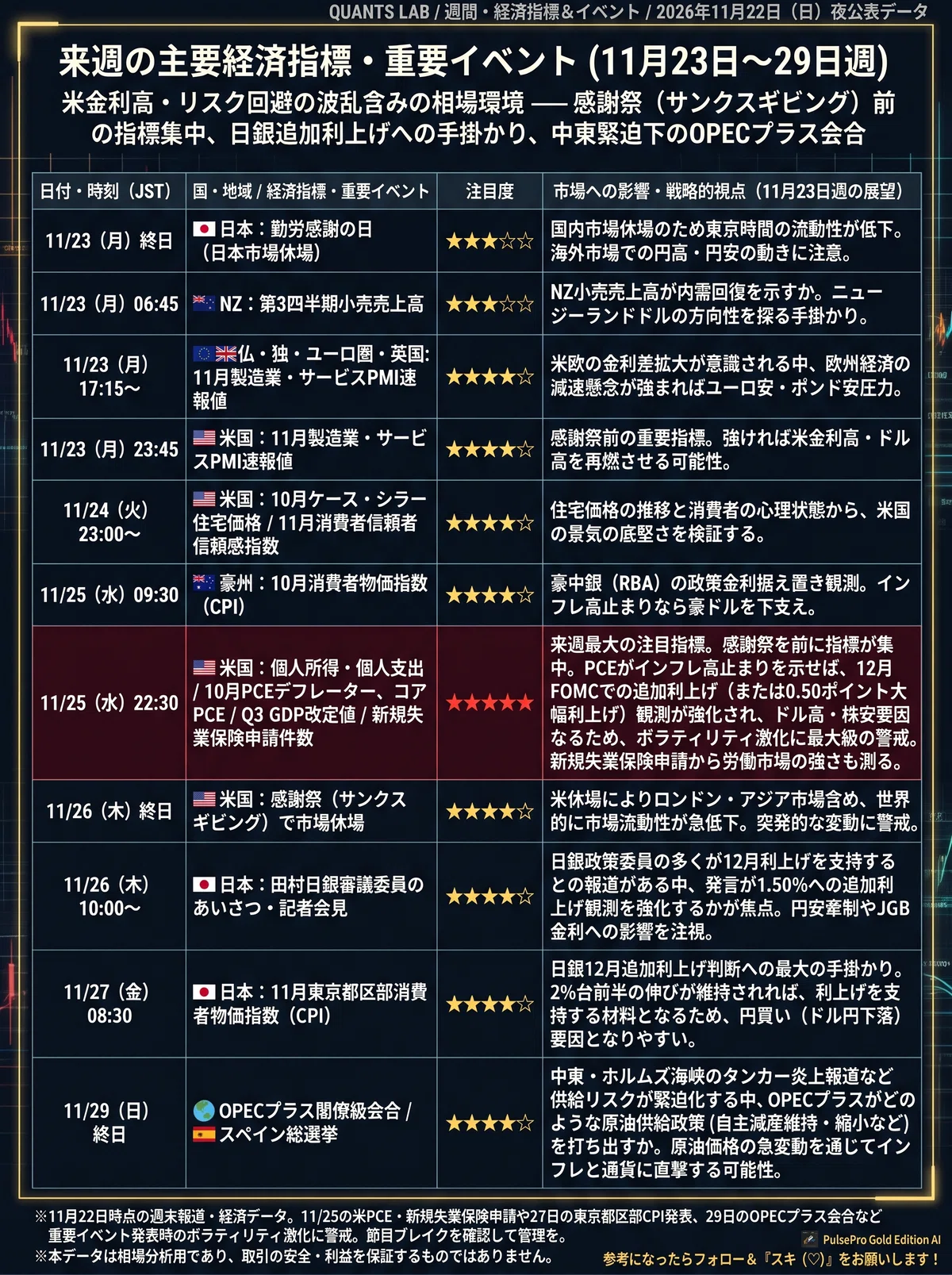
Chapter 7: The Week’s Three Major Scenarios and Top 10 Surveillance Priorities
Top 10 priorities for the week
Three possible divergence scenarios for next week, combining verified facts with conditional analyses.
? Scenario A: US stocks continue to fall (caution case):
Conditions: Further declines in semis (NVIDIA, SOX), rising VIX, continued decline in US Treasuries yields (especially 2-year).
? Scenario B: US stocks rally autonomously (rebound case):
Conditions: Buybacks in semis, VIX declines, and stabilization in US bond markets.
? Scenario C: Middle East tensions worsen (geopolitical risk expands):
Conditions: Ongoing tanker attacks in the Hormuz Strait and expanded shipping disruptions lead to smaller actual oil supplies.
Weekly surveillance priorities for trading (Top 10)
US 2-year Treasuries yield:Direct barometer of Fed policy outlook and the US-Japan short-term rate differential
USD/JPY:Range battle within 158.42–159.84, BoJ expectations, and 160 intervention risk
NASDAQ and SOX indices:Assess global risk appetite and the presence or absence of risk-off contagion
WTI/Brent crude:Start-of-week supply risk reaction to weekend Hormuz Strait incidents
Dollar Index (DXY):Check overall dollar strength and safe-haven demand
AUD/JPY:Strongly reflect Australia's CPI on the 25th and global stock declines
MXN/JPY (Mexican peso/yen):Watch Mexico GDP on the 23rd and risk-off carry adjustments
TRY/JPY (Turkish lira/yen):Risks of Turkish high-yield currency against the yen and the separation management of swaps and FX losses
XAU/USD (Gold):Juggling US real yields, dollar index, and geopolitical risk
BTC/USD (Bitcoin):Indicate whether risk assets’ decline has halted and assess liquidity conditions
Overall conclusion: A week to brace for changes in US 2-year yields and thin liquidity
and the risk of abrupt moves
The most important point of this week’s outlook is that the “US monetary policy outlook is beginning to change” and “the impact of US stock declines on yen carry trades.”
Until mid-last week, expectations for further rate hikes strongly supported the dollar, but after the US stock selloff on November 20, both “US Treasury yields fell (narrowing the US-Japan 2-year yield gap)” and “yen strengthened” progressed simultaneously. Ignoring this structural shift and assuming a one-way dollar strength and yen weakness is risky.
Next week, please track the movement of US 2-year Treasuries yields as the top priority, even more than US stocks. Also, after the release of important indicators on Wednesday the 25th (PCE deflator and GDP revisions), liquidity will thin on Thanksgiving (Nov 26) and on Friday the 27th due to shortened trading, leading to potential abrupt moves. High-yield currencies (MXN/JPY, TRY/JPY, etc.) may experience amplified volatility. Practice disciplined risk management with limited leverage and be prepared for next week’s markets.
Sources and references and notes
Main reference materials:Traders’ Web FX (economic indicators among overseas/domestic markets for Nov 23–27, FX/stock headlines on Nov 20) / StoneX (as of Nov 21: weekly USD/JPY and yen carry trade analysis) / Reuters (Middle East and shipping news) / Prime Minister’s Office (press conference after APEC and ASEAN)
Notes:Prices are based on confirmed trading ranges and closing prices as of Friday, November 20. Real-time prices that could not be confirmed by the end of Sunday, November 22, and prices for crude oil, gold, and crypto assets at the start of the week are not included. Also, forecasts for unreleased economic indicators are not treated as actuals.
If you found this helpful at all, please follow and press the “Like” (♡) button at the bottom of the screen for encouragement to update!

“TrendPulse Pro” Free Trial:https://www.gogojungle.co.jp/tools/indicators/86532?via=users
“TrendPulse Pro AI” Free Trial:https://www.gogojungle.co.jp/tools/indicators/86529?via=users
“QuickScalp AI” Free Trial:https://www.gogojungle.co.jp/tools/indicators/86523?via=users
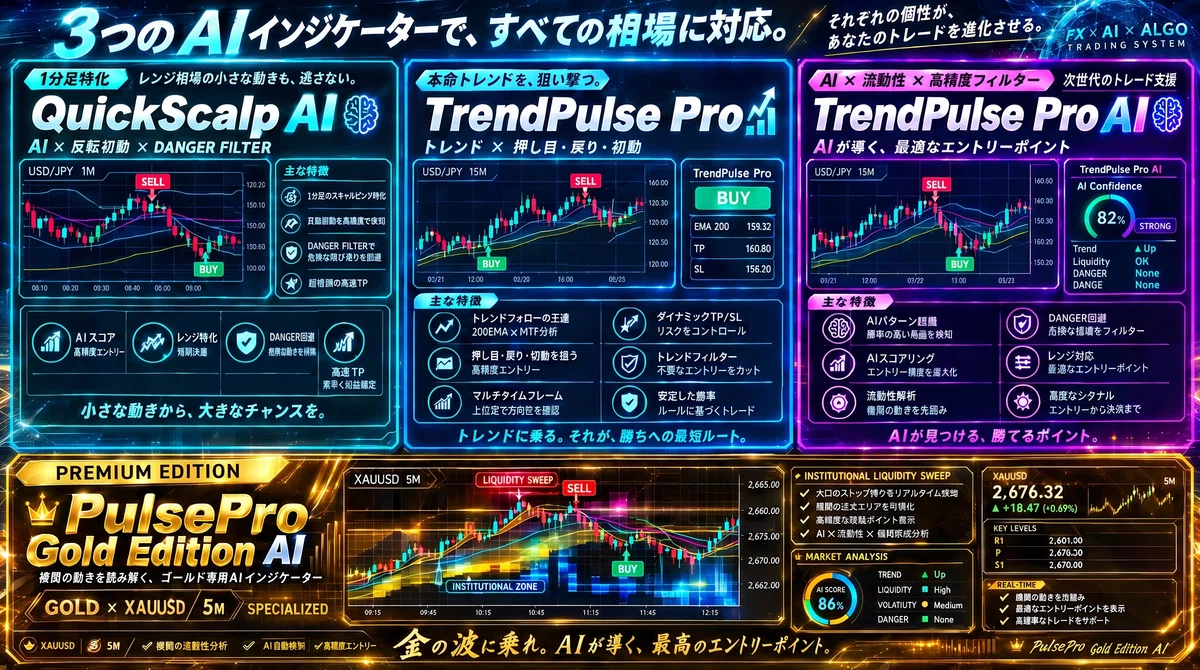
An indicator that eliminates emotion and captures market moves with clear evidence and rules.
Details and design logic are published on each product page
? [GogoJungle Product Page]