

【Re-reading the familiar confirmation procedure】Return one item you skipped thinking you understood
? GogoJungle AWARD 2026 voting is underway
As of the midterm announced on 11/17, I’ve been added to the list of creators currently receiving a surge of support votes^^
To everyone who voted, thank you so much!
Voting is once per person per day, until 11/30 (Mon) 23:59.
From those who voted, 13 people will be selected to win a QUO card worth 1,000 yen.
If my article has been helpful at all, I’d be happy to receive one vote for “Masashi”^^
Of course, if you want to vote for the person you want to support the most, that’s enough.
Have you ever reread the records of a losing trade and couldn’t recall what you checked before entering?
Why does the number of entries increase even when you follow the steps as you’ve been doing?
In the beginning, many people used to check each item, but now many people skip what they “already know.”
Good evening!
This is Masashi^^
This time, I’ll write about the procedure for checks that you’ve become accustomed to.
This is about reading and skipping checks that you think you understand, which happens because you’ve continued for a while.
Once a month, I reread my own checking procedure as if I were explaining it to someone new.
I describe in order what I write down, how I record it, how I compare it, and what I revert.
❌ There were no traces of going to the wall in the records
A common scenario is this.
A losing trade is reviewed on the weekend.
The single line for the reason of entry is written properly.
【Enter when you see you stopped at the lower wall / cut when settled under the wall】
There is a predetermined place to cut, and the amount of loss for one trade is written.
Up to here, it looks like a proper single trade.
But there is no record of whether you checked the higher and lower timeframes before entering to confirm the wall position.
I don’t remember whether I looked or not (;'∀')
✅ When you only read the record, that trade looks like it followed the procedure.
❌ A confirmation you can’t remember is usually a confirmation you didn’t do.
? In the beginning, I used to say each check aloud
Think back to when you first decided your checking procedure.
For example, you might decide the following for entry checks:
・Write the reason for entry in one line
・Decide where to cut
・Reciprocate between the higher and lower timeframes to confirm the wall position
・Calculate the loss amount up to the point of cutting
When you’re just starting, you confirm each of the four steps aloud, one by one.
After each completion, you should have checked what’s next by rereading your procedure notes.
As one month, two months pass, your body starts moving before you reread the notes.
It feels as if the procedure has become your own.
✅ As you continue, you’ll stop rereading the procedure notes.
? If you stop rereading the procedure, the content may have changed without you realizing.
? Getting used to speed is not a bad thing
First, let me say that getting used to checks and performing them faster is not inherently bad.
It’s the result of continuing, so there’s no need to deny it outright.
The line for your reason for entry may be written in a shorter time than before.
You may be able to decide where to cut without hesitation.
This is evidence that the procedure has settled into your body.
The problem is that, among the faster checks, checks you skipped may have crept in unnoticed.
Fast checks and skipped checks look almost the same from the outside.
✅ It’s hard to distinguish fast checks from skipped checks from an external view.
The fix is not speed but the skipped checks that have mixed in within the speed.
? Skipped checks appear as “nothing” in the records
The trickiest thing is not noticing when you skipped something yourself.
Why can’t you notice?
Because the records only show what you did.
The line for entry remains because you wrote it. The place to cut remains because you decided it.
But not going to the wall to check where it is isn’t written anywhere.
What you didn’t do isn’t even blank in the records; there’s nothing there at all.
That’s why, when you reread the records on the weekend, it can look like you followed the procedure.
The more you reread, the stronger your belief that you did it properly can become.
✅ Simply rereading the records won’t reveal skipped checks.
? What remains in the records is only what was done.
⚠ Skipping is most likely to start with the checks you think you know best
There’s another common trait of skipped checks.
Usually, checks that you think you know best tend to be the first ones you skip.
“I don’t need to look at the wall position anymore — I know it.”
“The amount lost per trade is usually the same, so I don’t need to check.”
Checks that you think you know tend to quietly slip away from the procedure.
On the other hand, checks you’re not confident about surprisingly stay in place.
Checks you think you know feel like you won’t cause trouble if you skip them.
But when you decided on those checks, there must have been a clear reason.
✅ The more confident a check is, the earlier it tends to disappear from the procedure.
⚠ When you feel you already know, reread from those checks next month.
? Skipping one check increases the number of entries
Recently, I heard a reader say something like this.
“If you reduce your entry count, you’ll reduce unnecessary losses.”
Reading this reminded me of the skipped checks.
Each check is meant to find a reason not to enter.
If you’re far from the wall, you skip it.
If the loss amount for one entry is too large, you skip it.
Skipping one check reduces the reasons to skip, thereby increasing entries.
The person thinks they haven’t reduced the checks, but the number of places to skip has gone down by one.
The person didn’t intend to reduce the steps.
When losses pile up in weeks with more entries, it may be because one place to skip disappeared rather than a decline in skill.
✅ For every skipped check, one place to skip has disappeared.
? In weeks with more entries, I first check whether the number of checks has decreased.
? Recalling from scratch with an offload of experience
Here, I’ll write a little about my younger self.
After stumbling in stocks and FX, I started a dedicated chat with friends and relearned things.
One rule we set was to not bring in prior experiences.
I aimed to learn from zero, trying to understand not just what someone said but why they said it.
When you have experience, you might immediately think, “I know that.”
The moment you think you know, you stop listening further.
I think the same thing can happen to my own checking procedure.
If I read a procedure I wrote when I was younger, my current self with more experience might skim over it by thinking, “That’s understood.”
✅ The procedure should be read by the eyes of someone who’s seeing it for the first time, not by an experienced self.
? The feeling of experience can hinder you from reading your own procedure.
✔ Write out all checks once a month
Rereading happens only once a month.
It’s small enough to fit on one sheet of paper and a pen, so I set aside some time on the weekend.
First, I write out all the current checking steps.
Even if I have notes from when I decided them, I don’t just copy them verbatim.
There are checks I’ve unconsciously added or removed in my head, so I write them in the order I actually perform them now.
When I write them out, I might find that the order has shifted from the original notes.
That change is considered a normal part of getting used to the process, so I just record it as is.
✅ Write by the current order, not by copying the original notes.
Even if it differs from the original notes, I write it as-is first.
? For beginners, add one-line explanations for why you do each step
Next, for each written check, I add a one-line reason why you do it.
This makes it clear to someone seeing your trading procedure for the first time.
【Reciprocate between the higher and lower timeframes / to avoid entering from a distant location】
【Calculate the loss amount / so you know the amount that can be lost before entering】
When writing for beginners, you can’t simply say “you’ll understand.” You must explain why you do each check.
If you can’t write a one-liner, you may have forgotten why you’re doing it in the first place.
If you read silently, your eyes will skip ahead on their own.
If you read aloud, you must articulate each word, making skipping less likely.
✅ A check that you can’t write in one line becomes the target for rereading.
? The person you’re explaining to can be your past self when you started trading.
⭕ Align with last week’s records and revert one check that has no trace
Finally, line up the written checks with last week’s records.
For each check, see whether there’s a trace of performing that check in last week’s records.
For those without traces, mark them.
There may be two or three marks, but revert only one at a time.
If you revert all at once, the procedure becomes suddenly heavy and another check may be skipped.
The one you revert goes to the very top of the procedure, and in the next month’s reread you confirm whether that one persisted.
In normal records, leave small traces for each check.
【Reciprocated / calculated the loss】
Giving it a name helps you see skipped checks on days without a name.
Checks that only reflect speed leave their name behind, while skipped checks do not have names.
✅ Revert only one check that has a mark.
⭕ Rereading is not about adding new checks; it’s about restoring one missing check.
? Isn’t it impossible to read your own procedure with a beginner’s eye?
People often ask, isn’t it impossible for you to read your own procedure with a beginner’s eye?
This is something I also thought initially was difficult.
What makes it easiest is to pick a specific person as the target.
If that person asks, “Why are you doing this?” you’ll think about what to answer.
Rereading the procedure doesn’t guarantee you won’t lose money.
Even after performing all checks, any loss is kept as an anticipated cost.
The hard part is when you’re looking for the wall position with just your own eyes; the act of going to see it can become fuzzy day by day.
If you see the same line every time, it becomes easy to leave a note in the records indicating you saw it.
However, the line does not replace the checks themselves.
✅ Look at the line and decide whether to enter or skip yourself.
? Choose one of next month’s checks from the ones you’re stuck on.
? GOLD Specific Drug has been featured^^
If you want to sort out your decision-making base, check the content and its limits.
? Summary: The more familiar checks, the more you reread monthly
The more you continue, the faster your checks become.
Getting faster isn’t bad, but sometimes faster checks mix in skipped ones.
Skipped checks don’t leave a mark in the records, so simply rereading won’t reveal them.
Moreover, skipping starts with the checks you think you know best.
Skip one check and you reduce places to skip by one, increasing the number of entries.
So every month, write out all current checks, and for beginners, add a line explaining why you do each check.
Line up with last week’s records and mark the checks that have no traces; revert just one to the top of the next month’s procedure.
This weekend, rewrite all checks, and for each one, add the check name and why you do it as a single line^^
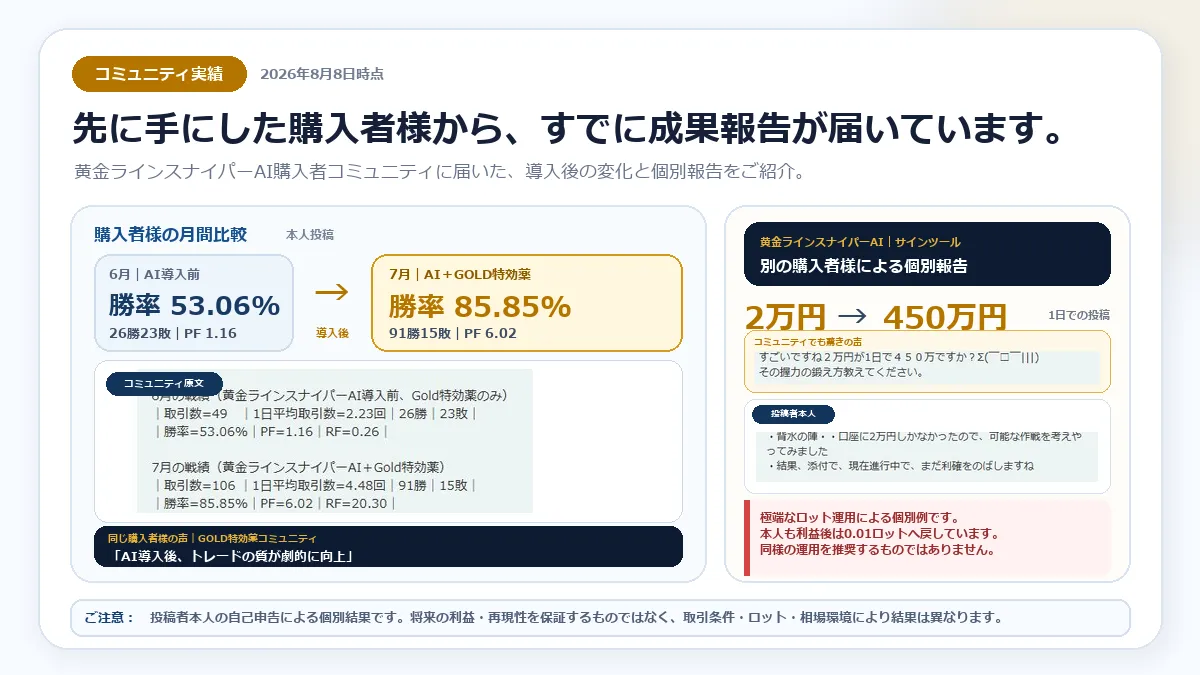
If you want to align wall checks with lines that appear at the same spot, the Golden Line Sniper AI is one option as well.
It does not decide whether to enter or skip for you.
Please use it with the understanding that the display content and limits are checked, and you make the final decision yourself.
✅ The next reread starts from the checks you think you know best.
? Monthly procedure: [Write everything down / Add explanations line by line / Revert one trace with no trace]
View details of Golden Line Sniper AI
Thank you again for reading until the end today^^