
【Weekly Summary and Global Financial Market Overview】NASDAQ Weekly 10% Drop and Entering Adjustment Phase — 95% Chance of December Fed Rate Hike and Bank of Japan Rate Hike Outlook at 1.50%, Hormuz Strait Tanker Fire, and BTC Sharp Decline Intersect in th
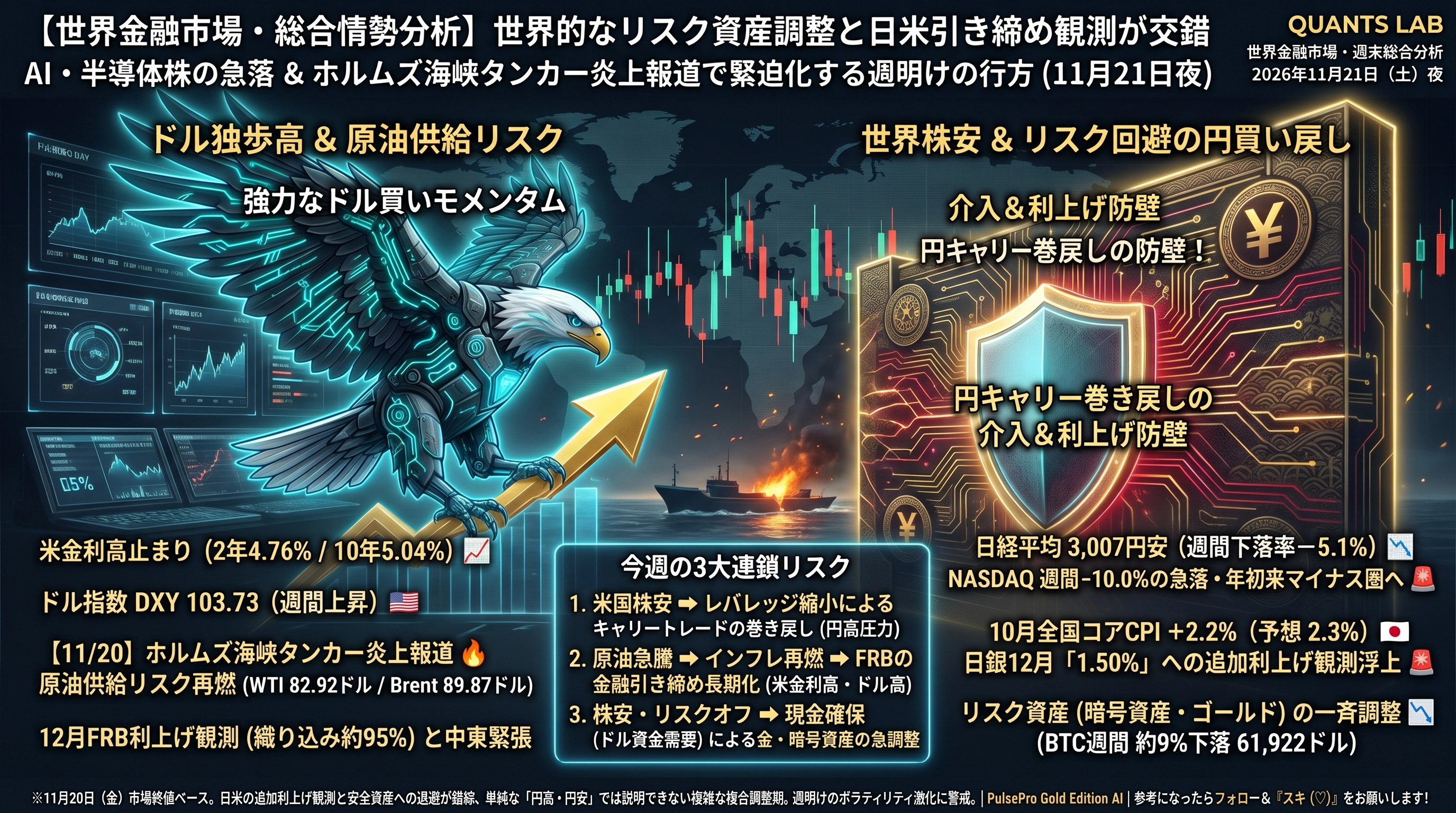
On November 21, 2026 (Saturday) around 20:00, the global financial markets are entering a crucial phase after a tumultuous week (November 16–20) marked by “a global risk asset adjustment sparked by a sharp drop in AI and semiconductor stocks,” with signs of an anticipated tightening in U.S. and Japan monetary policy and reports of oil tanker incidents in the Middle East and the Hormuz Strait. As the week begins, market participants are trying to gauge the next moves. and “The tightening expectations for U.S. and Japan monetary policy”, and further news of“an oil tanker incident near the Hormuz Strait in the Middle East”
Currently, the five most important themes moving the market are listed below.
U.S. monetary policy and long-term interest rates:Inflation concerns have reignited, pushing back expectations for rate cuts and heightening vigilance that December may bring a rate hike (priced in at about 95%) and a longer period of monetary tightening.
Adjustment in AI-related stocks:U.S. stock weakness centered on AI and semiconductor names, with the NASDAQ down 10% for the week and returning to negative territory for the year.
Japan’s prices and BOJ policy:The October nationwide core CPI released on November 20 rose 2.2% year over year, influencing expectations for a potential additional rate hike at the December BOJ meeting (lifting the policy rate to 1.50%).
Middle East and Hormuz Strait risk:Reports on November 20 that a tanker near the Hormuz Strait in northern Oman was attacked by a projectile and caught fire have reignited concerns about oil supply risk.
Crypto assets (BTC) decline:Capital inflows into risk assets such as stocks and crypto have cooled, with Bitcoin (BTC) down about 9% for the week.
A key takeaway from this week's market is that the environment is not a simple, one-way story of stronger dollar and weaker yen; rather, we are in a complex scenario where rising rates, stock declines, and geopolitical risks are all moving in parallel.
Note: Today, November 21 is a Saturday, so major markets are closed. The following forex, equities, commodities, and crypto prices are organized on the basis of the closing prices of November 20 (Friday) and the most recently confirmed public reports and data.
Chapter 1: What is happening in the world’s financial markets
(AI and semiconductor stock plunges and entering a correction phase)
On Friday, November 20, U.S. stock markets saw a broad sell-off led by AI and semiconductor stocks, triggering broader market weakness.
【November 20 (Fri) Close and Weekly Change of Major U.S. Indices】
・S&P 500: 6,910.39 (weekly change: -8.6% / down more than 10% from recent highs, signaling a correction)
・NASDAQ Composite: 22,617.73 (weekly change: -10.0% / also negative for the year)
・Dow Jones: 48,147.33 (weekly change: -8.0% / down more than 10% from recent highs, signaling a correction)
・Russell 2000: 2,581.79 (weekly change: -7.5%)
・VIX: rose to 30.00, signaling a sharp rise in market risk aversion
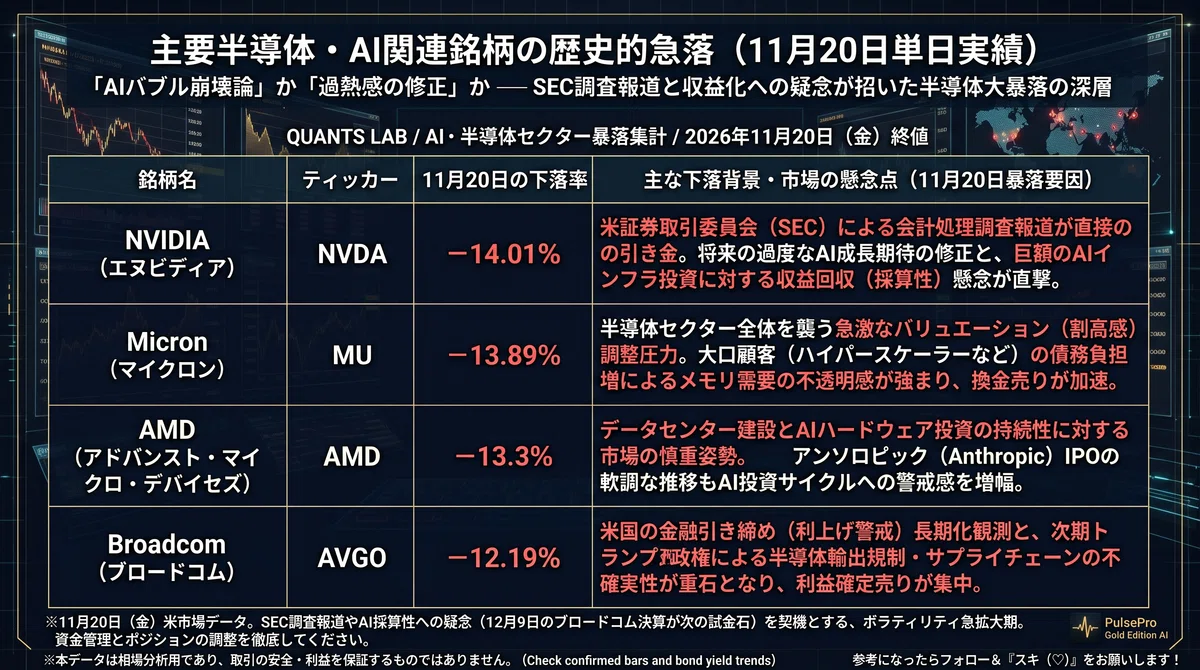
What will be the focus of the stock market going forward
The central question is whether this latest retreat will be limited to AI-related names through profit-taking and valuation adjustments, or it will develop into a broader market downturn. If NASDAQ continues to drop, Japanese semiconductor-related stocks, Korean stocks, and Taiwanese stocks could face stronger downside pressure.
Chapter 2: U.S. monetary policy, the Fed, and the U.S. bond market’s “four tug-of-ws"
1. October FOMC minutes and December rate hike expectations (about 95% priced in)
Key points from the minutes of the October 27–28 FOMC meeting released on November 18 are as follows.
Nearly all participants are wary about the persistence of inflation.
Some participants supported a rate increase at the October meeting.
There is growing discussion of a 0.25 percentage point rate hike in December, with some considering a 0.50 percentage point increase..
Inflation remains above the Fed’s 2% target.
Markets have priced in about a 95% probability of a December rate hike, but market pricing and the Fed’s actual decision are not identical, and future data on prices and employment as well as comments from policymakers could change expectations.
【Fed internal stance】
・Christopher Waller: supportive of a 0.50 point rate increase and additional tightening
・John Williams: cautious about rapid tightening
2. U.S. sovereign yields (around November 20 levels) and the complex impact on USDJPY
【U.S. Treasury yields and FF rate levels】
・U.S. 2-year yield: about 4.76%
・U.S. 10-year yield: about 5.04%
・FF target range: 3.75–4.00%
What is notable is that despite stronger rate hike expectations from the Fed, U.S. Treasury yields fell over the week due to safe-haven demand amid a stock sell-off. In the current rate environment, four forces are clashing:
① Inflation concerns (upward pressure),
② Expectations of further rate hikes (short-term rate rise pressure),
③ Stock sell-off (safe-haven demand),
④ Recession fears (long-term yields falling).
Therefore, the USDJPY is not likely to move in a single direction, as dollar buying from rate-hike expectations collides with yen buying from stock market risk aversion.
Chapter 3: Japan’s economy, the BOJ, and the government bond market — The path of the December 18 meeting for a 1.50% rate hike
1. October national CPI and Governor Ueda’s stance
The October nationwide CPI released on November 20 shows core CPI excluding fresh food at 2.2% year-on-year, surpassing the BOJ’s 2% target for the second consecutive month.
Also, in a November 18 parliamentary briefing, BOJ Governor Haruhiko Kuroda stated:
① It is necessary to stabilize the underlying price growth at around 2%;
② Monetary conditions remain accommodative;
③ It is appropriate to gradually raise policy rates while monitoring economic activity, prices, and financial conditions;
④ It is prudent to avoid asset purchases targeted only at suppressing long-term yields.
This stance was indicated.
2. The five major focuses for the upcoming BOJ Monetary Policy Meeting (to conclude on December 18)
From the current policy rate of 1.25%, a further rate hike to 1.50% is being considered, but December’s decision is not yet certain. The five key items that will influence the decision are below.
Is price increases temporary cost-push or a sustained trend?
Sustainability of wage growth, including spring wage negotiations.
Consumer spending recovery (balance with weak consumption in Q3–Q3 GDP).
Impact of yen depreciation on import prices.
Effect of long-term rate rises on the government bond market, financial institutions, and debt service burdens.
Inflation-driven rate hike expectations are yen-negative, but given the still-large U.S.–Japan rate gap, the yen may remain under downward pressure until a concrete rate hike is confirmed; the pace of U.S. tightening will determine how far yen strength can progress.
Chapter 4: Middle East tensions and the Hormuz Strait
Oil tanker fires and the oil market
1. November 20: Oil tanker attacked near Hormuz Strait in northern Oman
According to Reuters, on November 20, a tanker traveling near the Hormuz Strait about 8 nautical miles off the coast of Hasab, Oman, was attacked by an unidentified projectile and caught fire (UKMTO report). No casualties or environmental damage were reported. Iran’s Revolutionary Guards gave a different account, claiming the tanker contacted a mine, and the exact cause remains unconfirmed.
2. Oil prices (WTI $82.92, Brent $89.87) and four scenarios going forward
As of November 20, WTI was around $82.92 and Brent around $89.87, down for the week, but the continued navigation risk through the Hormuz Strait—a major route through which about one-fifth of global oil passes—directly affects oil-importing economies like Japan.
Middle East and Hormuz Strait scenarios and their impact on the oil market and exchange market
① Easing tensions and diplomatic progressReceives risk-on sentiment and declines in risk premium
② Limited ongoing attacksWith safety demand and possible dollar strength in times of crisis, yen could face mixed pressures
③ Escalation of shipping impedimentsWorsening Japan’s trade balance (yen depreciation) and impact on commodity currencies
④ Large-scale military conflict and risk-off volatilityGlobal risk aversion and equity declines spread
Chapter 5: China’s October data weakness and the 2026 APEC Leaders’ Declaration
1. China’s October economic indicators (released November 16)
【China 2026 October Economic Statistics】
・Industrial production (YoY): +4.8% (below expectations)
・Retail sales (YoY): +0.4% (consumption recovery remains weak)
・Real estate investment (Jan–Oct YoY): -21.6%
・Fixed asset investment (Jan–Oct YoY): -8.1%
China’s domestic demand and real estate slump are clear headwinds for AUD/USD, AUD/JPY, NZD/USD, NZD/JPY, copper and iron ore, and Asian equity markets.
2. Publication of the 2026 APEC Leaders’ Declaration (November 21)
Following China’s Shenzhen-hosted APEC summit on November 18–19, the “2026 APEC Leaders’ Declaration” was published today, November 21. The declaration includes:
① Improvement of trade and investment environment in the Asia-Pacific region,
② Strengthening of supply chains,
③ Utilization of digitalization and AI technology,
④ regional economic growth and macroeconomic stability,
⑤ strengthening of energy security (ensuring energy supply networks and protecting critical logistics hubs). It does not change near-term monetary policy but provides medium- to long-term guidance on the practical implications of U.S.–China trade frictions and semiconductor export controls.
Chapter 6: Europe, the U.K., and Australia’s economic outlook
UK (October CPI 3.6%):The October UK CPI rose 3.6% year-on-year (CPIH 3.7%, core CPI 2.8%), keeping the Bank of England's rate-cut decision challenging.
Australia:Wage and employment indicators, along with downturn in China’s domestic demand, weigh on commodity exports and the Australian dollar.
Europe (Eurozone):Inflation dynamics in the euro area, Germany’s manufacturing sector, energy prices, Russia-Ukraine tensions, and Europe’s fiscal and sovereign yields will influence ECB policy and EUR/USD direction.
Chapter 7: Currency markets (dollar strength, cross-yen, and high-yield currencies) — comprehensive analysis
As of around November 20, reference forex levels are provided (note: values vary by firm’s data cut times).
【Key exchange and dollar index levels around November 20】
・DXY: 103.73 (weekly +0.31%)
・USD/JPY: 159.19 (weekly -0.43%)
・EUR/USD: 1.10 (weekly -0.56%)
・GBP/USD: 1.31 (weekly -0.87%)
Currency-pair-specific strategic views (dollar strength vs risk aversion)
USD/JPY (the most watched pair):
While U.S. rate hike expectations and the U.S.–Japan interest rate gap support the dollar, BOJ’s December rate hike expectations and risk-off yen buying in response to a sharp U.S. stock drop are limiting upside. Next week’s key battlegrounds are around 160 yen, government and Finance Ministry yen-weakness controls, BOJ rhetoric, U.S. 2-year and 10-year yields, and the pace of U.S. stock declines (distinguishing actual intervention from mere speculation).
EUR/JPY and GBP/JPY:
EUR/JPY is capped by European economic slowdown and the divergence in policy between the U.S. and Europe, while GBP/JPY is underpinned by high interest rates driven by UK CPI at 3.6%; however, if global stock declines intensify, selling pressure may rise.
AUD/JPY and NZD/JPY:
Weak Chinese retail sales and global stock declines raise the risk of a risk-off unwind in carry trades, making AUD/JPY and NZD/JPY particularly vulnerable.
MXN/JPY and TRY/JPY:
Even high-yield currencies can face currency losses from capital outflows in emerging markets and risk-off selling during global stock declines. In particular, TRY/JPY requires cautious assessment of Turkey’s central bank policy rate, inflation trends, foreign exchange reserves, and current account dynamics.
Chapter 8: The current state of gold, silver, copper, and crypto assets
1. Precious metals and commodities (reference prices around November 20)
Gold (XAU/USD): $3,560 per ounce/Copper: $5.52 per pound
Why gold fell despite stock market declines:Typically, risk-off moves and Middle East tensions boost safe assets like gold, but this time higher dollar and higher carry costs, along with cash-holding needs from investors amid stock declines, outweighed safe-haven demand. Geopolitical risk does not always push gold higher, so caution is warranted.
2. Crypto assets (BTC, ETH, SOL) in adjustment
【Crypto reference levels around November 20】
・Bitcoin (BTC): approximately $61,922
(down about 9% week-on-week and significantly lower for the year)
・Ethereum (ETH): approximately $1,927.59
・Solana (SOL): approximately $78.10
BTC’s decline is driven by expectations of U.S. monetary tightening, risk-off pressure from AI and U.S. stock declines, a stronger dollar, deleveraging, and liquidity concerns. In the short term, crypto remains more of a risk asset than digital gold; caution is advised until U.S. stock declines stabilize, the DXY slides, physical ETF fund flows improve, and futures positions and funding rates improve.
Chapter 9: Weekly market wrap-up for November 16–20 and the “Four-Stage Structure of Capital Movements”
Weekly performance summary of major markets
S&P 500: -8.6% / NASDAQ: -10.0% / Dow: -8.0%
Dollar index (DXY): up; USD/JPY: slight decline
Gold: sharp drop; Crude down; BTC: about -9% drop
The four-stage process of capital movement observed this week
Stage 1 (AI and semiconductor stock corrections):Sell-off concentrated in AI-related stocks with high growth expectations.
Stage 2 (spread to risk assets broadly):Selling extended beyond NASDAQ to Dow, Russell 2000, and BTC.
Stage 3 (flight to safe assets and cash):Funds moved to U.S. Treasuries; dollar strengthened; gold pressured by cash-cash conversions.
Stage 4 (policy dilemmas surface):Inflation containment versus stock weakness fueling recession fears; markets move into a more complex regime that cannot be explained by a simple risk-on/risk-off dichotomy.
Chapter 10: Three major market scenarios for November 23 onward and monitoring priorities
Monitoring priorities
Three scenario branches to gauge market development next week (from November 23 onward).
Scenario A [? Risk-off expands further (watch scenario)]:
Condition: U.S. stocks keep falling, VIX stays high, BTC continues to slide.
Assumption: Money shifts into U.S. Treasuries and out of emerging-market currencies; strong downside pressure on cross-yen pairs (especially AUD/JPY, NZD/JPY, MXN/JPY, TRY/JPY).
Scenario B [? Autonomous rebound in U.S. stocks (rebound scenario)]:
Condition: AI and semiconductor stocks see buying; VIX declines and BTC stabilizes.
Assumption: Carry trades briefly recover and cross-yen pairs rebound, but ongoing Fed tightening expectations warrant caution about lasting momentum.
Scenario C [? Reignition of inflation and geopolitical risk (complex risk scenario)]:
Condition: Oil surges due to escalating Hormuz Strait disruptions, inflation re-accelerates, and expectations for further Fed hikes intensify.
Assumption: U.S. yields rise and the dollar strengthens, while gold, stocks, and crypto become more volatile. USD/JPY will swing as dollar strength and risk aversion collide.
Important watch items and trade priorities for next week
Most important themes:
① Possibility of a December Fed rate hike,
② Siding of U.S. stock declines and stabilization of AI/semiconductor stocks,
③ Hormuz Strait navigation conditions
Top priorities for currency and market trades:
1st: USD/JPY(Fed, BOJ, and intervention risk)
2nd: AUD/JPY(China economy and stock declines)
3rd: MXN/JPY(risk aversion and interest-rate differentials)
4th: EUR/USD(U.S.–EU monetary policy)
5th: TRY/JPY(outflows from emerging markets and swap risk)
6th: BTC/USD(U.S. stocks, dollar, liquidity)
Bottom line: Be wary of three linked risks and monitor correlations
and assess changes in correlations
The market from November 16–20 was not simply a temporary stock price correction; it was a week in which three factors—“monetary policy,” “re-evaluation of AI investment,” and “geopolitical risk”—simultaneously shook market structure. and
three linked processes.
1) U.S. stock weakness → leverage unwind and carry trade reversal (cross-yen triple)
2) Crude oil at high levels → inflation reaccelerates → prolonged Fed tightening
3) U.S. stock weakness → increased dollar demand → emerging-market currency declines (MXN, TRY, etc.)
In the current market, it is dangerous to assume that a stock market decline automatically means yen appreciation, or that expectations of higher rates automatically push long-term U.S. yields higher. Even when U.S. stocks fall, safe assets like the dollar can strengthen, and even when rate hike expectations are high, U.S. long-term yields can fall due to economic concerns. Next week, monitor not a single chart but four variables—“U.S. rates, the dollar index (DXY), U.S. equities, and crude oil”—simultaneously and maintain disciplined risk management.
Accuracy of information, timing basis, and primary sources
This article is organized based on public materials and reports verified as of Saturday, November 21, 2026. Since today’s markets are closed, forex and stock prices are primarily based on November 20 closing prices, including reference values that vary by data cut times from different organizations. Unverified policy statements and market prices have not been added as facts.
Main reference materials:Bank of Japan (published materials and Governor Ueda’s remarks) / APEC (2026 Leaders’ Declaration) / UK Office for National Statistics (October CPI) / AP News (FOMC minutes and November 20 U.S. stock market) / Reuters (Hormuz Strait tanker attack and China’s October economic data)
If you found this at least somewhat helpful, please consider following and pressing the heart icon at the bottom of the screen to encourage updates!

“TrendPulse Pro” free trial:https://www.gogojungle.co.jp/tools/indicators/86532?via=users
“TrendPulse Pro AI” free trial:https://www.gogojungle.co.jp/tools/indicators/86529?via=users
“QuickScalp AI” free trial:https://www.gogojungle.co.jp/tools/indicators/86523?via=users
An indicator that removes emotion and captures market conditions with clear evidence and rules.
Functionality details and design logic are published on each product page
? [GogoJungle product page]