

【Current status and future prospects of carry trades】Where should we focus in high-interest-rate emerging market currencies? Updated November 20, 2026 - Thorough analysis of the world's monetary policy and foreign exchange markets
Investigation Reference Date: November 20, 2026
In the foreign exchange market, carry trades (investments aiming for interest rate differentials) are at a major turning point now.
In this analysis, we deliver a comprehensive analysis of carry trades that goes beyond a mere introduction of high-interest currencies, considering the world’s monetary policy as of November 20, 2026, the interest rate differentials between Japan and the United States and emerging markets, exchange demand and supply, and each country’s economic and political situation.
The most important fact to emphasize at the outset is that it is not a simple market where you automatically profit by buying currencies with high policy rates. The success or failure of carry trades must be examined by clearly separating the following elements.
Interest income from high-yield currencies (swap points)
FX gains/losses against the yen
Monetary policy of each country's central banks (continued rate hikes or entering easing)
Inflation rate, fiscal discipline, current account, political risk
Risk of unwind of yen carry trades
Also, in practical trading, care must be taken not to confuse “the policy rate set by each country's central bank” with the swap points actually offered by FX companies to customers. This article uses data based on primary sources to detail the selection criteria for high-yield emerging market currencies toward 2027.
Chapter 1: The Carry Trade Mechanism and
The Essence of “Total Return”
Carry trade is an investment method that borrows funds in a low-interest-rate currency and invests the funds in high-interest-rate currencies or high-yield assets to earn profits from interest rate differentials. In the foreign exchange market, selling relatively low-interest-rate currencies like the Japanese yen or Swiss franc and buying high-interest-rate currencies such as the Mexican peso, Brazilian real, and Turkish lira is a representative example; the yen has been used as a primary funding currency for many years.
The ultimate profitability of this trade is determined by the following two interactions.
Earnings from interest rate differentials:Swap points accumulated daily during the holding period
Profit or loss from exchange rate movements:Whether the invested currency appreciates versus the yen (yen depreciation) or depreciates (yen appreciation)
For example, even if annual interest earnings amount to about 10%, if the invested currency falls 15% against the yen in one year, the exchange loss would exceed the interest income, resulting in an overall negative return. Therefore, in carry trades, what matters is not the nominal high interest rate by itself, but the total return that incorporates exchange rate risk.
Chapter 2: Global Monetary Policy and
Interest Rate Environment as of November 2026
As of November 2026, world monetary policy is not uniform, with clear policy twists varying by country. Some countries keep high rates to curb inflation, others are easing as price momentum softens, and some raise rates to defend their currencies.
Overview of Policy Rates in Major and Emerging Economies (as of November 20, 2026)
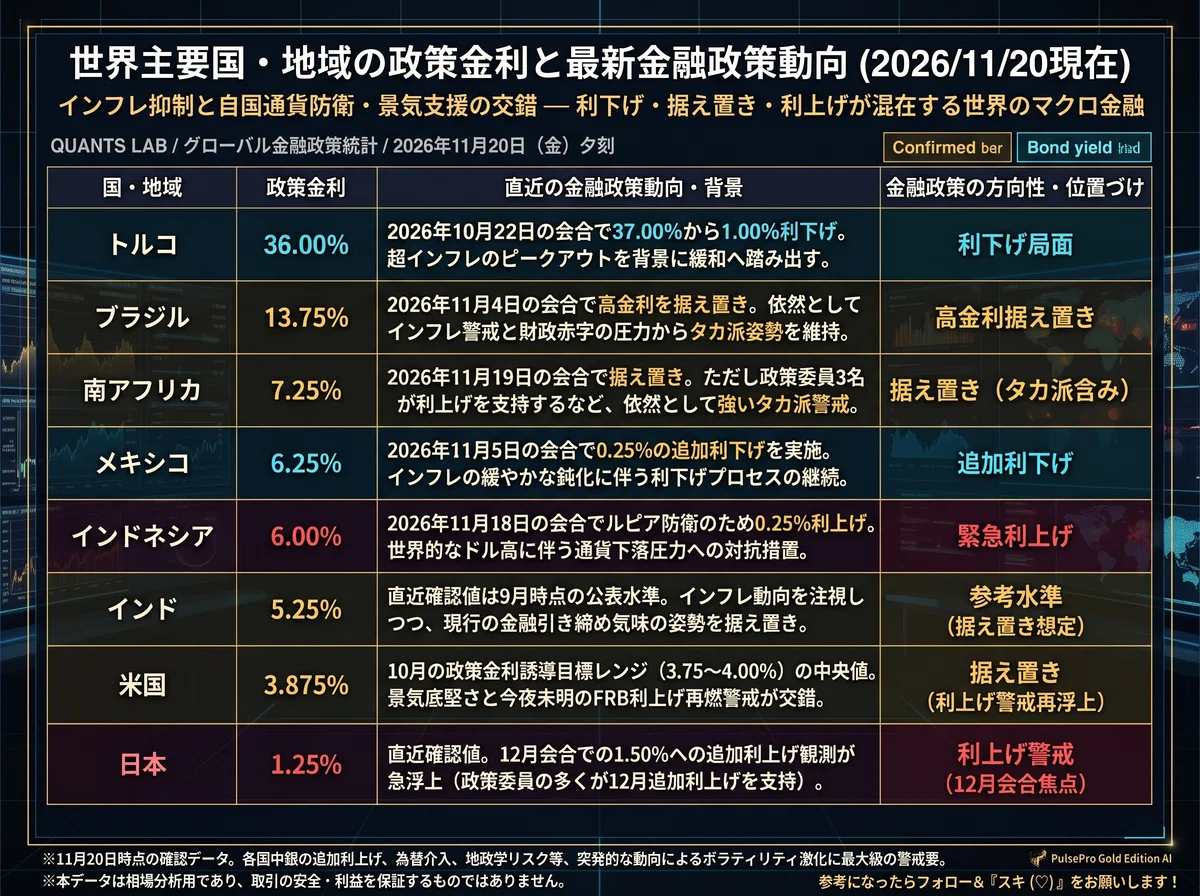
Note: Policy rates are those published by each central bank. Because interest rate regimes and publication dates vary by country, these are not direct one-to-one comparisons of the latest decisions on the same day.
Four Emerging Market Central Banks’ Latest Trends to Watch
Brazil (held at 13.75%):
The Central Bank of Brazil held the policy rate at 13.75% at its November 4 meeting. Inflation expectations rising, energy prices driven up by Middle East tensions, and uncertainty around fiscal policy keep the 2026 inflation forecast at 5.6% and 2027 at 4.7%, with residual uncertainty about convergence to the inflation target.
Mexico (cut to 6.25%):
The Bank of Mexico cut the policy rate to 6.25% on November 5. Inflation deceleration supported the cut, but the central bank notes upside risks to inflation Outlook. If further rate cuts continue, the interest-rate differential versus the yen may gradually narrow.
Indonesia (rate hike to 6.00%):
On November 18, Bank Indonesia raised the policy rate by 0.25 percentage points to 6.00%. The move is to defend the rupiah and curb inflation (October inflation 3.23%, Q3 2026 GDP growth 5.47%). It signals currency defense, but also implies strong currency depreciation pressure, so monitor foreign exchange reserves and capital inflows/outflows carefully.
South Africa (held at 7.25% with a hawkish internal tilt):
The South African Reserve Bank kept the rate at 7.25% on November 19, but voices are split within the Monetary Policy Committee, with 3 of 7 members supporting a 0.25% hike. October inflation rose to 5.2% due to energy-driven fuel price increases; future price dynamics will influence policy and the rand.
Chapter 3: Individual Thorough Analyses of Six High-Interest Emerging Market Currencies
to Watch
We examine the six major currencies not only from the interest rate level but also from the perspectives of economic fundamentals, monetary policy, and exchange-rate risk.
① Mexican Peso (MXN)
Characteristics and Strengths:A representative high-yield currency familiar to Japanese private investors, with strong economic ties to the United States (exports to the U.S., manufacturing investment due to nearshoring) supporting the economy.
Risks to Watch:Direct exposure to U.S. trade policy and business cycles; a slowdown in the U.S. economy would burden the peso. Also, pay attention to narrowing yield differentials as the Banco de México cuts rates in its cycle.
Key Considerations:Rate cut pace by Banco de México; U.S. monetary policy, economy, and employment; U.S.-Mexico trade relations; inflation in Mexico and capital inflows/outflows.
Overall Rating:Still important for yield-seeking, but must incorporate a diminishing rate advantage in a rate-cut phase.
② Brazilian Real (BRL)
Characteristics and Strengths:Among emerging markets, it offers notably high real interest rates. JPMorgan Asset Management’s Q4 2026 analysis also labels Brazil as an attractive market in terms of real policy rates.
Risks to Watch:Chronic fiscal deficits, government debt issues, and political uncertainty. Post-2026 election fiscal management and spending discipline will significantly affect the real rate’s credibility over the medium to long term.
Key Considerations:Trajectory of fiscal deficits and government debt; inflation and central bank policy; commodity markets and resource exports; foreign investor flows.
Overall Rating:High real yields are attractive, but require strict screening of fiscal and political risks.
③ South African Rand (ZAR)
Characteristics and Strengths:A high-yield currency tied to mineral resources such as gold and platinum, with strong linkage to global commodity markets.
Risks to Watch:In times of global financial market instability (risk-off), it tends to be sold first. Domestic power supply issues, high unemployment, and fiscal/political conditions present structural risks. Currently, inflation rising to 5.2% requires careful policy response.
Key Considerations:Gold, platinum, and crude oil prices; South Africa’s inflation rate and central bank’s rate-hike decisions; domestic power supply and fiscal conditions; global risk appetite.
Overall Rating:Benefiting from interest income and commodity strength, but at risk of sharp declines in a global stock slump or risk-off phase; require vigilance.
④ Turkish Lira (TRY)
Characteristics and Strengths:Remarkably high nominal interest rate of 36.00% among currencies covered here.
Risks to Watch:Prolonged high inflation and lira depreciation structure persist. Central bank has continued tightening, but in October 2026 cut rates from 37% to 36%. Even with high nominal rates, if the lira falls faster than the rate, swap income cannot offset the losses.
Key Considerations:Difference between real inflation and policy rate (real interest rate); central bank independence and policy continuity; foreign exchange reserves and current account; political situation and a controlled pace of lira depreciation.
Overall Rating:High interest income is attractive, but the risk of FX losses and policy shifts is very large; holding long-term based solely on high nominal rates is dangerous.
⑤ Indonesian Rupiah (IDR)
Characteristics and Strengths:With a large population and strong domestic demand, supported by the resource sector, it maintains high real GDP growth (Q3 2026 real GDP growth at 5.47%).
Risks to Watch:The November 18 rate hike is strongly about defending the rupiah; if U.S. interest rates rise and the dollar strengthens, rate hikes alone may not prevent outflows and currency depreciation. Monitor foreign reserves and capital flows carefully.
Key Considerations:Indonesia central bank policy; rupiah-dollar exchange rate and foreign exchange reserves; trade and current accounts; foreign investor holdings of government bonds; U.S. interest rates and the dollar index.
Overall Rating:Strong economic growth and a tightening stance are notable, but currency stability needs to be verified.
⑥ Colombian Peso (COP)
Characteristics and Strengths:Similar to Brazil, a South American currency attracting institutional investors due to high real rates. JPMorgan’s Q4 2026 analysis rates its prospective real policy rate at about 6.7%.
Risks to Watch:High dependence on oil and commodity markets; energy price fluctuations directly affect currency value, with fiscal, political, and inflation trends also uncertain.
Overall Rating:High real rates are attractive, but must monitor oil price trends and domestic policy changes in tandem.
Chapter 4: Carry Trade Towards 2027
Five Major Themes
By 2027, the macro environment that must not be ignored for trading emerging market currencies consists of the following five points.
U.S. monetary policy and the dollar (DXY rising toward around 103.9):
As of November 20, 2026, with concerns about renewed U.S. inflation and hawkish remarks by a Federal Reserve official, the dollar index has risen toward around 103.9 and the U.S. dollar is set for four consecutive weeks of gains. If U.S. interest rates remain high and the dollar strengthens, funding outflows from emerging markets intensify, creating headwinds for those with substantial dollar-denominated debt.
BOJ policy and the unwind of the yen carry trade:
A rise in Japanese rates (expected to move from 1.25% to 1.50% on December 1) would reduce the profitability of carry trades funded in yen. If risk-off moves push the yen higher, investors holding overseas assets may dump high-yield currencies to buy back yen, triggering a “carry trade unwind.” A unwind occurred in 2024 when the BOJ’s rate actions triggered a global stock market decline.
Two-sided Middle East tensions and oil prices:
Oil price increases from Middle East tensions worsen the trade balances and inflation (currency depreciation) for energy-importing countries (Turkey and some Asian EMs), while improving trade balances for resource-exporting countries (Brazil, Colombia), leading to mixed national outcomes.
Global stock market fluctuations and risk aversion:
Carry trades assume a calm “risk-on” market. Global stock declines or rising volatility can unwind leveraged positions rapidly, reducing profits built up from interest income.
Fiscal discipline and political climate of each country:
Widening budget deficits and political instability erode foreign investors' confidence, causing currency selling even if policy rates are high.
Chapter 5: Comprehensive Assessment of the Six Currencies and
Six Major Carry Trade Risks
Matrix of Characteristics for Noteworthy Currencies (as of November 20, 2026)
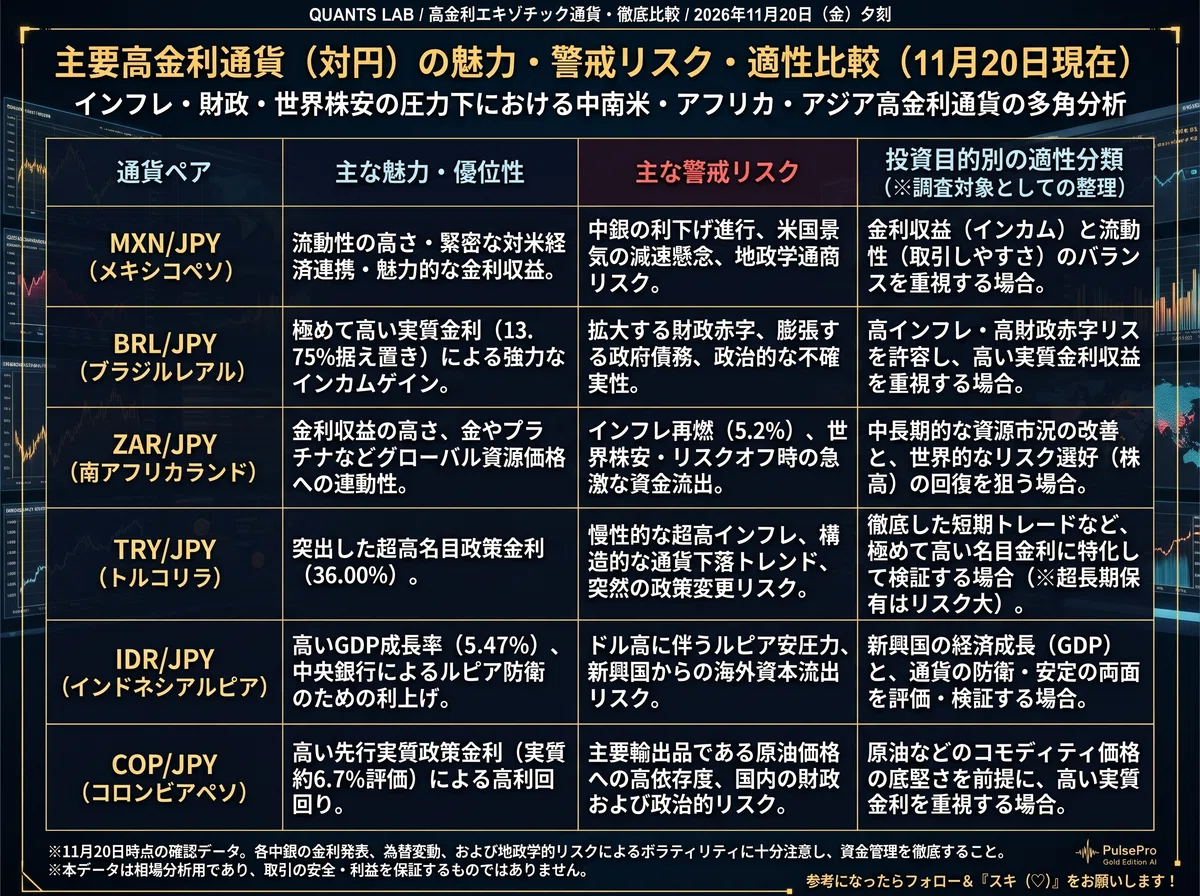
Note: The above classifications are for analysis purposes and do not guarantee future profitability or safety.
Six Major Risks in Carry Trades to Watch
FX Risk:A currency’s decline can wipe out years of interest earnings in a single move.
Monetary Policy Risk:Rate cuts by central banks (or BoJ rate hikes) can compress the interest-rate differential.
Political Risk:Regime change, post-election fiscal deterioration, or political interference in central banks can cause sharp currency declines.
Liquidity Risk:In EM currencies, spreads can widen rapidly during market shocks, making it hard to execute at desired prices.
Leverage Risk:Rapid yen appreciation can cause margin maintenance to fall sharply, triggering forced liquidations.
Swap Change Risk:Changes in swap conditions or market rates can reduce received swap amounts (or reverse payments).
In particular BIS (Bank for International Settlements) noted in its May 2026 analysis that unwind of carry trades using leverage could amplify exchange-rate movements caused by monetary policy changes. Money management is essential to avoid losing the gains accumulated during tranquil times when rapid yen appreciation and risk aversion trigger unwind.
Overall Conclusion: Toward 2027
Selection Criteria for Truly Viable High-Interest Currencies
As of November 2026, carry-trade environments worldwide have become more complex due to divergent monetary policies. The challenge for the next phase is not simply buying currencies with high nominal rates, but calmly selecting currencies that meet the followingsix conditionsto ensure resilience.
【Six Criteria for High-Interest Currencies Toward 2027】
1. Real interest rate (inflation-adjusted) is sufficiently secured
2. Inflation is stable or decelerating
3. Central bank independence and high credibility of monetary policy
4. Fiscal and current account sustainability
5. Sufficient liquidity in the foreign exchange market
6. Even in global risk-off environments, extreme currency crashes are unlikely
The essence of carry trades is not simply “continuing to collect high interest,” but “limiting losses from currency depreciation while preserving total interest income.”
Toward 2027, we should continuously monitor U.S. monetary policy (DXY trends), additional BoJ rate hikes, energy-price changes due to Middle East developments, and each country’s fiscal situation, while rigorously managing positions from four perspectives: interest rates, exchange rates, economy, and politics.
Disclaimer
This article is market analysis based on publicly available economic/financial information and does not recommend buying or selling any particular currency. Exchange rates, swap points, and policy rates are always in flux. Foreign exchange trading with leverage can result in losses exceeding the principal. Please make investment decisions based on the latest published information and your own risk tolerance.
Key Primary Sources and References for This Analysis
Banco Central do Brasil: Monetary Policy Decision on November 4, 2026 (policy rate held at 13.75%)
Banco de México: Monetary Policy Decision on November 5, 2026 (policy rate cut to 6.25%)
Central Bank of Turkey: Monetary Policy Decision on October 22, 2026 (policy rate cut to 36.00%)
Reuters: Indonesia on November 18 rate hike (raised to 6.00%)
Reuters: South Africa Reserve Bank on November 19 decision (held at 7.25% and inflation trend)
J.P. Morgan Asset Management: Q4 2026 Emerging Market Bonds and Real Interest Rate Analysis
BIS (Bank for International Settlements): May 2026 Analysis (Carry trades and the spillover to exchange rates from monetary policy)
Banque de France: Research on carry trades and exchange-rate volatility
If you found this helpful, please follow and press the “Like (♡)” button at the bottom of the screen to encourage updates!

“TrendPulse Pro” Free Trial:https://www.gogojungle.co.jp/tools/indicators/86532?via=users
“TrendPulse Pro AI” Free Trial:https://www.gogojungle.co.jp/tools/indicators/86529?via=users
“QuickScalp AI” Free Trial:https://www.gogojungle.co.jp/tools/indicators/86523?via=users
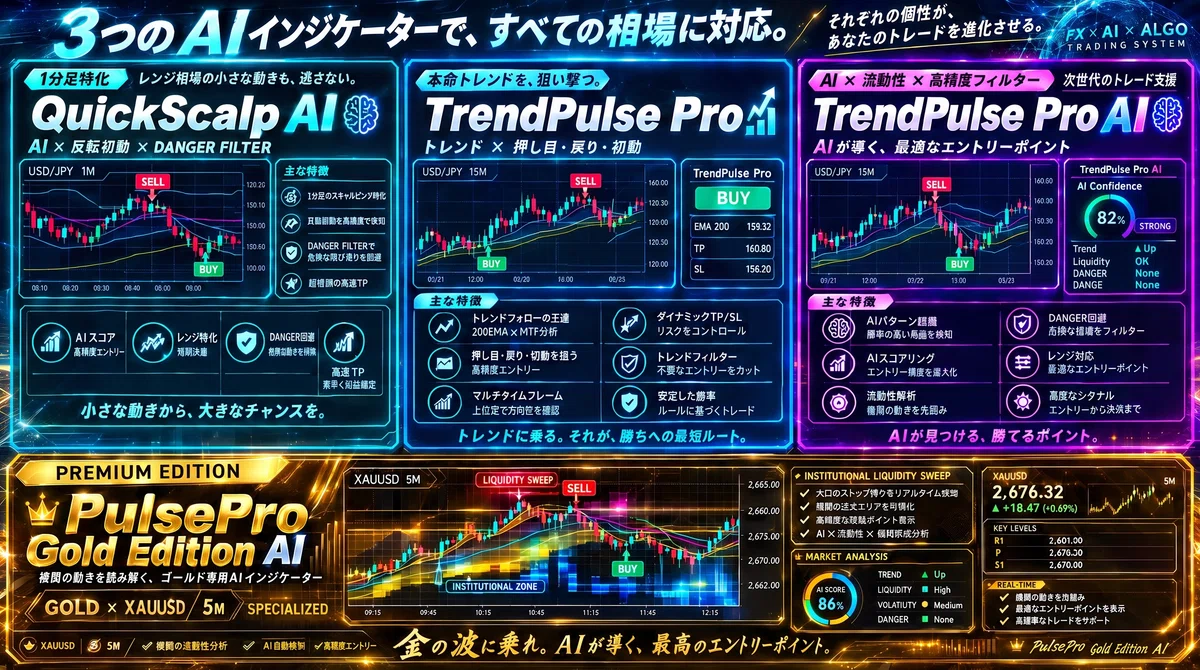
An indicator that eliminates emotion and captures the market with clear fundamentals and rules.
Details of features and design logic are published on each product page
? [GogoJungle Product Page]