
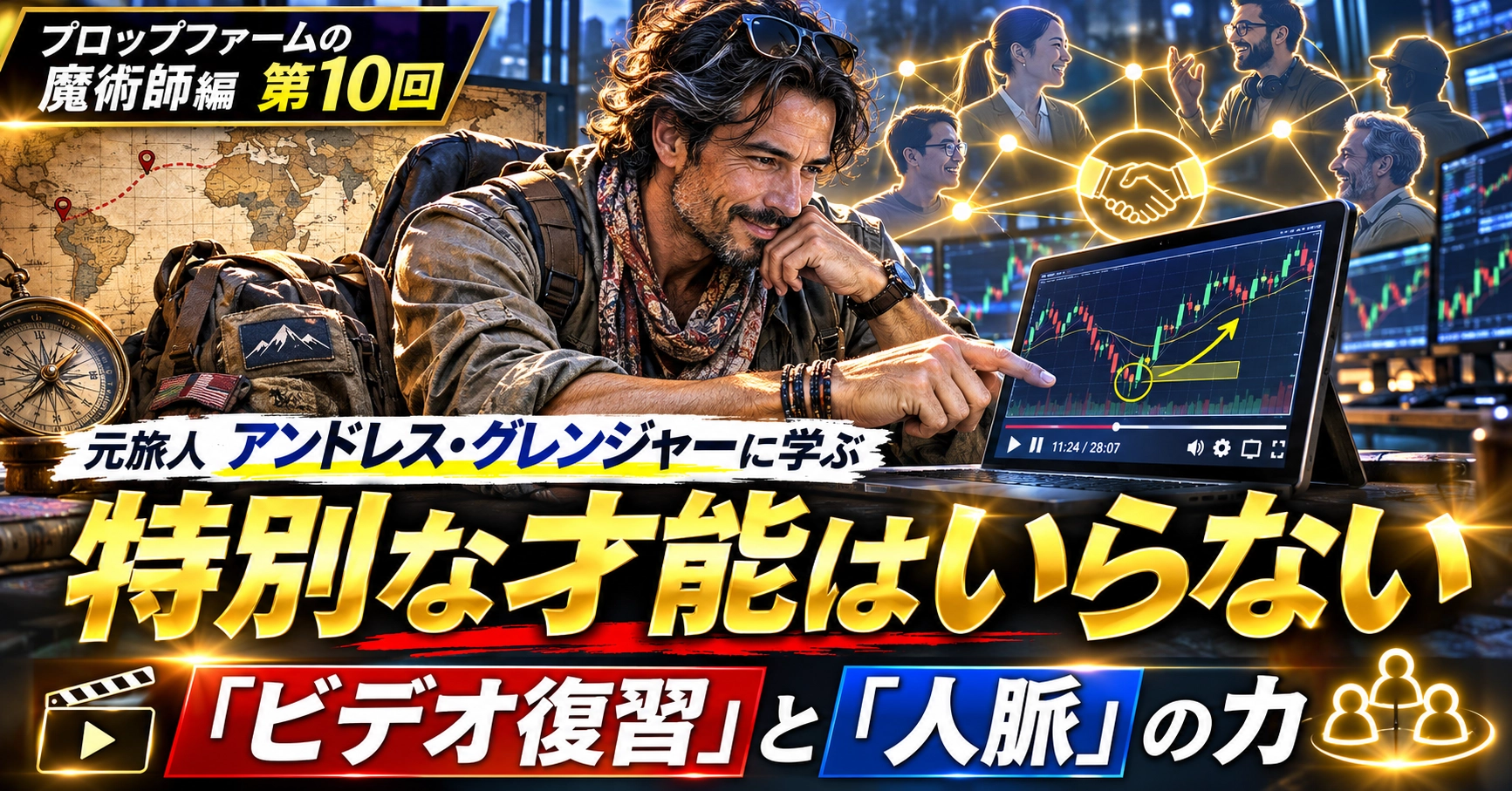
[Prop Farm Wizard Edition] Episode 10: You don’t need special talent?? Learn from former traveler Andres Granger the power of “video review” and “networks”

In short, Andres Grenger could become head of a fund managing tens of millions of dollars (over a hundred million yen) not because he was a special genius.“I recorded my trades to crush my mistakes, and valued connections with people”, these two things were steadily built up through earnest effort.
The person who appears in Chapter 10 is a “normal former traveler” from Spain who grew up in America and moved to Korea after a trip in Asia upon graduating university. As he himself says, “I am by no means exceptionally clever,” his path serves as the most practical and encouraging example for those of us aiming for independence in trading.
1. The Turning Point After Two Straight Years of Losing
The reason Granger took trading seriously was that he was exhausted with his life as a company employee in Korea. He longed to escape the days of leaving for work in complete darkness and returning home in darkness, and he plunged into the world of trading.
However, it did not go smoothly from the start.
The first two years he kept burning through capital:Every time he stepped into the market, he lost money, bouncing between real-money trading and practice accounts many times.
The fear of huge losses in just three seconds:In short-term trades lasting seconds to minutes, when he clicked, the market surged, and he froze like a deer in the headlights, losing 1,300 dollars in just three seconds (more than his one-month loss at that time).
The decisive reason his skill improved:After about two years his results stabilized and profits surged. It wasn’t because he found an amazing winning method, but because he was able to eradicate “ridiculous mistakes” such as accidentally clicking on the wrong stock or jumping in at high prices.This is why.
2. The Stronger-Than-Static “Trade Recording”
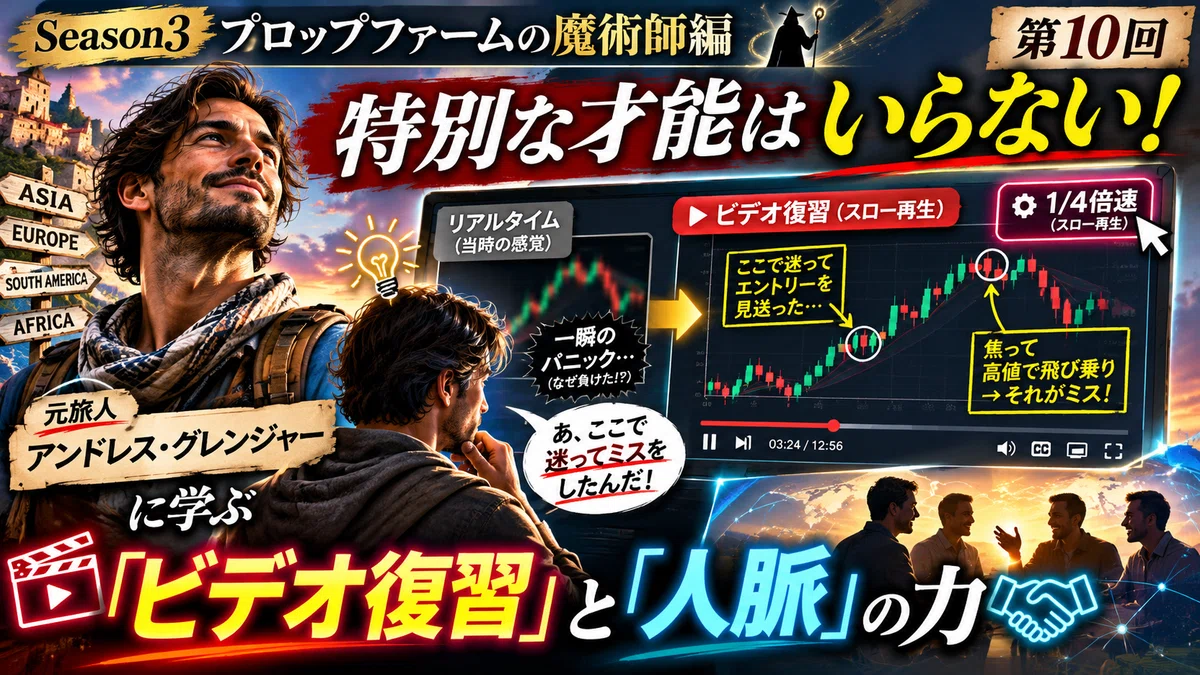
To eliminate trivial mistakes, he practiced and asserts that what truly helped wasrecording his own trading screen in its entirety and reviewing it.
He would record his home trades and later bring them to cafes like Starbucks to review them carefully. Watching videos has a major advantage over still images.
Slow motion at one-quarter speed:During live trading, price movements and his hesitation pass in an instant; slow review lets him confirm them slowly.
You can identify “days with bad price movement”:Continued review makes it intuitively clear which days have favorable moves and which days not to engage.
Useful for calm analysis immediately after a big loss:Even on days when he panicked after a three-second loss, closing the trading screen and reviewing the recording 15 minutes later allowed him to calmly understand what happened.
He also emphasizes maintaining the humility to question oneself after wins — “was this success due to the market, or was it due to my own trading?”
3. Making Money Without a Trend: Targeting Price Gaps
Many people think trading is simply buying when the market is rising and selling when it is falling (going with the trend). Yet Granger proves that profits can be made even without predicting whether the market will rise or fall.
Currently, he operates by combining two methods (funds).
Arbitrage: Targeting price gaps:Even for the same crypto asset, there can be a temporary price gap between the “spot market” and the “futures market.” Buy the cheaper and sell the higher-priced counterpart simultaneously when the gap exists, and settle once the price gap reverts to capture the spread.
Trend-following: Riding the wave:Using moving averages like the 5-day and 30-day lines, he jumps in when a clear trend appears. There are years of big earnings, but there are also tough periods with no profits for months, which can be mentally challenging.
Balancing bots and humans:While the core trading is automated, in unforeseen volatile market conditions, humans are always prepared to respond manually.
In terms of overall profitability, the trend-following method can be flashier in some years, but he is drawn to the steadier and more reliable method of “targeting price gaps” for consistent daily earnings. This shows a preference for stability and reproducibility over flashiness.

4. What Changed His Life: a Little Communication and Networking
The biggest inflection for a normal individual trader to become capable of managing large funds was his network of people (connections).
He joined a paid study group (Discord):He joined an online group run by a former trader from a major financial institution and was exposed to professional discussions.
Produced videos that were mostly jokes, with some learning:He created entertaining videos introducing his methods for group members, and fund personnel who saw them invited him to collaborate.
Collaborating with experts on things he was weak at:By teaming up with colleagues with different strengths, such as a programmer from a former major bank, they completed a full-fledged system that he could not have built alone.
Furthermore, after he began managing other people’s funds, his trading refined even more. As the saying goes, “the first cut losses are the cheapest,” and he developed prudence to cut losses immediately if anything seemed off.
?Overview and Next Actions (Summary)
The teachings of Andres Granger are all practical things we can imitate starting today.
Record your own trades and review them:Even just recording the screen with a smartphone is fine. Review losing trades and moments of hesitation in slow motion, and eliminate one simple mistake at a time.
Keep in mind that “the first cut is the cheapest”:Prolonged losses cost you money and heart. If something feels off, get out when the damage is smallest.
Don’t shoulder it alone—find peers:Connect with serious traders online or in real life, share your insights openly, and you’ll find opportunities often come through people.
Even without special talent, facing your mistakes honestly and valuing relationships can open many paths.
Now, we have reached Part 2, “Fund Managers Who Were Former Prop Traders.” From the next issue (Chapter 11), we will enter Part 3, “The Pros of Prop Trading.” The figure appearing in Chapter 11 isJean-François Bouchet. After a fierce battle with leukemia, he spent eight years to learn to profit from ultra-short-term trading and to acquire the discipline of facing losses correctly and exercising patience. We will delve into the record of his soul.