

Investigation into GAFA for antitrust law violations! Is growth that moves the world hitting its limits?
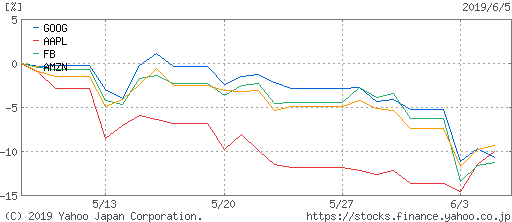
There were reports that the U.S. government is launching investigations into GAFA (Google, Apple, Facebook, Amazon) for potential violations of antitrust laws. In response, the four companies' stock prices have begun to fall.
Clash between entrenched interests and a new world
There is no doubt that these companies hold monopolistic power in the market. However,that power is sometimes a target of attack. President Trump has criticized Amazon for using the U.S. Postal Service at a loss.
Antitrust laws are designedto ensure fair trading practices. For example, if competitors collude to fix prices, consumers' interests can be harmed, so such behavior is prohibited. Also, it is considered unfair trade for a company with monopoly power to impose onerous terms on its trading partners (abuse of a dominant position).
However, the rise of internet companies represented by GAFA makes the interpretation of antitrust laws difficult. The reason isthat they have not raised prices to harm consumers, but have offered services for free to expand their share.
Who would be harmed as GAFA expands its share? It would becompetitors. As long as GAFA exists, it will be difficult for others to compete in the same business. Conversely, there is fear that their own businesses could be driven out by free services.
In other words, this is now seen less as protecting consumers' interests and more asa clash between entrenched interests and a new world.
Entrenched interests that fear and President Trump who exploits them
This tendency is most evident in Europe. Google was fined 570 billion yen by the EU for antitrust violations. The stated reason is that preinstalled Google apps on Android devices hinder competition, but since consumers can download any apps they want, it feels somewhat forced. Since then, they have continued to harass under the banner of protecting personal information.
In Europe, IT companies comparable to GAFA have not grown, and they constantly follow behind the United States. They are probably trying to protect regional companies by restraining GAFA, but consumers will still use Google search and Gmail on Android devices.
Of course, there are also similar moves happening locally in the United States.President Trump acts as a representative of entrenched interestsand seeks to gain support by criticizing GAFA. This move may also be a government action aimed at next year's presidential election.
On the other hand,the current economic prosperity of the United States cannot be explained without the power of GAFA. It is because these companies exist that money and information accumulate in America. Destroying that system would bring more disadvantages than benefits, so bold actions may not be taken.
The ultimate form of capitalism x the Internet
What is terrifying is that Googlecould be fined 570 billion yen and remain financially unshaken. In other words, these companies have so much money that they do not know what to do with it. Surplus funds are spent on cutting-edge technologies such as autonomous driving and on mergers and acquisitions.
In this way,when capitalism and the Internet fuse, the gap between the winning and losing companies widens further, I believe.
For example, Toyota continues to improve daily to earn a few percent profit in a limited automotive market, butGoogle can invest the ever-flowing profits to create a Toyota that builds autonomous vehicles.
To put it starkly,it's not impossible to say that Google could even buy Toyota. Toyota's market capitalization is 21 trillion yen, while Google's cash and marketable securities total 12 trillion yen, enough to take a majority on their own.
In other words, once a share is captured, the money made by the internet business (the float) can be reinvested in the next venture to grow even larger, which is theultimate form of business in capitalism x the Internet.
In fact, Buffett also had a similar approach, allocating profits from the insurance business into investments to grow Berkshire Hathaway.

I believe this trend will not stop for the time being. Therefore,I prefer holding steady, GAFA-like blue-chip stocks that drop rather than trying to pick the next big winner.
Having risen so much, I feel there is a tendency for profit-taking in downturns for these stocks. Yet growth has not ended.If the next major drop comes, I want to buy then.
※Please also visit the Tsubame Investment Advisory homepage for more information.