
The true nature of the brain bug that causes you to shift your stop-loss line afterward
This stop loss should be saved if you shift it a little!

Before entering, I had decided that if price broke this level, I would decisively cut losses. Yet, when the price approaches that line, I grip the mouse and tell myself that maybe it will rebound if I wait a little longer, and I end up dragging the stop-loss line farther away.
To state the conclusion: you shift the stop-loss line not because your character is sloppy or your will is weak.
It is because a powerful bug called the loss-avoidance bias, which is wired into the human brain from the start, hijacks normal judgment.
Here are the three reasons you end up shifting your stop loss.
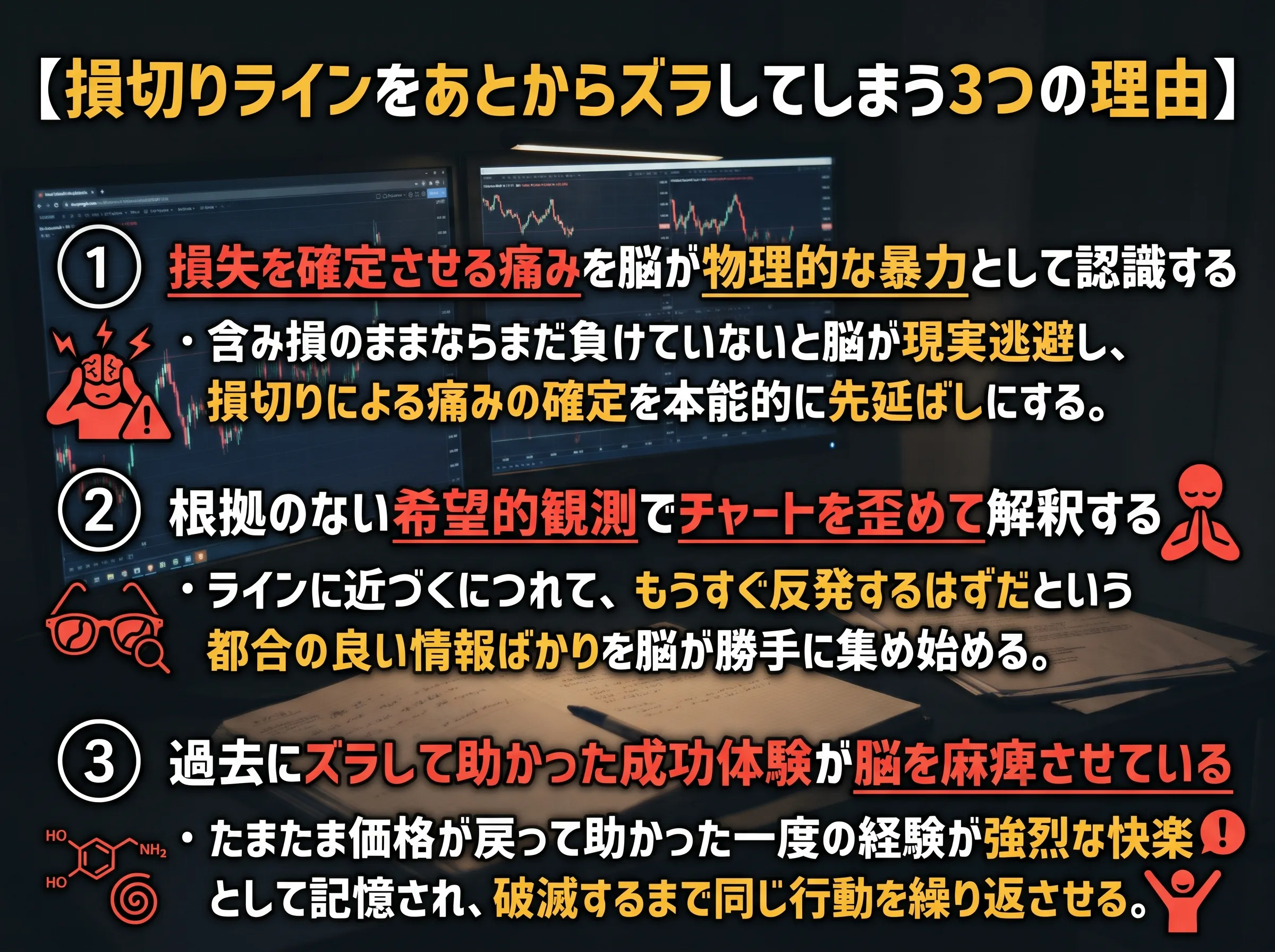
1. The moment you approach, the brain fully rejects confirming the loss
As the behavioral economics prospect theory shows, humans feel the pain of losses more than the joy of gains even for the same amount—more than twice as strongly.
When price approaches the stop line, a strong alarm sounds in your brain that if you close now, your loss and failure will be confirmed.
Then the brain, to escape that pain, activates a distorted defense instinct that says the unrealized loss is only an illusion, and that as long as you don’t close, you haven’t actually lost.
In that instant, the logical scenario you had decided with a calm frontal lobe before entry is blown away, and the impulse to shift the stop line to delay the pain takes over for even a second.
2. Fabricating convenient reasons to justify it
Once you shift the line, to justify your rule-breaking, the brain activates the second bug called confirmation bias.
Even though the original justification has collapsed, you start looking for convenient reasons on the chart that will help the current position, such as the moving average on a higher timeframe that will soon come to stop you, or the oscillator that is oversold and must rebound.
This is not market analysis; it is merely prayer.
In the hazardous area where the original advantage has vanished, you expose your funds to the market with far greater risk than initially planned.
3. The memory of having narrowly escaped saves your account from you
The scariest thing about shifting the stop line is not losing immediately, but that sometimes the price unexpectedly comes back and you are saved.
Because markets roam in ranges for long periods, if you endure by pushing the stop line away, you can unexpectedly recover to break-even many times.
However, this is the biggest trap.
The moment you break the rule and escape the danger, dopamine is released in the brain, and the brutal truth—that enduring was the correct choice—gets strongly imprinted as the incorrect sense of success.
A brain that has learned this erroneous pattern will naturally shift the stop line again in future trades.
And even if you narrowly escape nine times, on the tenth genuine trending market you will be pushed up without a single pullback, wiping out all profits and the principal in one blow.
4. Three steps to physically lock in the brain’s bugs
It is impossible to rewrite the very structure of the human brain.
Therefore, rather than enduring by willpower, you must create a mechanism that cannot physically shift the line.
So that you cannot shift the line, you should create a system that locks in the stop loss at the moment you place the order.
Place a stop-loss order (SL) with the broker as soon as you enter: Do not try to close manually by your mind’s line; fix the stop-loss order with the broker the moment you place the order.
Keep the stop-loss line well outside the area where the rationale collapses from the start: To prevent being hunted by noise and moving the line, set the SL well outside the clear support/resistance, even if it means lowering the lot size from the outset.
After order completion, close the chart screen and physically take your hand off the mouse: Because staring at the approaching candles in real time provokes fear and moves your hand, only set alerts and close the screen.
If even then, like my past self, you feel limited by your own discretionary risk management, please take a look at the details of the tools Trade Studio recommends.
Trade Studio recommended! Explanation & YouTube video of the all-in-one trading tool with automatic lot calculation, “Smart Pro” (SMAPRO) ↓↓↓