
[Procedure when signs differ] Decide which priority before entering
When you add indicators, doesn’t the message from the screen become conflicting?
If you buy by trusting the buy signal, you get pushed back by the line right above.
If the next day you trust the line and pass, sometimes it extends along the arrows as predicted.
For those who feel they can’t trust either, what should they change?
Good evening!
This is Masashi^^
This time, I’ll talk about what to do when signals conflict.
This isn’t about reducing tools, but about the order of what to look at first when there’s a mismatch.
What I decide for myself is to decide in one line before entering what to prioritize when there’s a conflict.
The remaining signals are not used as reasons to enter, only as reasons not to enter.
One line could be, for example【If there’s a discrepancy, look at the wall first / count only the arrows near the wall】as a short guideline.
✅ Adding more tools makes it possible to choose the direction you want to enter
In the past, I also thought that losses happened because I didn’t have enough information.
If you can’t tell from moving averages alone, add an oscillator, and if that still isn’t enough, add an arrow tool as well.
The more crowded the chart, the more reassuring it felt in a vague way.
But when you have three tools, in most situations, at least one of them points in the direction you want to enter.
When you want to buy, you see the buy signals; when you want to sell, you see the sell signals.
Feeling like you’ve increased information,“materials that support the side you want to enter”with unlimited choice… lol
✅ As you add more tools, you can select the most convenient one from a mismatch.
? Back then: [Lines three, arrows two kinds, and at least one points to the side you want to enter]
? On losing days, only the chosen side existed in notes
I realized this when rereading my notes on a losing day.
One day’s notes looked like this.
・ Reason for entry: Buy arrow appeared
・ Just above line: (not written)
・ After it ended: was pushed back by the line and exited
When I reopened the chart, another line from a different tool was clearly drawn just above.
It should have been visible when entering as well, but the note didn’t say a word (;'∀')
✅ The signal I didn’t choose disappeared from my mind at the moment of entry.
? When you lose, you remember the unchosen side and think, “I should have looked at that.” The next day you trust that side and it fails in the opposite form. This was the pattern.
? Why signals conflict
Why do different tools say different things even when looking at the same chart?
Because each tool answers a different question.
Some tools answer which direction the current momentum is headed.
Other tools answer where the current price sits in the range of the market.
Momentum can be strong upward, yet there can be a wall just above, which is normal.
Signals can appear different, but in most cases both are correct in what they say.
✅ Signal mismatches aren’t due to tool defects, but due to different questions being asked.
⚠ If you decide which question to listen to before deciding, and then just compare answers, you’ll get confusion.
? Weather forecast and clock answer different questions
Think a little about getting ready to go out.
The weather forecast answers“Will it rain?”and the clock answers“Will I make it on time?”.
Even if the forecast says sunny, if the clock shows lateness, you can’t stroll slowly.
Whether it’s sunny or rainy and whether you’ll make it on time are questions that are fundamentally separate.
Comparing which is correct doesn’t yield an answer.
If you decide before leaving that you’ll prioritize time today, you can head out quickly without hesitation.
✅ Decide in advance which question to prioritize before comparing.
? In trading too, momentum and position are separate questions. Both can be correct, just the priority isn’t set.
❌ The problem was reselecting on the spot
Ah, to be more precise, it wasn’t that the tools themselves were bad.
Every time I changed tools, I repeated the same confusion under a different name.
Because I hadn’t decided which question to listen to during a mismatch, I had to reselect on the spot each time.
When deciding on the spot, I usually chose the side I wanted to enter.
That’s why when I lost, the unchosen side looked more correct.
✅ What needed fixing wasn’t the tools’ contents, but the way I decided during mismatches.
❌ In my case, the weeks I swapped tools, I ended up losing in the same way during mismatches.
? Decide one priority before entering in one line
What you do is, at the moment you open the chart, decide the first question to ask when there’s a mismatch.
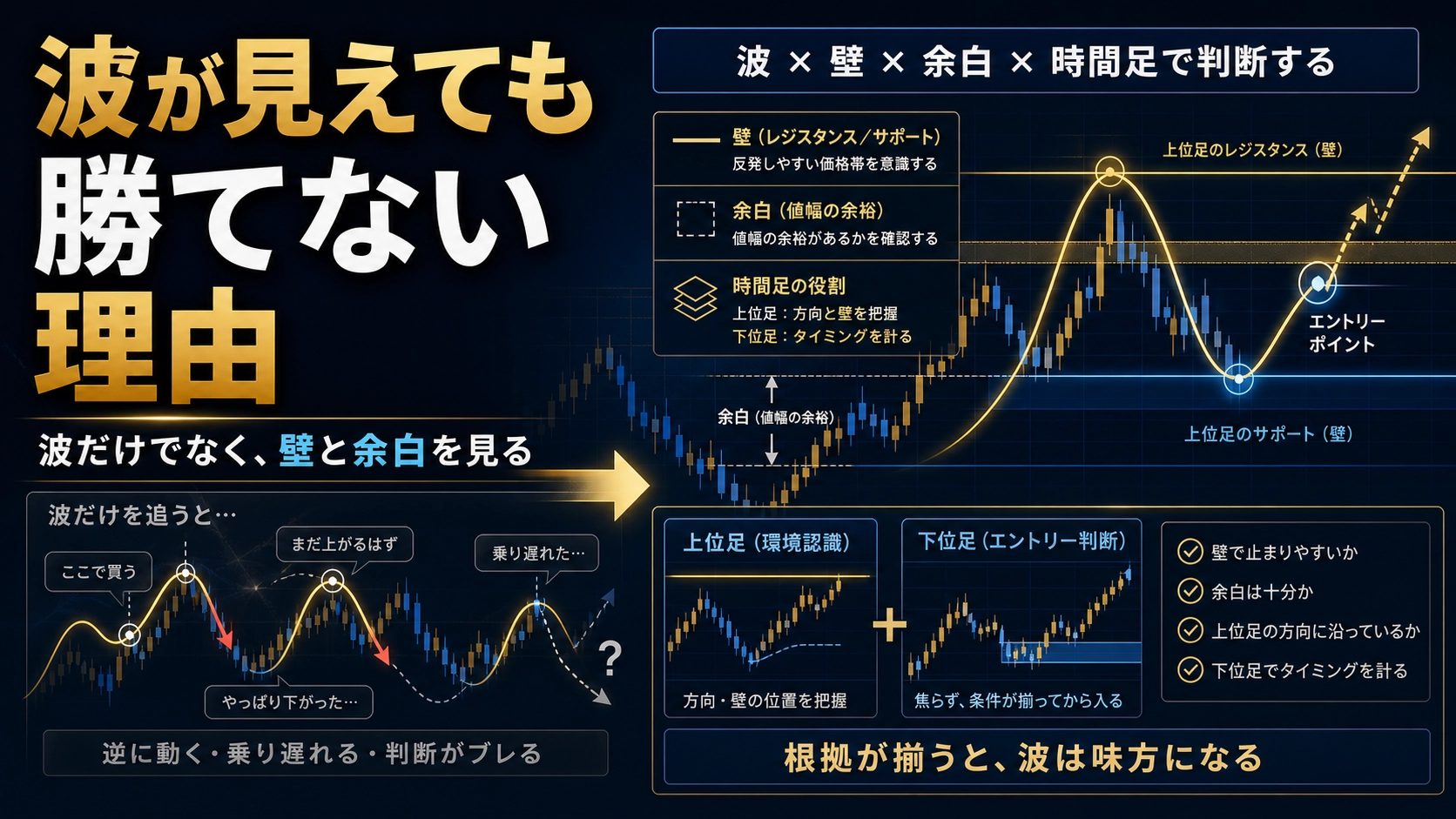
What I ask first is: where is the current price in relation to the wall?
I go back and forth between higher and lower timeframes to check the nearby wall first.
I look at momentum signals after that.
【If there’s a mismatch, prioritize the wall position / count arrows only when they’re near the wall】
The left side indicates what to prioritize; the right side handles the remaining signals.
Prioritizing position is because momentum can change after entry, but the wall’s location tends to stay for a while.
✅ Decide which question to ask before mismatches before the signals appear.
? If the mismatch is in the middle of the wall, I write “pass” and close it. If the mismatch cannot be resolved, I consider it not a place to trade.
✔ Treat signals that come from the same arrow differently depending on where they appear
If you look line by line, even the same buy arrow can be treated differently.
・Arrows appearing right near the lower wall are counted
・Arrows appearing in the middle between walls are not counted
・Arrows appearing above where there is a wall just above are not counted
Only arrows that appear near the wall are used to confirm whether to enter.
Not counting middle arrows is because there is no clue where to cut, as walls are distant both above and below.
✅ Previously treated the same “buy arrows” now naturally split by where they appear.
✔ The time saved from not hesitating comes from having already decided which question to refer to before hesitating.
? Use remaining signals only for reasons not to enter
That said, you don’t discard the signals you didn’t prioritize.
Just narrow down their use to one reason for not entering.
Even if the buy conditions are near being met near the wall, if momentum still points downward strongly,“Momentum still downward / wait for one more line”and wait.
Conversely, just because momentum is strong upward doesn’t mean you have a reason to buy far from the wall.
If you decide to use it only to stop you, no matter how many tools you have, you won’t increase indecision.
What increases are the potential reasons not to enter, but increases in not-entering reasons don’t increase your losses.
✅ Signals you didn’t prioritize are used only as brakes.
? The one you use for acceleration is the one you prioritized. If you decide that, you’ll be less swayed by the screen’s information.
⚠ There are situations where you don’t need to reduce tools
Let me break the foregoing once.
Is it better to narrow tools to one? I don’t think so.
Having one tool that answers position and one that answers momentum is natural.
The problem arises when several tools answer the same question.
Point to each tool on the screen and write down what question each is answering.
【Line = current position】【Arrow = current momentum】【Wave counting = current flow stage】
If the same answer appears in two or more, keep only one of them.
✅ The reduction is not the number of tools, but the overlap of tools answering the same question.
⚠ If you can’t explain the prioritized tool in your own words, temporarily reduce the tools and come back.
? The place of confusion moved from the signal to the wall
Since adopting this method, the place of confusion has changed.
Previously, every time a signal appeared,“Can I trust this?”I hesitated.
Now, most of my confusion ends at the stage of opening the chart and confirming the wall position!
When a signal appears, I only think about whether it’s near the wall.
Of course, this hasn’t made me never lose.
There are days when you enter near a wall and get broken by the wall, as before.
✅ The losses I predicted with one line before entering are acceptable as expected costs.
? I hardly ever regret thinking of the unchosen side after the fact^^
⭕ Which tool should I look at first?
When I discuss this, people ask
“In the end, which tool should I look at first?”
For me, I prioritize tools that answer where the current price is in relation to the market.
Momentum and pattern I look at afterwards to confirm what’s happening there.
This is just my method, so others may place a different question first.
What matters is deciding which to prioritize before signals conflict.
✅ When you open the chart next time, write one line about the priority before looking at signals. Start there.
⭕ Deciding what to prioritize during a mismatch is up to you.
? GOLD Remedy is featured in a special report ^^
If you want to organize from the ground up, check the contents and its limitations.
➤ Summary: Decide one priority before a mismatch
As you add tools, you can choose a signal that suits you from the mismatch.
On losing days, only the chosen signal remains in notes, and the unchosen side becomes a reminder of what you regret afterward.
Signals conflict because each tool answers a different question.
Tools that answer momentum and tools that answer position are usually both correct, just not prioritized.
Therefore, when you open a chart, go back and forth between higher and lower timeframes to confirm walls, and decide one priority in a single line for mismatches.
For the same buy arrows, count them near walls, not in the middle.
Don’t throw away the signals you didn’t prioritize; use them only as reasons not to enter.
Rather than reducing the number of tools, review whether tools that answer the same question are overlapping.
Once the priority is decided, the next issue is not being able to recall the entered chart exactly after entry. I’ll cover that in another article.
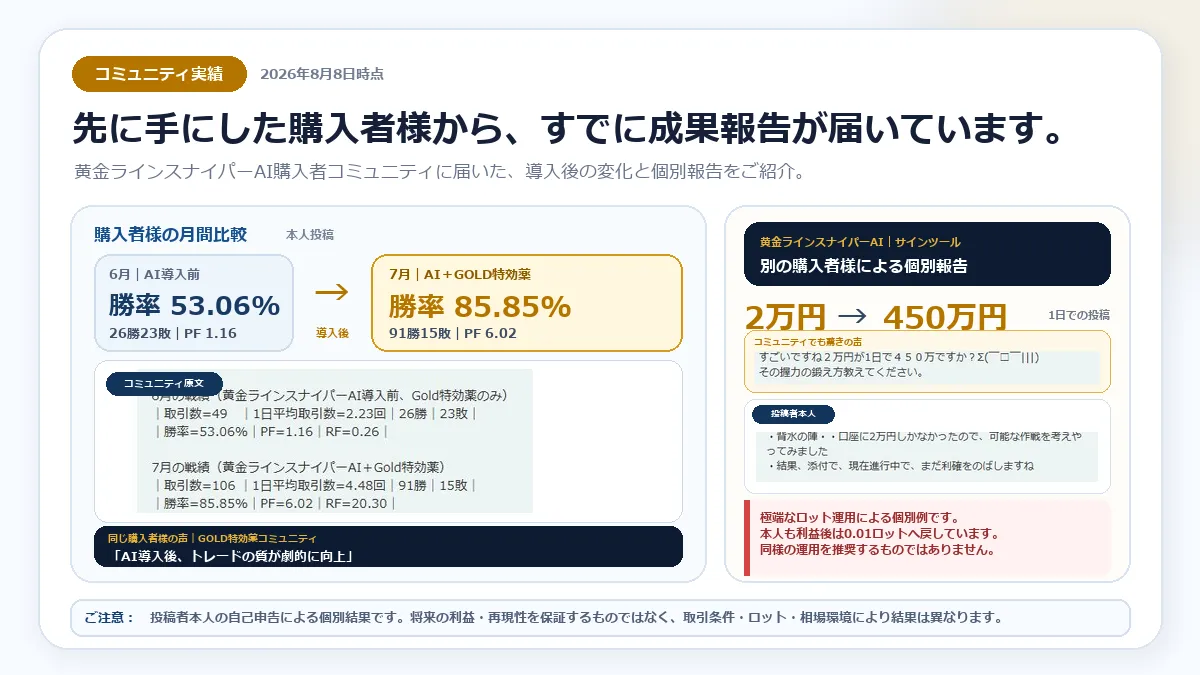
For those who want to shorten the time to confirm wall positions, Golden Line Sniper AI is also an option.
It helps verify price position with arrows and lines, but it doesn’t determine what to prioritize or whether to enter when signals conflict.
Please use it after confirming display and limitations, and make the final decision yourself.
✅ Before your next order, write one line about the priority when you have a mismatch.
? One line when you open the next chart: 【Prioritize the wall position when there’s a mismatch / The rest are reasons not to enter】
View details of Golden Line Sniper AI
Thank you for reading to the end today as well ^^