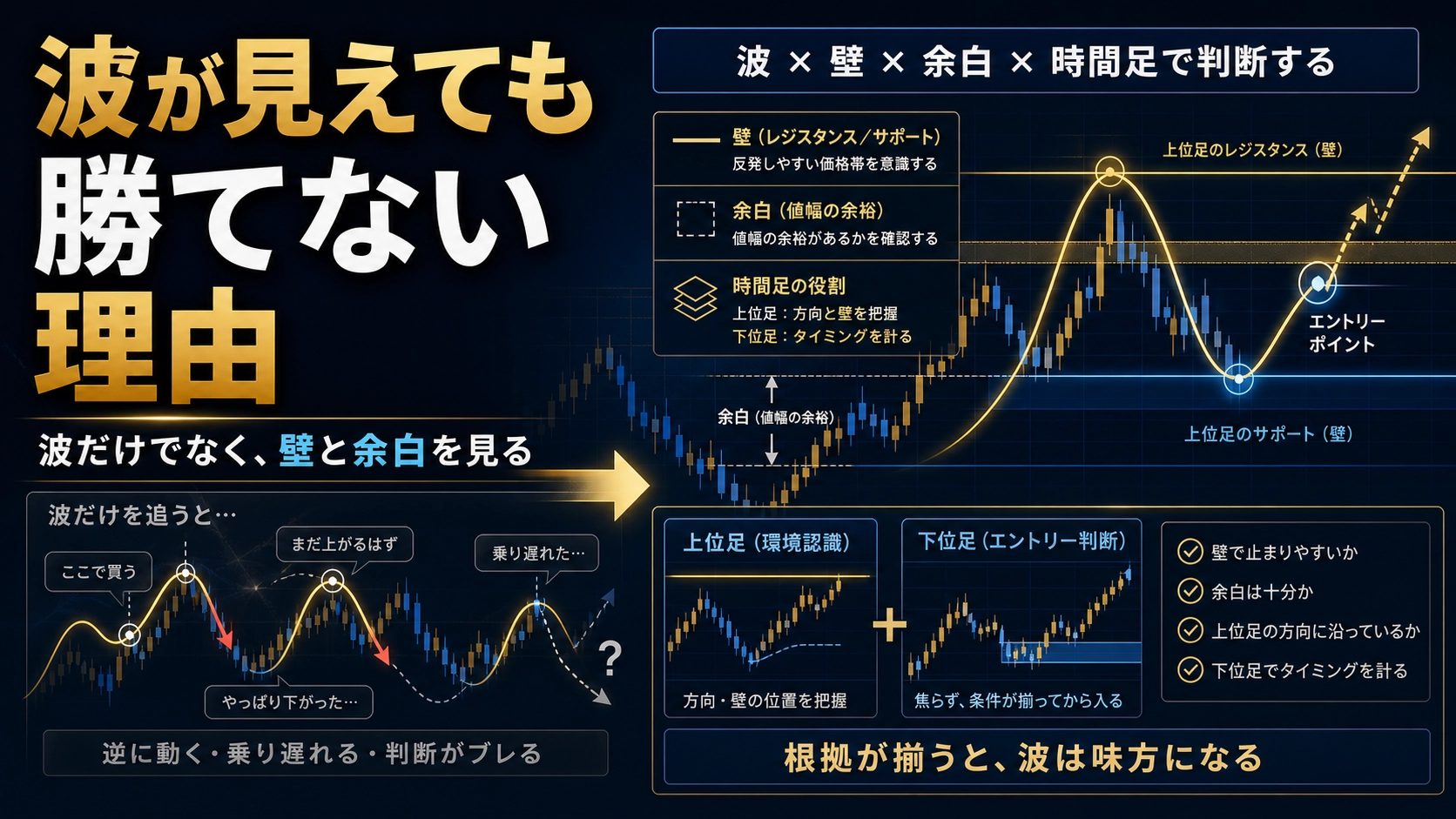

[Procedure to reduce entries after indecision] Write one line about the reason you’re unsure to confirm
After hesitating more than enough about whether to enter, did you end up entering on impulse anyway?
While you were hesitating, a small rebound appeared, and you felt a little relieved as you pressed the order button.
There are times when, right after you enter, it moves in the opposite direction, making you feel like the time you spent hesitating was erased.
For those who feel they lose more the more they enter after hesitating, what should be changed?
Good evening!
I’m Masashi ^^
This time, I’ll talk about how to handle the rounds that you entered after hesitating.
This isn’t about how to stop hesitating; it’s about the procedure of what to write first when you hesitate.
What I’ve decided for myself is that once I begin to hesitate, I will write the reason for my hesitation in one line.
Only if that one line is confirmed by the chart and can be erased will I enter; if it cannot be erased, I will pass.
A single line could be something like【I feel close to the upper wall】which is a short example.
✅ The reasons for entering accumulate while you’re hesitating
In the past, I thought that taking a long time to hesitate was proof of careful observation.
If you look longer, your judgment should become more accurate, I believed.
But in reality, while I was hesitating, I was constantly trying to find reasons to enter within the chart.
At first, the thing that caught my eye was just one line that seemed to stop near the lower wall.
As I watched longer, the small rebounds on the lower time frame added to the reasons.
If I waited a little longer, the distance to the line on the higher timeframe would be added as a reason.
In the end「Because it stretched in the same place a moment ago」was also among the reasons… lol
✅ The reasons for entering may be four, but three of them were found later during the hesitation.
? The way I hesitated at that time: 【Only one thing I’m concerned about/Find a rebound/Feels far away/Enter on momentum】
? When I lined up the rounds where I hesitated, the losses were solid
I realized this after changing the way I keep records.
For rounds where I hesitated for a long time before entering, I started writing at the edge of my notes【Hesitated】and a small mark.
When I lined up the weekend with marked items, one day’s notes looked like this.
・Reasons for entry: stopped near the wall/rebound/far from the line/recently stretched
・Where to exit: (to be decided after entering)
・Afterward: fell more than expected, and I hurriedly cut
Although the reasons column was lively, the exit point column was empty (;'∀')
I was so focused on collecting reasons that I didn’t leave enough time to decide where to exit.
✅ On hesitation rounds, both the number of reasons and the blank exit point remained.
? This order is my own, so it may not apply to everyone. It’s worth trying to line up your own records.
? Why do we start finding reasons when we hesitate for a long time
Why do the reasons keep increasing while you’re in the middle of hesitation?
Reasons appear because charts always have both bullish and bearish factors side by side.
If your desire to enter is ahead, you will only see the favorable reasons to enter.
If you search, you will surely find them, so the longer you hesitate, the more reasons accumulate.
Moreover, the person who’s hesitating cannot notice that they are adding reasons.
It’s like looking at a chart and collecting the materials that say "enter" even though you’re watching it.
✅ The longer the hesitation time, the later the entering reasons were added.
⚠ The more numerous the reasons, the more confident you feel about entering, but that confidence might be based on later-gathered material.
? It’s risky to cross with a yellow signal the way it is
But some may think hesitation is something that happens to everyone.
I think so too, and hesitating isn’t inherently bad.
Think about the traffic signal while walking.
If it’s green you cross, if red you stop. Hesitation usually happens when it turns yellow.
Many have had a heart-stopping experience when hesitating on yellow and then crossing quickly.
Trading is the same: if all entering conditions are met, there’s no hesitation to begin with.
✅ Hesitation is a sign that something is not aligned yet.
? Don’t erase hesitation; read it as information on what isn’t aligned yet.
❌ Entered without turning the contents of hesitation into words
Oh, to be more precise, it wasn’t the act of hesitating itself that caused the loss.
The problem was entering without verbalizing what was inside the hesitation and letting time pass.
If you enter without stating what isn’t aligned, when it moves against you, you won’t know what collapsed.
So you can’t decide where to cut, and you end up thinking after it starts to go down.
Treating the hesitation time as something that would disappear if you waited a little longer was the biggest mistake.
✅ What to fix isn’t the number of hesitations, but the flow after hesitating.
❌ In my case, on days I entered without writing the hesitation, there was no reason for the exit point.
? Write one line describing your hesitation to confirm
What you should do is stop at the moment you start hesitating and write the reason for hesitation in one line.
Write not about feelings, but about what in the chart is sticking out.
【I feel close to the upper wall】
【The rebound is only one and weak】
After writing the line, go back and forth between higher and lower timeframes to verify whether that line is true.
If you wrote that you feel the wall is close, check where that wall is on the higher timeframe.
If it’s farther than you thought, that hesitation is erased.
If it’s closer, that hesitation is not yet erased.
✅ Enter only after you can erase the hesitation line; if you cannot erase it, pass.
? When you pass, you can close with 【The upper wall remains close/Pass】 as your closing statement.
✔ "Ambiguously scary" needs one more layer of digging
When you try to write the hesitation, at first you may only get「I feel vaguely scared」which is common.
At that point, dig one more layer to identify what exactly is scary.
・Whether it’s the upper wall pressing back and that’s scary
・Whether the rebound is weak and it might drop again
・Whether the indicator’s timing is close and it could move suddenly
If you can write this much, the hesitation becomes something you can verify on the chart.
If it can be verified, the hesitaton time won’t prolong.
✅ If you dig into the scary part one layer, the place to verify becomes clear.
✔ If you dig but can’t put it into words, it’s enough to write 【Don’t know what I’m hesitating about/Pass】.
? Mark hesitant rounds and count them separately on weekends
Hesitant rounds are kept separate from ordinary rounds.
At the edge of the notes,【Hesitated】and beside it, write whether you entered or passed.
【Hesitated: the upper wall is close → verify and it was far → entered】
【Hesitated: the rebound is weak → verify and it remains weak → passed】
There are days when passes grow and you feel frustrated, to be honest.
But compared to rounds entered while hesitating without erasing hesitation, passes don’t reduce your account at all.
✅ Even the rounds you pass are recorded as decisions you made yourself.
? Weekend reviews take about ten minutes. You only look at where the hesitation line pointed in the market.
⚠ There are situations where it’s okay to enter even if you hesitate
Let me overturn what I’ve said so far.
If you hesitate, do you have to pass every time? I don’t do that.
There are times when the hesitation content isn’t in the chart at all.
For example【I’m scared because I lost yesterday】or【The lot size feels large】These hesitations may not disappear even if you go back and forth on the chart.
Market conditions may be aligned, but your feeling is not catching up yet.
In such cases, you may reduce the lot size and enter according to the written conditions.
✅ If the hesitation is inside the chart, pass; if it’s outside the chart, adjust with the lot size.
⚠ A way to tell is whether the hesitation line includes chart terms like wall, rebound, or line.
? The time spent hesitating has shortened
By continuing this approach, the most changed thing was the length of hesitation time.
Days where I froze in front of the chart for longer than enough virtually disappeared!
Once you start hesitating, write one line and verify by going back and forth. If you can erase it, enter; if not, close.
Since the process is set, there’s no room for hesitation to drag on.
Of course, this doesn’t mean you won’t lose anymore.
There are still days when you enter after hesitation and it moves against you, and you exit as before.
✅ The losses from entering after writing the place to exit before entering are now manageable as expected costs.
? The losses from entering on impulse after hesitation feel utterly different from lingering hesitation.
⭕ Are you missing opportunities by only passing?
When I discuss this, people often ask me this:
“If you pass every time you hesitate, won’t you hardly be able to enter?”
At first, I think you’ll actually enter fewer rounds.
In the early days, I was anxious because most of the notes were marks of passes.
But when I reviewed the passed rounds, many of them couldn’t be explained by one line before entering.
With fewer entries, I became able to write the exit point before entering each time.
✅ Before the next order, write one line describing your hesitation before pressing the order button. Start there.
⭕ It’s up to you to verify whether to enter or pass.
? The GOLD antidote has been featured ^^
If you want to reorganize the basis of judgment, please check the content and its limits.
? Summary: For hesitant rounds, decide after writing the hesitation contents
The longer you hesitate, the more reasons to enter will be added afterward.
While reasons line up, there’s no exit point written. Hesitant rounds tend to leave such records behind.
Hesitation should not be erased; read it as an indication that something is still not aligned.
When hesitation begins, stop and write in one line what in the chart is sticking out.
Then verify that line by going back and forth between higher and lower timeframes, and only enter if you can erase it.
If you cannot erase hesitation, pass on that round.
However, outside-chart hesitations such as yesterday’s Losses or large lot sizes are treated differently.
In those cases, you may reduce the lot size and enter according to the written conditions.
For hesitant rounds【Hesitated】mark and compare the rounds entered and passed separately on weekends.
Once you can form hesitation into one line, the next challenge is when signs and lines give conflicting signals and cause confusion. I’ll cover that in another article.
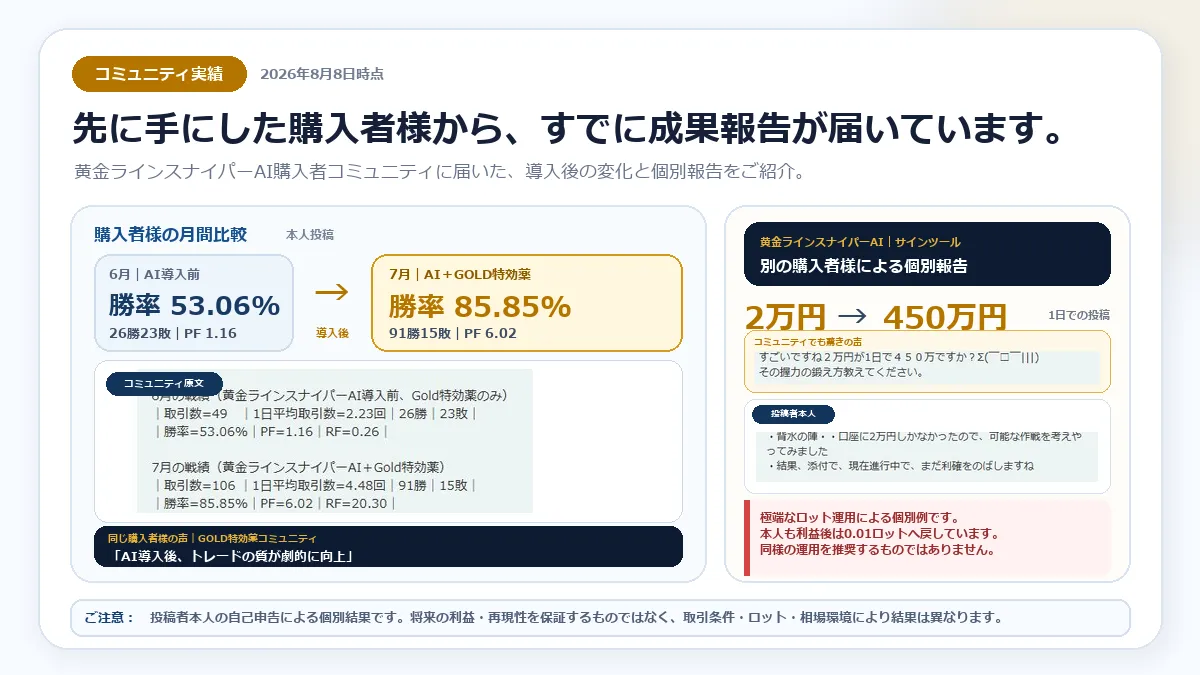
For those who want to shorten the time spent confirming hesitation, GOLD Lines Sniper AI is one option.
It’s a tool to help confirm price position with arrows and lines, not to erase hesitation or decide entering for you.
Use it after confirming its content and limits, and make your final decision yourself.
✅ Before your next order, write one line explaining your hesitation.
? Next hesitation one-liner: 【What am I hesitating about / Confirm and erase to enter】
View details of GOLD Lines Sniper AI
Thank you for reading until the end today as well^^