

【MirrorTrailPro Practical Story】 I want to chase profits. But I don’t want to imitate the reckless averaging down in a public account.
MIRRORTRAILPRO × AIRA | STORY & GUIDE
Even if you imitate the entry point,
you don't have to imitate all the way to ruin.
――A meeting with ACCESS not distributed, public accounts, and AIRA.
A non-distributed EA and a public account. A salaryman who was only going to “watch” trades learns the mechanism of copying and what it means to judge with his own account.
※Characters, conversations, and trading scenes are fictional for the purpose of explaining functions. Prices and lot sizes cited are fictional examples. AIRA’s controls and MTP filters do not guarantee avoidance of ruin.
Even after midnight, smartphone notifications did not stop.
“I took profit!” “You saved me again today!” “All positions closed!” On the screen, a stranger kept expressing joy one after another.
Meanwhile, on the desk, a position in his own account remained unsettled. On the neighboring screen, the public account, which should have been watching the same trades, showed “Holding none.”
Why did the endings differ when they were looking at the same trading information? The story goes back a few days.
SCENE 01No one had yet talked about what was behind the profit reports
Friday night, an open chat found in the car after work.
On the way home, he casually joined an FX open chat in an empty seat. When the screen opened, short congratulatory words and trading history images appeared alternately. Akira, the protagonist, had his interest in the market stirred by such posts many times since he started paying attention.
Participants
“profit today at S1 again!” “Yesterday’s unrealized loss was settled safely!”
The lively atmosphere wasn’t disagreeable. But what Akira really wanted to know was not the numbers after settlement but what happened before. How many levels were added? How far did the price retrace?
Akira
“I wonder how much unrealized loss there was before this profit report…”
There may not have been no losses, only they weren’t visible yet. With such questions, he reread the posts the next morning.
SCENE 02The EA I wanted, I couldn’t get
The answer was “We don’t distribute.” That should have been the end of it.
Mustering courage, he asked how to obtain the EA. The reply was brief.
Chat participants
“We do not distribute the EA itself. But there is a public account you can monitor for operational status.”
Akira nearly closed the screen. Merely watching the operation wouldn’t let him place the same orders in his own account.
Still, the term “public account” stuck in his mind. Opening the chat notes, he found an account number and a password shared for viewing. Opening the public account in MT4, beneath the chart there were times of trades, lots, BUY/SELL, and current open positions.
Akira
“I see... Even if I can’t view the EA’s internals, I can see the trades themselves.”
With viewing rights only, he couldn’t place orders in the original account. He understood that. But if this information could be conveyed to his own account within permitted limits — a small doubt began to turn into a concrete idea.
SCENE 03“MTP, you don’t know it?”
A blue-line-suited figure appeared in the late-night search results.
That night, Akira searched for “public account copy trade.” After navigating several pages, he arrived at MirrorTrailPro — MTP.
On the説明 screen, an AI secretary in a dark navy suit holding a tablet smiled as if waiting for his question, with blue accents on the jacket sleeves.

AIRA
“MTP, you don’t know it? Even if you don’t obtain the EA itself, you can receive the public account’s trading information via Master and use it on the Slave side for copy decision.”
Akira
“Instead of making the trades identical, using order information to decide on my own account?”
AIRA
“That’s right. Which stage to copy from, where to wait for price, whether to allow additional orders, where to settle — those are your account’s operating rules.”
That was a new concept for him. Copying had been thought of as simply following the original account’s decisions without question.
SCENE 04Two screens opened, roles became clear
Master watches and transmits. Slave receives and judges.
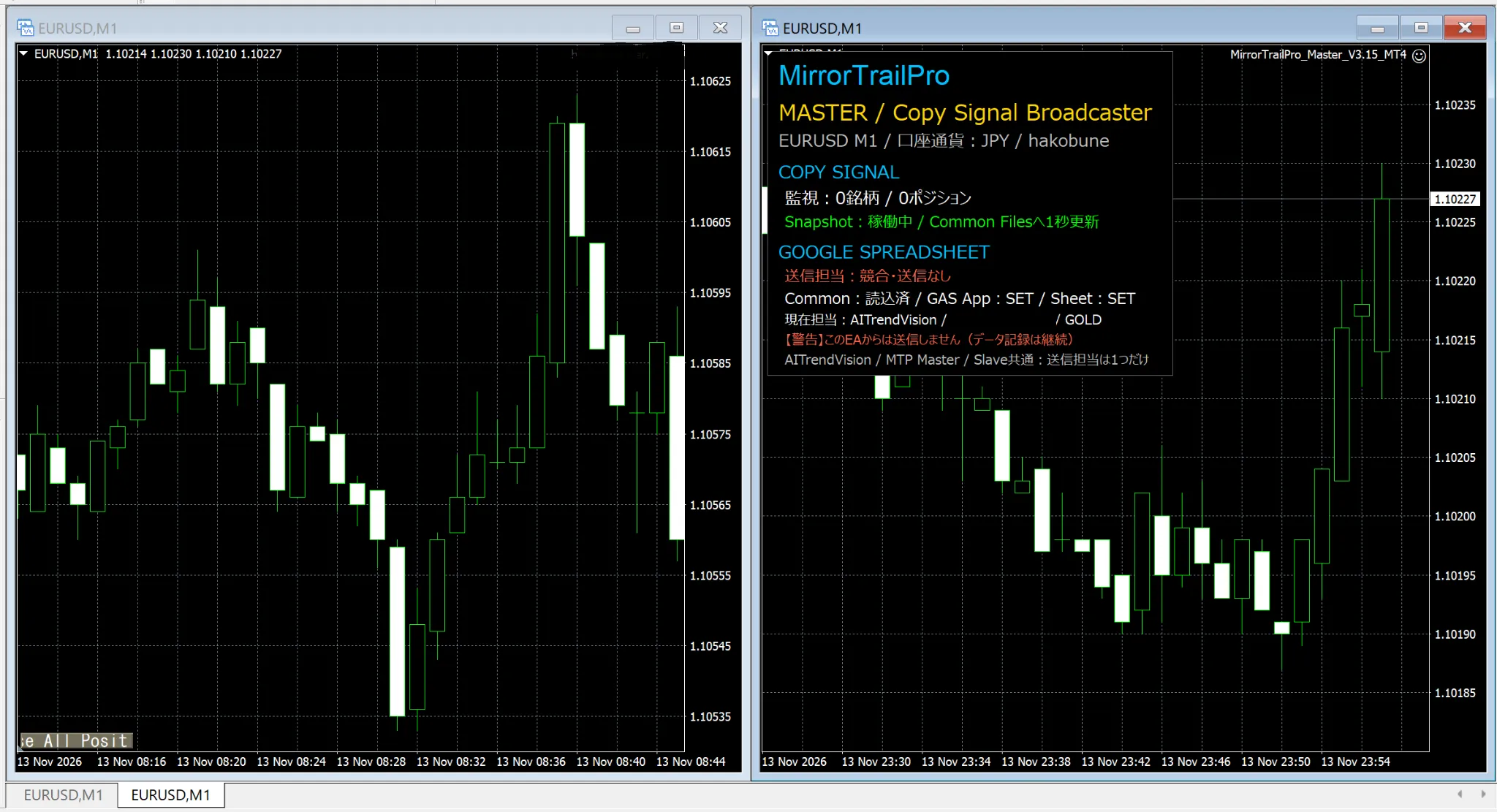
A holiday morning. He launched the public account’s MT4 on a Windows VPS. Keeping the chart with the trading history visible, he opened another EURUSD chart and set up the MTP Master there.
Akira
“So you aren’t modifying the original EA.”
AIRA
“Yes. The Master does not place orders. It monitors the order state of the target account and sends trading information to a shared file within the same VPS. On your account side, you install a Slave on another MT4/MT5.”
He opened another MT4 and, instead of a real account, installed a Slave on a demo account. After confirming the connection, it showed “Master: flat / Slave: no positions.”
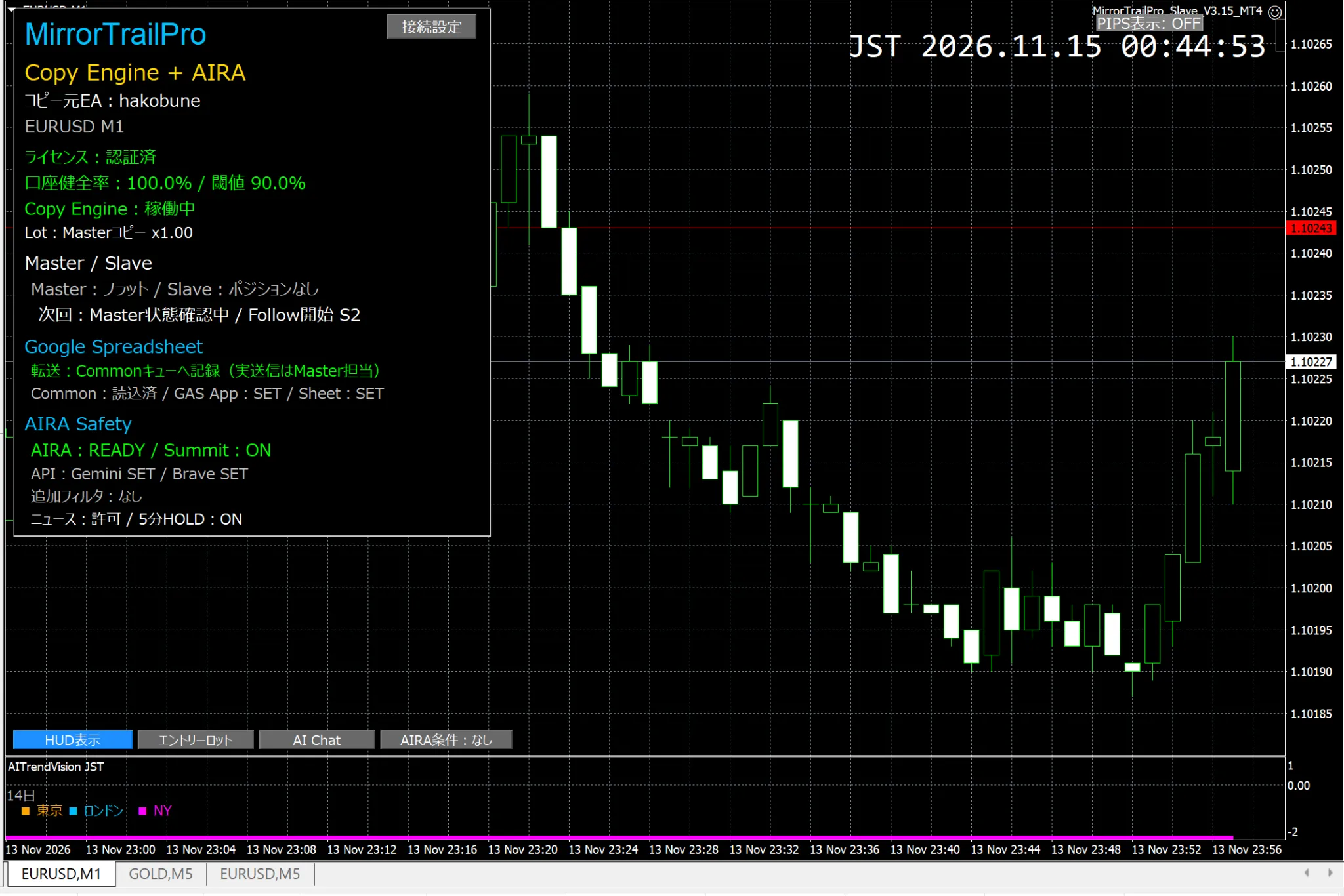
The transmission and reception connections were established. Yet Akira still had one worry.
Akira
“If I run this, will it copy even the dangerous Martingale on the public account?”
AIRA
“No. The operation design starts here. First, decide whether to participate in the first stage.”
SCENE 05Take the first profit or avoid holding the first position
—In the input fields, there are “1” and “2.” What differs is not the numbers but the scope of trades to participate in.
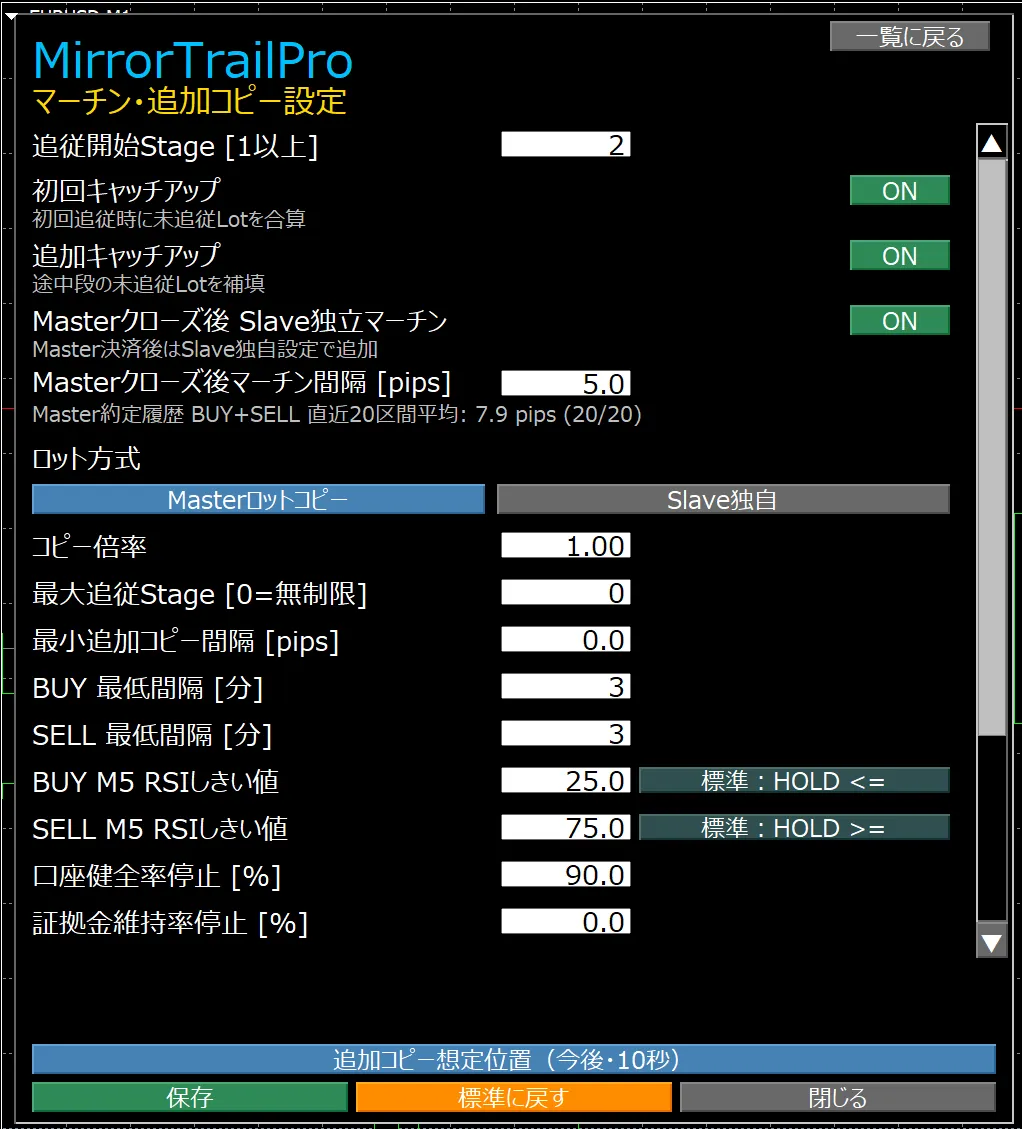
On the weekend, Akira opened the demo account’s settings screen. The item that caught his eye was “Copy Start Stage.” There was no reason to hesitate. Since he would test the public account’s trades, it would be best to chase from the first stage. With that in mind, he chose “1” first.
Akira
“If I participate from the first stage, the Master can profit in trades that closed at S1, and I can participate in my own account. Let’s try this first.”
In the first test, the public account’s BUY rose after a small pullback and recovered. The Master’s S1 profit was realized, and in Akira’s demo account, orders at the initial stage that met the conditions were also settled. He now felt the congratulatory “profit!” in the chat a little more personally.
However, in the next trade, the price moved differently. After buying at the first stage, the price gradually fell, and the Master moved to S2, then S3. Each new buy order on the chart added to the open positions, including the initial S1. The profit realization posts now seemed heavier than before, as the holding time for the initial stage extended.
Akira
“I want all the opportunities to take profit. But holding the initial level while the others increase is heavier than I expected.”
AIRA
“‘1’ is a copy start from S1. There are profit opportunities that end with only S1. On the other hand, ‘2’ ignores S1 and copies only trades where the Master advanced to S2. By avoiding holding the initial position, you cannot take profits from S1 alone.”
After that trade ended and the account was flat, Akira changed the setting to “2.” The next trade that took profit at S1 again brought cheers in the chat. But Akira’s demo account remained no-position, and no profit history appeared on the screen.
Akira
“It’s still frustrating. But it’s not that I couldn’t enter. It’s just that I decided not to participate in S1.”
If the market hadn’t turned back and the Master advanced to S2, what would happen? The Master would have two open positions, S1 and S2, while the Slave, joining from S2, would have only one order — such a setup could form. Even when the market retraces,holding no initial stage reduces the number of positions compared to the Master.
However, this does not mean that the total lots are necessarily smaller. When initial catch-up ON, if S2 becomes the first real-order, the design combines the lots for S1 and S2 and places an order for the total. The quantity is adjusted by copy multiplier, lot method, and caps, and may be blocked by filters; if there is even one open position, total lots or unrealized risk may not be reduced. Akira began to think of the number of stages to participate in and the lot size separately.
Akira looked again at the small numbers in the settings. The profit that could be lost from the initial stage and the choice to not hold the initial stage from the start. Depending on which he weighs heavier, even when looking at the same public account, his own account’s operation changes.
SCENE 06Two stages on one order
“Catch-up” is how you deal with the missed lots.
The next trade wasn’t finished at the initial stage. Master buys 0.01 lot at S1. Retracements continued, adding 0.02 lot at S2. Akira’s Slave became the first follower at this S2 scene.
Akira
“Slave’s order becomes 0.02 lot, right?”
AIRA
“If initial catch-up is ON, combine S1’s 0.01 lot and S2’s 0.02 lot, and place an order for0.03lotat S2”
Initial catch-up (fictional example)
Master S1: 0.01 lot + S2: 0.02 lot = 0.03 lot
Slave S1: skip → S2: 0.03 lot place a single order
※Assumes lot multiplier 1.00, allowable lots, and conditions pass through various filters.
“You can have just one open position. But that doesn’t mean the funding burden is halved.” Akira finally understood the meaning of the numbers. This is not a function to reduce lots, but a function to fill missing lots from mid-entry and align closer to the Master’s quantity structure.
Additional catch-up is a bit more complex. Up to S3 you could participate, but for sudden changes in S4, additional Slave orders are HOLDed due to news detection. When the market settles and by S5 the conditions for resumed participation are met.
Akira
“What if I skip S4, how much will I participate in S5?”
AIRA
“If additional catch-up is ON, it decides to supplement the Slave’s missing quantity against the Master’s current total. For example, combining S4’s 0.05 lot and S5’s 0.08 lot yields0.13lot”
If you get closer to the Master’s total, the potential profit range at retracements also increases. But that moment also brings the possibility of large orders. Akira felt that catch-up shouldn’t be treated as a purely advantageous setting.
SCENE 07Waiting for 90% retracement when nine-tenths moves goes, profit-taking is already done
AUTO-learning numbers reflect reasons for waiting, not the probability of winning.
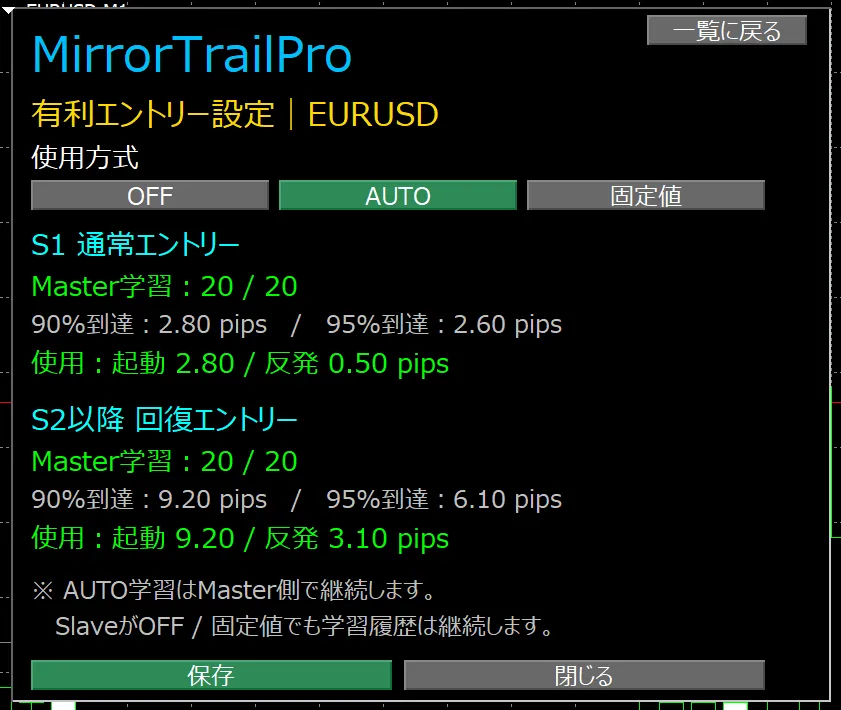
One evening, the Master placed a BUY at S1. The market fell, and S2 was added. Akira’s Slave, whose copy-start stage was set to “2,” also became a candidate. Yet the screen showed “waiting for favorable price.” Just because the Master’s order arrived did not mean he jumped into the same place immediately.
Akira
“Waiting until the 90% threshold means there’s a 90% chance of entering at a good price?”
AIRA
“No. It records how far retraced after each of the most recent 20 Master trades. The 90% threshold is an indicative distance for retracement, e.g., 18 of 20 trades retraced to that distance.It does not predict that it will always reach the target”
For the AUTO-learning that day from S2 onward, consider an hypothetical setting: startup width 2.80 pips, retracement confirmation width 0.50 pips. Even if moving to S2, no immediate buy. The Slave checks a fixed deviation from its own reference price and waits for a rebound.
However, right after the Master opened S2, the market began rising with hardly any retracement. The Master’s average entry price for S1 and S2 was exceeded, and profit-taking occurred soon. Meanwhile, the Slave did not reach favorable-entry conditions and ended the sequence with no position.
Akira
“Public accounts took profit, but my account had zero orders… waiting resulted in not participating in that trade.”
AIRA
“Yes. Even with a setting to participate from S2, favorable-entry price conditions are judged separately. This time, while waiting for retracement, the Master took profit first.Choosing a good entry price and participating in all opportunities may not always coincide.Of course, in this case no position was held, so there were no losses.”
When Akira asked, “What happens at S1?” AIRA pointed to the settings. S1 normal entries and recovery entries from S2 onward learn the prior retracement widths separately. If you set the catch-up to “1” again, the learning values for S1 are used, and from S2 onward recovery-entry values are used. In both cases, if Master closes profit before reaching a favorable price, the Slave will skip placing that order.
Akira stared at the chat’s “Profit!” words flowing by. His own trading history remained zero. But after seeing the result, it’s easy to say, “If I had bought there.” Before placing an order, you cannot know whether the reversal is real. Accepting both postponing near-term gains and not forcing yourself into it is the rule you set for yourself.