

Criteria for Choosing EA (1) Why Compound Interest is Necessary
I am Tonochi, working on EA development. I had operated EAs purchased on GogoJungle, and from there I started developing my own. I understand the perspective of someone who buys and uses a not-cheap EA, and I will share practical EA selection and utilization methods over several installments, based on the know-how gained from actually creating EAs. I plan to cover basics and an applied section that efficiently raises annual interest, so please take a look if you’re interested.
The first installment is about compound interest.

1. How much difference does simple interest and compound interest make after 20 years
Simple interest is the idea of adding the same amount of profit each year to the original principal. Compound interest also includes the earned amount into the principal and reinvests for the next year.
As an example, suppose it operates at 20% annual rate for 20 years. This number is an example for calculation, and does not mean that any EA will achieve this rate.
- With simple interest, 1,000,000 yen becomes 5,000,000 yen after 20 years. It’s 5 times.
- With compound interest, 1,000,000 yen becomes 38,340,000 yen. It’s 38 times.
In the first several years, there is little difference. The gap grows in the later years. At year 10, simple interest is 3,000,000 yen vs compound 6,190,000 yen; at year 15, 4,000,000 yen vs 15,410,000 yen. The longer the time, the more impact profits create profits.
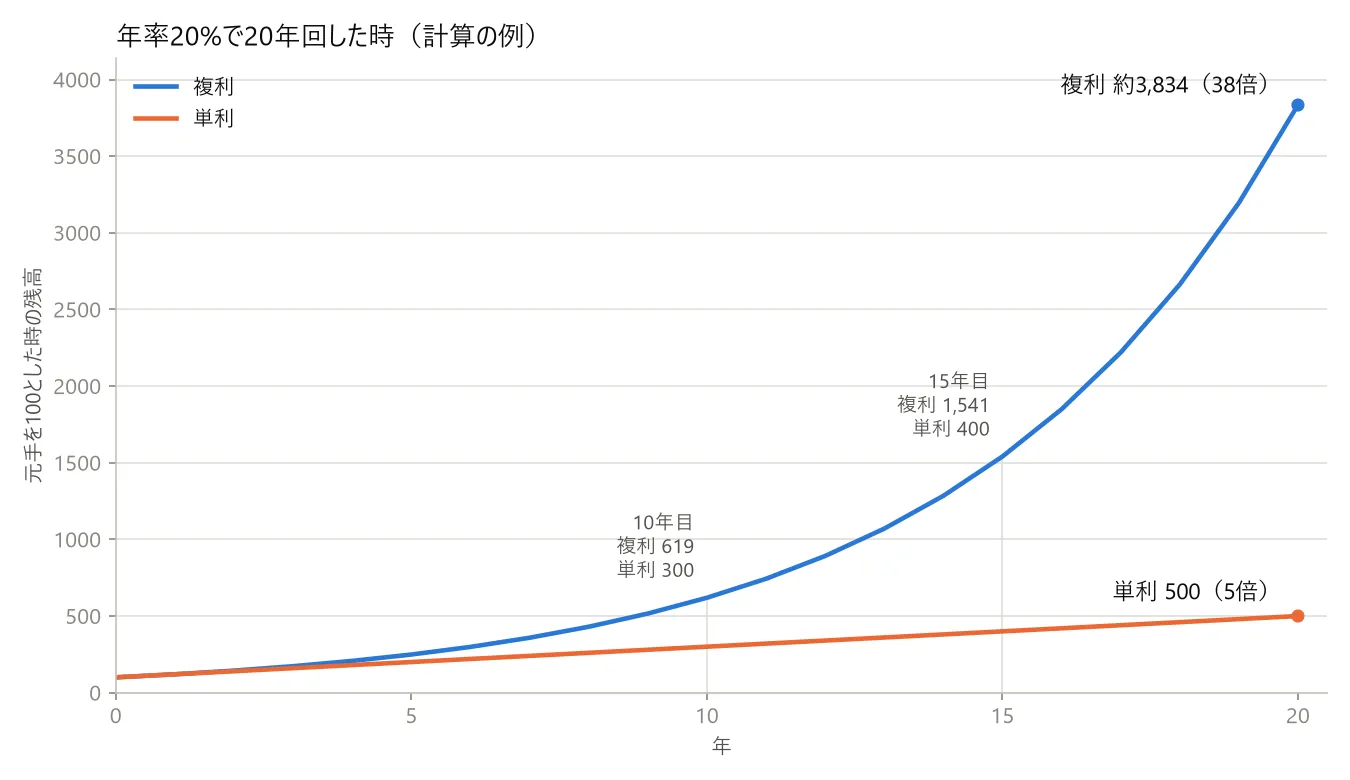
▲Figure 1: 20 years of simple vs compound interest. Example with 20% annual rate. No difference in the early years, widening later.
Actual figures are also shown. In our EA, Tonochi FX BEST, backtests (for reference only) from February 2007 to September 2026, starting with 300,000 yen, became 35,521,000,000 yen. Net profit was 351,491,000,000 yen, averaging an annual return of 43.5%. The conditions were 4 currencies (EURUSD, USDJPY, USDCAD, EURGBP), leverage 25x, all ticks, compound interest. Not a single losing year out of 20.
The growth from 300,000 yen to 300,000,000,000 yen comes from compounding. With fixed lot sizes, profits would accumulate about the same amount each year.
However, to use compound interest in an EA, the EA must be designed to do so.
2. Making an EA compound means adjusting the lot size to the balance
Compound-interest in an EA means increasing or decreasing the trade size (lot) in proportion to the account balance. When balance is 1,000,000 yen, a 0.1 lot. If balance rises to 1,500,000 yen, use 0.15 lot; if balance falls to 800,000 yen, use 0.08 lot.
A human can do this manually, but recalculating each time and changing EA settings won’t last. You might forget to increase or hesitate to lower after a loss. If the EA itself computes the balance and adjusts, this hassle and hesitation disappear. Tonochi FX BEST is built this way, deciding trading volume by balance. The amount you trade can be altered by adjusting the multiplier setting.
Conversely, what happens with fixed lots? Since the per-trade amount doesn’t change with balance increases, the trade size relative to balance gradually becomes smaller. The extra capital isn’t working. When losses persist, the opposite happens: balance decreases while the trade size remains the same, so the proportion of a single loss to the balance grows.
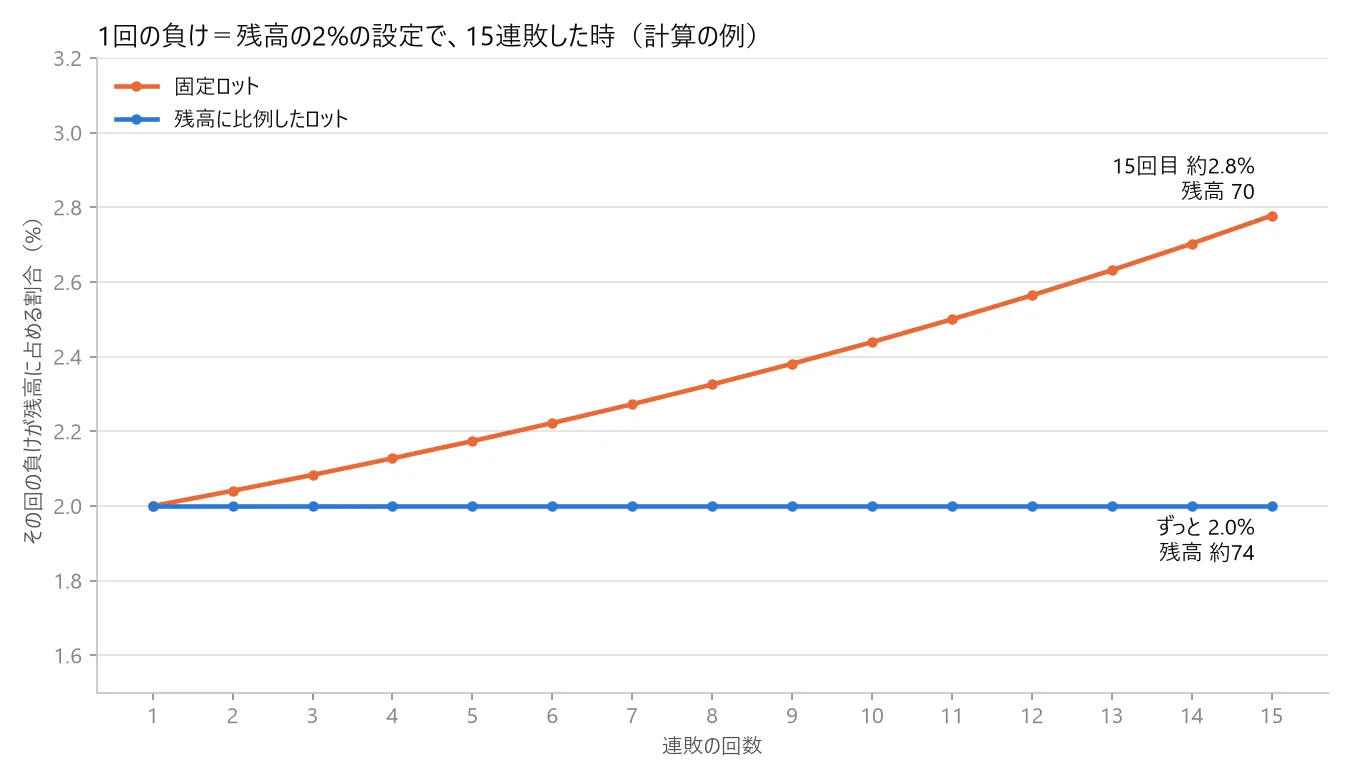
▲Figure 2: 15 consecutive losses at, the share of balance that one loss takes. With balance-proportional lots, it stays at 2%, while fixed lots rise from 2% to about 2.8%
Figure 2 shows the case of 15 straight losses with a setting where a single loss is 2% of the balance. With balance-proportional lots, the loss proportion stays at 2%, and the balance after 15 losses is about 74. With fixed lots, the loss proportion rises from 2% to about 2.8% at the 15th loss, reducing the balance to 70. Fixed lots appear steadier, but during prolonged losing streaks, the damage from compound interest can widen more than with balance-proportional lots.
3. Compound interest works both ways
Up to now, I’ve highlighted the positive aspects of compound interest, but the same mechanism also works in downside scenarios. When a balance is large, losses are also larger in amount. 10% of 10,000,000 yen is 1,000,000 yen.
Therefore, when using compounding, before deciding how much to risk, you should first decide how much you’re willing to lose — i.e., the maximum drawdown. I set the order to decide EA multiplier with maximum drawdown first. Tonochi FX BEST uses a stated maximum drawdown of 20% as the baseline multiplier, and the backtest maximum drawdown was 19.7%. The annual return of 43.5% comes from that result. I do not decide the annual target and then scale the trading size accordingly.
Even with the same EA, changing the drawdown guideline you set beforehand can change the results this much. I extract three samples from the same period and conditions from the multiplier table in the setup guide.
| Maximum drawdown guideline | Multiplier | Net profit | Average annual return | Actual maximum drawdown | PF |
|---|---|---|---|---|---|
| 10% | 1.27 | +933万円 | 19.4% | 9.4% | 1.98 |
| 20%(default) | 2.64 | +3億5,491万円 | 43.5% | 19.7% | 1.91 |
| 30% | 4.18 | +23億1,310万円 | 57.9% | 29.3% | 1.71 |
The contents of trading are the same. What changes is how much you risk relative to the balance. If you double the tolerated drawdown, the results of compounding change by orders of magnitude. However, you will go through phases where as much as 30% of funds are wiped out mid-way. That is why you decide how much you can endure beforehand.
This discussion will continue in the next installments. There are conditions for EAs to withstand compounding, and the drawdown size directly influences the efficiency of compounding.
4. Summary
- With the same annual rate, simple interest and compound interest yield differences of 5x vs 38x over 20 years. The gap appears in the latter years.
- EA compounding means deciding lot size proportionally to the balance. Check whether the EA has this capability.
- Fixed lots look solid, but when losses continue, the share of a single loss to the balance increases. It can seem prudent, but not always.
- Compound interest affects both up and down, so decide the maximum drawdown first, then determine the amount to risk.
In the next installment, I will describe the conditions for EAs that can run on compound interest.
The 20% annual rate example is for calculation. The Tonochi FX BEST numbers come from backtests (February 2007 to September 2026, initial capital 300,000 yen, leverage 25x, all ticks, compounding multiplier 2.64), and do not guarantee future performance. Actual operation can vary due to spreads and order conditions. Please make investment decisions on your own.