

FX If you’ve been losing all the time, it’s about time you realize it. The delusions and reality you have about scalping
Hello, Ikura. This is.
This time, I’ll talk about something a little harsh.
You watch the chart every day, enter many times, win and lose, and repeat. Yet, when you check at month-end, your money has decreased.
Even so, you think, “If I gain more experience,” or “If I make entries more accurately,” and continue trading in the same way the next day.
If this state continues, there is something I’d like you to stop and consider once.
Is your goal to increase money, or to trade?
At first, everyone probably started to increase money.
However, before you realize it, has your purpose become watching the chart, making entries, and predicting price movement in front of you?
I realized this substitution.
After that, the results of trading improved rapidly.
If you continue with the same mindset without noticing this substitution, the number of trades and fatigue will just increase, and your funds may keep decreasing.

Why do beginners get drawn to scalping
Scalping involves short trades of a few seconds to a few minutes, stacking small price moves.
For beginners, this style looks very appealing.
“If there’s a little movement, I can take it.”
“Because I close quickly, I’m less likely to lose big.”
“If I trade many times, I can grow my funds quickly even with a small amount.”
And behind that, the following expectation sits.
There is a correctness in the market, and if you find it, every trade increases your money.
With that mindset, choosing high-frequency scalping is natural. It is better to earn 20 or 30 times a day than only twice.
However, there is a decisive premise missing here.
Is there any basis that profits remain after deducting costs for that one trade?
Without this, increasing the number of trades is meaningless.
Rather, you may just be increasing the speed at which losses accumulate.
“You’ll earn more by increasing the number of trades” is a story for those with positive expectancy
Suppose the average profit and average loss are both 1,000 yen before costs. The winning rate is 50%.
At this point, profits and losses are balanced.
But if the cost per roundtrip trade is 100 yen on average, you’re down 100 yen per trade on average.
If you repeat this 100 times, the expected P/L becomes minus 10,000 yen.
Actual results vary, but increasing the number of trades does not turn this unfavorable structure into a favorable one.
The following formula explains it.
Expected profit per trade = win rate × average profit − (loss probability × average loss) − average trading cost
Note: average profit/loss are calculated before costs. If your real trading history already reflects costs, don’t deduct them twice.
“Trade a lot, and profits will accumulate someday.”
Before you think so, you need to check what will accumulate as a result of those trades.
If the expectancy is negative, increasing trade count is not a basis for profit, even if it is a proof of effort.

There are certainly advantages to scalping
Of course, scalping has its merits.
Reduces the anxiety of holding a position for a long time.
After closing, you’re away from the price movement risk of that position.
If you limit trading time, it’s easier to finish without carrying positions over.
Because results come out quickly, it’s easier to record and verify in accordance with rules.
In particular, the appeal of “you don’t have to hold it” is significant.
You can reduce the burden of watching floating profit decrease for hours or price fluctuations while you sleep.
However, be careful not to confuse this with the overall trading stress being low.
Reducing holding time and reducing overall trading stress are not the same
Because you reduce holding time, you must make quick judgments many times, place orders, cut losses, and search for the next opportunity.
The anxiety isn’t gone; it may be replaced by a different class of burden.
The smaller the price move aimed for, the greater the impact of costs
What scalping cannot avoid is spreads and commissions.
With frequent trading, the cost per trade accumulates and compresses profits. FINRA notes that frequent intraday trading requires attention to increased trading costs and time. (syndication.finra.org)
What matters here is not just the amount of cost.
It is how large the cost is relative to the profit you are aiming for.
For example, assume the roundtrip cost is 1 pip in price movement terms.
Even with the same 1 pip roundtrip cost, the burden varies depending on the target price move.
Target 5 pips: 20% of profit is cost
Target 20 pips: 5% of profit is cost
Target 50 pips: 2% of profit is cost
Even with the same 1 pip, people aiming for 5 pips and those aiming for 50 pips carry different weights.
Taking small price moves may seem easy.
However,the smaller you target, the more stringent the conditions to leave that profit against costs must be.
Additionally, actual trading includes order slippage and judgment delays.
The smaller the target move, the more any slight misalignment affects performance.
Even with the same RR, costs change the conditions
“My take profit is 5 pips, stop loss is 5 pips, so RR is 1:1.”
In terms of settings, that is true.
However, if the pre-cost profits and losses are both 5 pips, and roundtrip cost is 1 pip, simplifying yields:
Net profit when winning: 4 pips
Net loss when losing: 6 pips
Profit and loss are effectively 1:1.5.
To balance the books under these conditions, a win rate of 60% is needed.
On the other hand, with pre-cost profit 20 pips, stop loss 20 pips, and roundtrip cost 1 pip, net profit 19 pips, net loss 21 pips. Break-even win rate is 52.5%.
※Simplified for explanation. If you set TP/SL from order price, calculations change depending on how spreads are reflected.
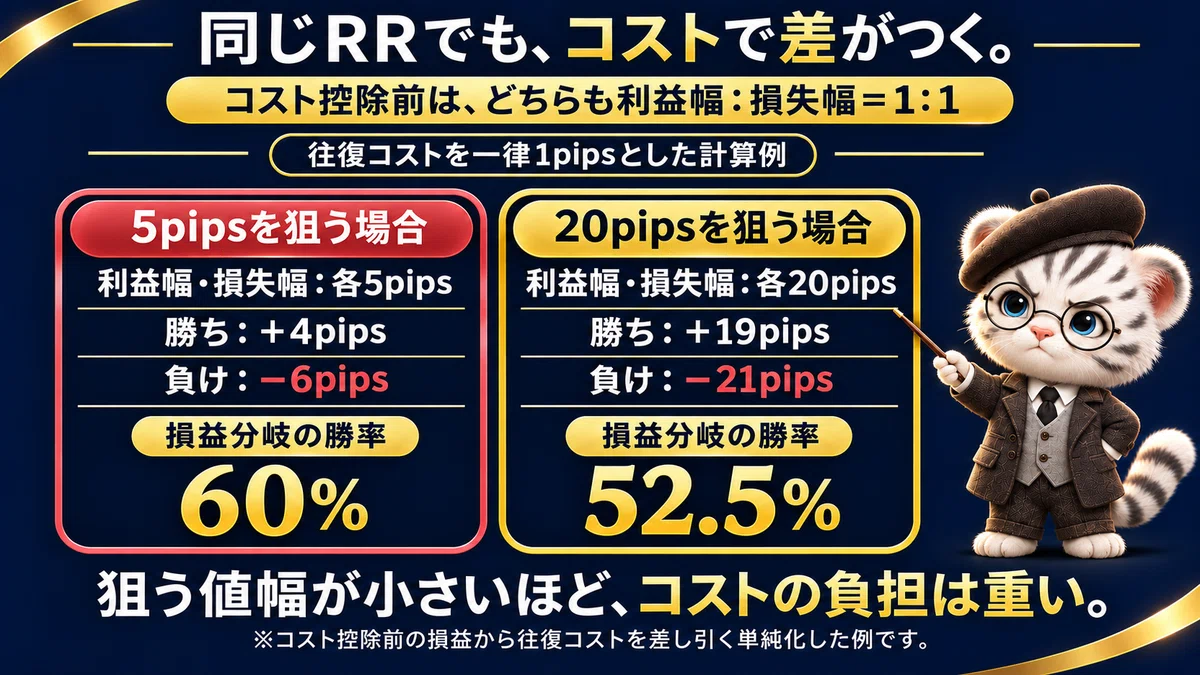
In short, scalping does not necessarily mean a worse RR.
Even with the same pre-cost RR, the smaller the target move, the more the actual profit and loss deteriorate due to costs.
“The direction is fairly correct, but money isn’t increasing.”
The cause may lie not only in the accuracy of reading, but also in this structural issue.
“If 5 pips seems easy to take”
Now, consider this.
Set take profit and stop loss to 20 pips each, and maintain a 53% win rate.
Set take profit and stop loss to 5 pips each, and exceed a 60% win rate.
Which is harder?
It varies by currency pair, market environment, and method, so you cannot decide just by numbers. However, if a beginner trades with discretion and consistency, I think the latter tends to be more difficult.
Reason:Smaller price moves require not only direction but also entry price and timing accuracy.
For example, after buying, if it drops 6 pips once, then rises 20 pips from the purchase price.
If stop loss is 5 pips, you lose before the rise. If stop loss is 20 pips, you may allow the intermediate dip and reach take profit.
Thus, even if your expectation that it will go up is correct, with a tight stop loss you may lose on the small fluctuations beforehand.
Here, the noise refers to short-term fluctuations that disrupt your judgments or trades against the movement you’re targeting.
Hitting “it will go up eventually” and hitting “go up 5 pips after a 5-pip drop” are not the same thing.
Furthermore, the smaller the target move, the heavier the slippage and judgment delays become.
Even with the same 0.5 pip disadvantage, it is 10% against 5 pips profit, and 2.5% against 20 pips profit.
The smaller you take, the less room you have to absorb such misalignments.
Then add the cost issue described earlier.
In a simplified example where pre-cost profit and loss are the same and roundtrip cost is 1 pip, break-even win rate for aiming for 20 pips is 52.5%. For 5 pips, it’s 60%.
Aiming for 5 pips only just balances at a 60% win rate. To leave profits, you must exceed that.
Maintaining a win rate that exceeds costs in the face of short-term volatility leading to stop-loss. This is what scalping demands.
Of course, aiming for 20 pips does not guarantee easy wins. The trend may change before you reach it, and if you widen the stop loss, you must adjust lot sizes to avoid larger losses.
However, at least it’s premature to think scalping is easy simply because you aim for 5 pips.
A small target move and lower difficulty in leaving profits are two different matters.
In a short time frame, you’ll see lines like moving average breakouts or recent highs updated one after another, suggesting possible trades. But seeing a pattern and having a basis to profit from that movement are different things.
If you cause a stop-out due to noise but do not adjust take-profit width, profits may become losses. Even with higher win rate, profits do not necessarily improve.
The more you examine the chart in detail, the less guaranteed that your judgments will be accurate. Are you increasing information but also increasing confusion and unnecessary entries?
This needs a calm review.
Staring at the chart makes you create reasons to enter
This is a key issue in discretionary scalping.
At first, you waited for the decided condition to come.
But nothing happens for 30 minutes, an hour.
Gradually, your criteria begin to loosen.
“Not a perfect setup, but it looks like it’ll go up.”
“I’ve watched this long, so I want to take a little.”
“Let me recover from that earlier loss and finish.”
At this point, the reason for entering shifts from market conditions to your own convenience.
The market doesn’t care how many hours you’ve waited or today’s losses.
Still, the longer you watch, the more you feel, “If I don’t do something, it’ll be a waste.”
Wishing to earn that day’s profit and having the conditions in the market to profit are two different matters.
Can you end the day without trading when there’s no suitable situation?
Here you can see whether that person is aiming for profit or for trading itself.
If you trade a lot, reflection tends to become vague
Trading dozens of times a day makes it hard to sort out the causes of losses.
Was the loss due to following the rule?
Didn’t meet the conditions in the first place?
Was the spread wide?
Did you enter right after losing to try to recover immediately?
Aren’t you finishing with “the market was bad today” or “my mental state was weak” without distinguishing these?
Increasing the number of trades does not guarantee experience.
If you repeat without recording, separating causes, or making corrections, you may be paying for the same mistakes multiple times.
Especially for beginners, it’s better to be able to explain what you did and why you lost than to simply increase the number of trades.
Then try limiting to 1–3 trades per day
To a beginner who keeps losing, I propose starting with limited-day trading.
Aim for 1–3 trades per day as a maximum, and target only situations you can explain.
This doesn’t mean you enter three times every day.
If there are no conditions, you can end with zero trades.
Expanding the target price move and narrowing the situations can improve at least the following:
Comparison points
When trading frequently with a narrow price move
When widening the price move and limiting the number of trades
Costs relative to profit potential
Tend to be larger
Tend to be more controllable
Judgment time
Repeat quick judgments
Easier to prepare in advance
Many unnecessary entries
Continue seeking trading opportunities
Easier to cap with upper limit and conditions
Reviewing
Higher burden of recording and analysis
Easier to check one by one
Of course, switching to day trading does not guarantee more profits.
If holding time increases, you must face the price movement and unrealized losses during that period. If you widen stop loss, you may need to lower the lot size to avoid larger single losses.
Still, if your current losses include costs, decision-making load, and unnecessary entries, it is rational to move toward reducing them.
Continuing to lose without changing your current style is questionable.
Do you have reasons based on verification?

“I like scalping” and “I can make money with scalping” are separate issues
You enjoy short bouts of trading.
Results come quickly, which is more enjoyable.
You’re not good at holding positions for hours.
I understand that feeling.
But that is a matter of taste.
Separate it from the basis for making profits.
If you continue scalping, at least confirm the following in your records.
Whether profits remain after costs.
Which conditions yield profits and which cause losses.
Whether performance improves when you increase the number of trades.
How much losing trades due to rule violations worsen overall P/L.
If you don’t know these and simply believe “increasing count improves,” it would be wise to question that idea.
Repeatedly doing actions that you aren’t sure are correct quickly does not make them correct.
Can you reduce trades to earn money
There are people who profit from scalping.
That’s why you want to think, “If I continue, I’ll eventually get there too.”
However, others’ profits do not prove that your current method has an edge.
What you should look at is your own trading history.
After paying costs, using time, and repeating judgments, what remains?
If your funds keep decreasing, don’t dismiss it with a simple “I’m still putting in effort.”
Before increasing effort, you must confirm the direction you’re diligently pursuing.
If money growth is the goal, you can choose to reduce trades as well.
Still, if you dislike reducing trades and want to enter even without opportunities, ask yourself this.
Today, do you want profits, or do you want the satisfaction of entering?