

【AITrendVision】Ultimate rock-paper-scissors after the fact | Even with the same EA, “Only me SELL”? AIRA NETWORK changes the new standard before entry
【Ultimate Late-Night Rock-Paper-Scissors】Same EA, “Only Me SELL”? How AIRA NETWORK is changing the new pre-entry norm
2026/11/11・GOLD M5|Edited 15 minutes 30 seconds at 31x speed (no sound)
On November 11, GOLD 5-minute chart. The movement of about 15 minutes and 30 seconds has been condensed to 30 seconds.
Sell signals dominated the last 5 minutes, showing 95%. Then it drops to 65%, then to 10%. This does not mean “everyone stopped selling.” It is the process of peak signals being sequentially removed from the five-minute aggregate.
If you only look at the chart prices, anyone can see that. So,“What is happening in other participant accounts?”Do you look at that as well?
In this 30 seconds, the fun of AIRA NETWORK added to AI Trend Vision is packed.
Just a little while longer, please follow the story.
※The conversations and numerical examples of Aさん/Aさん/Bさん below are fictional for explaining features. They are not depictions of real users appearing in the November 11 recording.
Act 1|“What? Why only me?” A screenshot arriving in the night chat
One night. As GOLD started to get a bit choppy, Aさん checked the notification on his smartphone.
“SELL, entered”
Aさん hurriedly opens the chart.
“Huh? Am I selling at this timing today…?”
He sent a message to friend Bさん who uses the same EA.
Aさん「Wasn’t SELL entered just now?」
Bさん「No. I’m not in a position at all here」
Aさん「Huh, the settings should be the same, right?」
Bさん「The accounts are the same broker’s standard, too」
Aさん checks the settings screen. Currency pair, timeframe, lot size, and major parameters are all the same.
The EA version also matches.
And yet, for some reason, he’s the only one holding a position.
At this point, a position that had been fine just minutes earlier suddenly feels a bit scary.
Before whether it makes a profit, the anxiety is that you can’t explain why you entered alone.
Act 2|Even with the same standard account, the chart isn’t a perfect twin
Cさん joins the conversation. He’s also well-versed in EA development.
Cさん「Since it’s the same account type, you don’t think the candlesticks would be exactly the same, do you?」
Aさん「Different?」
Cさん「They look similar. But it’s not guaranteed they always match exactly」
For example, even with the same broker, the timing of ticks received on each device, server communication, spreads, past chart history, and start-up time can differ.
When EA decides “if a price exceeds a threshold” or “if a short-term price movement meets certain conditions,” even tiny differences near the boundary can decide whether the initial signal appears or not.
Let’s consider an illustrative example here.
Threshold exceeded 70.0
SELL condition met
Threshold not reached 70.0
SELL condition not met
※Thresholds and numbers here are fictional and illustrate small differences near the boundary, not actual AI Trend Vision buy/sell logic.
Aさん「Just this small difference?」
Cさん「Yep. In EA, there’s no mercy to say ‘just a little more tolerance’」
And the trouble is, it doesn’t end with the first move.
If only Aさん sells, only Aさん may bear unrealized losses. If the market moves against, options like averaging down or capital progression diverge for Bさん.
Of course, there are cases where only Aさん profits.Entering alone does not always mean a bad trade.
The issue is whether you can run the initial signal created by unintended environment differences without verifications.
Act 3|If you could see “other people’s hands” before placing an order?
Aさん quietly says.
Aさん「If other people are selling too, I’d feel a little safer…」
That single remark becomes the turning point of this story.
Normal EAs decide based on their own chart, the rates they received, their indicators and conditions.
That is the essence of EA.
But what if you could share the signal status from other participating accounts?
Could you check before placing an order whether “my entering SELL” aligns with others?
Enter: AIRA NETWORK.
AIRA NETWORK sends the status of initial entry candidates, initial fills, and current holding direction from participating accounts to the server, and displays aggregated information on the chart.
It’s not just a passive display.
Using the specified “required signal match rate,”you can add a new order condition that the network judgment in the same direction as your own initial signal must reach a certain level.
It’s not a copy EA that simply imitates others’ orders.
Your own EA issues a signal, and you confirm whether the same-direction condition in other accounts is met.
Before you place your own hand, you look at everyone’s hand.
Yes. This is why this title is“Ultimate Late-Show Rock-Paper-Scissors”.
Act 4|0% is a lone wolf, 90% means “everyone checks”
This is the setting I want to emphasize here.
AI Trend Vision V2.16’s AIRA NETWORK allows you to set a “required signal match rate” per currency pair.
0% | Your own EA decides
Setting the match rate to 0% disables the network filter for initial orders.
If Aさん’s EA issues a SELL signal, whether others buy or sell,the network match rate is not added as an order condition.
Of course, news stops, account health, spreads, and other safety conditions are not disabled.
Aさん「So, it’s the same mode as before—relying on my own judgment」
90% | Verify same-direction signals from other participating accounts
Setting match rate to 90% adds an extra condition for your own initial order: the network must have a same-direction judgment rate of at least 90%.
For example, suppose the target for aggregation is 100 accounts. If 90 accounts have signals in the same direction that satisfy the condition, that meets the 90% threshold.
※100 accounts is hypothetical. The actual target, denominator, aggregation/verification conditions are decided on the server. It cannot be asserted just from the MT4 client source that 90% of all users worldwide.
If only Aさん’s account has SELL candidates, the network condition does not pass.
Cさん「Only you sold. It might be a price feed quirk. So we check again」
Aさん「I see. It’s like checking one person’s error across many signals」
However, just because everyone otherwise sells does not prove the price will drop. This isnot a function that guarantees profits by majority trading direction, but a function that adds a verification step to the initial order.
Act 5|This is the real value: even if “everyone sells,” you won’t jump in
So, when the 90% same-direction signals are sufficiently gathered, do you sell immediately?
Here, another face of AIRA appears.
Advantageous Entry feature.
When combined with AIRA NETWORK and Advantageous Entry, you can consider two separate conditions.
Checked at the time of initial order submission.
※Processing order is not simply “Network 90% → wait.” In the source, waiting starts with your own account’s signal, and the network condition is checked at the final stage of ordering.
For example, when a SELL signal occurs.
Your account enters a waiting state for advantageous entry, waiting for price movement up to the activation distance and the subsequent rebound.
And even when you are about to send the order, if the 90% match rate setting is in place, the network’s permission condition must be satisfied.
This is a crucial point you can verify in the source code.
“Just because the network exceeded 90% doesn’t mean advantageous entry waiting starts.”
Advantageous entry waiting starts from your own initial signal. The network match rate is checked when actually sending the initial order.
In other words, such scenarios can happen.
AIRA (illustrative)「Price conditions are met」
Aさん「Ok, SELL now!」
AIRA「But right now the network conditions are not met. Initial order is on hold」
Aさん「You check that far!」
Furthermore, trading conditions are not governed by the network alone. Even if price favorable conditions are satisfied, other filters such as spreads and account risk may delay execution.
“Many in the same direction” and “enter at favorable price” are two different questions.
Act 6|SELL 95% → 65% → 10%. Actually, this is the natural movement of the last 5 minutes
Now, return to the first video.
Nov 11 GOLD M5. At the start, the video shows changes from SELL 95% → 65% → 10%. What’s important isn’t the numbers falling, but why they fell.AIRA NETWORK aggregates signals from the last five minutes.
SELL 95% | The moment of peak signal generation
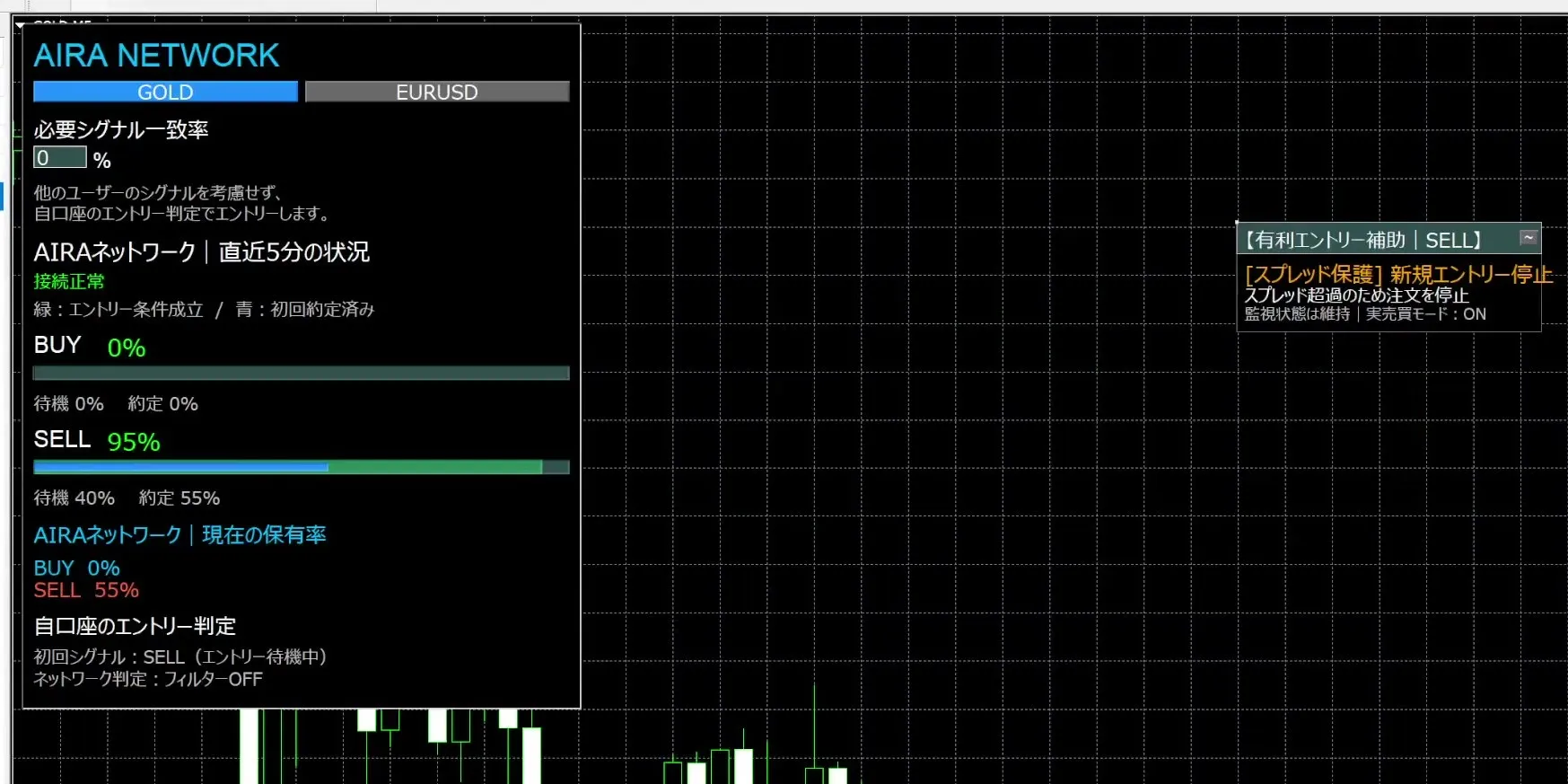
In this moment, SELL is 95%. Breakdown: 40% waiting for signal, 55% initial fill completed. In a short time, SELL-direction signals cluster, making the last five minutes’ aggregate large.
Aさん「Oh, SELL is 95%!」
Cさん「Now signals focusing on SELL. But this value won’t stay forever」
SELL 65% | The five-minute window advances, peak signals begin to drop out
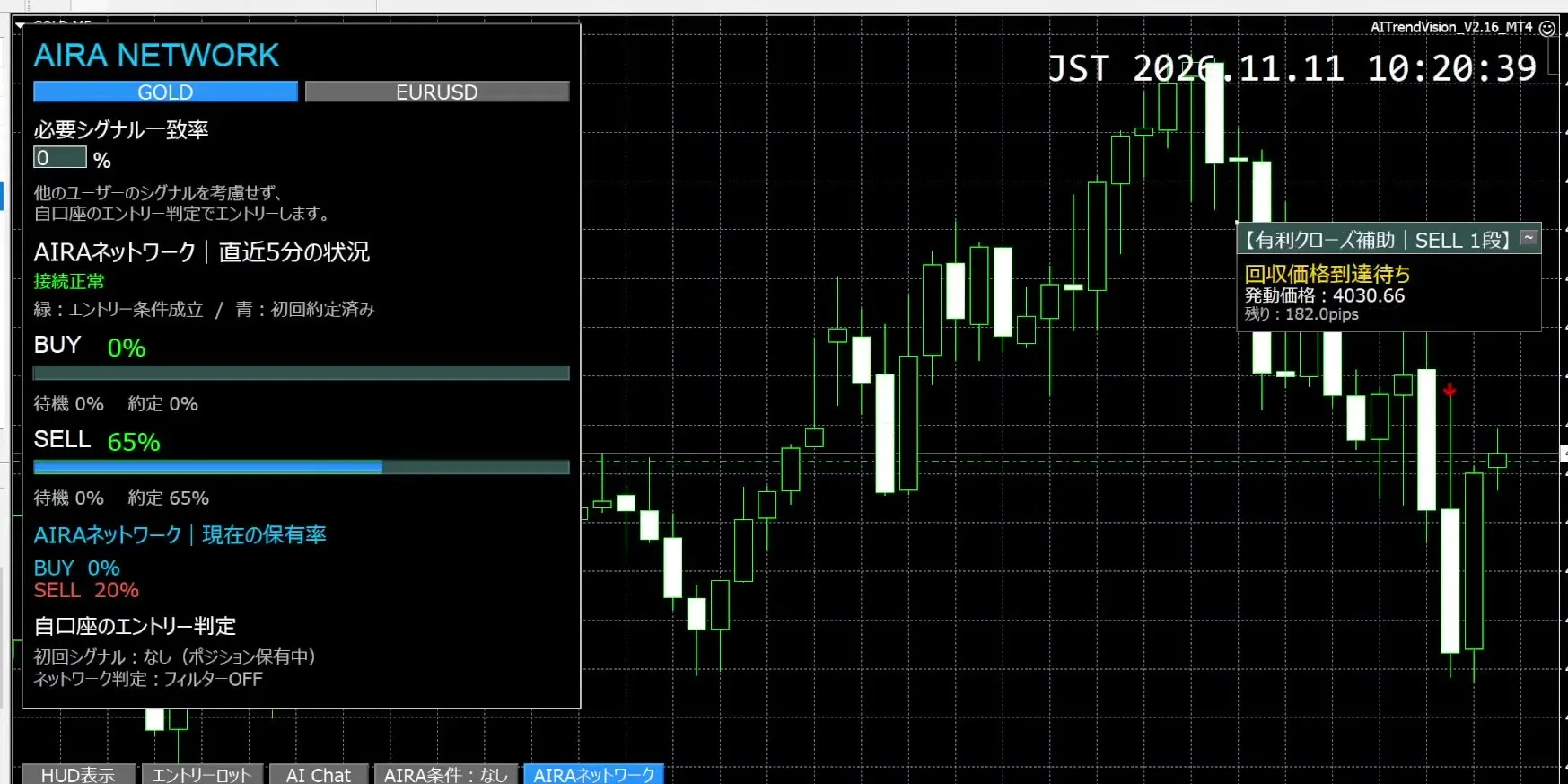
As time passes, the display drops to 65%. It isn’t that “everyone’s opinion suddenly changed.”
AIRA NETWORK always looks back at the five-minute window starting now.As time passes since the peak, older signals drop out of aggregation in order.Therefore, if no new same-direction signals appear, a decline in the display is natural.
Cさん「When the festival ends, fewer signals remain in the last five minutes. So numbers settle down」
Aさん「I see. It doesn’t mean more people canceled SELL」
SELL 10% | Once the peak drops from the aggregation window, the numbers settle
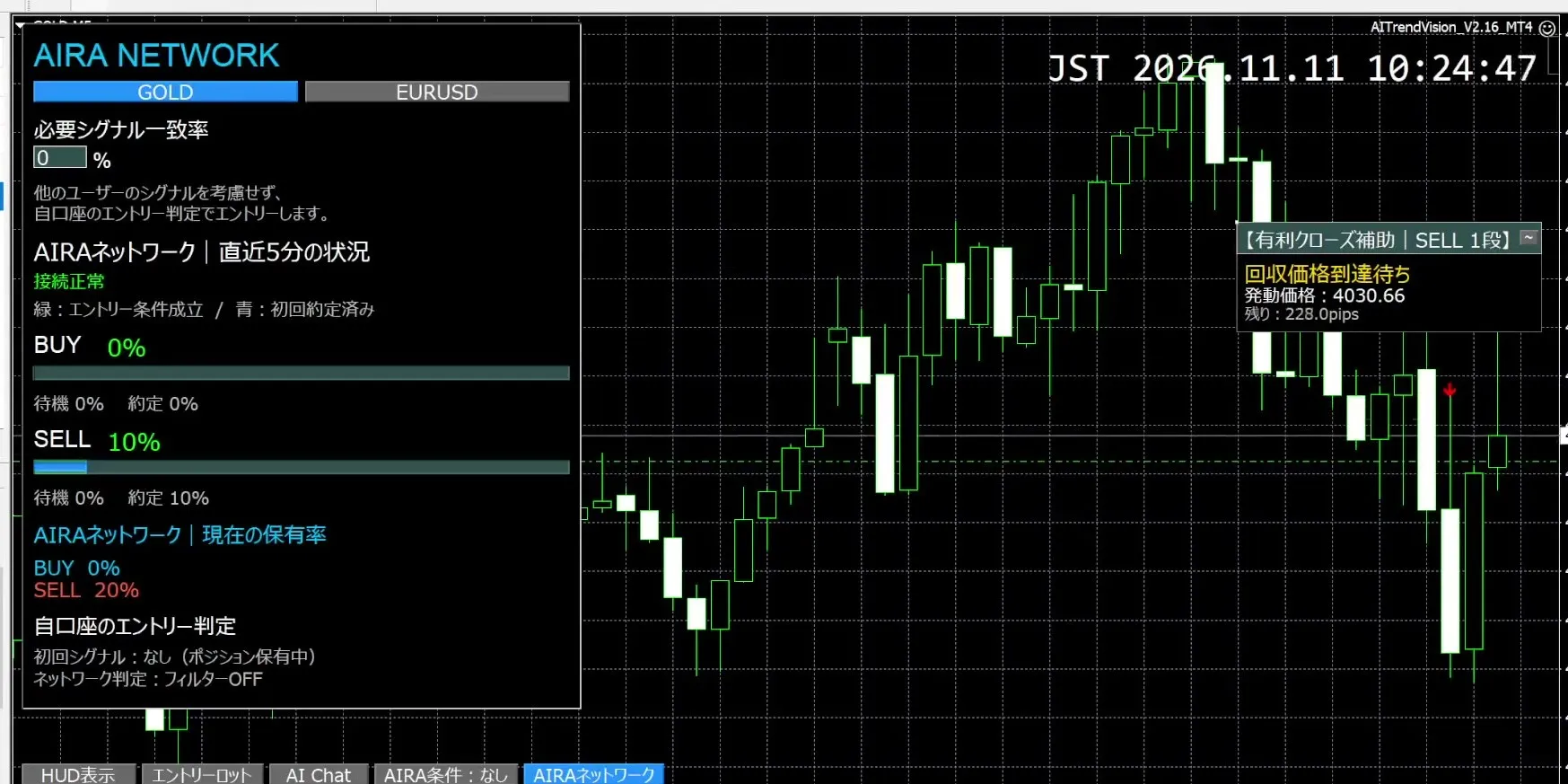
As time advances further, SELL drops to 10%. Signals that formed at the peak move out of the last five minutes’ window, and aggregation settles. This is not an anomaly or a network misjudgment.
And the “Current SELL holding rate 20%” on the screen is separate from the last five minutes’ signals.Even if five-minute signals disappear from aggregation, positions already entered as SELL do not automatically disappear.
Aさん「So the drop from 95% to 10% isn’t because SELL was negated」
Cさん「Right. This is a change consistent with the five-minute window specification.That’s why it’s meaningful to confirm the entry-time information
Note: The required match rate in the footage is 0%. This video does not demonstrate network halting the initial order. It shows the account moving while displaying the network status.
Act 7|“Is 100% safest?” Remember the answer from Act 2
Having read this far, Aさん thought of something. If the required match rate were pushed to the extreme, would it be even safer?
Aさん voiced the same thought.
Aさん「Then wouldn’t 100% be the safest?」
Cさん「Recall Act 2. Even with the same standard account, not everyone’s chart and ticks are exactly identical」
Aさん「Ah… that’s why I alone sold, right」
For example, if the target is 100 accounts and 99 have the same SELL signal, but the remaining one does not meet the condition, you won’t reach 100%. Setting that requires unanimous agreement can cause you to miss entries even with very small environmental differences.
Aさん「If 99 win, and only 1 is different, do you skip?」
Cさん「That’s right. 100% is not “safest,” but the strictest participation condition. If you make it stricter, you may reduce the number of trades, and even those trades won’t guarantee profits
Moreover, even if all participants’ SELL signals align, future price is not predetermined. Even with many accounts showing the same SELL signal, prices can rise afterward and you may lose.
Conversely, a BUY that occurred on only a few accounts could have been the day’s best entry.
Raising the match rate generally tightens entry conditions. But that alone does not guarantee improved win rate, profitability, or maximum drawdown.
If the server loses connection or the received data becomes stale, a 1%+ setting keeps new initial orders on hold. To favor safety, you may miss trading opportunities.
So I believe that the match rate isnot a magic number that increases profits, but a management rule that determines how much to seek agreement from other participants.
| Settings/Status | V2.16 Basic Behavior |
|---|---|
| 0% | Network filter OFF. Judgment by ordinary buying/selling rules |
| 90% | Initial order passes when same-direction judgment rate is 90% or higher |
| Network disconnected/awaiting update | If 1% or more, hold to prevent advancing initial stage with old data |
| Advantageous Entry ON | Start price waiting from your account’s initial signal and also verify network conditions at order time |
| Existing positions | Match-rate restrictions apply to Stage 1 only. Averaging down and settlements are managed by separate rules |
← Please swipe left and right to view the table →
Final Act|What Aさん really wanted that night
Afterward, Aさん sent Bさん another message.