
【How to Decide the Ending of the Day You Won】Place the morning line side by side before entering again
Isn't the third time after winning twice the one that ends up giving back the day's profit?
Why does it feel like the more you win, the more you want to enter again?
I think many people keep staring at the chart without deciding when to quit.
Good evening!
This is Masashi^^
This time, I will write about how to end the day after a win.
It’s my record of how the winning days tended to crumble more than the losing days.
One night, the third entry triggered me to start ending the day with a one-line note in the morning.
I will describe in order how I started handling the “one more trade after a win.”
❌ After two wins, I gave back everything on the third night
This is about my old self.
On a weekday night, the first trade went as planned.
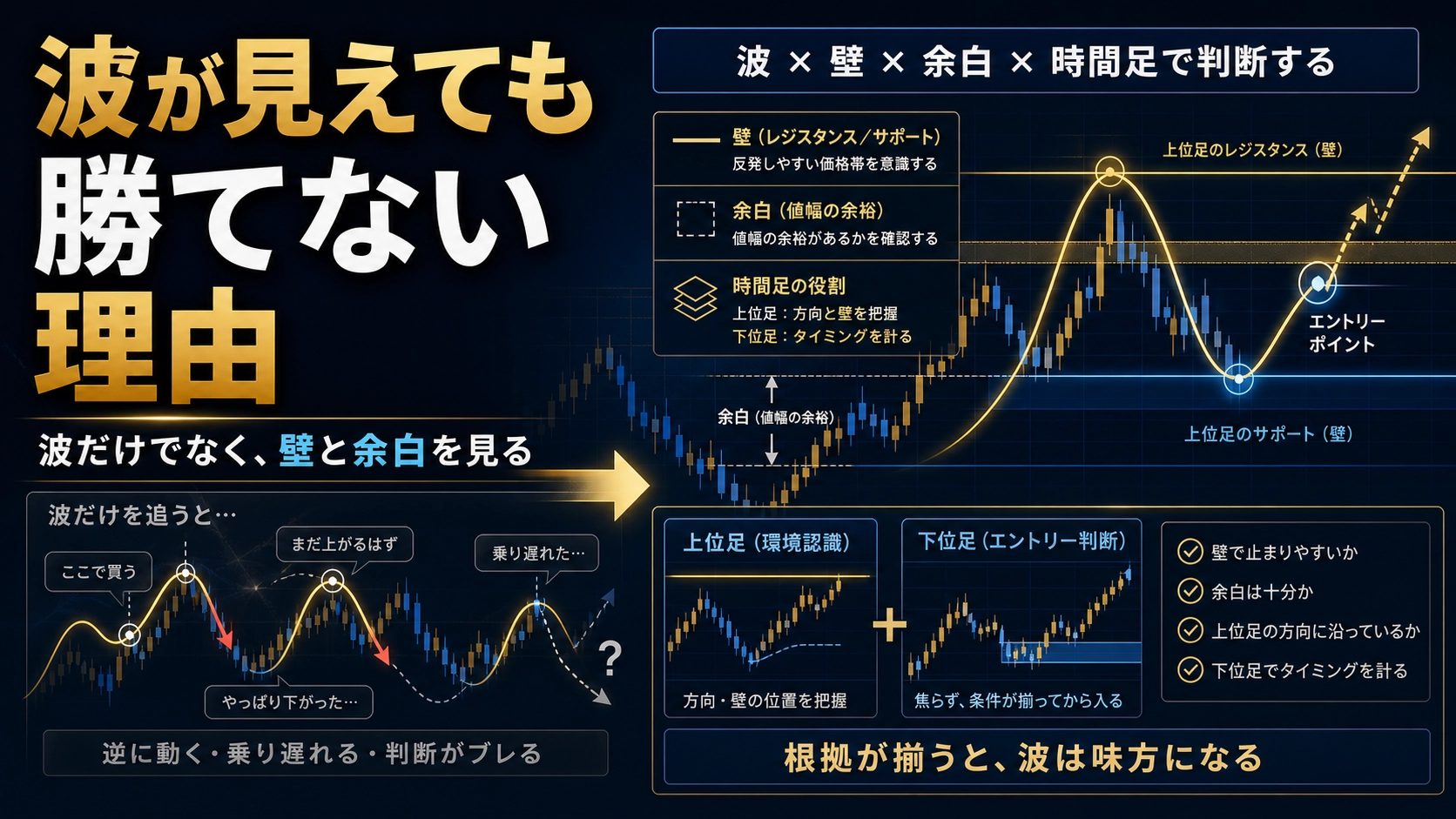
I watched the pullback on the lower timeframe and confirmed the distance to the resistance on the higher timeframe.
I wrote the one-line note before entering, entered, and then locked in at the place I expected.
The second trade also went smoothly with a similar flow.
At this point, my mood rose a little.
“Today I can see the market well.”
I felt there was no reason to close the window, so I kept watching the chart.
After about ten minutes, when I saw a similar pattern, I entered the third trade.
The result was giving back the profits of the first two trades and a little more.
✅ Remembered more clearly after two wins than after one loss
Before entering the third trade, I hadn’t decided on how many closes or what time, anywhere.
? When I opened my records, the third-trade line was short
The following weekend, I reviewed the night’s records.
The first line said this.
【Enter when you see it stop at the lower wall/Close when it settles under the wall】
The second line was written with nearly the same length.
But the third line was just a single word.
【Same as just now】
It didn’t even write where to close.
When I found this, I couldn’t help but laugh a little… w
I had no explanation for why I should enter, yet I was giving the order.
Rather than looking for reasons for the losses, I noticed that the length of the check had changed.
✅ After a win, the one-line before entering was shorter
? When reviewing records, I compare the length of the lines before looking at the profit/loss.
? When I lined up other winning days, the same pattern appeared
I became curious and lined up the records of all the previous winning days.
Then I found that within a day, one line tended to be shorter in a predictable way.
In my case, it was after two wins, the third line.
On days with consecutive losses, the line tended to be longer.
After a loss, I became even more cautious.
After a win, there was no obvious reason to be cautious.
The crumbling happened not on the losing day but in the latter part of the winning day.
It was a lineup I had never considered before.
✅ The days when it crumbled were not random; they varied by day.
? If you mark the days when the line shortened, you can see how many marks accumulate.
? What you were seeing wasn’t the market, but the recent result
So, was that night really when you could see the market well?
Actually, what I could see on the first two entries was what I had confirmed myself.
I confirmed the wall position, watched how it stopped, and decided where to close.
That’s why I was able to enter and close at the place I expected.
The third time, I almost didn’t verify at all.
What seemed visible was not the market, but my own recent results.
To write a more precise line, it wasn’t that winning was bad, but that I gave myself permission to skip verification after a win.
I wanted to stop giving this permission.
✅ The first two successes teach only about the first two times.
? The third-trial wall position and stopping method provide no information from the first two times.
⚠ Decide after winning, then the winning self decides
Back then, I didn’t completely ignore stopping time.
If I felt things were going well, I would decide on the moment, saying, “Just a little longer.”
The problem was that this decision was made by my post-two-wins self.
When you decide in a buoyant mood, you tend to accumulate reasons to take another trade.
“If I stop now, I might miss out on what I could have made.”
“The momentum is good today.”
Both were statements that came from my own result, not the market.
I handed the job of stopping time to the time when I should not trust myself most.
✅ Stop time should be decided before you even enter once.
⚠ Re-deciding stop time while you are winning tends to be overwriting, not redeciding.
? If two items go well, skip tasting the third
This is somewhat like cooking.
First dish, you look at the recipe, measure ingredients, and taste.
If the second dish goes well, your technique improves gradually.
By the third, you might stop cooking before checking the recipe or tasting.
Not because you’re used to it, but because the first two succeeded, you feel you don’t need to confirm.
And only the third dish ends up saltier.
“No, no, trading isn’t cooking!”
Some may think this.
I think so too. You can eat salty food, but a third trade in trading remains in the account.
So I stopped trying to guard the third taste with sheer willpower.
I decided in the morning to skip the tasting when it’s likely to occur.
✅ Rather than strengthening my mindset, I moved the decision time to the morning.
? The morning one-line is written in the time before I open the chart and have seen nothing yet.
? Write in the morning line how many times you will close
What you do is just write one line in your morning note.
It contains three items.
・ How many times to close
・ What time to close
・ If you will enter after a win, what you will write first
First you decide the count.
For example, a line like this.
【Close after two wins】
There is no rule about what count is correct.
In last week’s records, I marked the day when the one line shortened and placed it one step before the day when the marks accumulated.
In my case, the marks accumulated on the third time, so I set it to two times.
If your marks accumulate on the fourth time, you can close on the third.
✅ Place the count just before the day when your line begins to crumble in your own records.
? For tomorrow, you can just write in the memo, “Close after two.”
✔ Also write the time and the condition after a win
Besides the count, also write the closing time.
【Close at ten p.m.】
Just the count alone would make the night feel long while waiting for the first close.
Having a time helps, because it leaves one reason to close the chart whether you win or lose.
The last sentence is the most important.
【If you enter after a win, only enter when the previous line is the same length as usual】
I don’t completely ban entering again after a win.
Putting these three together, it looks like this.
【Close after two wins / Close at ten p.m. / After a win, only enter if the line is the usual length】
✅ Endings are described in one line using three parts: count, time, and condition.
✔ The place to write is the same memo as the line before entering, so you can read them side by side.
? If you crave entering after a win, line it up with the morning line
Even if you write a morning line, you still will want to enter after a win.
I think this feeling is unstoppable.
So when you crave entering, first read the morning line and your current line side by side.
I look at three things.
・ Has the morning count already been exceeded?
・ Has the morning time already passed?
・ Does the current line specify a closing location?
If any of these apply, you close for that day.
If none apply, you bounce between the higher and lower timeframes as usual to check whether to enter.
Arranging “Close after two” and “Same as before” together, you really cannot press the order button… w
✅ If you crave entering, open the morning line before the order.
? After-win steps: 【Open the morning line / Compare with the current line / Close if it matches】
⭕ Even after a win, there are days when it’s okay to enter
Let me break the above a bit.
It is not that you must never enter after a win.
If the morning line says 【Three times】 and the third line is of the usual length, and the closing location is decided, and the full check is done as on the first time, I would normally enter.
Even if you incur a stop loss there, that cost is within expectations.
There are weeks when you want to change the morning line itself.
But I keep the changes to the morning line to after-trading time, when things are calm.
✅ It’s better to edit the morning line after the day ends, not while winning.
⭕ The morning line is not a prohibitive sheet, but a confirmation sheet to check if you may enter.
? Is it wasteful to quit on a winning day?
People sometimes ask whether quitting on a good day makes them miss profits.
I too used to think so.
Even now, when I see a chart that continued rising after I closed, I feel a twinge of regret.
But the profits you would have made are only known after you look at the chart after you closed.
The amount you gave back on the third time remains in the records as is.
I would rather reduce the amount that is given back in the records than chase unvisible missed gains.
With this one-line rule, there are days when I can write in the final line, “Closed after two wins.”
There are still losing days, but there are fewer days when I give back the entire winning amount on the third trade.
The hard part is that even after a win, you must write the original one-line length before entering.
If the wall position stays vague, that line inevitably becomes shorter.
If the price position is shown clearly on the screen, it becomes easier to write with the same length as the first time.
However, the tools do not decide for you.
✅ The number of times to close is something you decide yourself.
? If you cannot write the morning line, you should just open the chart and look at it.
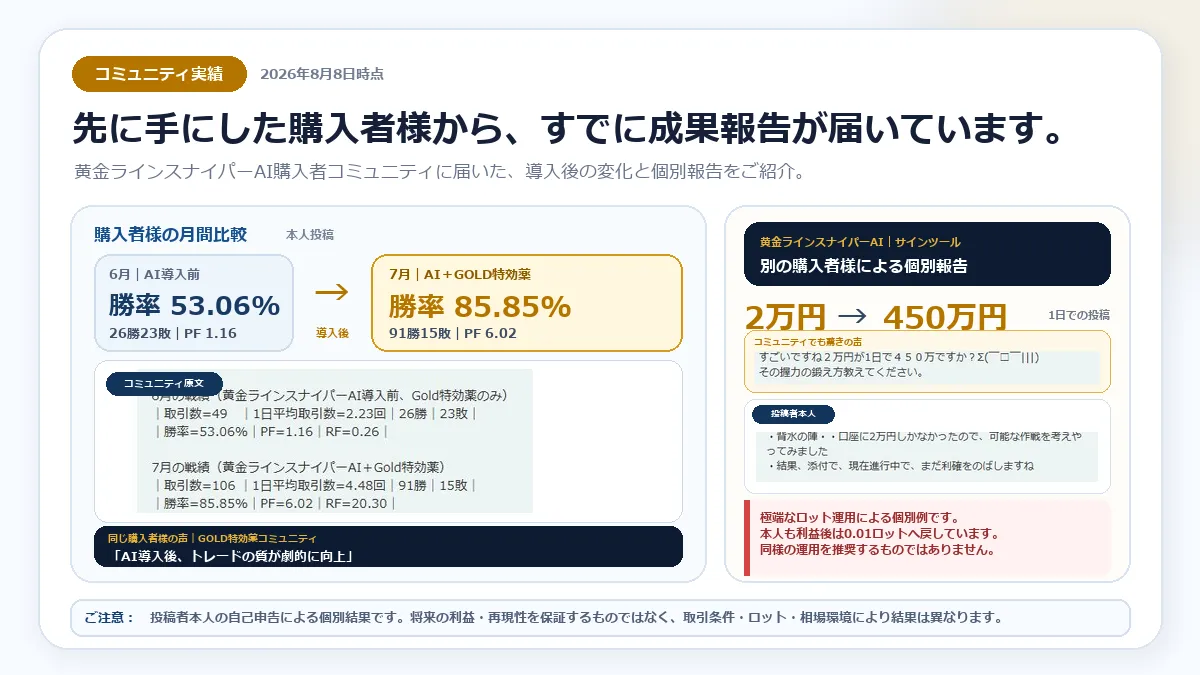
? GOLD Special Medication has been featured^^
If you want to organize from the ground up, please check the content and its limits.
? Summary: On winning days, close in the way decided by your morning self
In my case, the crumble after a win wasn’t because the market suddenly became unreadable.
The fact of two wins shortened the third verification.
So I let the morning self decide how to end the day, even after a win.
I make one line with three parts: how many times to close, what time to close, and what to write after a win if you enter again.
If you crave entering after a win, line up the morning line and the current line before the order.
If the count is exceeded, the time has passed, or the closing location isn’t written, that day ends.
Place the count before the day when your one line begins to crumble, in your own records.
Tomorrow morning, before opening the chart, just write the word 【Close after two】 in your memo^^
For those who want the morning line to stay at its usual length after a win, GOLD Line Sniper AI is also an option.
It does not decide how many times to close or whether to enter on your behalf.
Please use it after confirming its display and limits, and make your own final decision.
✅ Next winning night, open the morning line before the order.
? Tomorrow’s line: 【Close after how many times / Close at what time / After a win, only if the line is at its usual length】
For reference, I’ve included the current operating status of GOLD Line Sniper AI’s EA^^
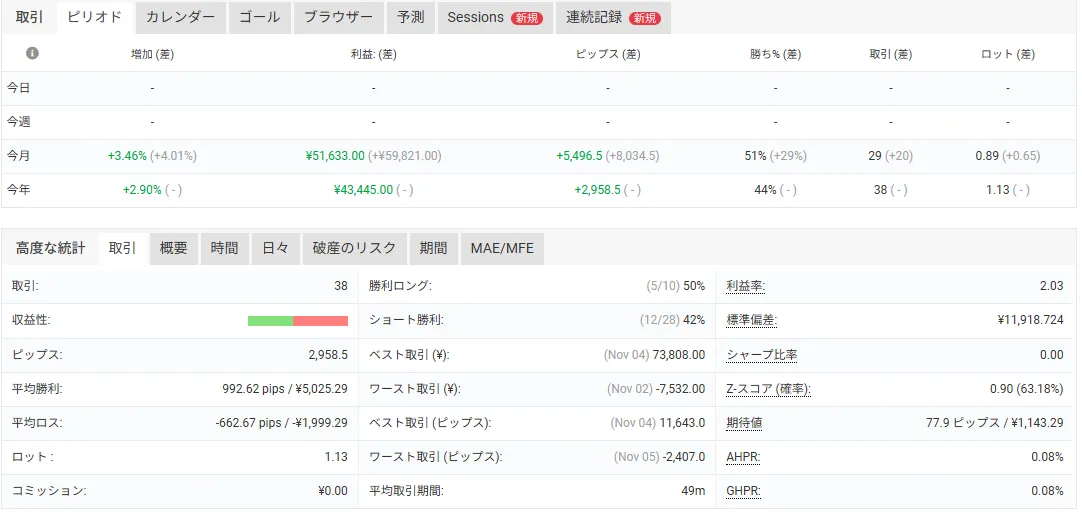
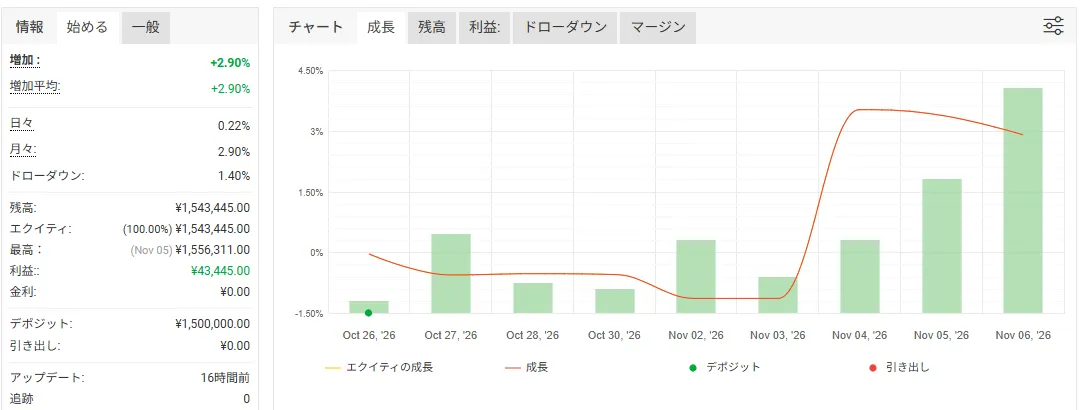
The settings are low risk, simple interest, and results are recorded on myfxbook.
From October 26, 2026, for about two weeks, I’ve completed 38 trades.
During this period, the winning trades were 44%, not quite half.
The increase was +2.90%, the drawdown 1.40%, but since the period is short I don’t think it’s appropriate to judge by numbers alone.
This is not a promise of future results, so please take it as an interim update.
View details of GOLD Line Sniper AI
Thank you again for reading until the end today ^^