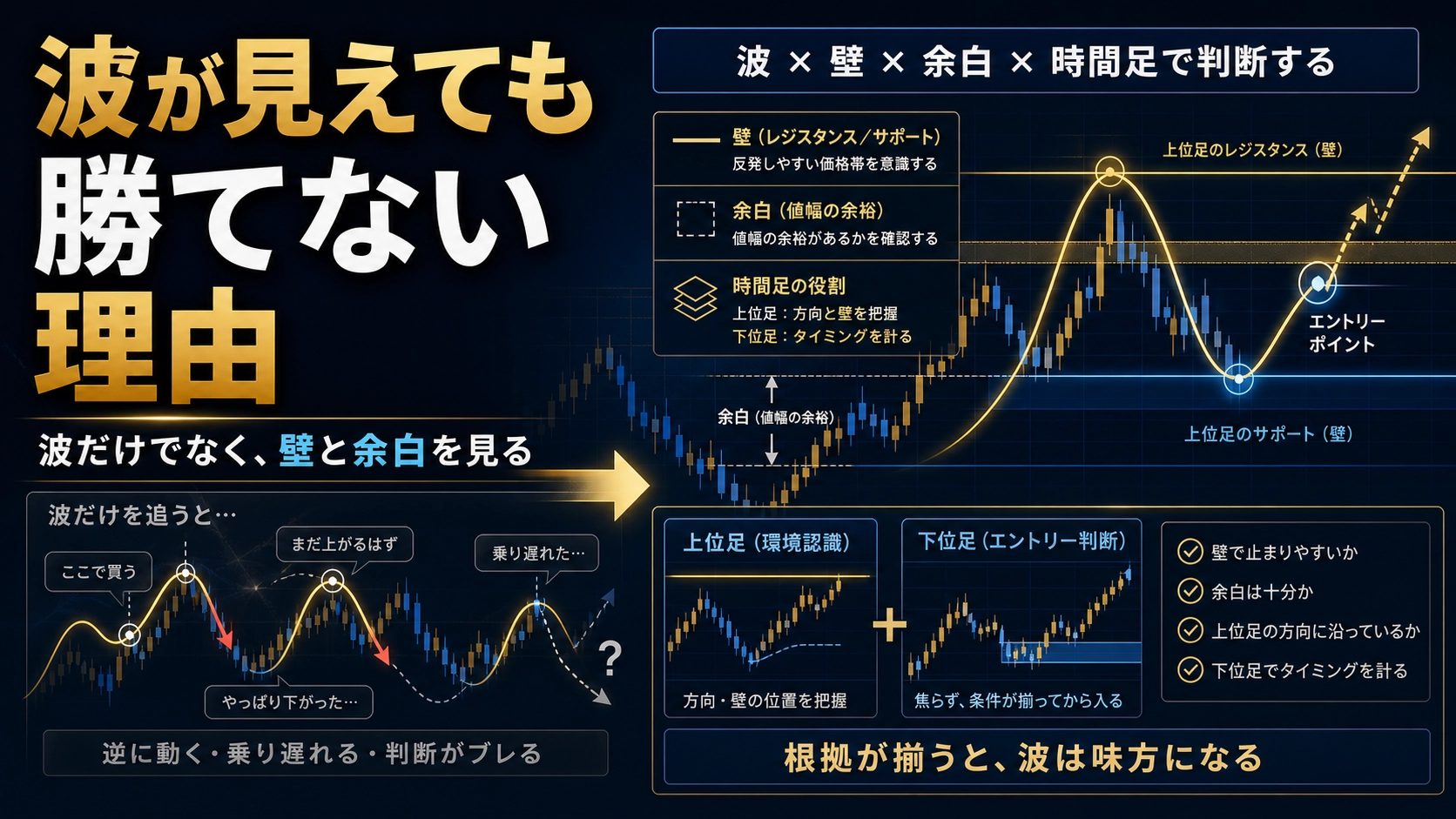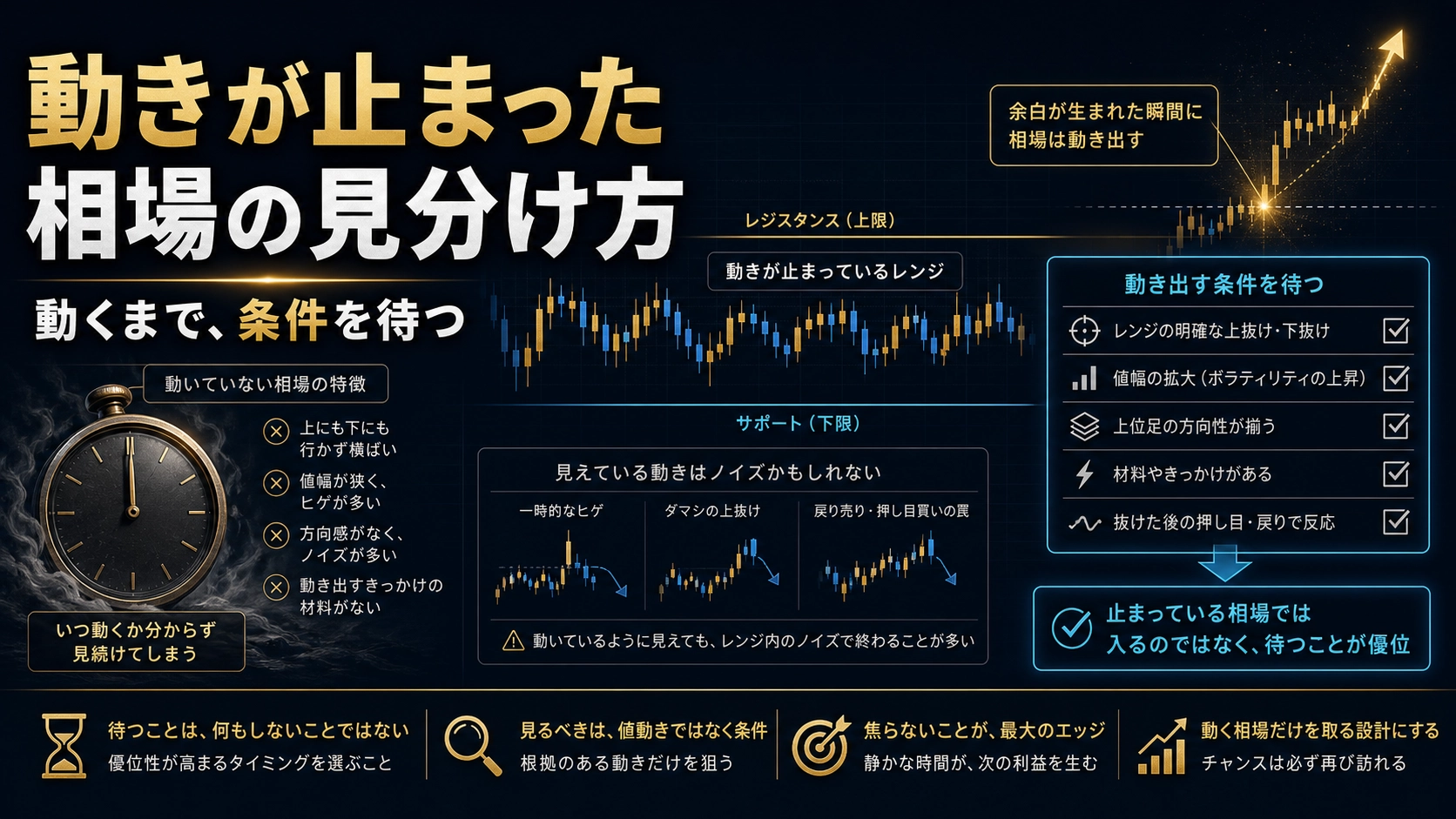

[Procedure to write the conditions for moving to the entry price first] Do not exit immediately even if there is unrealized profit
As soon as a little profit appears, aren’t you moving the stop to break-even?
With that, you feel relieved that you’ve eliminated the possibility of losing, and then a small pull back touches the break-even level and ends.
Sometimes just as you’re about to close the screen, price extends back toward the initial direction, doesn’t it?
People who have decent win rates but aren’t growing their accounts, where should they change?
Good evening!
This is Masashi^^
This time, I’ll talk about the habit of escaping to break-even too quickly.
Break-even refers to the entry price, and if you move the stop there, even when it ends, the profit and loss becomes almost zero.
What I decide for myself is to write, before entering, one line describing the condition to move the stop.
Until that condition is met, I won’t touch the stop.
A line might be, for example,【After breaking through the next barrier and calming down, move to break-even】like a short one.
✅ The sense of relief the moment you move to break-even
In the past, I used to move the stop as soon as I earned a little profit.
Right after entering, the distance to the stop loss felt very scary.
So, as soon as I became a bit in profit, I wanted to escape that fear.
The moment you move to break-even,“I won’t lose anymore”The sense of relief was considerable… lol
But when reviewing the records, there were cases where it ended before it had a chance to grow.
✅ The sense of relief was instant, and the movement that should have grown came afterward.
? The flow at the time: 【Enter / a little profit / move to break-even immediately / ends with a push]
? What I woke up to on the morning I thought I had protected
There is a morning I remember well.
I bought when I saw the price hit the lower wall, and moved the stop to break-even as soon as it rose a little.
After that, price pulled back once close to the entry price and touched break-even, ending there.
The profit and loss was almost zero, and at that moment I thought“Okay, I protected it.”I thought.
But from there price continued to rise without turning back, and passed beyond the level I had first considered.
Looking later, it was a movement that never even reached the initial stop level (;'∀')
✅ At the break-even I thought I protected, it was pulled back by a pull to the downside before it could run.
? While looking at the chart, I wasn’t sure what I had protected.
? A pattern where win rate isn’t bad but account doesn’t grow
When I lined up the old records, they looked odd.
・Many ended at break-even, with zero profits
・When price moved against me before breaking to break-even, I cut losses properly
・When it rose, it came back down at break-even, so I didn’t capture much
There are times when win rate isn’t bad, but profits vanish after a few losses.
My records were close to that pattern.
✅ I focused on reducing losses and paid little attention to preserving rising opportunities.
⚠ In zero-like records, there were also traces of me cutting off moves that might have extended.
? Opening an umbrella but turning back at the first drop
Some might think it’s important not to incur losses.
I think so too, and reducing losses is crucial.
Think a bit about everyday life.
If you see a forecast of rain, grab an umbrella, but if you turn back home at the first drop, wouldn’t your trip be pointless?
Similarly, entering with a stop loss but stepping down on a small pull just before is a bit like this.
✅ If you went out with an umbrella, you might as well walk in the light rain.
? The reason for deciding the stop loss was to accept the fluctuations up to that point.
❌ Moving during the expected fluctuation
The stop location decided before entry is where, if price breaks below, the reason for entering collapses.
Price movement up to that point, I believe, is the expected range of fluctuation at entry.
If you move to break-even during that fluctuation, each time you get a push you end the trade as expected.
I feel it’s like tightening the fluctuation width you planned before entering, after you’ve entered.
Ah, to be more precise, moving to break-even itself isn’t bad.
In my case, the problem was the timing—moving before the expected fluctuations end.
✅ The fix isn’t about whether to use break-even, but about timing to move.
❌ In my case, the more fear there was on a day, the earlier I moved.
? Write the moving conditions in one line
What you do is decide, before the move, whether to move the stop or not, in a single line describing the condition for profit.
Before placing the order, write just one line on paper or your phone.
【Enter after touching the lower wall / Cut after it settles below the wall / After breaking through the next wall and settling, move to break-even】
The first is the reason to enter, the second is where to cut, the third is the condition to move the stop.
The third is based on what you see on the chart, not on amount or distance.
If you say “a little profit,” that little profit changes every time.
To verify whether you’ve passed the next wall, you can alternate between higher- and lower-timeframe charts.
✅ Only after writing up to the third item do I consider placing the order.
? When you can’t find the next wall, you can’t write the third, so you don’t enter that trade.
✔ Read the third item before the amount when profit appears
When profits appear and you want to move the stop, read the third item on your memo.
What you verify is only whether the stated conditions are met.
In my case, looking at the amount tends to pull me toward fear.
I try to step away from the screen except when verifying conditions are needed.
✅ Whether to move the stop is decided by the conditions written before entry, not by the amount.
✔ If you watch price movement, even within expected fluctuations, fear can seem to creep in.
? Write the urge to move in a separate section
Still, the urge to move appears every time the conditions aren’t met.
“I don’t want the profit to disappear.”
You can’t help thinking that sometimes.
So I started writing that feeling in a separate memo section.
Section name【When I Wanted to Move】What I write here isn’t counted as a reason to move the stop.
Afterward, I compare the moment I wanted to move with the moment the price started to run.
In my records, there were also several cases where it ran right after I felt the urge to move.
✅ Write the urge to move without erasing it. However, do not use it as a reason to move.
? Simply having a column to write in makes your fingers hesitate a moment before you act.
⚠ There are times when stepping down early is okay
Let me break the story here for a moment.
It isn’t that you must not touch the trade until all conditions are met.
One case is when the reason for entry itself collapses.
If price doesn’t stop at the barrier you expected and instead drifts to the other side, you may exit without waiting for the stop place.
That’s not moving the stop; that’s exiting because the reason to enter disappeared.
Another case is when a major indicator is approaching.
If you don’t plan to cross the indicator while holding, you may consider closing even if conditions aren’t met.
✅ Because it’s scary or profits are shrinking, you don’t move the stop just for those reasons.
⚠ Stepping down early happens when the reason for entry collapses, or when a large unexpected move is near.
? How recording changed after you began writing conditions
Since adopting this procedure, the most changed portion of my records was the number of trades ending at break-even.
Records with zeros lined up more neatly!
Instead, the trades where I could hold after a typical push started to appear in the records gradually.
Of course, this didn’t reduce losses overall.
There are still cases where price reverses before moving to break-even and results in a loss, as before.
Conversely, some trades that used to end at break-even turned into actual losses.
✅ A loss counted at the place you wrote is simply the cost you anticipated before entering.
? For me, the records look calmer now than before ^^
⭕ What to do when you’re terrified of being pushed back to break-even
When I talk about this, I’m often asked:
“I can’t stand the idea of losing after moving to profit—why does this happen?”
I truly understand this.
In my case, that fear was strongest when the distance to the stop was large relative to my lot size.
So first, try reducing your lot size to a level where you feel safe getting cut at the stop.
There are still times when you cut a loss even though you waited as written.
Not just once, but across ten or twenty trades, compare how it works for you.
✅ For the next order, add one more condition to move the stop behind the place you cut. Start there.
⭕ Even deciding whether to move the stop is up to you.
? GOLD-specific medication has been featured^^
If you want to organize from the ground up, check the contents and limitations.
? Summary: Put the moving condition in a single line before entering
When you push to break-even at the slightest profit, what’s happening isn’t necessarily caution.
Every time an expected pull comes, you close the trade, and you cut yourself off from a possible longer run.
Even if win rate isn’t bad, there might be a pattern hiding in zero-like records where you’re not growing your account.
So before you enter, line up the reason to enter, the place to cut, and the condition to move the stop all in one line.
When profits appear, read the third condition before looking at the amount.
By alternating between higher and lower timeframes, you can verify if the conditions are met.
The urge to move goes into the column labeled【When I Wanted to Move】
Exiting is allowed when the reason for entry has collapsed or when a large, unexpected move is near.
As you can keep more winning trades, you might then feel like re-entering on winning days.
I’ll write about that in another article.
If you want to shorten the time spent finding the next wall, GOLD Line Sniper AI is one option to consider.
It does not decide where to move the stop or when to exit for you.
Please use it after confirming the display content and its limits, and make your final decision yourself.
✅ Before the next order, write the moving condition in one line.
? Next line: 【Add one more condition to move to break-even after the place to cut】
Here, it would be helpful if you could also check how the included EA is currently moving ^^
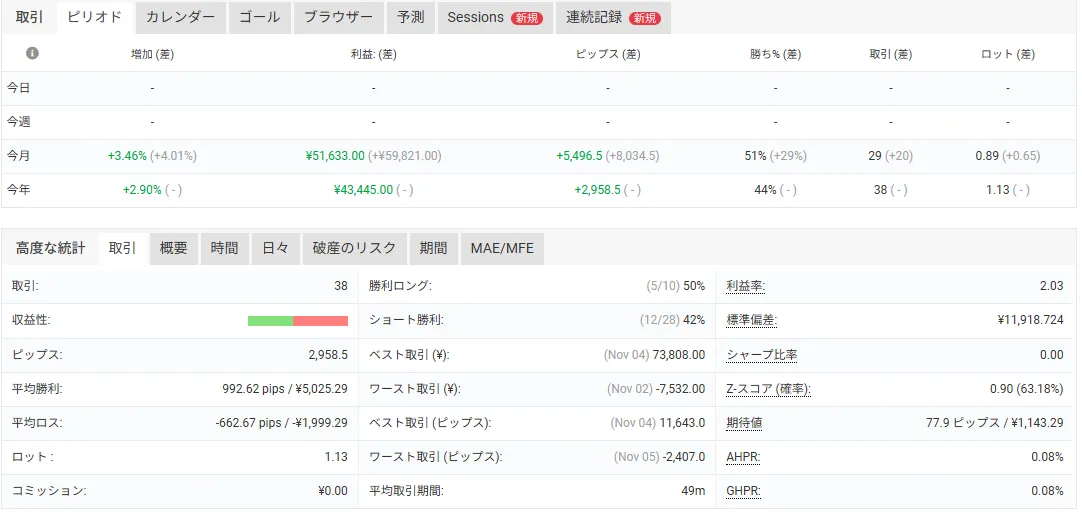
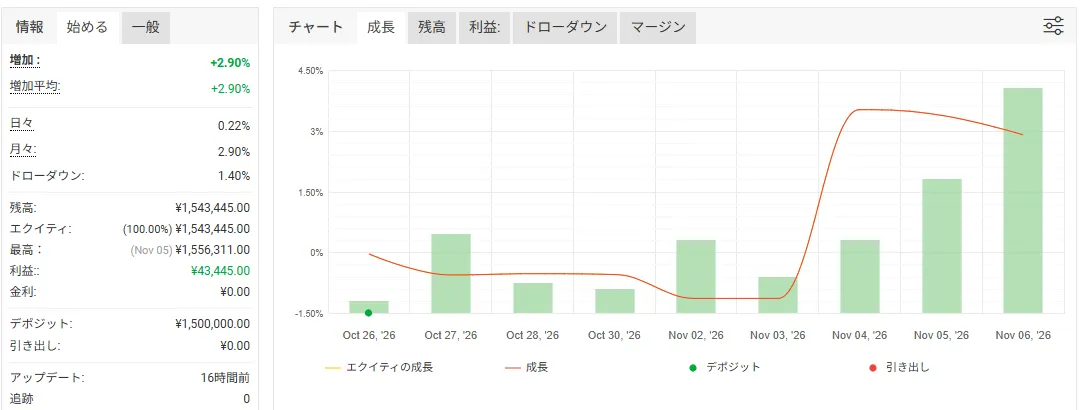
I’m recording accounts with low risk and simple compounding on myfxbook.
I just started moving on 2026-10-26, and there have been about 2 weeks and 38 trades.
Among them, wins are 44%, so there are more losses.
Increase is +2.90%, drawdown is 1.40%, but two weeks is still possibly a matter of chance.
This is not a guarantee of future performance, so please treat it as data to gauge the current state.
View details of GOLD Line Sniper AI
Thank you for reading until the end today as well^^