
[Steps before viewing others' analysis] Write your own single line first and compare
Before opening the chart, have you read someone’s entry report?
After seeing a post like “buy from here,” I open my chart.
There are times when a place you were hesitating at just a moment ago suddenly looks like a setup to buy.
When asked why you entered, and you can only say “because that person was buying too,” what should you change?
Good evening!
I’m Masashi ^^
This time, I’ll talk about why you fail to cut when you enter after looking at others’ analyses.
It’s not about methods; it’s about the order of what you write first after you open the chart.
What I decide for myself is to write one line before reading anyone’s analysis.
Other people’s opinions are read only as material to compare with the line I wrote.
The line is short, for example【Enter after you see a wall and exit when the wall is broken and you’ve calmed down】such as this.
✅ A chart’s appearance can change with a single word from someone
In the past, I used to be a trader who opened timelines before charts.
When I wake up in the morning, I skim posts from people who seem good at trading.
If it says “I want to buy when it drops,” that alone determines the direction in my mind.
When I open the chart in that state, the place that looked up or down becomes a buying setup only.
All small rebounds and pullbacks seemed to say“Buy after all”as if they were saying that… lol
✅ I was validating the posted ideas by looking at the chart as if I were reading the posts.
? Morning at the time: 【Read posts / Open chart / It only looks like a buy】
? On losing days, the notes contained people’s names
When losses piled up, I doubted my method for a long time.
I thought there must be a better method used by more successful traders, so I followed more people.
But when I review the records, what was common on losing days was the way I wrote notes.
One day’s note looked like this.
・Reason for entry: many people with a bullish bias
・Where to cut: (blank)
・After: I couldn’t stand it and cut
There was no mention of what part of the market I looked at or what aligned to enter.
There was no reason for where I cut, just that I reached a point where I couldn’t watch any longer (’(;’))
✅ On days when the reason for entry contained a person’s name, the column for where to cut was left empty.
? When you line up losing days, you can see in the way you write that the differences are more important than the method itself.
? Why entering based on a person’s name makes you unable to cut
If the reason for entering is a person’s name, why does it make it hard to cut?
The reason is that I don’t know where that person intends to exit.
If you write your own reason, the place where that reason collapses becomes the exit point.
But if you enter based on a person’s name, there’s no way to verify whether it collapsed.
So when it moves in the opposite direction, I would go to that person’s posts rather than the market.
I wanted to think I’m still holding, that it’ll be okay.
✅ The cause of losses was not the method but that the reason for entering wasn’t mine.
⚠ By checking whose post you relied on when prices reversed, you can tell whose reason it was.
? Borrowing a single line from a recipe won’t give you the same taste
Some people may think it’s not bad to reference someone else’s analysis.
I used to think that too; there’s a lot to learn from others’ analyses.
Think a bit about cooking.
From someone’s recipe“Fry on high heat”Even borrowing just that one line won’t give you the same taste, right?
Because quantities of ingredients and the timing to turn off the heat are all decided within the whole recipe.
Trading is the same: someone’s “buy from here” comes with their own place to cut and lot size.
✅ You can borrow only the direction, not the exact place to cut.
? What is written in posts is usually only the direction to enter.
❌ The problem was a sequence that borrowed only the direction
Oh, to be precise, it’s not the author’s fault.
Posts that include where to cut are already scarce in the first place.
The problem was the borrower entering with only direction in mind and in that order.
If you read first and then open the chart, your direction is already decided before you confirm the wall yourself.
When you look at the wall after direction is decided, you tend to see walls that are convenient for that direction.
Even if you follow the rules and think you’re winning, this order mixing can happen.
✅ The fix is more about the order you read than the content of the method itself.
❌ In my case, the days I read posts first left the cut column more empty than other days.
? If you open the chart, write one line first
All you have to do is swap the order once.
In the morning, I start with the chart, not the timeline.
I go back and forth between higher and lower timeframes to check the walls near my current location.
Then I write the reason for entry and the place to cut in one line.
【Enter after you see a wall at the lower wall / Cut after you settle under the wall】
The left of the diagonal is the reason to enter, the right is where to cut.
If you can’t write it,【For now, I’ll skip since I’m in the middle of the wall】is also fine as a line.
✅ Writing “I’ll skip” is also a valid, well-considered judgment.
? Writing on paper or on a phone in a place separate from the chart makes it easier to review later.
✔ Read others’ analyses to see the difference from one line
After you write your line, it’s okay to open SNS.
When reading, look at how your line differs from that person’s direction, not at that person’s direction itself.
・Are they looking at the same wall or a different one
・Is the place to cut written
・How different is your cut place from theirs
If there’s someone looking at a different wall, return to your chart and recheck that wall.
Only when you’ve confirmed with your own eyes should you rewrite your line.
✅ “Because that person said so” is not a valid reason to include in your line.
✔ If you can’t see the wall after confirming, you cannot put it in your line no matter how good that person’s opinion sounds.
? Do not count read opinions in a separate column
Nevertheless, once you read an opinion, it doesn’t vanish from your mind.
When you’re in a loss, the thought grows louder:“But that person said to buy.”This is stronger than ever.
So I decided not to force myself to forget what I read, but to write it in a separate memo column.
The column name is【Other’s Assessment】and it isn’t counted as either a reason to enter or a reason to keep.
If you write it, you’ll find something interesting after finishing.
On both winning and losing days, the 【Other’s Assessment】 column tends to be similar.
The difference shows up in your own line.
✅ Do not erase read opinions; write them down. However, do not use them as a replacement for your own line.
? Just having a writing area helps prevent external opinions from entering your mind as easily.
⚠ There are scenes where using others’ analyses is okay
Let me shake up this part of the discussion a bit.
Is it better not to read any of others’ analyses? I don’t think so.
First, it can tell you about walls you might have missed.
Go back to the chart and if there really is a wall, adjust your line.
This isn’t because you entered due to others’ opinions, but because others’ opinions prompted you to verify yourself.
Second, it helps you learn why you shouldn’t enter.
If you see that a major indicator’s timing is close, you may decide to skip today.
Information indicating not to enter won’t hurt your losses.
✅ The only supportive direction you borrow is not a line to substitute your line.
⚠ Use it to learn about overlooked walls and reasons not to enter.
? What changed in the notes when you swapped the order
Since adopting this order, the most changed area was the reason-for-entry column.
People’s names disappeared cleanly!
Instead, there are now lines listing which walls you observed stopping at.
Of course, this did not mean I stopped losing.
There are still days of entering as per line and exiting as per line, just as before.
What changed was how I handled losses after they happened.
If I cut at the place I wrote myself, it feels like the cost I anticipated before entering had appeared.
✅ I can now write the contents of losses in my own words.
? Losses on days when I entered using others’ words remained without knowing what to fix ^^
⭕ What to do on days when you can’t write one line?
When I talk about this, I often get asked:
“Even if I try to write one line, I don’t know where the wall is.”
I think that’s how it is at the beginning for everyone.
When I started, it took me several minutes to write one line.
On such days,【I won’t enter because I don’t know the wall today】and close the chart.
Afterward, reading SNS and seeing where smart people view the walls is a good balance.
・If you don’t know the wall, write that you won’t enter
・When you enter, reduce the lot size for the days you rely only on your line
・Use the records of your small-trial days as material for your next line
If you can’t trade without reading others’ analyses, start with a small lot and create days where you enter with only your own line.
✅ Tomorrow morning, open the chart and write one line before looking at SNS. Start there.
⭕ You decide what to write and whether to enter yourself.
? GOLD-specific solution has been featured ^^
If you want to organize the basis of judgment, please check the content and its limits.
? Summary: Read others’ analyses after your own line
If you enter after reading others’ entries, the reason-for-entry column will contain a person’s name.
In that state, you can’t write the place to cut, and when prices move against you, you’ll open SNS again.
When losses pile up, you may doubt more about whether your reasons to enter are yours rather than the method itself.
So swap the order: open the chart, move between higher and lower timeframes, verify the walls, and then write one line.
One line is enough to include the reason to enter and the place to cut with the diagonal on either side.
If you can’t write, just write that you’ll skip and close it.
Read others’ analyses afterward and use them as material to compare with your own line.
Only when you can verify with your own eyes should you rewrite.
Read opinions【Other’s Assessment】in the column, and do not count them as a reason to enter or to keep.
When you can enter with your own line, the next issue is the urge to exit as soon as there’s a small profit.
I’ll write about that in the next article, too.
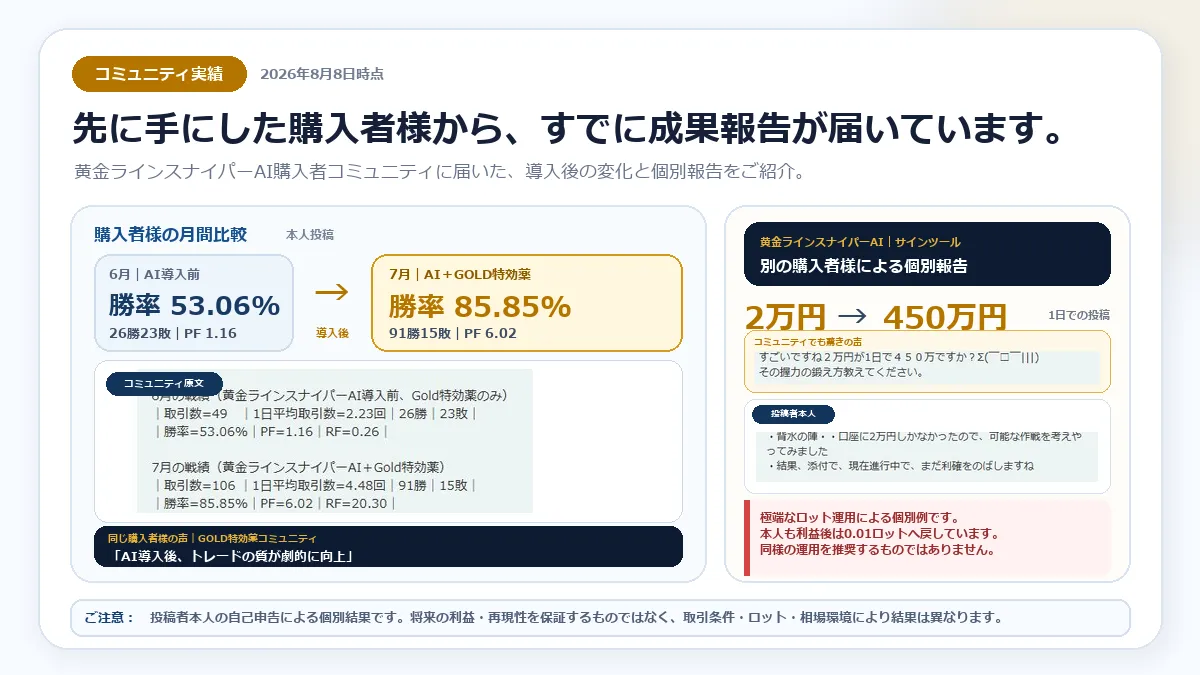
For those who want more to shorten the hesitation when writing one line, the Golden Line Sniper AI is also an option.
It does not decide whether to enter or where to cut instead of you.
Please use it after confirming the display content and its limits, with the understanding that you make the final decision yourself.
✅ Before the next order, I write my line first.
? Tomorrow morning’s line: 【Open the chart first / Write one line then check SNS】
I’ll also include the current operating status of the EA that comes with the Golden Line Sniper AI ^^
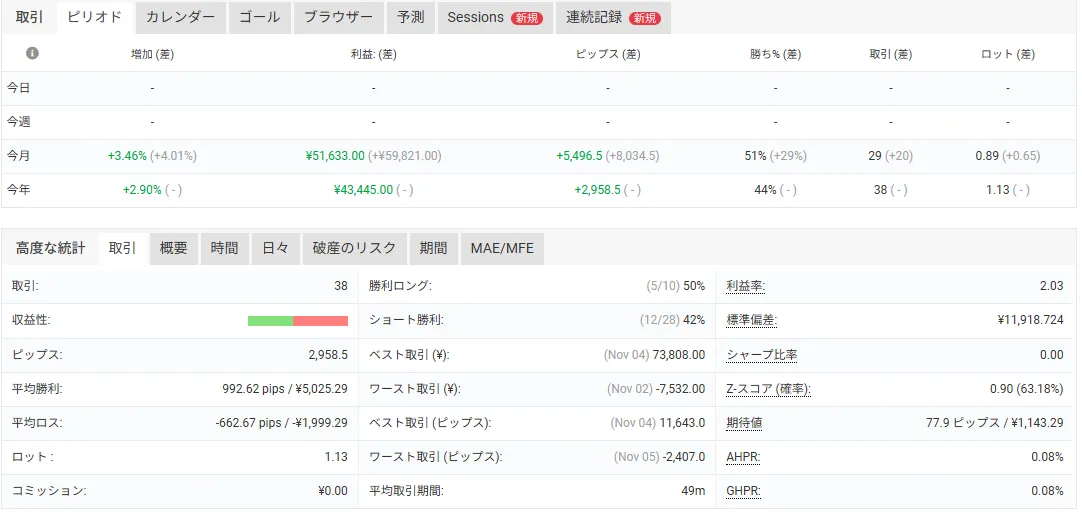
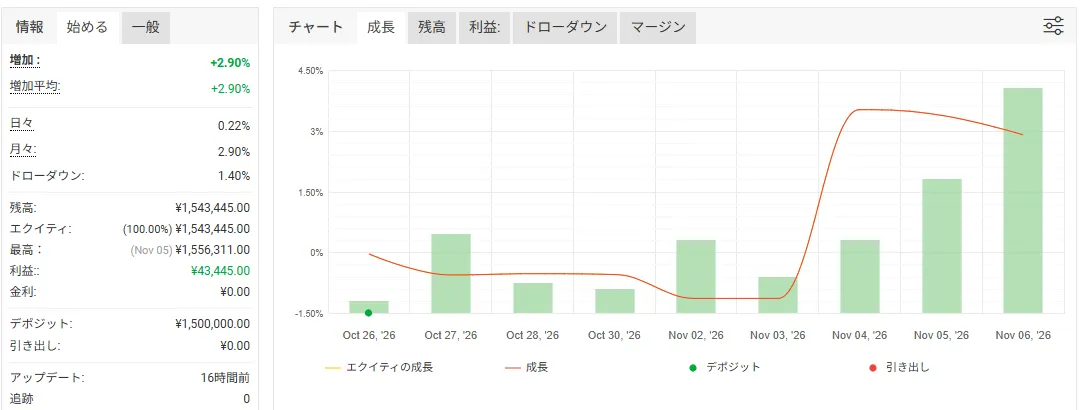
In the account I record on Myfxbook, settings are low risk and simple interest.
The period is about two weeks from October 26, 2026, and I’ve had only 38 trades so far.
The win rate for this period is 44%, and in terms of number of trades, losses are more numerous.
The increase is +2.90%, the drawdown is 1.40%, but since it’s only two weeks’ data, a large part may be due to chance.
It doesn’t guarantee the same shape going forward, so view it as a current snapshot.
View details of Golden Line Sniper AI
Thank you again for reading to the end today ^^