
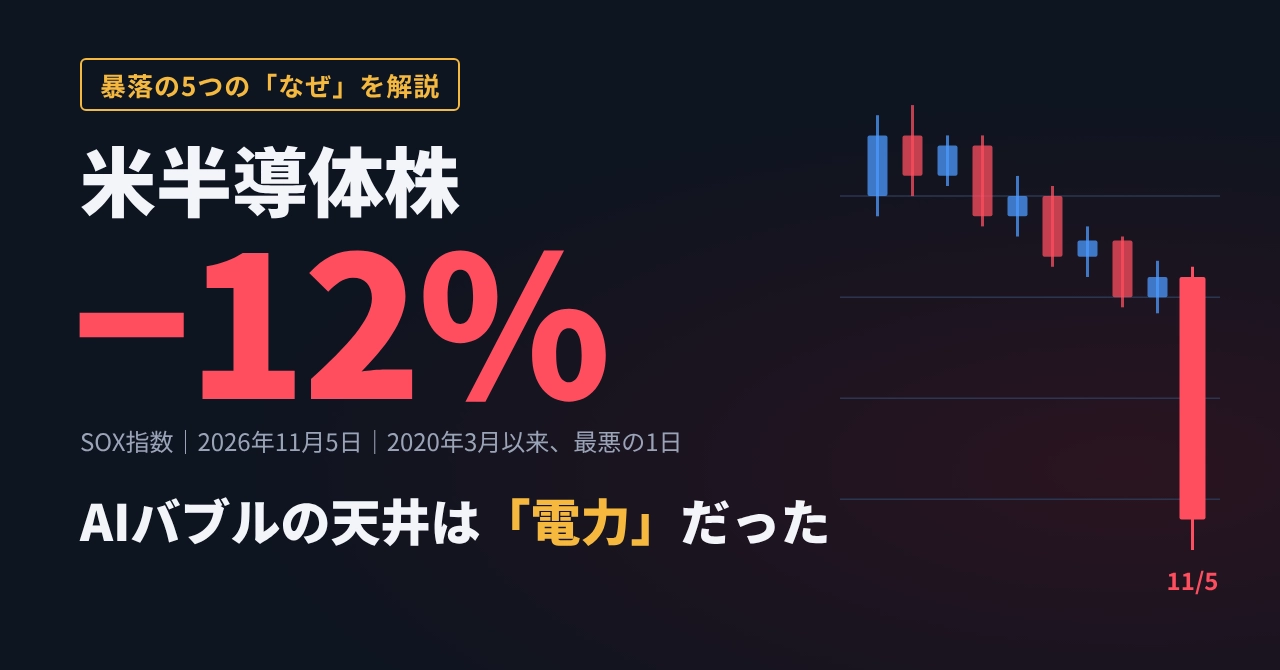
Why did semiconductor stocks plunge as much as 12% in one day? The ceiling of the AI bubble was in "electric power"
This article is written based on information as of November 6, 2026.
A 30-second takeaway from this article
- The current crash does not mean the defeat of AI technology.
- The speed of AI investment hasexceeded the “physical limits” of electricity and memoryand those costs have been passed on to ordinary people as electricity bills first.
- As a result, the “speed of AI investment” has entered a stage wherepolitics and public opinion influence it—this is the essence of what happened.
To answer the title first: the ceiling of the AI bubble is not in the technology, but in“the speed that electricity and the people bearing its burden will permit”—that is my assessment.
- What happened:On November 5 (U.S. time), the U.S. semiconductor stock index (SOX) fell 12% in one day—the worst day since the early COVID-19 shock in March 2020. The S&P 500 also fell 4.4%, pulling the market down; on the next day, November 6, the Nikkei fell 5.96% (the drop was the third-largest in history), triggering a global chain reaction.
- Trigger:A local referendum on limiting data center construction, held concurrently with the midterms, where regulators won nearly all the votes
- Market miscalculation:They focused on AI demand (whether there were buyers) and overlooked whether construction would be allowed socially (social license).
The crash in numbers: the epicenter was the U.S., spreading to Asia the next day
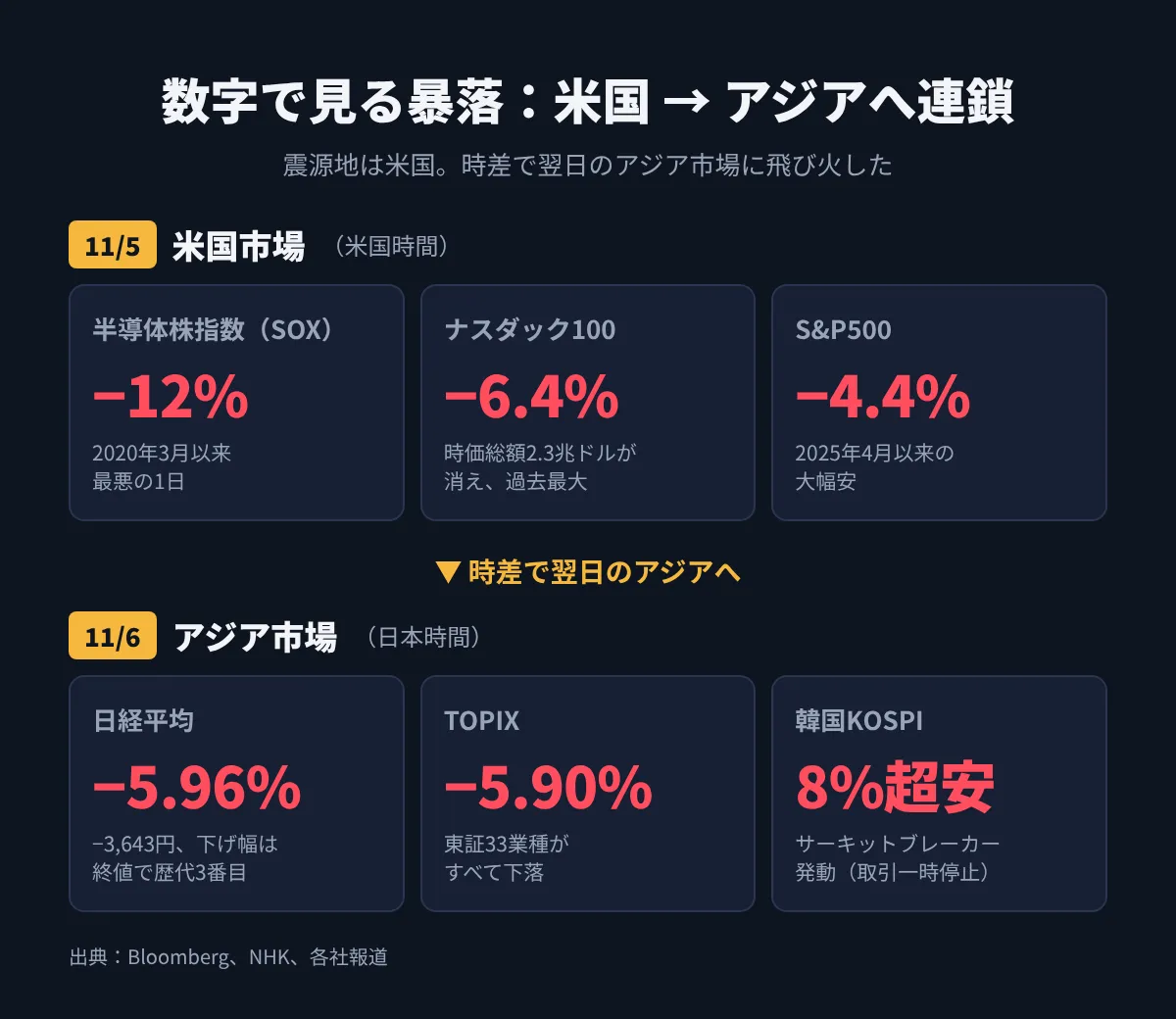
The sell-off starting from semiconductors spread to the entire U.S. stock market as represented by the S&P 500. AI and semiconductors had driven U.S. stock gains in recent years, so when those “main actors” faltered, the whole market trembled.
The next day, Asia jumped in (November 6)
Because of time-zone differences, the U.S. crash was reflected in Asia the following day.
- Nikkei Stock Average:−3,643 yen (−5.96%) to 57,434 yen. The fall was the third-largest on a closing basis; it briefly dipped below 60,000 for the first time in about half a year.
- TOPIX(an index of a broad range of Tokyo Stock Exchange listed stocks):−5.90%. All 33 sectors on the TSE Prime declined; only 21 stocks rose, 1,523 fell, marking a broad-based decline.
- KOSPI (Korean)(Korea’s representative stock index):Dropped over 8%, triggering a circuit breaker (trading halt during a steep decline). Samsung Electronics and SK Hynix fell about 10% and 12% respectively right after market open.
What’s notable here is the difference from the previous day.
On November 5, the Nikkei fell 1,110 yen, but the TOPIX rose, and about 70% of the TSE Prime’s stocks rose. In other words, on the 5th, what was being sold wasonly semiconductors.
But on the 6th, in response to the U.S. crash, it became a broad-based decline regardless of sector.The issue of semiconductors expanded overnight into a market-wide risk-off—that’s the scary part of this crash.
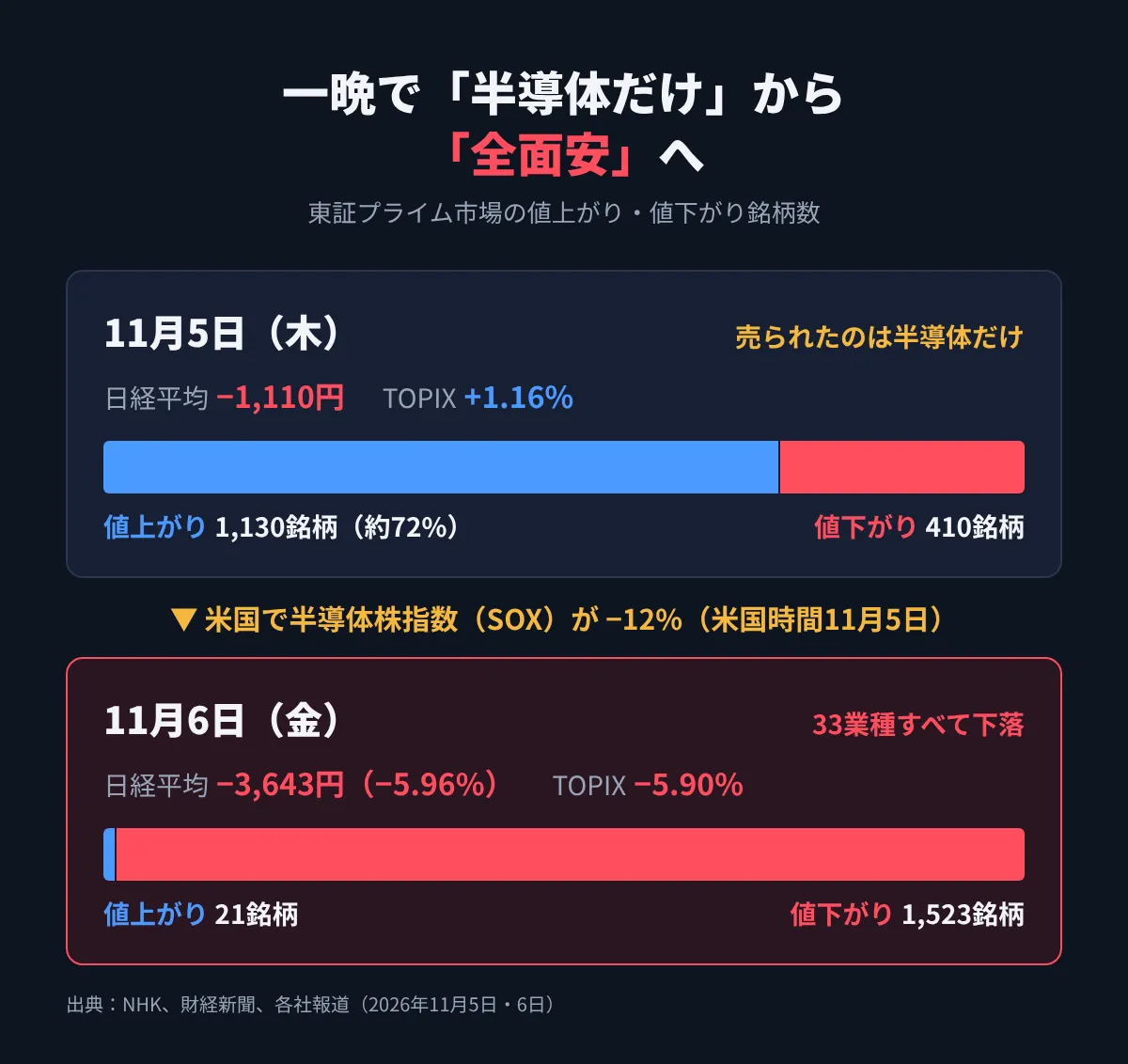
※Regarding the sectors that fell the most on the 6th, foodstuffs fell about 10%; this was largely due to news about JT’s Russian assets, and not AI-related.
The “domino effect” structure to the crash
News about election results and earnings figures are only symptoms that appear on the surface. Behind them, the following chain of events was underway.
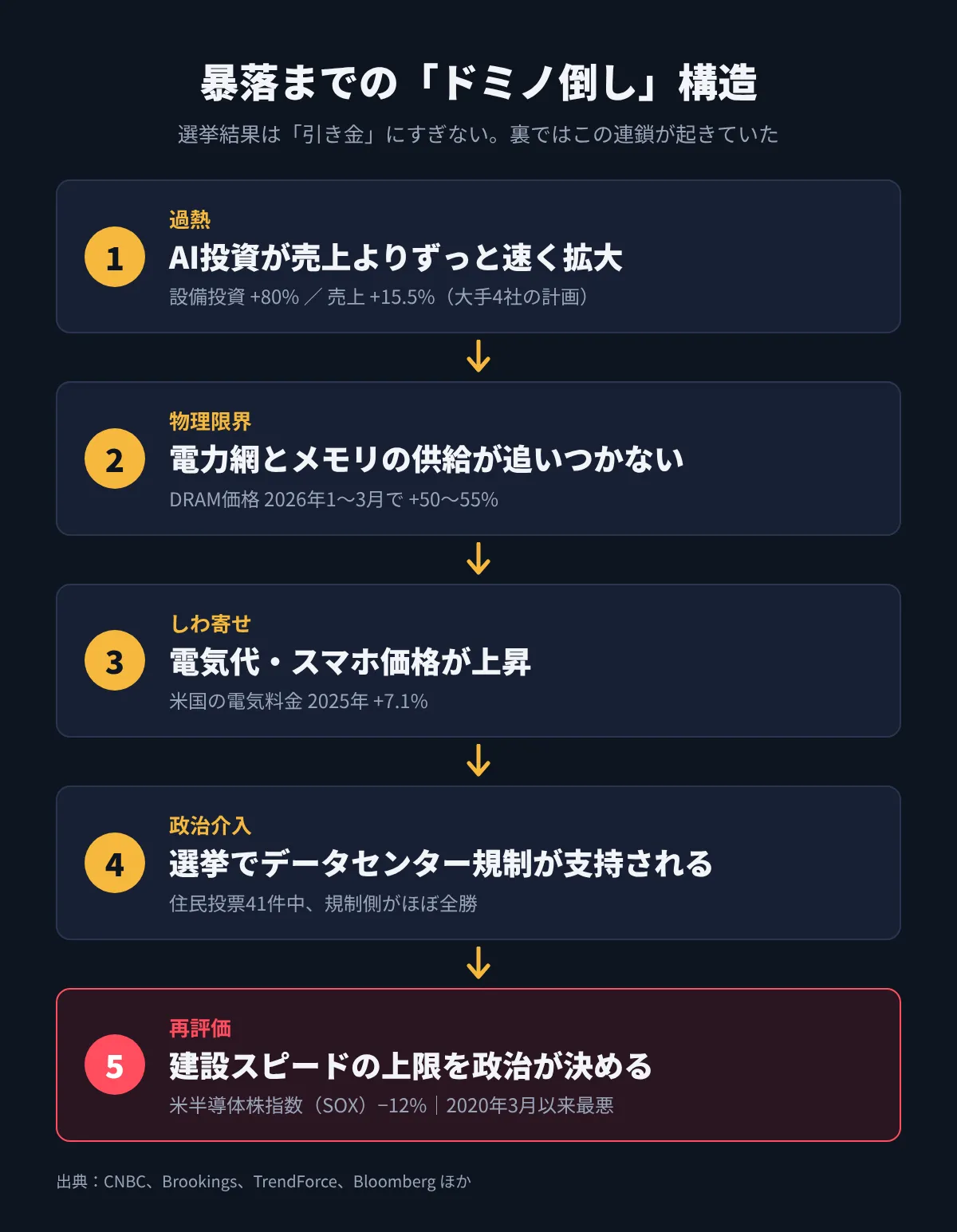
【Overheating】AI investment grew much faster than sales (returns on investment could not catch up)
↓
【Physical limits】Power grid and memory supply could not keep up
↓
【Reallocation burdens】Electricity costs and smartphone prices rose (costs borne by households)
↓
【Political intervention】Data center regulations gain social license in elections
↓
【Reevaluation】Politics decides the “speed limit of construction” → semiconductor stocks plunge
From here, we will delve into this chain step by step with five “whys.”
Unraveling the crash in five whys
【Why 1: The immediate reason】 Why were semiconductor stocks sold in the midterms?
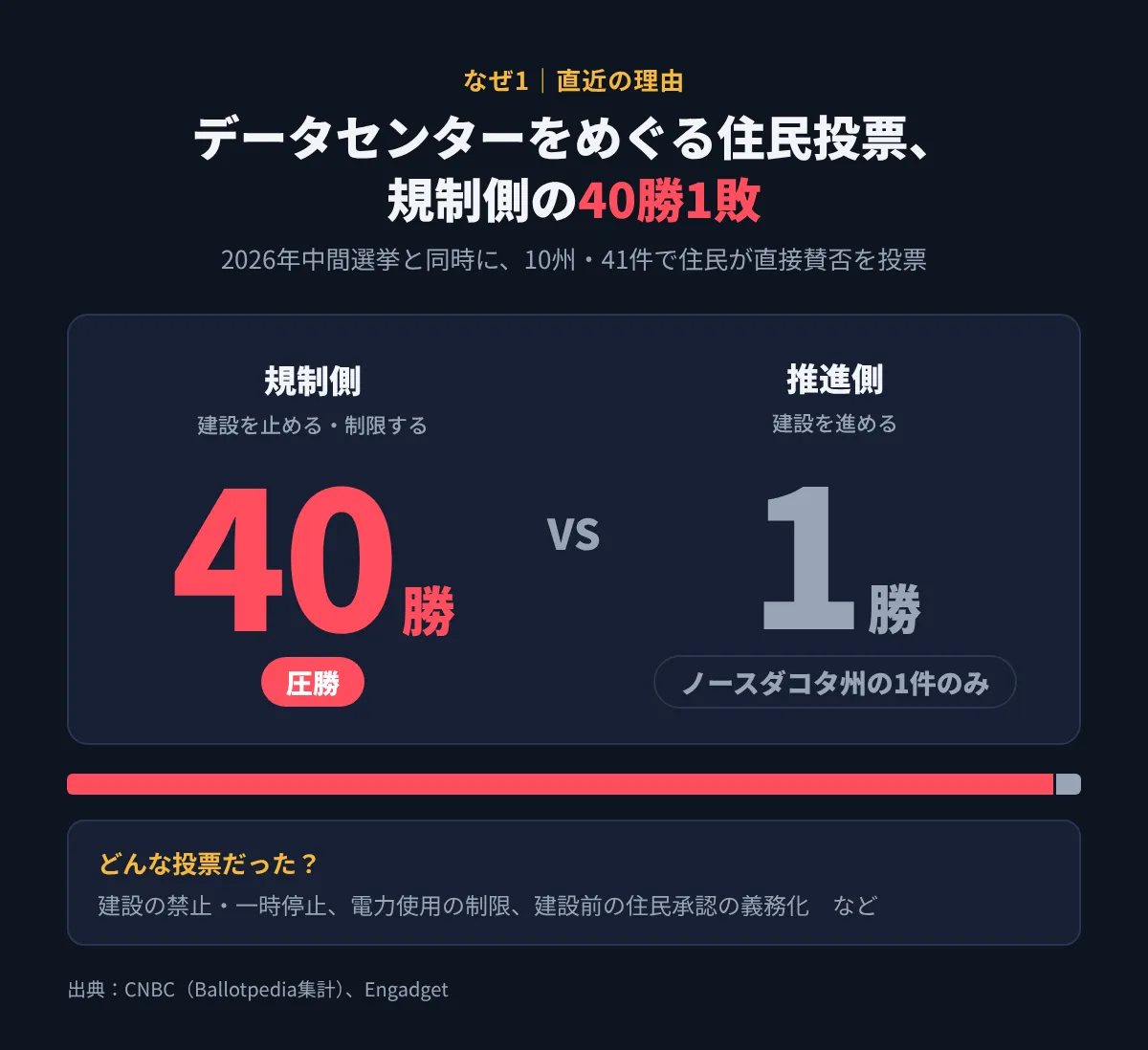
Conclusion: The Democratic Party’s landslide and the near-total win of the proposition to restrict data center construction.
- Among 10 states and 41 referenda on data centers, only one (Harwood, North Dakota) did not see the regulators win
- The market interpreted “data center construction plans will be delayed → AI semiconductor demand will slow” and sold semiconductors across the board
- On the same day, Qualcomm (a major smartphone semiconductor maker) issued a profit forecast for the current quarter that was lower than market expectations, causing its stock to fall over 10% and accelerating the selling
【Why 2: Structural reason】 Why did data centers become the election issue?
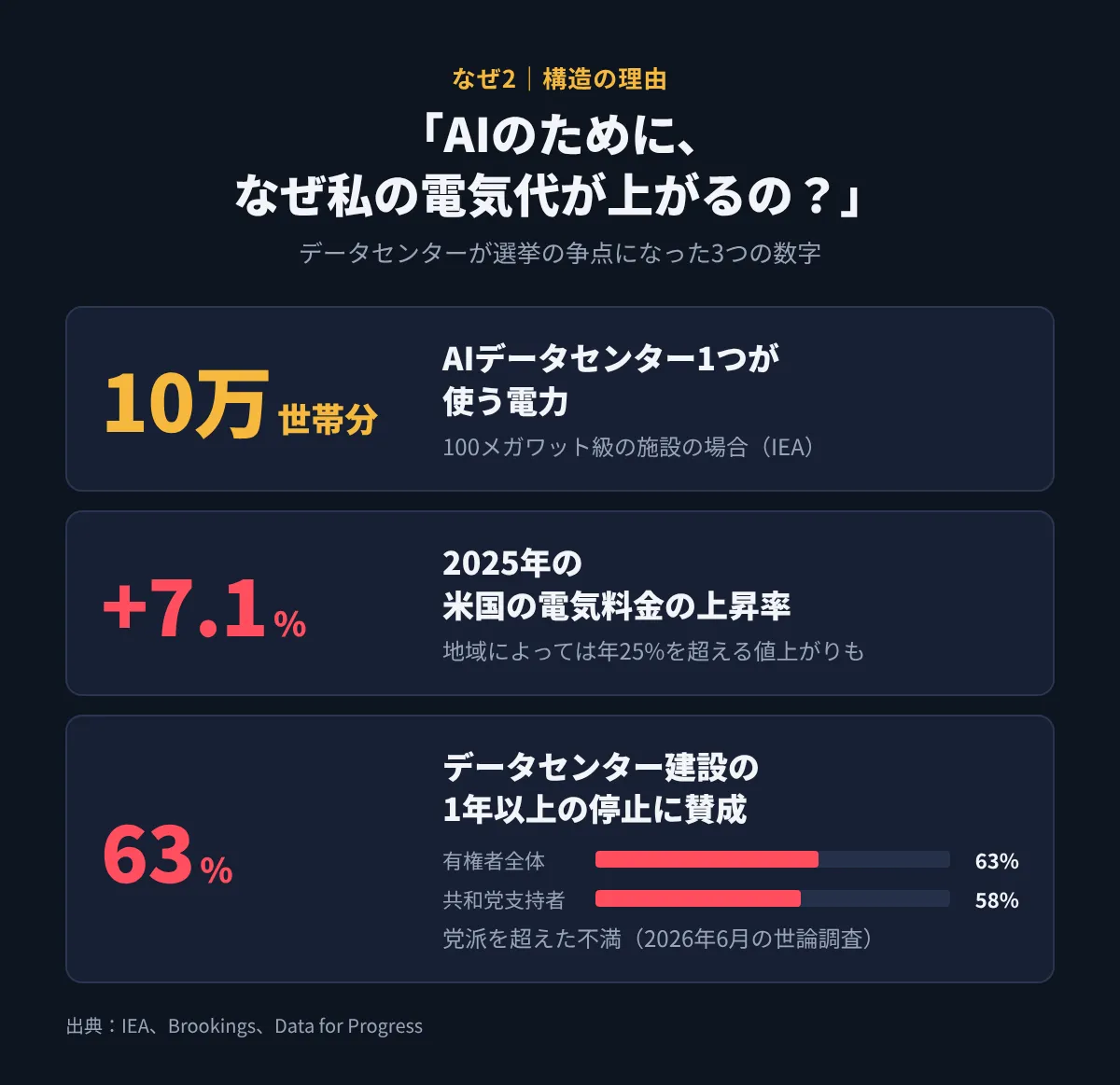
Conclusion: Consumers’ frustration was that electricity costs rose because of data centers.
- According to the International Energy Agency (IEA), one AI data center at 100 megawatts uses electricity equivalent to about 100,000 households
- U.S. electricity prices rose 7.1% in 2025; in some regions, increases exceeded 25%
- This sentiment crossed party lines. A June 2026 poll showed 63% supported stopping AI data center construction for more than a year; even 58% of Republican voters supported it
The simple question “Why does my electricity bill go up for AI?” surfaced in the elections.
【Why 3: Bottleneck reasons】 Why did the surge in electricity costs create such a strain?
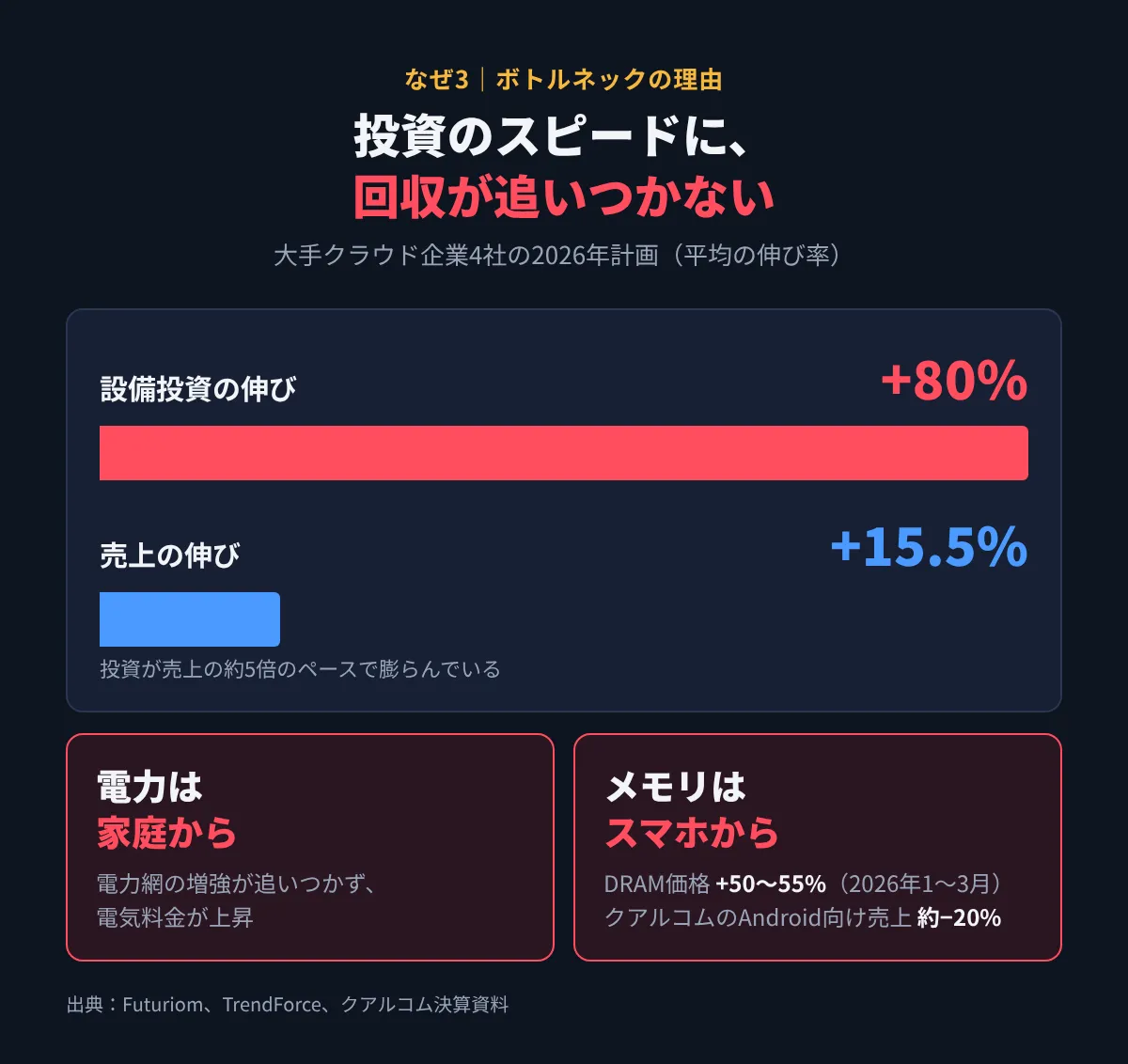
Conclusion: AI investment expanded beyond the supply of power and memory, which are resources that cannot be ramped up quickly.
① Investment grew far faster than sales
- In 2026, the four major cloud companies plan average sales growth of 15.5%, while capital expenditure (data centers, etc.) grows by 80% on average
- Thus, ROI is not catching up at all
② Battle for memory
- As memory was prioritized for AI, DRAM prices rose 50–55% in just Jan–Mar 2026
- As a result, Qualcomm’s smartphone memory-intensive sales are expected to fall about 20% in 2026
AI grew by taking “electricity from households” and “memory from smartphones” in a way that caused rapid changes
【Why 4: Overlooked factors】 Why couldn’t the market foresee this?
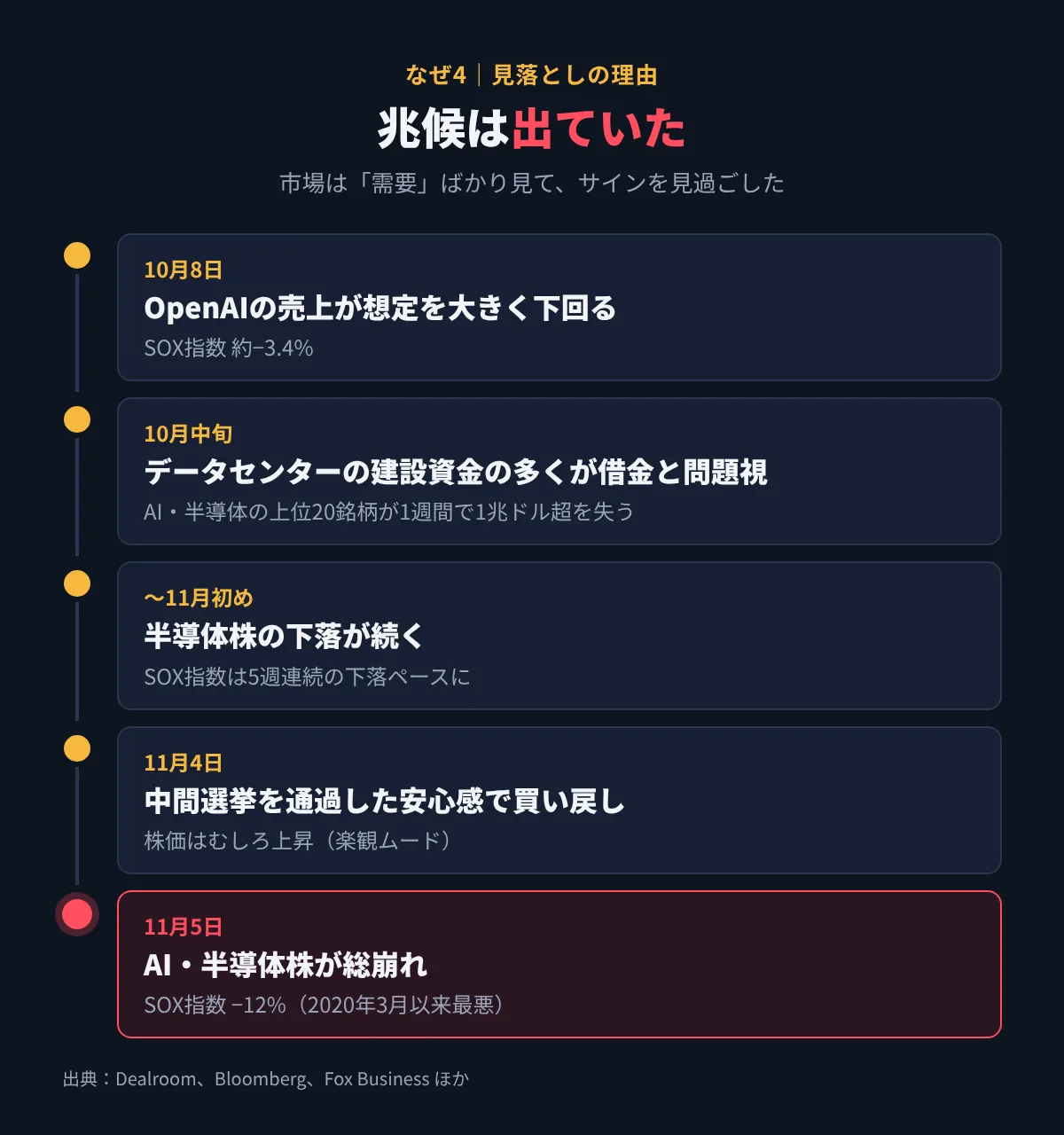
Conclusion: Signals existed, but the market focused on demand and underestimated social license.
Three overlooked reasons
- Underestimated local concerns:Bills to halt construction nationwide were politically unlikely within the Democratic Party; thus municipal opposition movements were undervalued.
- Funds accumulating in one place:Semiconductor stocks were among the market winners in 2026, with many investors betting in the same direction. When institutional investors (pension funds and insurance companies) started taking profits, the chip ETFs with 3x leverage fell over 18% in a single day, creating a self-reinforcing sell-off.
- Optimism right after the election:On November 4, the day after the election, relief led to a rebound, and stock prices rose; the big crash came the next day.
【Why 5: The real cause】 What is the essence of this crash?
Conclusion: The constraint shifted from “whether chips can be made” (tech) to whether society will provide electricity, land, and memory (social license).
Before AI generate large profits, the bill titled “increased electricity costs” arrived in people’s hands first.
Regulatory actions are already underway. Texas paused data center construction until electricity usage audits are completed, and Pennsylvania is considering restricting new projects.
Still, deceleration was anticipated earlier. UBS projected cloud providers’ capex growth at +76% in 2026, +25% in 2027, and +6% in 2028. The election seems to have accelerated the market’s realization of the expected slowdown.
Market overreaction? Three twists
Panic selling led to some irrational excesses.
① Local referendums do not equate to a national construction stop
Many referendums were municipal and targeted large facilities beyond 25 MW. Data centers can be built elsewhere. Still, the reality is that construction delays and higher costs are real changes.
② Demand itself did not disappear
(CEO tends to sound bullish given their position, which should be considered with caution)
③ There is a contradiction in selling pressure
If data center construction slows, memory shortage should ease, which should benefit memory-intensive smartphone semiconductors (like Qualcomm). Yet memory stocks and Qualcomm were sold together.
This is speculationbut seems to be a sign of mechanical selling to reduce semiconductor exposure regardless of fundamentals.
Next, three checkpoints to watch

I won’t forecast prices, but these three are worth watching for the future trend.
- Spread of data center regulations
Results of Texas electricity audits and whether restrictions spread to other states like Pennsylvania. Will this end as a local issue or become a national trend? - Capex plans of major cloud providers
In upcoming earnings, will there be reductions in data center investments or changes in construction locations to maintain them? This is the fastest indicator of AI demand. - Electricity prices and DRAM memory price movements
If households bear the burden continuously, support for regulation may grow stronger; if it stabilizes, it could become a point of contention.
Summary
This crash does not mark the end of AI’s dream.
It is an event showing that “the speed of AI’s progress exceeded the physical infrastructure of electricity and the patience of people bearing its burden.”This is what surfaced.
From now on, the market may move away from “AI goes up no matter what,” and toward selecting companies that secure electricity and bear costs with social consent. This cannot be stated definitively, but I’d be glad if you could use this as a lens when reading the news.
About the author
Emako Papa: Asking five whys about the market
Parent of two and a part-time trader. I write about reasons behind market moves and chart analysis from the roots. I also sell MT4/MT5 tools to reduce charting hassle at GoGoJiang.
※This article is provided for information purposes and does not recommend buying or selling any specific securities. Investment decisions should be made at your own risk.