

Gold秒スキャ is a technique refined through practice. The reason for creating the "Mame Sca Dojo"
Nice to meet you. I’m Minokun, developing the Mamesukiya Dojo. I’ve been involved in FX for 16 years. I usually work as a company employee while researching short-term gold trading.
On this blog, I’ll write about why I created the Mamesukiya Dojo and what I realized through practice. First, I’ll talk about what sparked its development.
From user of tools to maker
Last summer, I had an experience where I turned 300,000 yen into 1,250,000 yen in a week through gold scalping. At the time, I used a tool developed by a certain trader.
Later, due to a certain encounter, I had the opportunity to meet that developer directly. It was there that I was asked, “Would you like to turn the logic you’re thinking in your head into an EA?”
About six months later. I verbalized my ideas, verified their movements, and completed one EA.
Taking what I had perceived by intuition and turning it into language, then making it actually run. Discovering the fun and joy in that became the origin of my tool development. Since then, I have continued to develop various indicators and EAs, focusing on using them myself.
Note that the operation results at the time were a personal example and not a result of using the Mamesukiya Dojo. It does not guarantee that the same results can be reproduced.
Want to create something usable for beginners as well
While continuing development for myself, I have always wished to create something that beginners can also use someday.
Gold scalping requires quick judgments in short timeframes. Therefore, I wanted a place where you could repeatedly practice “wait, enter, settle” before actually risking real money.
That wish became the form of what I’m releasing today: the Mamesukiya Dojo.
When you want to practice, but the market isn’t moving
On weekdays I’m busy with work, so there’s limited time to face the charts. Even if I have a free weekend and want to practice thoroughly, the gold market is closed.
You can review past charts. But comparing “I should have bought here” while looking at finished candlesticks is different from making a judgment when you don’t know what comes next.
Whether to wait a little longer as the candlesticks move, where to enter here, whether to exit at a profit, or whether to push a bit further.
I wanted a place to repeatedly practice such judgments without using real money, even on holidays. That desire was the origin of the Mamesukiya Dojo.
Gold scalping is a skill honed through practice
What I consider important in gold scalping is not just increasing knowledge, but the ability to judge real price movement in response to that knowledge.
Even when you could enter, you wait a bit more. Once it starts moving, you enter. If momentum weakens, you exit. Even if you understand it in your head, you hesitate in front of a moving chart.
Therefore, I believe it’s necessary to practice repeatedly in the same scenarios to confirm your own judgments.
In the Dojo, I codified the senses I value in scalping—“the feel of waiting to enter” and “exiting while watching momentum”—into a logical structure, and made it visible with panels and lines.
Using those displays as clues, wait yourself, enter, and settle. Review the results and refine your own technique. That’s the practice this Dojo aims for.
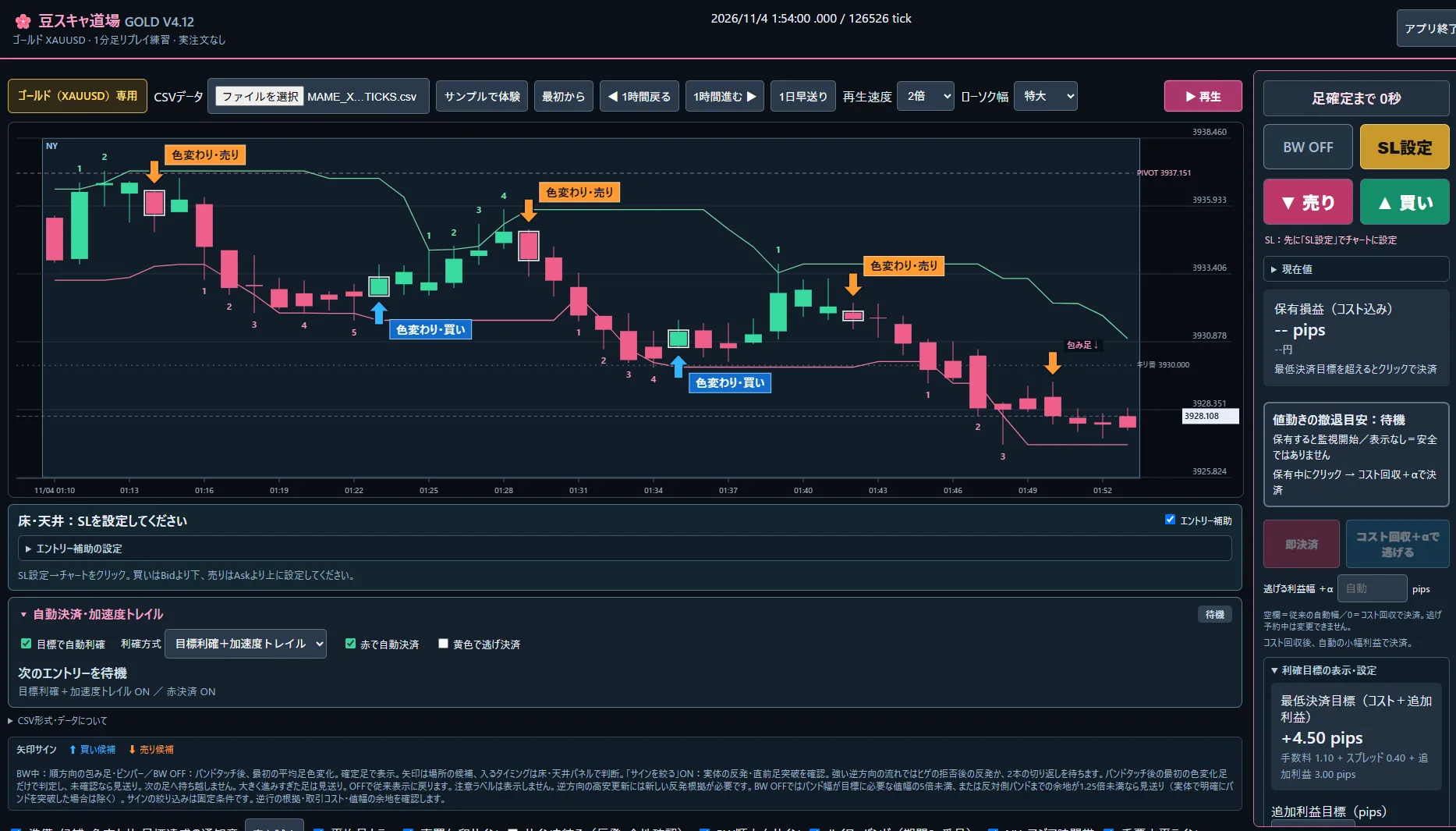
Dojo operation screen. I replay past price movements and determine entry and exit yourself. The displayed screens are examples from the development phase.
What you want to practice is “wait, enter, settle”
In second-by-second scalping, you decide entry and exit in a very short time. Even if a signal appears, whether you jump in right away or hold back a little changes the subsequent moves.
The same goes for settling. Do you lock in profits at a small target, or chase while momentum remains? It’s easy from hindsight, but it’s tricky in the moment.
So in the Dojo, I replay historical gold tick data and let you enter and settle yourself. This is virtual trading using real price movements.
Redo the same scenario, change your entry position and settlement method. “I rushed in earlier, so this time I’ll wait.” I aimed to create a practice environment where you can compare those approaches.
Waiting for the entrance while sensing the floor and ceiling
It keeps dipping, yet every time it’s bounced back at around the same level. When looking at the chart, don’t you sometimes sense a solid floor? Conversely, places where it keeps getting pushed back as it tries to rise look like ceilings.
The Dojo’s “Floor/Celing mode” uses those tiny fluctuations and rebounds as a support for entries. It displays readiness status and green entry acceptances on the panel.
If there’s a floor, you buy as low as possible; if there’s a ceiling, you sell as high as possible. I built this to give you a moment of pause before jumping in and to practice waiting and pulling back.
Of course, you may break through floors or ceilings. It doesn’t mean you will always win when it’s green. You need to consider SL placement and decide whether to enter or pass—this is also part of the practice.
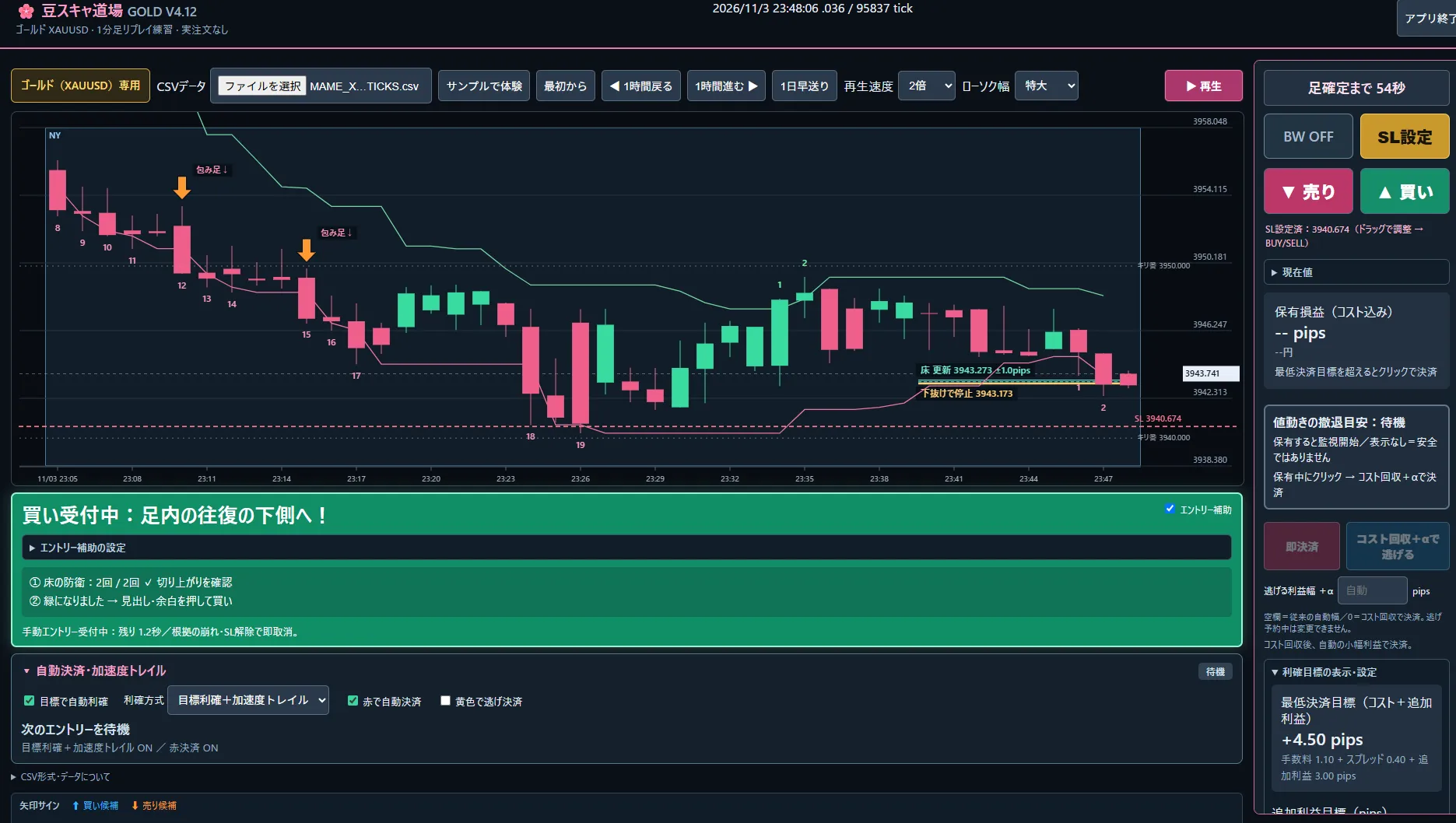
Example of the green “Buying acceptance” display. It assists timing to wait before entering, but it does not guarantee profits.
Take profits at targets, or chase momentum
For exits, we provide two methods: “target profit only” and “target profit plus acceleration trail.”
Practice locking in profits at a target, and practice chasing movement when momentum continues. Trying the same scenario with both methods gives you a basis to reflect on which you find easier to use.
Acceleration trail isn’t always a way to consistently maximize profits. If price reverses during the trail, you may settle for less than the target you set. I hope you’ll explore both the advantages and challenges in the Dojo.
Not only successful moments, but also failures
This blog will cover not only feature introductions but also moments of practice where you hesitated or failed.
Did you enter too quickly? Did you wait too long to take profits? Or would it have been better to pass altogether? I want to review not just the results but what you were thinking at each step.
The Mamesukiya Dojo is the practice environment I personally wanted. I’d love to learn from users’ feedback for future improvements as well.
To buyers, toward an even better dojo
For those who purchase the full product, we’ve prepared a buyers-only community. We’d love for users of the subscription, perpetual, and complete editions to participate.
I want a place to freely exchange details about what you noticed during practice, features that were easy to use, and confusing operations. Please share your update requests like “This display would help” or “Please make this operation easier.”
Feedback from beginners who say “I don’t understand this part” is also valuable to us as developers. Regardless of experience or results, I’d be happy if you could tell us what you felt when you actually used it.
While we cannot promise to address every request, we will use your voices to refine a more user-friendly, practice-supporting tool. Participation and posting are optional, so please engage at your own pace.
First, try the operations for 7 days
For those who are interested, we’ve prepared a 7-day free trial. It’s for Windows PC and includes gold tick data, so you can start practicing without preparing a CSV yourself.
To use it, you must apply for GogoJungle and authenticate with the issued activation code and registered email address.
First, try the “wait, enter, settle” operations to see if they suit your practice. I’d be glad if you could use it for weekend practice time.
View the product page for Mamesukiya Dojo GOLD [7-day free trial]
※The dojo is a practice software that uses historical data. It does not place real orders. Practice results do not guarantee profits in actual trading. Please check the product page for trial period and usage conditions.