
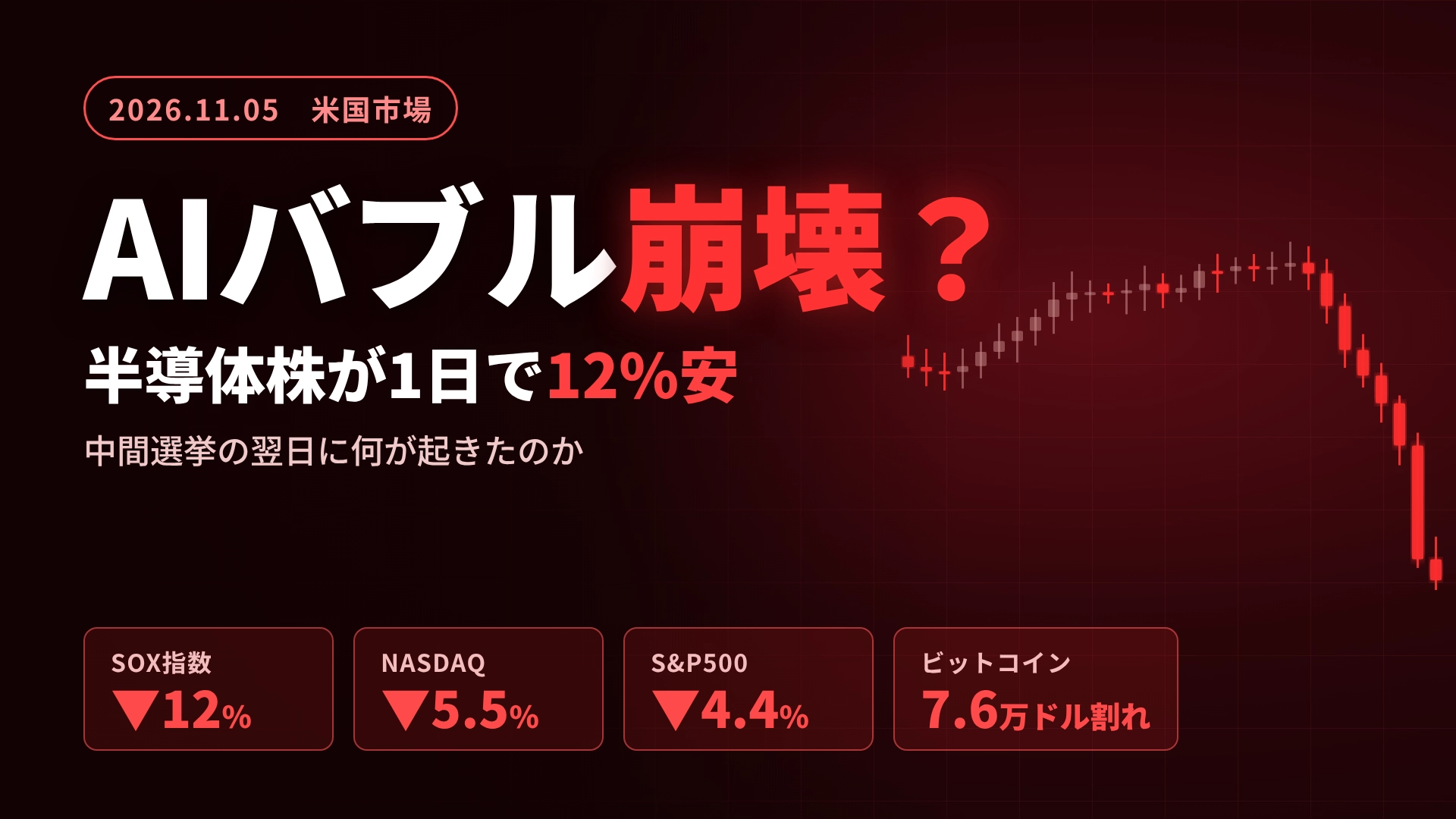
"AI Bubble Burst?" Semiconductor stocks fall 12% in one day. What happened the day after the midterm elections
Following the election results, there was a surprising plunge the next day.
On November 5, US stocks opened with a chart that might have surprised many.
The three major indices all fell sharply, and in particularsemiconductor stocks were sold off in unisonand Bitcoin also declined as if pulled by the stock market.
On social media, there were voices asking, “Is this the AI bubble bursting?” A bubble is when prices rise far beyond actual value just on expectations.
Is it really that serious? With tonight’s employment data in view, I’d like to整理 the factors for now.
For busy readers, here’s a quick rough overview
- US stocks all three indices ended notably lower.Semiconductors (SOX) down about 12%
- The backdrop includedconcerns about AI regulationandcorporate earnings and outlookoverlapping, it seems
- Bitcoin also briefly fell below $76,000. It felt like a sell-off of the same “risk asset” as stocks
- Tonight’s employment datawill be watched to see how interest rates move
- In my view,“it’s too early to call it a collapse. But caution is warranted.”
First, a look at the numbers
| Indexes (Nov 5) | Change from previous day |
|---|---|
| Dow Jones | -3.4% |
| S&P 500 | -4.4% |
| NASDAQ | -5.5% |
| SOX index (semiconductors) | about -12% |
The SOX index aggregates semiconductor-related stocks. This drop is described asthe largest since March 2020according to reports.
It largely erased the gains from the day after the election in a single day.
▼ Chart ① US500 (US stock index)
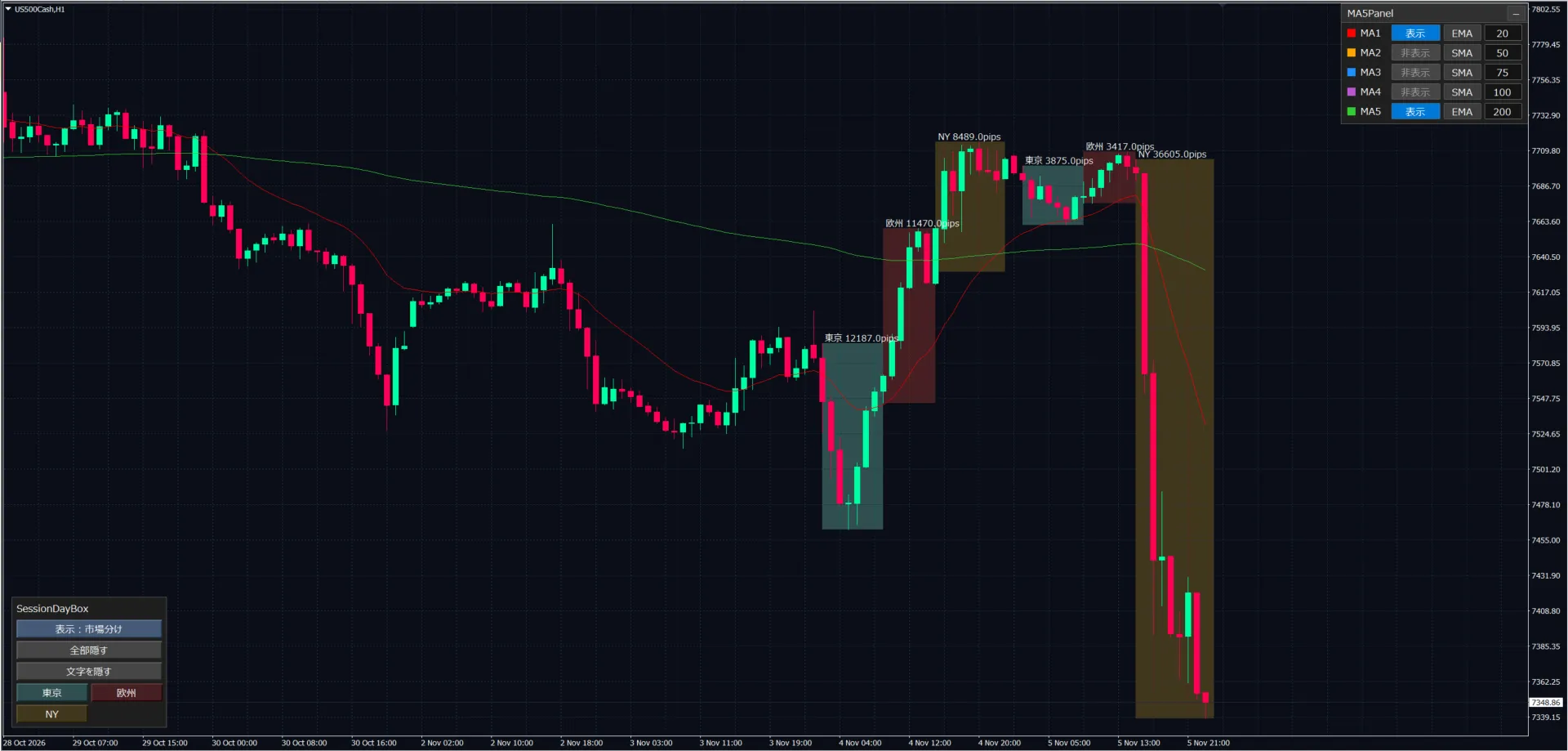
Gains after the election were almost completely erased the following day
Why was there so much selling?
It’s hard to explain with a single reason; several factorsseem to have overlapped at the same timesimultaneously.
① Worries that AI regulation may tighten
With Democrats holding majorities in both the Senate and the House, there are views that checks on AI and data centers could become stricter. Since data centers use大量の電気と水, some voices worry about electricity costs and environmental impact in certain regions.
② Re-evaluating “Can AI really make money?”
The spread of AI itself is likely true. However, the idea that “AI demand will grow” and that “related companies will achieve returns that justify investment” are separate matters. Land, buildings, GPUs, power facilities require enormous expenditures for data centers.
③ Corporate earnings and outlooks
Qualcomm and Arm were sold off significantly after earnings and outlooks. NVIDIA, AMD, Micron, and other AI-related semiconductor stocks also fell across the board.
Of course, election results alone won’t halt data center construction. Still, it seems that the previously anticipated smooth expansion of AI investment has becomeuncertaintyevident.
▼ Chart ② SOX index (US semiconductor stock index)
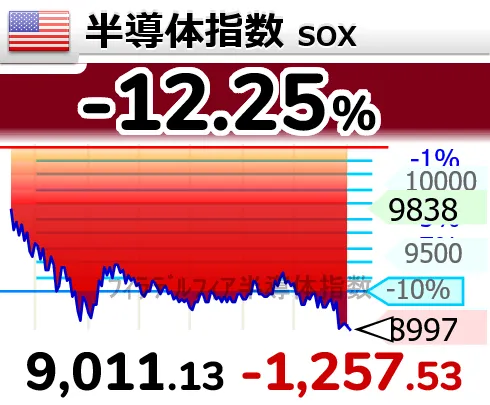
About 12% drop in one day. The largest decline since March 2020
The stocks with the biggest expectations tend to show the largest moves when those expectations crack a littleprice swings tend to intensify. The semiconductor stocks this time seemed to move exactly like that.
Bitcoin also fell with stocks
Bitcoin, which had recovered to the $80k level the day before, was sold off on the 5th along with stocks.
- At one pointbelow $76,000. The lowest in about seven weeks
- A decline leads to forced liquidation of long positions“stop-loss cascade”and is estimated to have exceeded $1 billion in 24 hours
- In recent days, there has also been fund outflows from Bitcoin ETFs (products similar to mutual funds that can be bought in brokerage accounts)
Bitcoin, often described as “a separate asset from stocks,” has dropped at nearly the same timing as NASDAQ this time.If stocks crack further, Bitcoin may also be affectedmaybe.
How will employment data affect the market?
US Employment Report (October)
Release: Friday, November 6, 22:30 (Japan time)
Forecast: Nonfarm payrolls around +65,000; unemployment rate 4.2% (previous +29,000)
Currently, the market is focused on whether the Fed will raise rates in December. Employment data tend to heavily influence this view.
To summarize, there are three rough scenarios:
If the data come in stronger than expected
The market may push toward expectations of a rate hike, potentially pushing rates higher. That could further weigh on already-sold semiconductor stocks and Bitcoin.
If the data come in as expected
The employment data itself is unlikely to be a major driver; the market may continue to focus on “AI and semiconductor reevaluation.”
If the data come in weaker than expected
Rate-hike expectations might recede, and rates could fall further. While this could be supportive for stocks, new concerns about weaker economy may arise.
In any scenario, the moments right after the release tend to see large swings. I plan to watch the charts after the movement settles rather than chasing the headlines.
Is it really an AI bubble collapse?
Reasons why it’s hard to call it a collapse
The spread of AI hasn’t stopped, nor has demand for data centers disappeared. It feels premature to declare an AI bubble crash based on a single day’s drop.
Reasons for continued caution
Regulatory concerns, doubts about whether investments can be recovered, and weak earnings. Fears that were hard to see before have surfaced all at once.
From the era of“everything AI-related is bought”toa market that asks whether a company can actually earn moneymay be approaching.
Personally, I want to keep an eye on four things:
- Whether the SOX index finds support
- Earnings of major semiconductor companies
- Progress of data center investments
- Price movement of rates after the employment data
Whether this sharp drop ends as a temporary correction or truly marks the start of a bubble burst. I will continue to monitor not only stock prices but also the underlying factors behind them.
Thank you for reading to the end. If you found it helpful even a little, I’d be happy if you “like” it. It motivates me to write the next article.
※The market prices and figures cited in this article are based on market data from November 5–6.