

Why does breathing determine the success or failure of a trade?
The moment I saw the candlestick move dramatically, I held my breath and jumped on it...
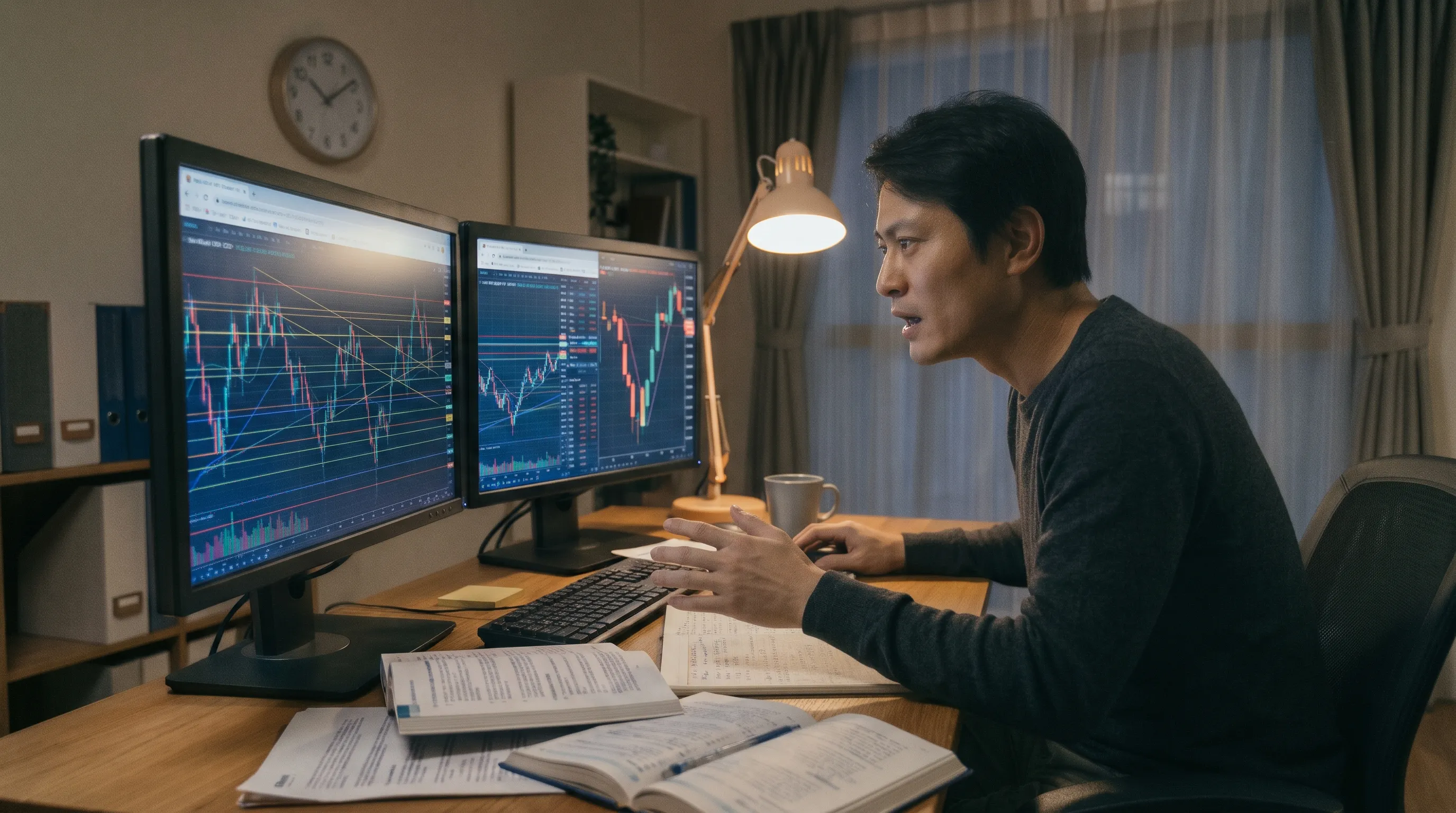
When you’re in a drawdown or at the moment of entry, do you ever notice your breath stopping or your shoulders rising and your breathing becoming shallow?
This videoalso explains, but there are three trading books that had a major influence on my own trading. “The Zone,” “The Zone: The Final Chapter,” and “A Day Trading.”
All three of these books are not about trading methods, but about trading psychology and mindset.
And the ultimate mental state advocated by these classics is nothing other than the switch to physically reproduce it in the trading field, which is none other than control of breathing.
This time, we will explain why a single breath can determine the outcome of a trade, by weaving together the teachings of the three classics and the brain's mechanisms, and provide concrete methods to stop emotional runaways.
Here are the three reasons why breath disturbance destroys trading.
When the market suddenly moves, or the price approaches the stop-loss line,
the human body misinterprets it as a life-threatening danger (attack by a predator).
Thenbreath-tensing occurs unconsciously, the sympathetic nervous system runs amok,
and the brain switches to an extreme mode of fight or flight.
- Rather than waiting for the natural level, you pull the extended candlestick’s tip and jump on it.
- Unable to bear the fear of drawdown, you drag the predetermined stop-loss line with your finger.
These do not occur because your will is weak,
but because breathing stops, causing the brain to be in anoxic state and normal judgment to physically shut down.
2.The only key to embodying the teachings of the classics ‘The Zone’ and ‘A Day Trading’
The books that influenced me, “The Zone,” “The Zone: The Final Chapter,” and “A Day Trading,” describe the absolutes for traders who keep winning.
That is,do not swing up and down over a single trade result in front of you; calmly repeat actions with edge (advantage).
And, like a skilled craftsman, continue to execute the rules without hesitation or fear.
However, when the real money is at stake before the chart,
even if you tell yourself to stay calm or think probabilistically in your head, the fear does not vanish.
The mind and body are connected.
Even if your breath is shallow and ragged, keeping your mind in the ‘Zone’ is impossible due to human physiology.
The first step to manifesting the disciplined mindset described by the classics in real markets is not to strengthen the mental, but to first exhale the expanded chest breath and release bodily tension.
3. In front of the chart,exhale completely for 6 seconds
Today, incorporate a single physical rule into your trading routine.
The moment you open the chart, take a deep breath and exhale:Relax your shoulders, look away from the screen a bit, and take in the market as a whole.
Just before you press the order button, exhale for 6 seconds:Exhaling promotes parasympathetic dominance and provides a strong brake to a brain that's about to run wild.
If you feel your breathing is off, never enter:If your heart is racing or your breathing is shallow, know that this signals excessive position sizing or insufficient justification.
Only when you can breathe deeply and steadily can you have an edge-driven trade.
4.Breathing is important but not万能(万能 means universal/omnipotent)
Trading is not a game where you battle against the big investors on the other side of the screen.
It is a game of how to quell your own instinct and fear that constantly seeks to run out of control, and to uphold discipline.
Take a breath before entering.
That single habit dramatically reduces unnecessary jumping in and impulsive rule violations.
That said, no matter how careful you are with breathing, if you keep watching a chart with positions open and it trembles violently, your breathing will eventually become disturbed and your mouse will move out of fear.
To compensate for such human limits, we at Trade Studio (Toresta) are developing tools.
If you want something more fundamental than habit formation—something that forcibly changes you and your trading environment—