

[Development Log] Submitting to the verification app was first confirmed via notification — How the measurements appear and how to read n=4
【Key Points】
・Two verification events on October 25 and two on October 26 were received as Discord notifications indicating the verification runs
・The notification items are “Verified,” “Route,” and “Tier”; submitter and logic details are not included
・Whether the LP click logs (2) and the notifications (4) come from the same person cannot be determined. Treat the four notifications as observations, not a trend
■ 1. What was received
The LP verification app automatically performs verification when a backtest report (.htm) output from MT4 or MT5 Strategy Tester is submitted. When the verification runs, a notification is sent to a dedicated channel in the lab’s Discord
 【Image: fig35_signal_table.png】
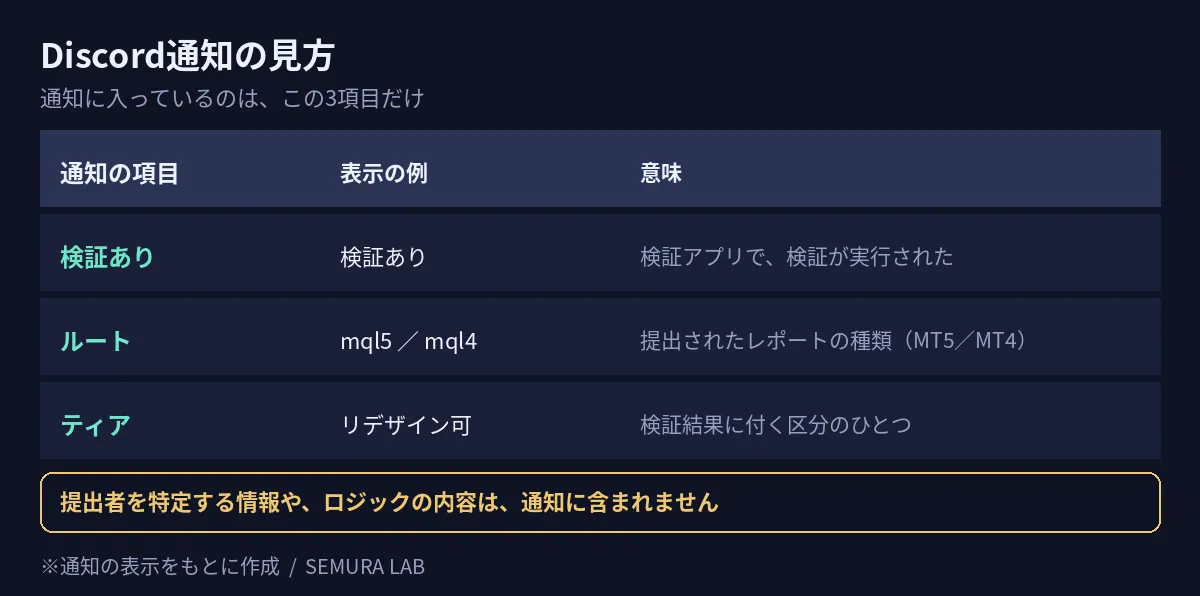
The notification consists of the following three items:
・Verified: indicates that verification was executed
・Route: type of submitted report. mql4 corresponds to MT4, mql5 to MT5
・Tier: one of the categories attached to the verification result. In the received notifications, it showed “Design redesign possible.”
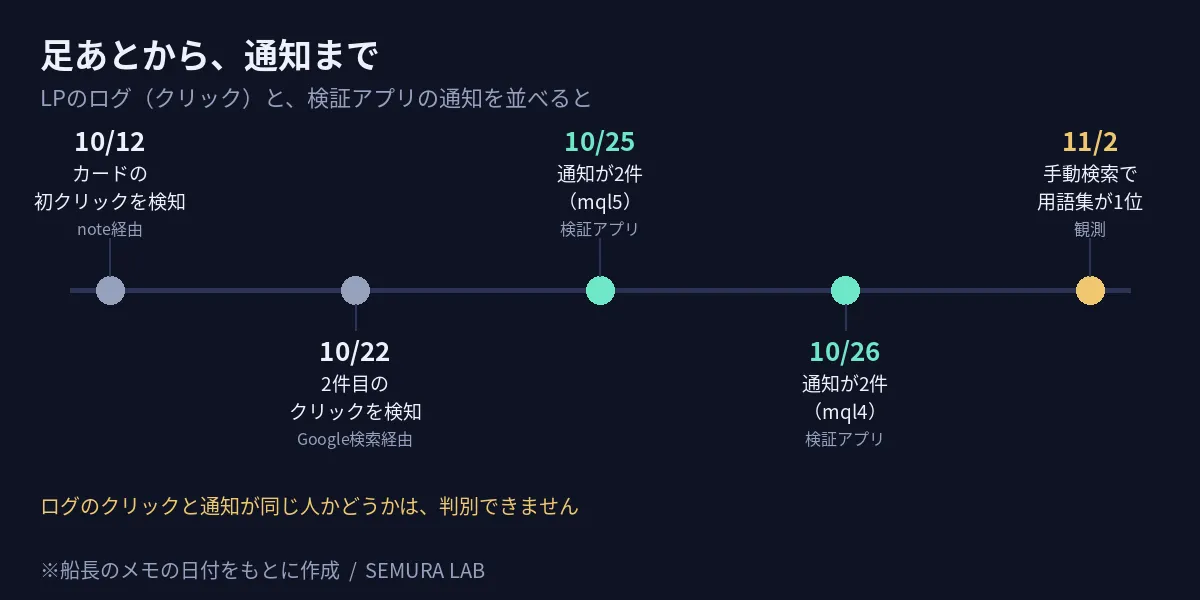
Around noon on October 25, two notifications with “Verified / Route: mql5 / Tier: Redesign possible” were received. On the evening of October 26, two notifications with “Route: mql4” were also received. In total, four.
■ 2. Timeline: from click logs to notifications
 【Image: fig34_signal_timeline.png】
LP analytics (tracker) detected the first card click on October 12. Traffic came via note, moving from the home page to the verification page. On October 22, a second click was detected. This came from a Google search, and the user read the page to the end, staying over two minutes.
After that, verification app notifications were received on October 25 and 26. In chronological order, it appears that actual usage occurred after the clicks; however, caution is needed with this interpretation.
■ 3. Logs and notifications cannot be linked
What trackers record are LP views and clicks. On the other hand, notifications indicate the use of the verification app. Neither source can identify individuals. Therefore, it is not possible to determine whether the two logs of clicks and the four notifications come from the same person.
There is an urge to connect them, but there is no material to do so. If we presume causality here, we risk drawing incorrect conclusions from a small sample. Therefore, treat them as separate observations.
Furthermore, to link logs and notifications, the LP views and verification app usage would need to be connected with the same identifier. However, such a design would conflict with the policy of keeping submitter information to a minimum. Being unable to link them is both a constraint of observation and a consequence of the policy. Adding items to notifications would increase what can be observed, but also increase the information handled. A pre-drawn line is needed for what to observe and what not to observe.
■ 4. How to read n=4
There are four notifications, arriving two at a time on two consecutive days, with different routes. Several interpretations are possible from this structure.
・One submitter tried multiple logics
・Different submitters used it successively
・Other possibilities
The notification information alone cannot determine which; performance with few trades is hard to trust even if numbers look good. Likewise, four notifications cannot be called a trend. For now, record it as an observation. The only information we can preserve is the time, route, and tier. Record with a decided perspective given the limited information.
■ 5. What is not included in notifications
Notifications do not include submitter-identifying information or logic details. The verification app is provided to visualize a black-boxed trading process. Submitted files are encrypted and stored, and after verification ends they are completely deleted from the server. The copyright of the logic belongs to the submitter. This policy is clearly stated in the LP.
After verification results, a submitter may discard the EA, continue using it, or redesign it. The submitter makes that decision. The lab’s role is to extract factual information up to that point. Therefore, the notification side also does not carry unnecessary information.
■ 6. Change at the entry: observation of search results
There is another observation about entry. On November 2, I manually searched Google for terms related to EA logic verification. The top page did not appear, but the first result was a glossary page, the second a lab note article from the same lab. The AI overview card also cited the glossary.
The glossary page was added to the LP in early October. If it functions as an entry point for searches, that addition had purpose. However, this is only an observation on my screen. Search results vary by region and history, so others may not see the same ranking.
■ 7. Summary and future
What arrived was simply the fact that the verification app was used. Anything beyond that is currently speculation. The submitter who saw the verification result is not visible to the lab. Therefore, it is premature to say “no requests” changed to “there were requests.” What changed is the shift from “being seen” to “being used.”
Going forward, we will continue to observe the number of notifications and their routes. At the same time, we need to establish an environment to continually check search rankings on Google as well.
We, Semura Lab., will continue to observe and record facts and hypotheses even with small numbers.
If you have concerns about EA verification or how to interpret the analytics, please feel free to ask at the general inquiries desk.